
Wristwatches · Wristwatch
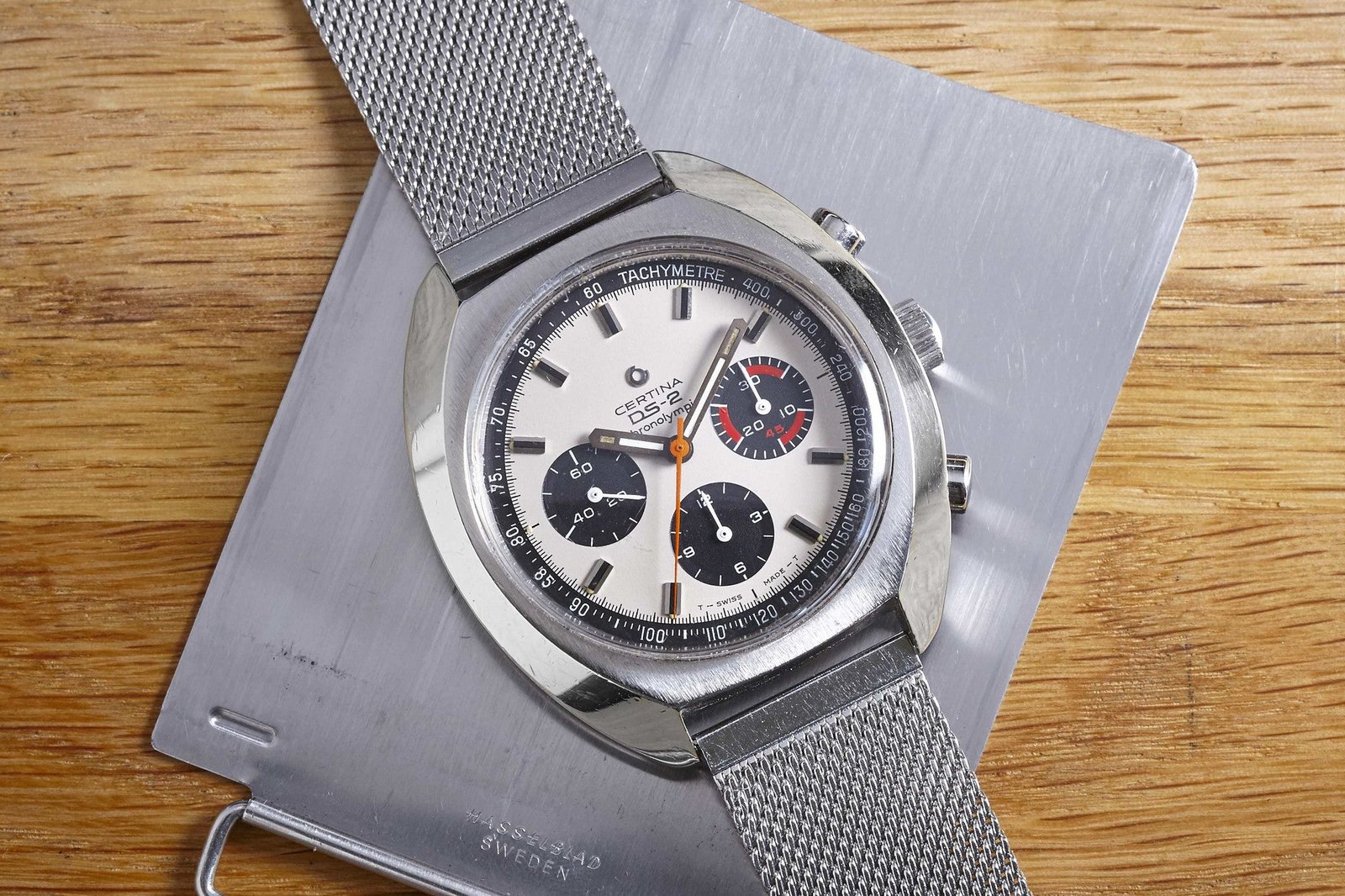
Certina Chronolympic, 1960s
- Maker / attribution
- Certina (maker)
- Date
- 1960s
- Historical period
- Modern Mechanical Horology (1945 – 1969)
- Country of origin
- Switzerland
- Object type
- Wristwatch
- Dimensions
- Case 43.5 mm
- Stock no.
- Product 2061029697
- Credit line
- Dealer listing, Analog/Shift (product 2061029697)
- Catalogue title (original)
- Certina Chronolympic (English)
View the source record (dealer listing) ↗ (opens another website in a new tab)Suggest a correction
Record summary
Catalogued by Analog/Shift (dealer), New York (stock number Product 2061029697), this is a wristwatch by Certina, made in Switzerland, dated 1960s. The Atlas places it in the Modern Mechanical Horology period (1945 – 1969) of its Wristwatches collection. Recorded dimensions: Case 43.5 mm. The record is illustrated with 6 photographs.
Assembled from the source record's structured fields. Dates and attributions are given as the source states them; where a field is missing the Atlas leaves it blank rather than estimating.
Catalogue description
Dealer description — Analog/Shift
When it comes to vintage chronographs, "Panda Dials" are a whole different kind of awesome that have been getting lots of attention on the collector market as of late. The nickname refers to a white dial with black subsidiary registers, and is a simple aesthetic choice which has become entirely sought after in the collector community, with Panda Dial variants often commanding many multiples of their "standard" dial brethren (think "Siffert" Heuer Autavias , "Nina Rindt" Universal Geneve Compaxes , and of course "Paul Newman" Rolex Daytonas ). Of course, a timepiece need not have an association with a famous historical figure to have the same great looks, and in many cases the best values in vintage are those without any celebrity connection that have yet to be "discovered" by the collector community. Such is the case with this awesome Certina DS-2 Chonolympic chronograph - an absolutely stunning vintage sports watch that hasn't received any notoriety for being worn by a movie star or racing legend (although the black dial version WAS worn by a guy who climbed - and then skied down - Mount Everest) , but has all the looks and mechanical muscle to be counted amongst the best. Dating from the 1960s, this steel chronograph is sized at a meaty 43.5mm, more substantial than many of its contemporaries and perfectly sized for the modern wrist. It features an absolutely immaculate Panda Dial with triple subdial layout, featuring registers for 30-minute and 12-hour counters along with sweeping subsidiary seconds. A dash of orange is visible in the chrono seconds hand and some red on the 30-Minute register. The white dial is surrounded by a crisp outer tachometer ring. Powering this gorgeous timepiece is the legendary Calibre 72 manually-winding chronograph movement by Valjoux, a movement as robust as it is iconic - hell, even the original Rolex Daytona had one of these bad boys inside! We have only come across a few of these Chronolympics, and none have come close to this beautiful example. If you're looking for big dollar looks on a down to earth budget, your search is over.
Historical context
Modern Mechanical Horology (1945 – 1969)
Tool watches for divers, pilots and astronauts; electric watches anticipate the electronic age.
The classic era of the mechanical wristwatch: dive watches, chronographs for motor racing and space flight, GMT watches for jet travel, slim dress watches, automatic calendars, and the rise of Japanese manufacturers alongside Swiss, American, German and Soviet industries.
Read the period in the timelineMore wristwatches from this periodEarlier: Golden Age of Mechanical Watchmaking
Atlas type guide
Wristwatches
Bracelet watches were worn by women from the early nineteenth century — Breguet made one for Caroline Murat, Queen of Naples, in 1810–12 — but the wristwatch only became a man's instrument with military use and aviation in the early twentieth century. Between the World Wars it overtook the pocket watch; the 1920s and 1930s brought rectangular Art Deco cases, water-resistant cases and the first automatic winding systems.
After 1945 the wristwatch became a carrier of identity — dress watches, sports and dive watches, chronographs, calendars — produced by Swiss, American, Japanese, German, Soviet and Chinese industries. The quartz revolution after 1969 and the mechanical renaissance since the 1990s, including the rise of independent watchmakers, complete the story.
What to look for
- The reference number (between the lugs or inside the case back) and serial number, the starting point for dating.
- The calibre: its maker and number are often stamped under the dial or on the bridge.
- Originality of dial, hands and crown — refinished ('redial') dials are common.
- Case material marks: 18K/750, 14K/585, stainless steel, gold-filled, plated.
Dating clues
- Wire-lug cases: before c. 1925.
- Water-resistant screw-down cases: from 1926.
- Quartz movements: from 1969; sapphire crystals widespread after c. 1980.
General guidance written by the Atlas editors about this kind of object. It is not a statement about this particular piece; for that, rely on the source record above and on physical examination.
Related records

Wristwatches · 1900–1999
Wristwatch by Certina, Switzerland, 1900–1999
Nordic Museum Foundation
Wristwatches · originally sold in December 2025 (per the lot record)
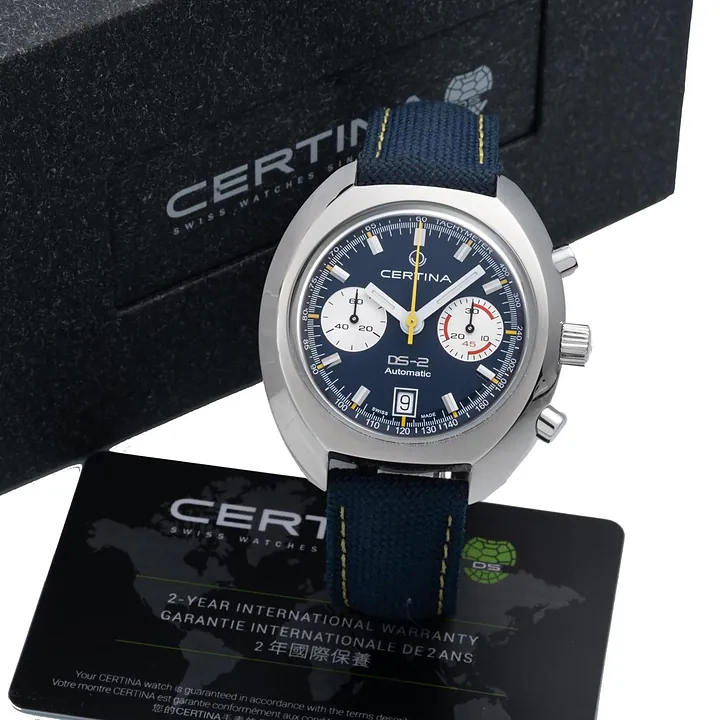
Certina DS-2 Chronograph Automatic, ref. C024.462.18.041.00, originally sold in December 2025
Antiquorum auction archive, Geneva
Wristwatches · originally sold in January 2026 (per the lot record)
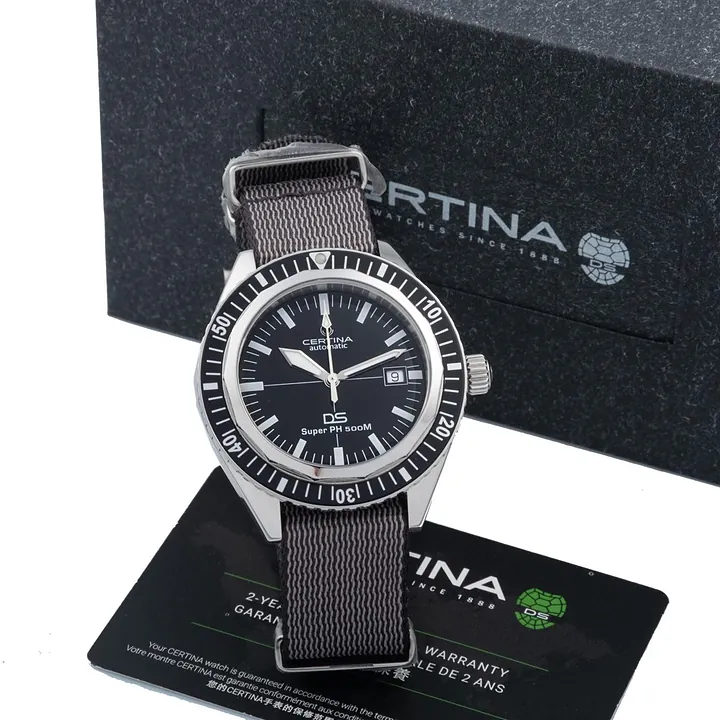
Certina DS Super PH 500m, ref. C037.407.18.050.00, originally sold in January 2026
Antiquorum auction archive, Geneva
Wristwatches · c. 1965-1970
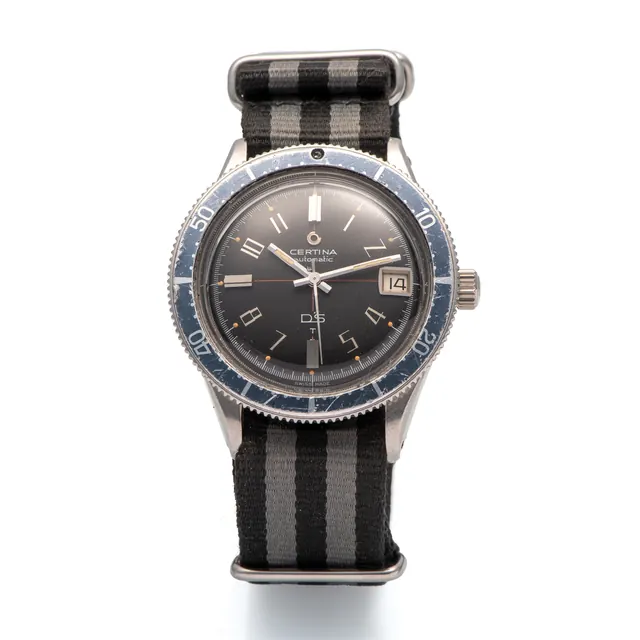
Certina wristwatch, ref. 5801, Ds, circa 1965-1970
Antiquorum auction archive, Geneva

Wristwatches · 1945
Wristwatch by Eterna, 1945
Museum Rotterdam

Wristwatches · c. 1945
Breitling Premier, ref. 790, c. 1945
Antiquorum auction archive, Geneva

Wristwatches · c. 1945
Universal Genève Uni-Compax, ref. 22492, c. 1945
Antiquorum auction archive, Geneva

Wristwatches · c. 1950s
Baume & Mercier wristwatch, c. 1950s
Antiquorum auction archive, Geneva