
Wristwatches · Wristwatch
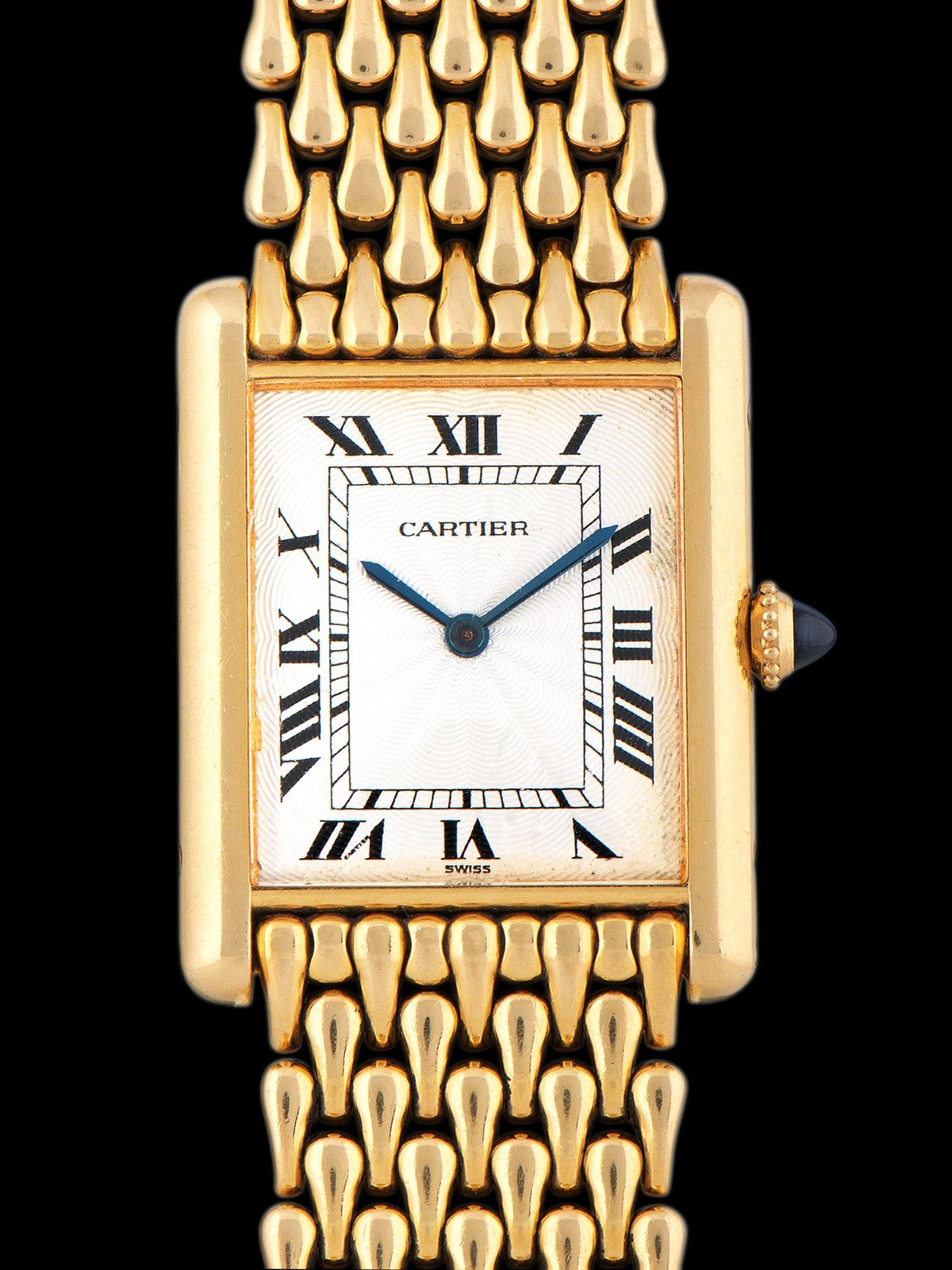
Cartier Tank LC 18K YG "Extra Plate" (Ref. 16121) Flinque Dial W/ Teardrop Bracelet, 1990s
- Maker / attribution
- Cartier (maker)
- Date
- 1990s
- Historical period
- Mechanical Renaissance (1990 – 2010)
- Country of origin
- France
- Object type
- Wristwatch
- Stock no.
- CTRTLCEP16121
- Credit line
- Dealer listing, Craft & Tailored (CTRTLCEP16121)
- Catalogue title (original)
- 1990s Cartier Tank LC 18K YG "Extra Plate" (Ref. 16121) Flinque Dial W/ Teardrop Bracelet (English)
View the source record (dealer listing) ↗ (opens another website in a new tab)Suggest a correction
Record summary
Catalogued by Craft & Tailored (dealer), Los Angeles (stock number CTRTLCEP16121), this is a wristwatch by Cartier, made in France, dated 1990s. The Atlas places it in the Mechanical Renaissance period (1990 – 2010) of its Wristwatches collection. The record is illustrated with 6 photographs.
Assembled from the source record's structured fields. Dates and attributions are given as the source states them; where a field is missing the Atlas leaves it blank rather than estimating.
Catalogue description
Dealer description — Craft & Tailored
The Cartier Tank has become one of the most iconic watch designs of all time, and other than some more eclectic references produced has remained relatively the same over its long run of production. The Cartier Tank was originally designed in 1917 and became commercially available in 1919, and its design was inspired by the Renault FT-17 tank used by the French Military in the First World War. Although the Cartier Tank appears to have remained the mostly same for the course of its production life, there have been some interesting anomalies that were introduced during its illustrious tenure, resulting in very collectible and very rare timepieces. This Carter Tank Louis Cartier, or Tank LC, is best known amongst collectors as the "Extra Plate" or "Extra Thin" and is one of the thinnest Cartier watches ever produced and features a total thickness of 5mm including the crystal. This impressive feat is achieved through the utilization of the renowned Frederic Piguet Cal. 21 ultra-thin mechanical movement. Though this Cartier Tank LC Extra Plate is one of the thinnest watches Cartier ever made, it retains the standard height and width dimensions of the Tank LC in this era. This makes for a perfect dress timepiece, both beautiful and elegant with the added benefit of sliding under the shirt cuff with ease. The ref. 16121 is also renowned for its alluring "Flinque" dial, which is a painstaking dial-making process that involves a carved guilloché pattern that is then finished with a layer of enamel, creating a truly beautiful dial presentation with incredible depth. This specific model is also fitted with its original and extremely rare "teardrop" bracelet which was reserved specifically for VIP clients of Cartier at the time, whereas standard models were typically fit with the standard Cartier strap and deployant buckle, and remains highly sought-after and celebrated today for its intricate, unique, and beautiful design. Stock # CTRTLCEP16121 Brand Cartier Style Tank LC "Extra Plate" Model 16121 Serial C3XXXX Size Men's Material 18K Yellow Gold Dial White Roman "Flinque" Millimeters 23.5 X 30 Bracelet Cartier 18K YG "Teardrop" Bracelet W/ Hidden Butterfly Clasp CASE & BRACELET The extra thin or "Extra Plate" 18K yellow gold case is in exceptional condition, showing honest signs of light use with no notable evidence of previous polishing present as the original hallmarks and dimensions remain extremely crisp and defined. The original mineral glass crystal shows subtle signs of use which is relatively unnoticeable to the naked eye. The case retains its original blue sapphire cabochon crown. The case back features very crisp factory finishing with deep factory markings. The watch comes supplied on its original and very rare 18K yellow gold Cartier "teardrop" bracelet with a hidden butterfly clasp which retains 24 links that show minimal stretch for the style and age of the bracelet and will fit up to a 6 1/2-inch wrist. DIAL & HANDS The original silvered white guilloché and enamel "Flinque" dial with black Roman numerals is in very well-preserved condition with no cracking present in the top lacquer of the dial and only minimal elements of age present in the form of spotting mostly seen at the dial edges. The original blued hands are also in excellent condition with no age or wear present. ACCESSORIES None. The watch is functioning and keeping time, previous service history is unknown.
Historical context
Mechanical Renaissance (1990 – 2010)
Mechanical watches return as cultural objects; independent watchmaking flourishes.
Mechanical watches returned as cultural and luxury objects. Complications, tourbillons and new materials proliferated; independent watchmakers such as George Daniels, F.P. Journe and Philippe Dufour revived artisanal watchmaking; collecting vintage watches became a major field.
Read the period in the timelineMore wristwatches from this periodEarlier: Quartz Revolution
Atlas type guide
Wristwatches
Bracelet watches were worn by women from the early nineteenth century — Breguet made one for Caroline Murat, Queen of Naples, in 1810–12 — but the wristwatch only became a man's instrument with military use and aviation in the early twentieth century. Between the World Wars it overtook the pocket watch; the 1920s and 1930s brought rectangular Art Deco cases, water-resistant cases and the first automatic winding systems.
After 1945 the wristwatch became a carrier of identity — dress watches, sports and dive watches, chronographs, calendars — produced by Swiss, American, Japanese, German, Soviet and Chinese industries. The quartz revolution after 1969 and the mechanical renaissance since the 1990s, including the rise of independent watchmakers, complete the story.
What to look for
- The reference number (between the lugs or inside the case back) and serial number, the starting point for dating.
- The calibre: its maker and number are often stamped under the dial or on the bridge.
- Originality of dial, hands and crown — refinished ('redial') dials are common.
- Case material marks: 18K/750, 14K/585, stainless steel, gold-filled, plated.
Dating clues
- Wire-lug cases: before c. 1925.
- Water-resistant screw-down cases: from 1926.
- Quartz movements: from 1969; sapphire crystals widespread after c. 1980.
General guidance written by the Atlas editors about this kind of object. It is not a statement about this particular piece; for that, rely on the source record above and on physical examination.
Related records

Clocks · 1863
Clock by Albert-Ernest Carrier-Belleuse, France, 1863
The Metropolitan Museum of Art, New York

Clocks · c. 1980s
Cartier "art Deco", c. 1980s
Antiquorum auction archive, Geneva

Clocks · c. 2000s
Cartier Desk Clock with Alarm, c. 2000s
Antiquorum auction archive, Geneva

Clocks · c. 2000s
Cartier Lacquer Arched Desk Clock with Alarm, ref. W0100037, c. 2000s
Antiquorum auction archive, Geneva
Wristwatches · c. 1990
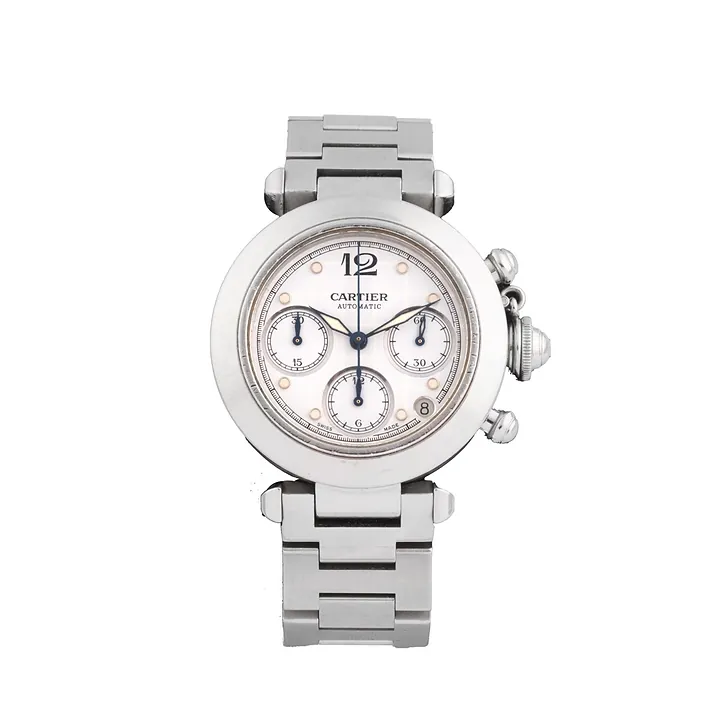
Cartier Pasha, ref. 2412, c. 1990
Antiquorum auction archive, Geneva
Wristwatches · c. 1990
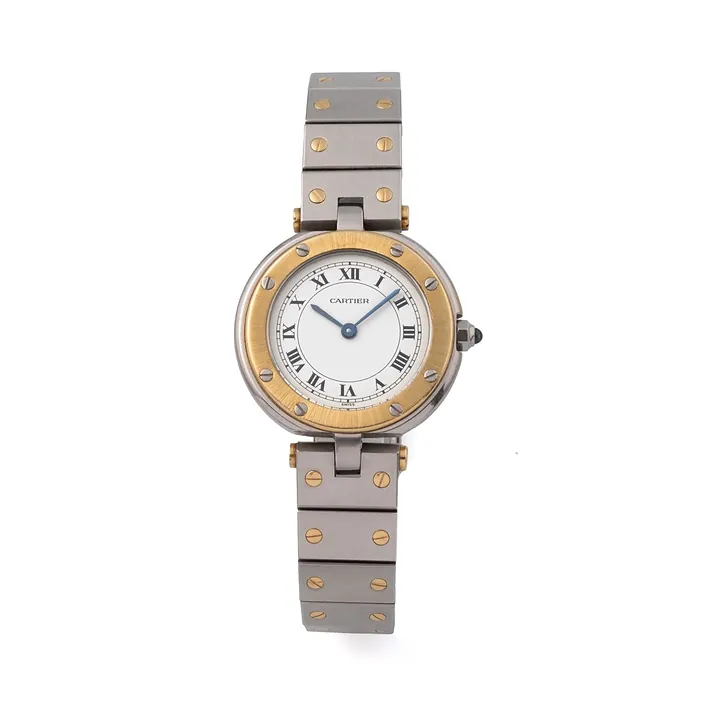
Cartier Santos Ronde Vendome, c. 1990
Antiquorum auction archive, Geneva
Wristwatches · c. 1990s
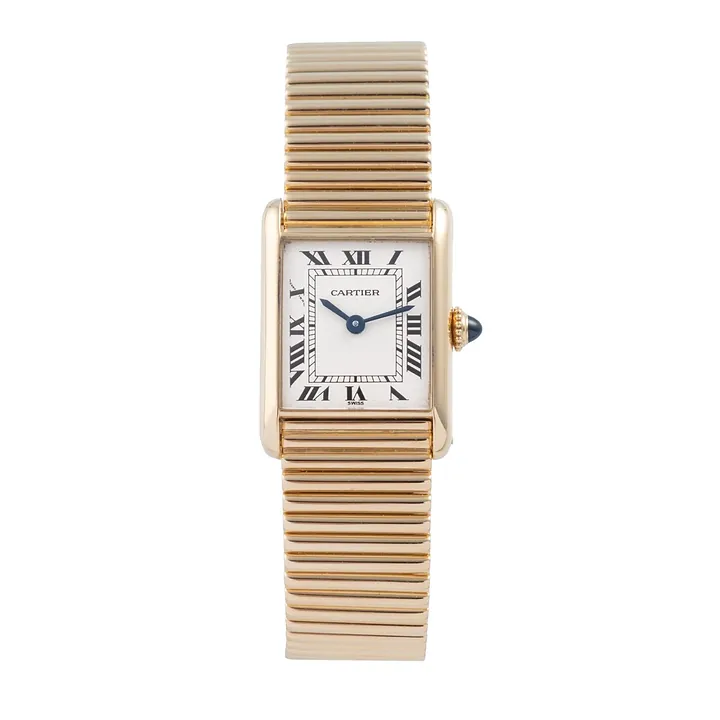
Cartier Tank Louis Cartier, ref. 6711, c. 1990s
Antiquorum auction archive, Geneva
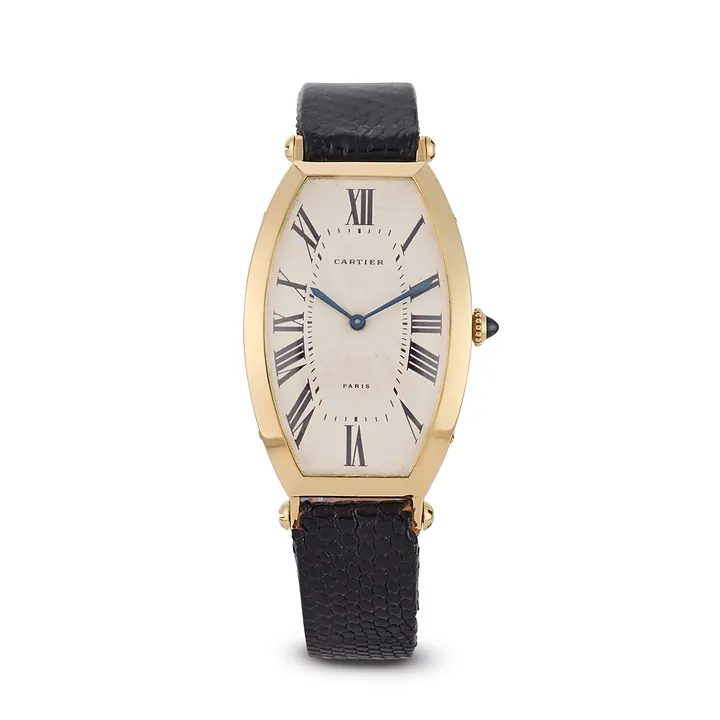
Wristwatches · c. 1991
Cartier Tonneau Paris 1991, c. 1991
Antiquorum auction archive, Geneva