
Wristwatches · Wristwatch
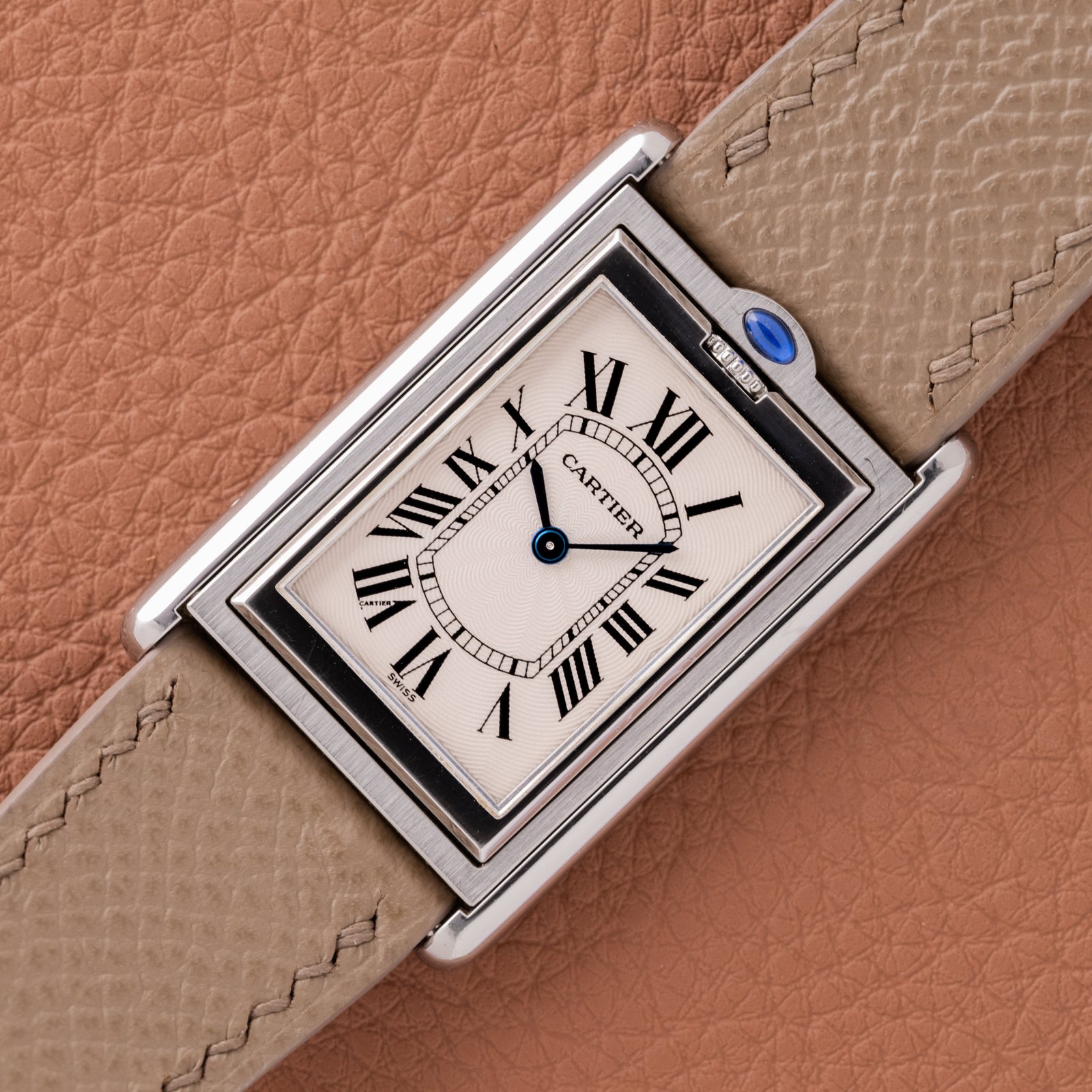
Cartier Tank Basculante Manual Wind (Ref. 2390), 1990s
- Maker / attribution
- Cartier (maker)
- Date
- 1990s
- Historical period
- Mechanical Renaissance (1990 – 2010)
- Country of origin
- France
- Object type
- Wristwatch
- Dimensions
- Case 25 mm
- Stock no.
- Product 15932940746935
- Credit line
- Dealer listing, Huntington Company (product 15932940746935)
- Catalogue title (original)
- 1990s Cartier Tank Basculante Manual Wind (Ref. 2390) (English)
View the source record (dealer listing) ↗ (opens another website in a new tab)Suggest a correction
Record summary
Catalogued by Huntington Company (dealer) (stock number Product 15932940746935), this is a wristwatch by Cartier, made in France, dated 1990s. The Atlas places it in the Mechanical Renaissance period (1990 – 2010) of its Wristwatches collection. Recorded dimensions: Case 25 mm. The record is illustrated with 6 photographs.
Assembled from the source record's structured fields. Dates and attributions are given as the source states them; where a field is missing the Atlas leaves it blank rather than estimating.
Catalogue description
Dealer description — Huntington Company
History and Significance The Tank Basculante is what happens when Cartier takes a practical problem and refuses to solve it in an ordinary way. Created in the early 1930s, its rectangular case can be released from its frame and rotated, allowing the dial to face inward and protecting the crystal. The concept came from the same sporting era that produced other reversible watches, but Cartier's execution was distinctly more architectural. Rather than flipping from side to side, the entire watch pivots vertically within its surrounding frame. Reference 2390 revives that unusual construction in a watch that otherwise contains nearly every classical Cartier signature. The silver guilloché dial is surrounded by oversized Roman numerals, a chemin de fer minute track, and blued steel hands. A manually wound movement keeps the case slim and preserves the interaction that makes a watch like this enjoyable in the first place. Wind it, release the case, rotate it, and put it back on the wrist. There is a physical quality to the Basculante that most modern dress watches simply do not have. For all of its mechanical cleverness, however, the rotating case never becomes the entire point. Closed and worn normally, the Basculante remains an exceptionally elegant rectangular Cartier. That balance between ingenuity and restraint is why the design has endured. Writer’s Thoughts The Tank is normally celebrated because of how simple it is, yet the Basculante takes that familiar formula and adds an entire mechanical structure around it. You can see the rails, hinges, and frame every time you rotate the case, but none of it makes the watch feel bulky or overengineered. Reference 2390 still wears exactly like the elegant Cartier it is. The guilloché dial on this example adds texture without competing with the Roman numerals and blued hands, and the steel case keeps everything understated. We've fitted this Tank Basculante to a black leather strap so the focus remains entirely on the watch itself. There are more recognizable Cartier references, but very few are as fun to actually handle. Our Promise Every watch is thoroughly vetted, carefully described with complete transparency, and guaranteed authentic. Each piece is offered in honest condition, ensuring collectors receive a timepiece that reflects both originality and integrity. Specifications Brand: Cartier Model: Tank Basculante Year: Circa 1990s Case Material: Stainless steel Case Size: Approximately 25mm x 38mm Dial: Silver guilloché dial with black Roman numerals Movement: Manual wind Strap/Bracelet: New unworn generic black leather strap Buckle/Clasp: Generic stainless steel buckle Contents: Watch only Condition Case: Stainless steel case presents very well with strong definition and light signs of wear consistent with age. The Basculante mechanism works perfectly. Dial: Original silver guilloché dial is exceptionally well preserved with crisp printing and no distractions. Hands: Original blued steel hands remain clean with strong color. Crystal: Crystal presents cleanly with no damage. Strap/Bracelet: New unworn generic black leather strap. Buckle/Clasp: New generic stainless steel buckle.
Historical context
Mechanical Renaissance (1990 – 2010)
Mechanical watches return as cultural objects; independent watchmaking flourishes.
Mechanical watches returned as cultural and luxury objects. Complications, tourbillons and new materials proliferated; independent watchmakers such as George Daniels, F.P. Journe and Philippe Dufour revived artisanal watchmaking; collecting vintage watches became a major field.
Read the period in the timelineMore wristwatches from this periodEarlier: Quartz Revolution
Atlas type guide
Wristwatches
Bracelet watches were worn by women from the early nineteenth century — Breguet made one for Caroline Murat, Queen of Naples, in 1810–12 — but the wristwatch only became a man's instrument with military use and aviation in the early twentieth century. Between the World Wars it overtook the pocket watch; the 1920s and 1930s brought rectangular Art Deco cases, water-resistant cases and the first automatic winding systems.
After 1945 the wristwatch became a carrier of identity — dress watches, sports and dive watches, chronographs, calendars — produced by Swiss, American, Japanese, German, Soviet and Chinese industries. The quartz revolution after 1969 and the mechanical renaissance since the 1990s, including the rise of independent watchmakers, complete the story.
What to look for
- The reference number (between the lugs or inside the case back) and serial number, the starting point for dating.
- The calibre: its maker and number are often stamped under the dial or on the bridge.
- Originality of dial, hands and crown — refinished ('redial') dials are common.
- Case material marks: 18K/750, 14K/585, stainless steel, gold-filled, plated.
Dating clues
- Wire-lug cases: before c. 1925.
- Water-resistant screw-down cases: from 1926.
- Quartz movements: from 1969; sapphire crystals widespread after c. 1980.
General guidance written by the Atlas editors about this kind of object. It is not a statement about this particular piece; for that, rely on the source record above and on physical examination.
Related records

Clocks · 1863
Clock by Albert-Ernest Carrier-Belleuse, France, 1863
The Metropolitan Museum of Art, New York

Clocks · c. 1980s
Cartier "art Deco", c. 1980s
Antiquorum auction archive, Geneva

Clocks · c. 2000s
Cartier Desk Clock with Alarm, c. 2000s
Antiquorum auction archive, Geneva

Clocks · c. 2000s
Cartier Lacquer Arched Desk Clock with Alarm, ref. W0100037, c. 2000s
Antiquorum auction archive, Geneva
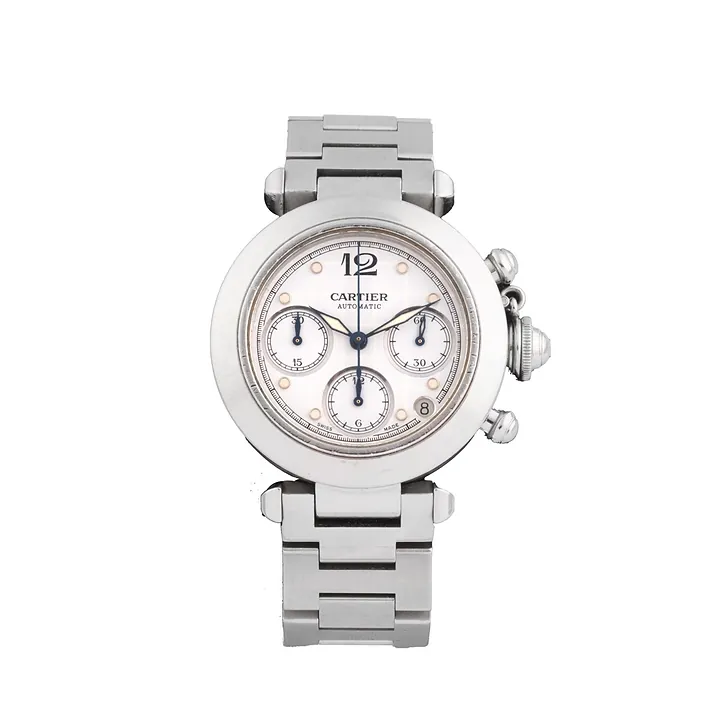
Wristwatches · c. 1990
Cartier Pasha, ref. 2412, c. 1990
Antiquorum auction archive, Geneva
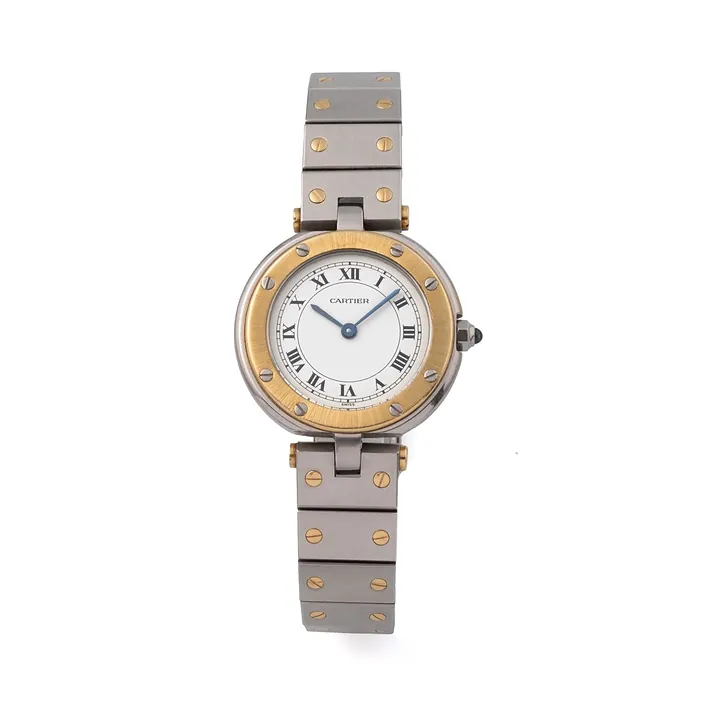
Wristwatches · c. 1990
Cartier Santos Ronde Vendome, c. 1990
Antiquorum auction archive, Geneva
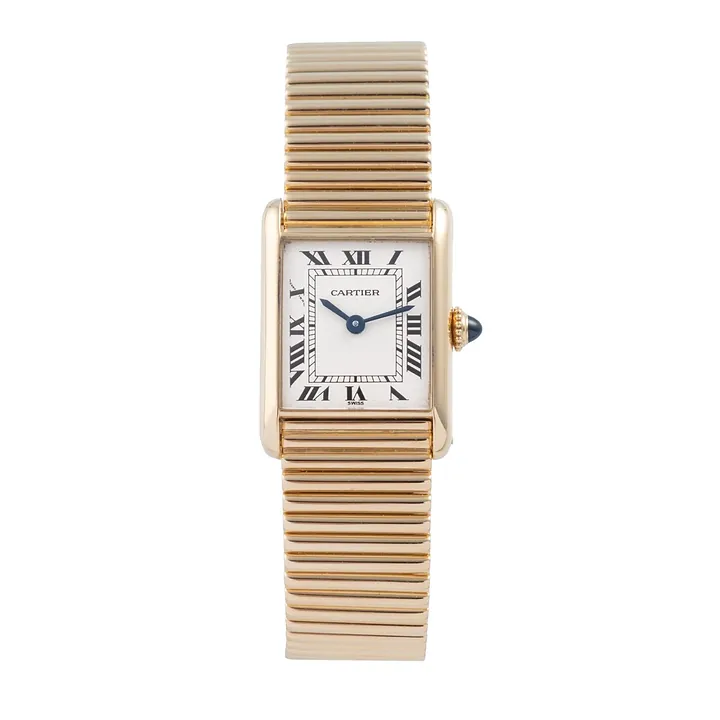
Wristwatches · c. 1990s
Cartier Tank Louis Cartier, ref. 6711, c. 1990s
Antiquorum auction archive, Geneva
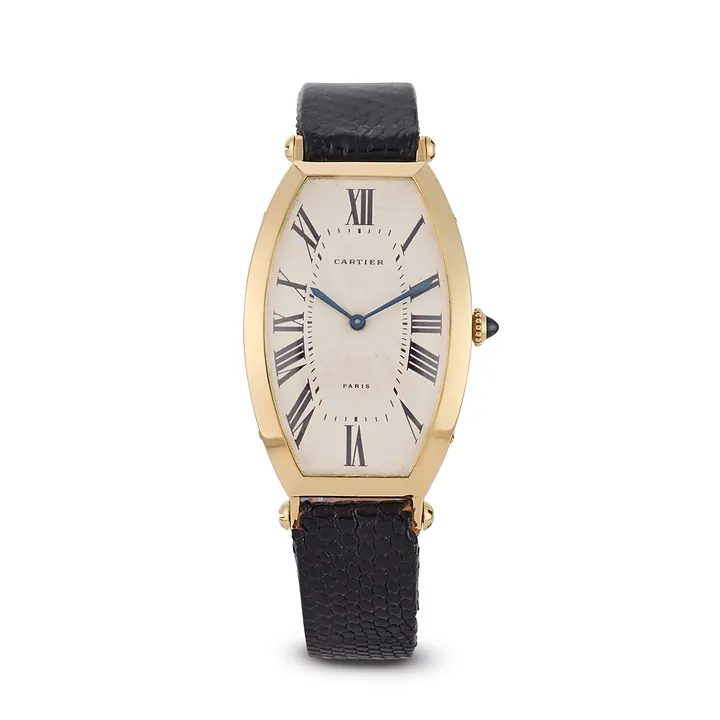
Wristwatches · c. 1991
Cartier Tonneau Paris 1991, c. 1991
Antiquorum auction archive, Geneva