
Wristwatches · Wristwatch
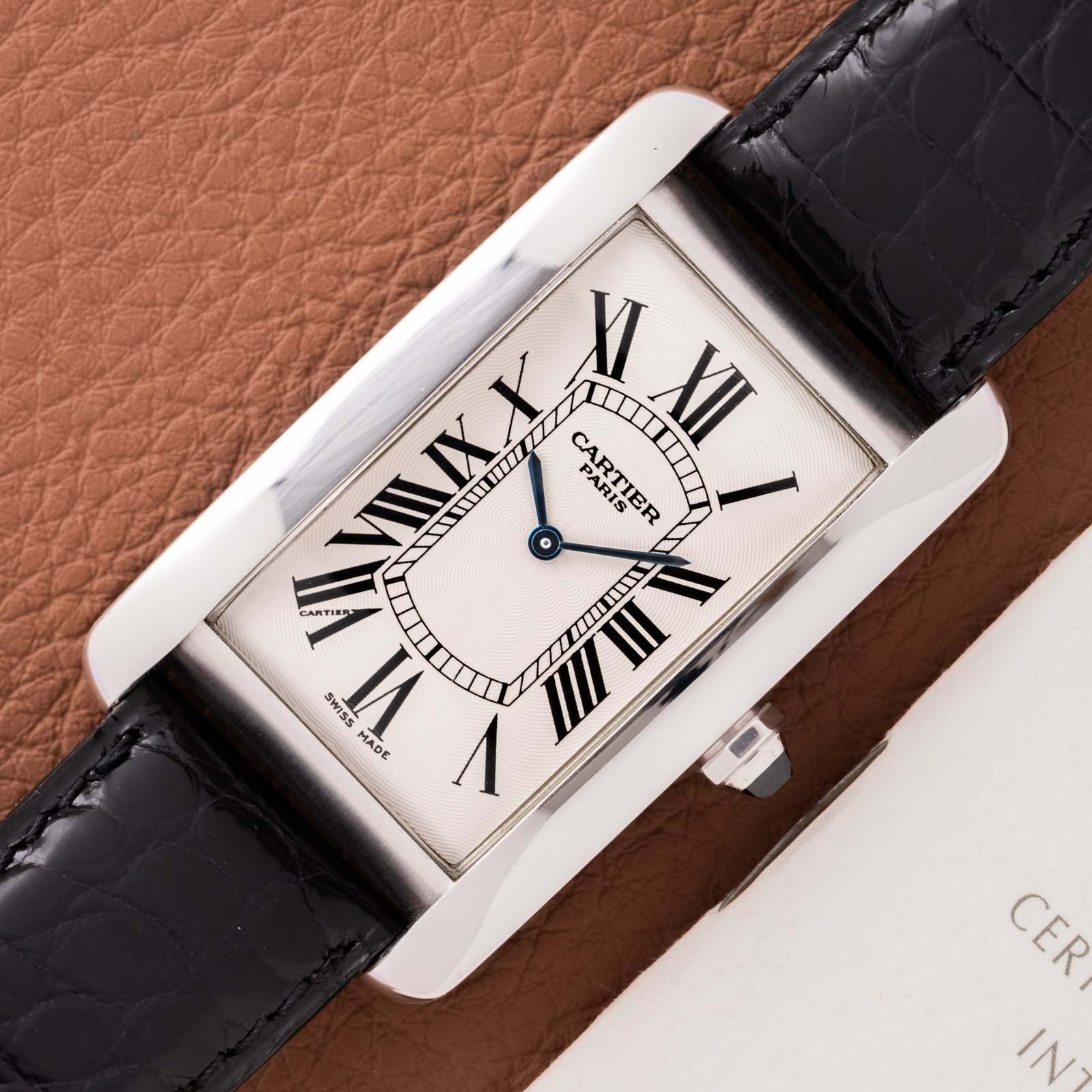
Cartier Tank Américaine Platinum CPCP (Ref. 1734B), 2000
- Maker / attribution
- Cartier (maker)
- Date
- 2000
- Historical period
- Mechanical Renaissance (1990 – 2010)
- Country of origin
- France
- Object type
- Wristwatch
- Materials / technique
- platinum
- Dimensions
- Case 45 mm
- Stock no.
- Product 8585587916983
- Credit line
- Dealer listing, Huntington Company (product 8585587916983)
- Catalogue title (original)
- 2000 Cartier Tank Américaine Platinum CPCP - Papers (Ref. 1734B) (English)
View the source record (dealer listing) ↗ (opens another website in a new tab)Suggest a correction
Record summary
Catalogued by Huntington Company (dealer) (stock number Product 8585587916983), this is a wristwatch by Cartier, made in France, dated 2000. The Atlas places it in the Mechanical Renaissance period (1990 – 2010) of its Wristwatches collection. Materials and techniques recorded by the source: platinum. Recorded dimensions: Case 45 mm. The record is illustrated with 6 photographs.
Assembled from the source record's structured fields. Dates and attributions are given as the source states them; where a field is missing the Atlas leaves it blank rather than estimating.
Catalogue description
Dealer description — Huntington Company
History and Significance The Cartier Tank Américaine traces its roots back to 1989 when Cartier reinterpreted the curved profile of the Tank Cintrée for a modern audience. The elongated rectangular case maintained the elegance of the original Tank family while introducing a more contemporary presence on the wrist. By the late 1990s and early 2000s, the model had become one of the most important references within Cartier's dress watch collection. This particular example belongs to the Collection Privée Cartier Paris, commonly known as CPCP. Introduced in 1998, the CPCP program represented Cartier's effort to produce its most traditional and enthusiast-focused watches. Cases were crafted in precious metals, movements were sourced from respected Swiss manufacturers and finished to a higher standard, and dials featured details that closely reflected Cartier's historic designs. Today, CPCP models are widely regarded as some of the most collectible Cartier watches of the modern era. Reference 1734B is among the most desirable Tank Américaine variants produced under the CPCP banner. The platinum case is paired with a silver guilloché dial, bold Roman numerals, blued steel hands, and a faceted sapphire cabochon crown. The manually wound movement preserves the slim proportions that define the Américaine and contributes to the elegant profile of the watch. The use of platinum adds another layer of appeal. While visually understated, the metal carries a distinct heft on the wrist that separates it from white gold examples. Combined with the elongated curved case and CPCP execution, it represents one of the most refined interpretations of the Tank Américaine. Writer’s Thoughts The CPCP Américaine occupies a unique place in the Cartier world. It has all the familiar Tank design language, but the longer case and curved profile give it a stronger presence than a traditional Tank Louis. In platinum, it feels substantial without drawing attention to itself. This is the kind of watch that reveals its significance slowly, and for many collectors, that is exactly the appeal. Our Promise Every watch is thoroughly vetted, carefully described with complete transparency, and guaranteed authentic. Each piece is offered in honest condition, ensuring collectors receive a timepiece that reflects both originality and integrity. Specifications Brand: Cartier Model: Tank Américaine CPCP (Ref. 1734B) Year: circa 2000 Case Material: Platinum Case Size: 45mm x 26.5mm Dial: Silver guilloché dial with black Roman numerals Movement: Manual wind Strap/Bracelet: Cartier black alligator strap Buckle/Clasp: Cartier platinum deployant clasp Contents: Original Cartier international guarantee papers Condition Case: Excellent overall condition with sharp lines and well-preserved brushed and polished surfaces. Light signs of wear visible under close inspection. Dial: Excellent original guilloché dial with clean printing, crisp Roman numerals, and no damage visible. Hands: Original blued steel hands in excellent condition. Crystal: Clean and free from any notable scratches visible in the photographs. Strap/Bracelet: Cartier alligator strap showing light signs of wear from use. Buckle/Clasp: Original Cartier platinum deployant clasp in excellent condition with light handling marks.
Historical context
Mechanical Renaissance (1990 – 2010)
Mechanical watches return as cultural objects; independent watchmaking flourishes.
Mechanical watches returned as cultural and luxury objects. Complications, tourbillons and new materials proliferated; independent watchmakers such as George Daniels, F.P. Journe and Philippe Dufour revived artisanal watchmaking; collecting vintage watches became a major field.
Read the period in the timelineMore wristwatches from this periodEarlier: Quartz Revolution
Atlas type guide
Wristwatches
Bracelet watches were worn by women from the early nineteenth century — Breguet made one for Caroline Murat, Queen of Naples, in 1810–12 — but the wristwatch only became a man's instrument with military use and aviation in the early twentieth century. Between the World Wars it overtook the pocket watch; the 1920s and 1930s brought rectangular Art Deco cases, water-resistant cases and the first automatic winding systems.
After 1945 the wristwatch became a carrier of identity — dress watches, sports and dive watches, chronographs, calendars — produced by Swiss, American, Japanese, German, Soviet and Chinese industries. The quartz revolution after 1969 and the mechanical renaissance since the 1990s, including the rise of independent watchmakers, complete the story.
What to look for
- The reference number (between the lugs or inside the case back) and serial number, the starting point for dating.
- The calibre: its maker and number are often stamped under the dial or on the bridge.
- Originality of dial, hands and crown — refinished ('redial') dials are common.
- Case material marks: 18K/750, 14K/585, stainless steel, gold-filled, plated.
Dating clues
- Wire-lug cases: before c. 1925.
- Water-resistant screw-down cases: from 1926.
- Quartz movements: from 1969; sapphire crystals widespread after c. 1980.
General guidance written by the Atlas editors about this kind of object. It is not a statement about this particular piece; for that, rely on the source record above and on physical examination.
Related records

Clocks · 1863
Clock by Albert-Ernest Carrier-Belleuse, France, 1863
The Metropolitan Museum of Art, New York

Clocks · c. 1980s
Cartier "art Deco", c. 1980s
Antiquorum auction archive, Geneva

Clocks · c. 2000s
Cartier Desk Clock with Alarm, c. 2000s
Antiquorum auction archive, Geneva

Clocks · c. 2000s
Cartier Lacquer Arched Desk Clock with Alarm, ref. W0100037, c. 2000s
Antiquorum auction archive, Geneva
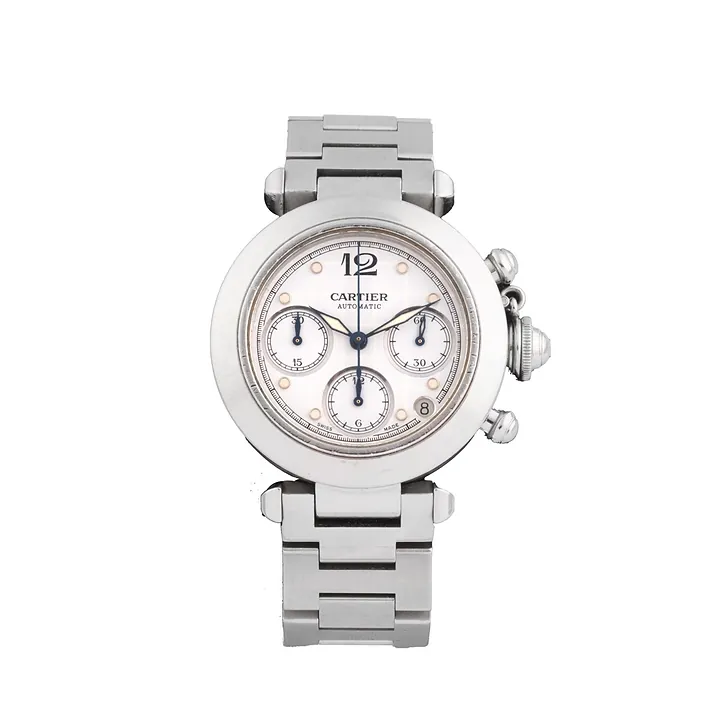
Wristwatches · c. 1990
Cartier Pasha, ref. 2412, c. 1990
Antiquorum auction archive, Geneva
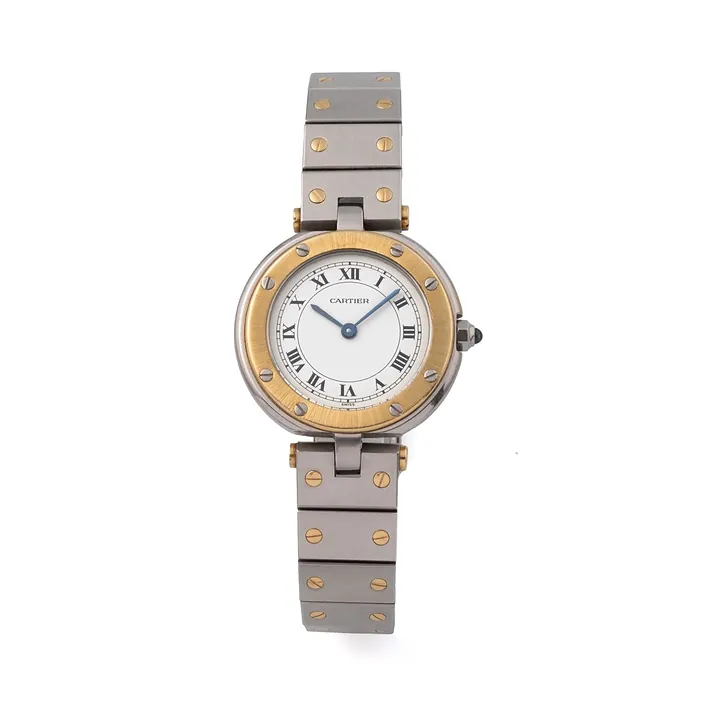
Wristwatches · c. 1990
Cartier Santos Ronde Vendome, c. 1990
Antiquorum auction archive, Geneva
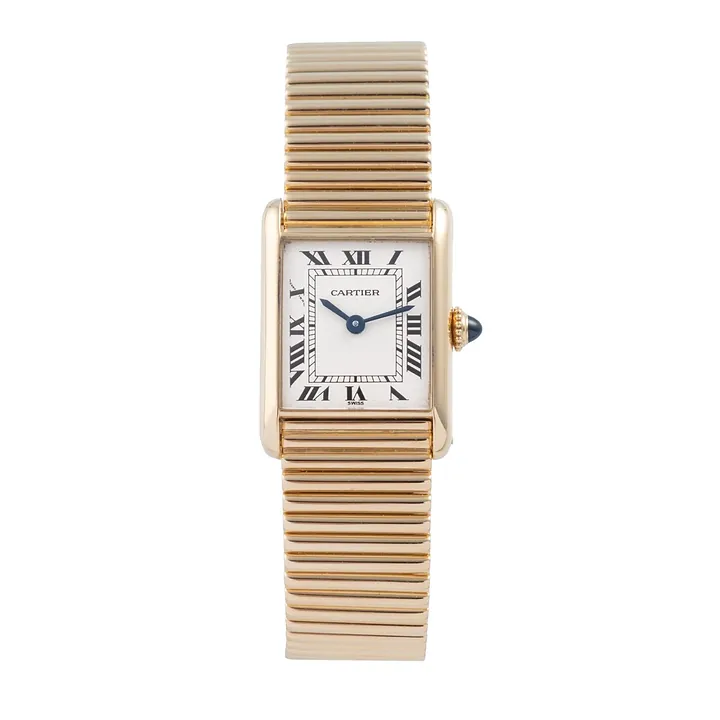
Wristwatches · c. 1990s
Cartier Tank Louis Cartier, ref. 6711, c. 1990s
Antiquorum auction archive, Geneva
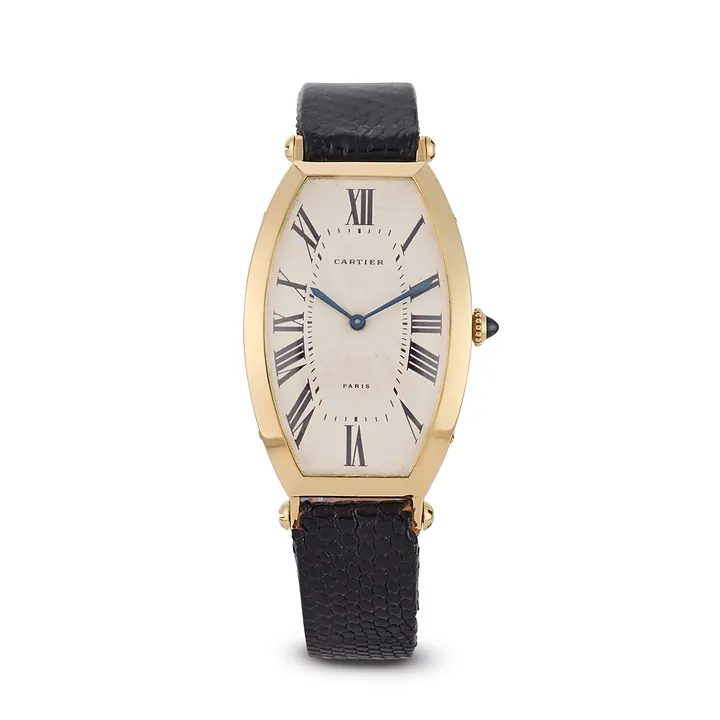
Wristwatches · c. 1991
Cartier Tonneau Paris 1991, c. 1991
Antiquorum auction archive, Geneva