
Wristwatches · Wristwatch
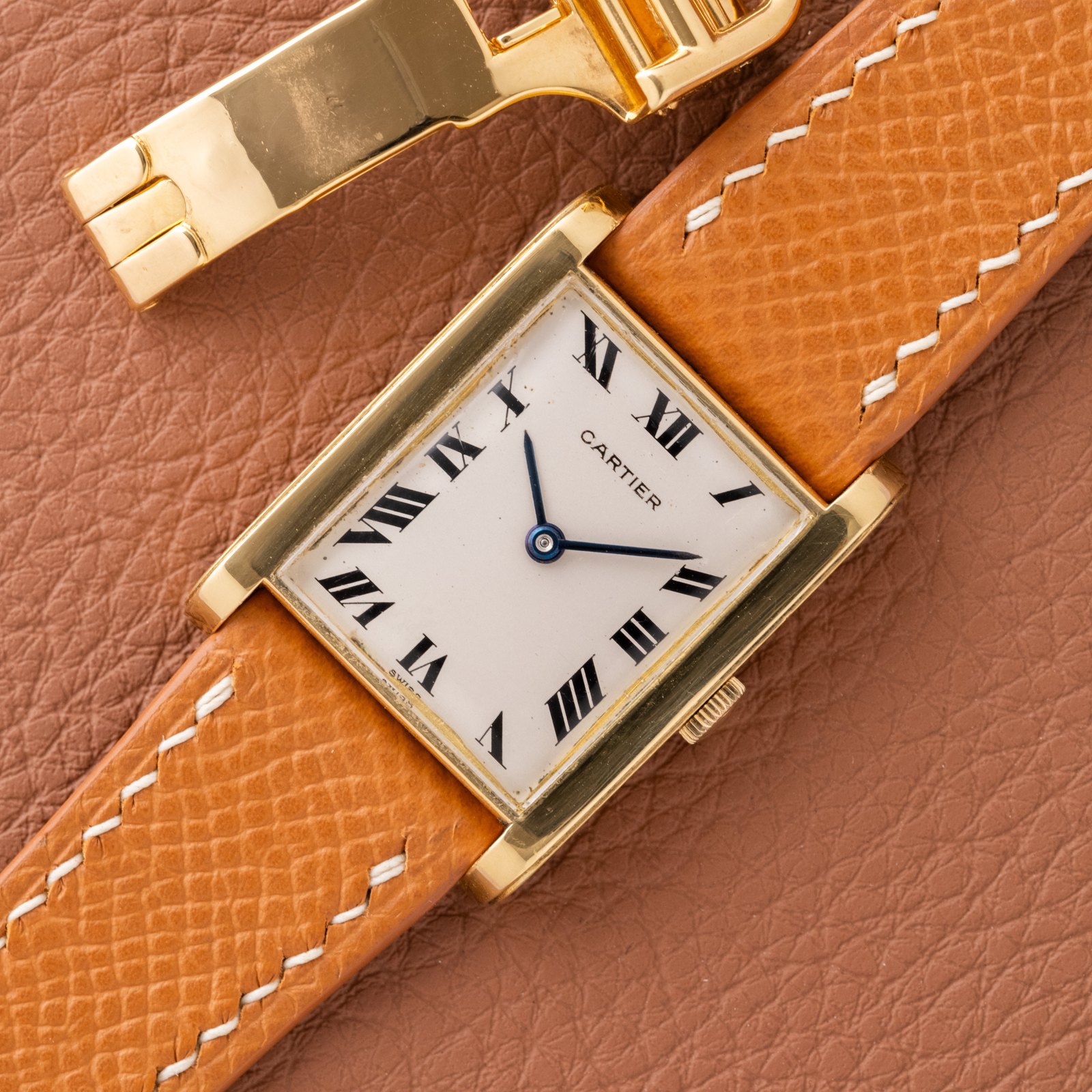
Cartier New York Tank Bec d’Aigle Large Size - Audemars Piguet Movement, 1960s
- Maker / attribution
- Cartier (maker)
- Date
- 1960s
- Historical period
- Modern Mechanical Horology (1945 – 1969)
- Country of origin
- United States
- Object type
- Wristwatch
- Stock no.
- Product 8534230663351
- Credit line
- Dealer listing, Huntington Company (product 8534230663351)
- Catalogue title (original)
- 1960s Cartier New York Tank Bec d’Aigle Large Size - Audemars Piguet Movement (English)
View the source record (dealer listing) ↗ (opens another website in a new tab)Suggest a correction
Record summary
Catalogued by Huntington Company (dealer) (stock number Product 8534230663351), this is a wristwatch by Cartier, made in United States, dated 1960s. The Atlas places it in the Modern Mechanical Horology period (1945 – 1969) of its Wristwatches collection. The record is illustrated with 6 photographs.
Assembled from the source record's structured fields. Dates and attributions are given as the source states them; where a field is missing the Atlas leaves it blank rather than estimating.
Catalogue description
Dealer description — Huntington Company
History and Significance Cartier’s Tank has taken on many forms since its introduction, but certain variations stand out for how far they push the original design. The Bec d’Aigle is one of those. Defined by its distinctive, slightly flared lugs and thicker stepped brancards, it carries more presence on the wrist than a traditional Tank Louis while still maintaining the same underlying proportions and elegance. This example is especially interesting for a few reasons. The case proportions at 24x32mm already give it a bit more size, but the architecture of the case makes it wear even larger. The stepped sides catch light differently than a standard Tank, giving the watch more depth and structure when viewed from the wrist rather than straight on. There is also a strong New York connection here. Cartier pieces signed for the New York market often show subtle differences, and the Swiss signature at 6 o’clock helps confirm that production lineage. Combined with the sharp hallmarks and overall condition, it suggests this watch has likely avoided polishing, something that is increasingly uncommon for pieces of this age. Inside, the use of an Audemars Piguet caliber K2001 adds another layer of interest. Cartier’s use of high-grade movements from top-tier manufacturers is well documented, but finding an example this clean, with a movement only 7mm tall, reinforces how refined these watches were, both mechanically and aesthetically. Writer’s Thoughts The case shape is what makes this so special. It’s familiar at a glance, but the moment you look closer, it’s clearly something different. It wears larger than the numbers suggest, which makes it easier to live with compared to a traditional Tank Louis. Pieces like this don’t come around often in this kind of condition, especially with the Bec d’Aigle (Eagle Beak) lugs. Our Promise Every watch is thoroughly vetted, carefully described with complete transparency, and guaranteed authentic. Each piece is offered in honest condition, ensuring collectors receive a timepiece that reflects both originality and integrity. Specifications Brand: Cartier Model: Tank Bec d’Aigle Year: circa 1960s Case Material: Yellow gold Case Size: 24x32mm Dial: Opaline dial with Roman numerals Movement: Manual wind Audemars Piguet caliber K2001 Strap/Bracelet: Leather strap Buckle/Clasp: Tang buckle Contents: Comes with the original deployant Condition Case: Case appears unpolished with very sharp hallmarks and light wear consistent with age. Dial: Dial shows light aging but remains clean and well-preserved. Hands: Hands are correct and in good condition. Crystal: Crystal shows light surface wear consistent with age. Strap/Bracelet: Strap is new.
Historical context
Modern Mechanical Horology (1945 – 1969)
Tool watches for divers, pilots and astronauts; electric watches anticipate the electronic age.
The classic era of the mechanical wristwatch: dive watches, chronographs for motor racing and space flight, GMT watches for jet travel, slim dress watches, automatic calendars, and the rise of Japanese manufacturers alongside Swiss, American, German and Soviet industries.
Read the period in the timelineMore wristwatches from this periodEarlier: Golden Age of Mechanical Watchmaking
Atlas type guide
Wristwatches
Bracelet watches were worn by women from the early nineteenth century — Breguet made one for Caroline Murat, Queen of Naples, in 1810–12 — but the wristwatch only became a man's instrument with military use and aviation in the early twentieth century. Between the World Wars it overtook the pocket watch; the 1920s and 1930s brought rectangular Art Deco cases, water-resistant cases and the first automatic winding systems.
After 1945 the wristwatch became a carrier of identity — dress watches, sports and dive watches, chronographs, calendars — produced by Swiss, American, Japanese, German, Soviet and Chinese industries. The quartz revolution after 1969 and the mechanical renaissance since the 1990s, including the rise of independent watchmakers, complete the story.
What to look for
- The reference number (between the lugs or inside the case back) and serial number, the starting point for dating.
- The calibre: its maker and number are often stamped under the dial or on the bridge.
- Originality of dial, hands and crown — refinished ('redial') dials are common.
- Case material marks: 18K/750, 14K/585, stainless steel, gold-filled, plated.
Dating clues
- Wire-lug cases: before c. 1925.
- Water-resistant screw-down cases: from 1926.
- Quartz movements: from 1969; sapphire crystals widespread after c. 1980.
General guidance written by the Atlas editors about this kind of object. It is not a statement about this particular piece; for that, rely on the source record above and on physical examination.
Related records
Clocks · 1863
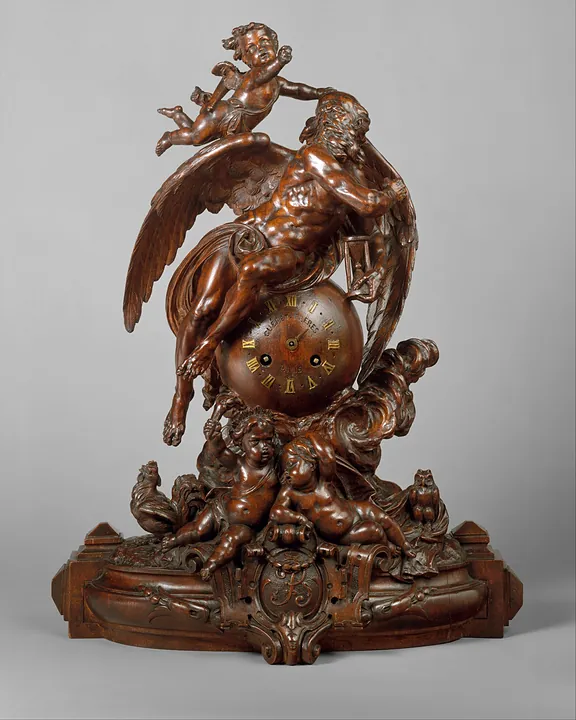
Clock by Albert-Ernest Carrier-Belleuse, France, 1863
The Metropolitan Museum of Art, New York
Clocks · c. 1980s
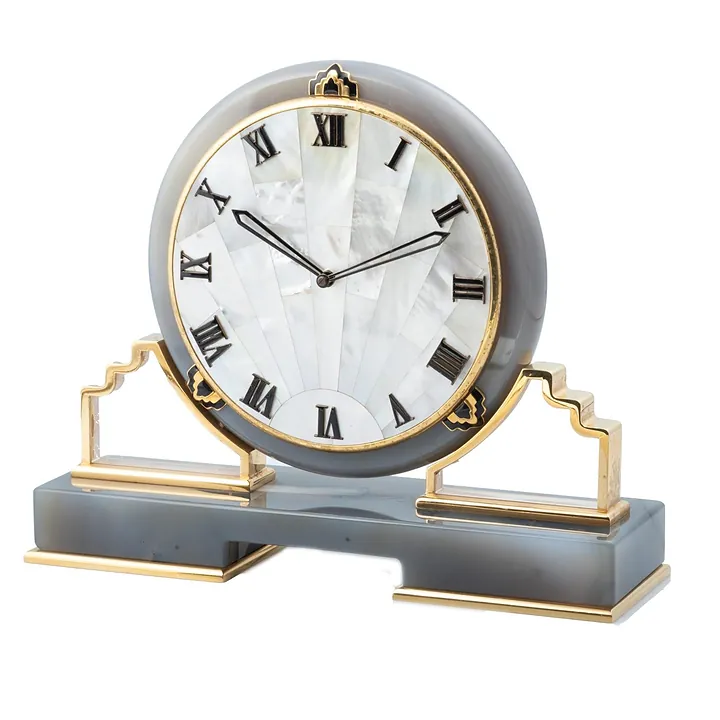
Cartier "art Deco", c. 1980s
Antiquorum auction archive, Geneva
Clocks · c. 2000s
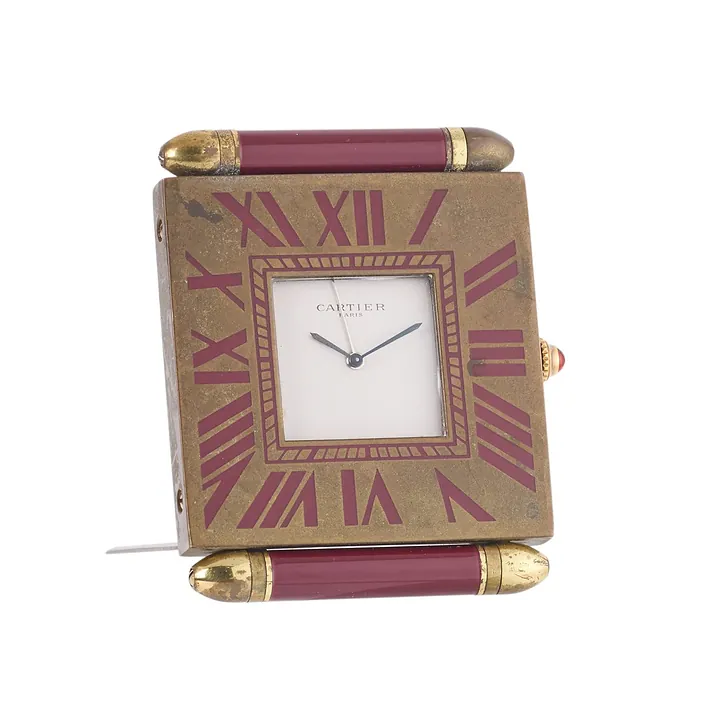
Cartier Desk Clock with Alarm, c. 2000s
Antiquorum auction archive, Geneva
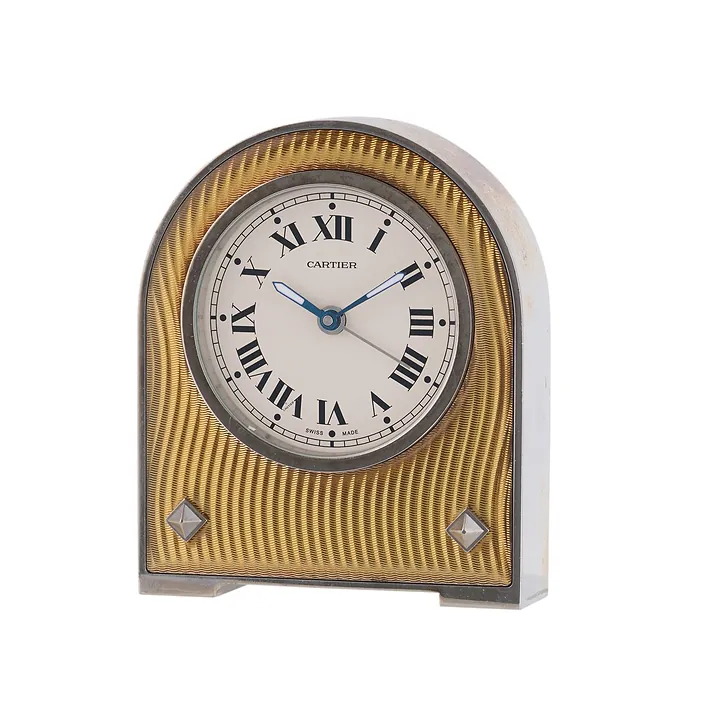
Clocks · c. 2000s
Cartier Lacquer Arched Desk Clock with Alarm, ref. W0100037, c. 2000s
Antiquorum auction archive, Geneva
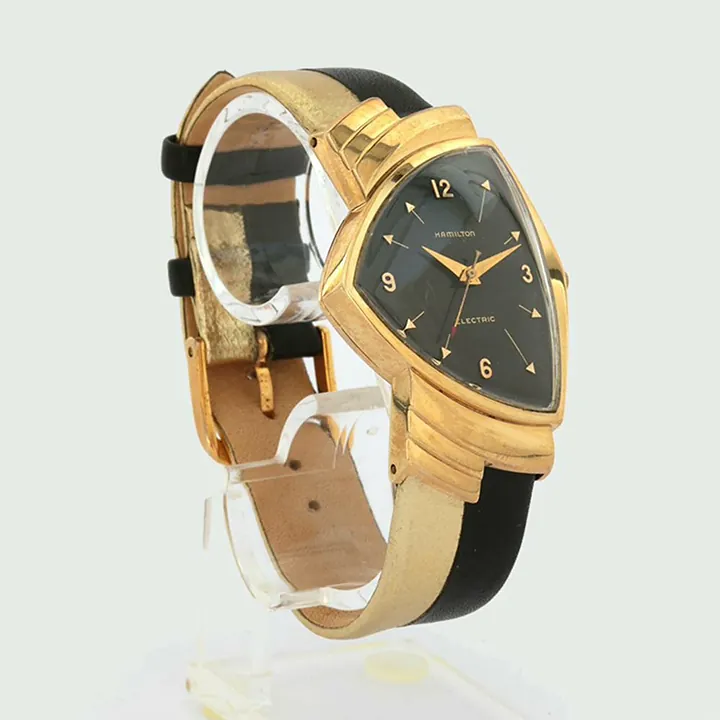
Wristwatches · c. 1957
Wristwatch by Richard H. Arbib, United States, c. 1957
German Clock Museum
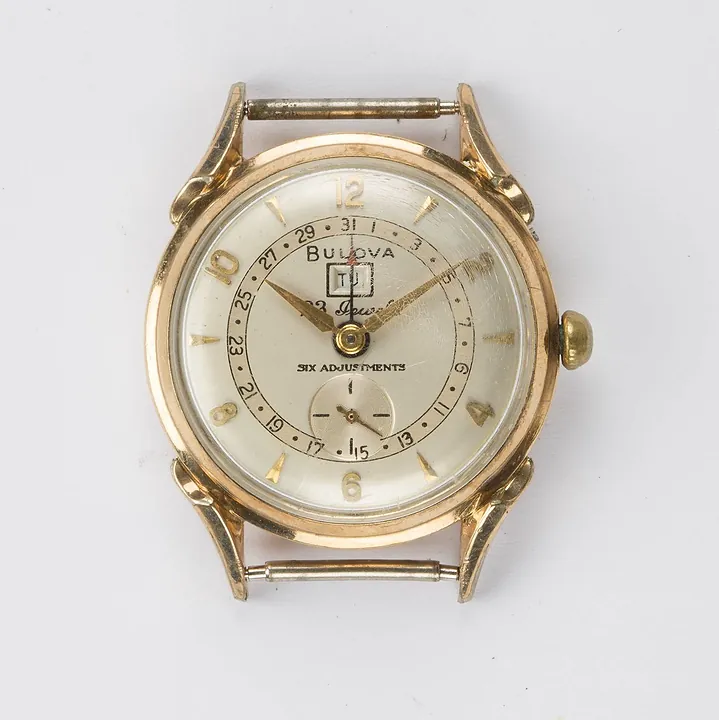
Wristwatches · 1959
Wristwatch by Josef Bulova, United States, 1959
German Clock Museum
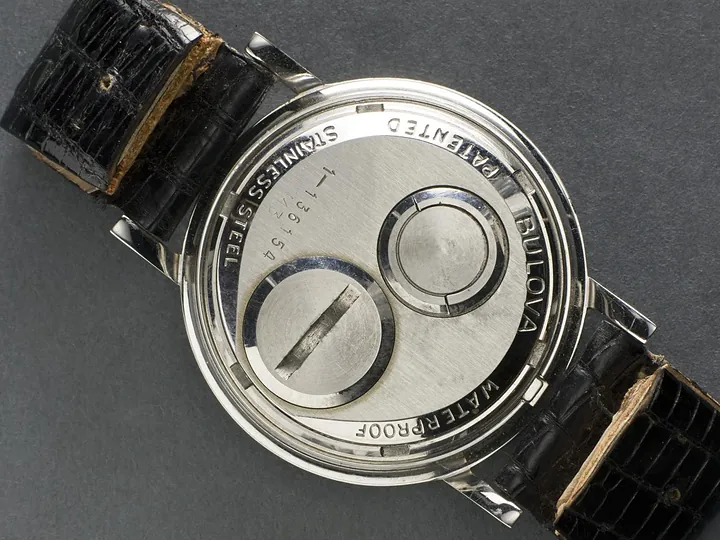
Wristwatches · 1960–1963
Bulova Accutron tuning-fork wristwatch on a demonstration stand, designed by Max Hetzel, United States, 1960–1963
Science Museum Group, London
Wristwatches · 1964
Tornek-Rayville wristwatch, ref. TR 900, 1964
Antiquorum auction archive, Geneva