
Wristwatches · Wristwatch
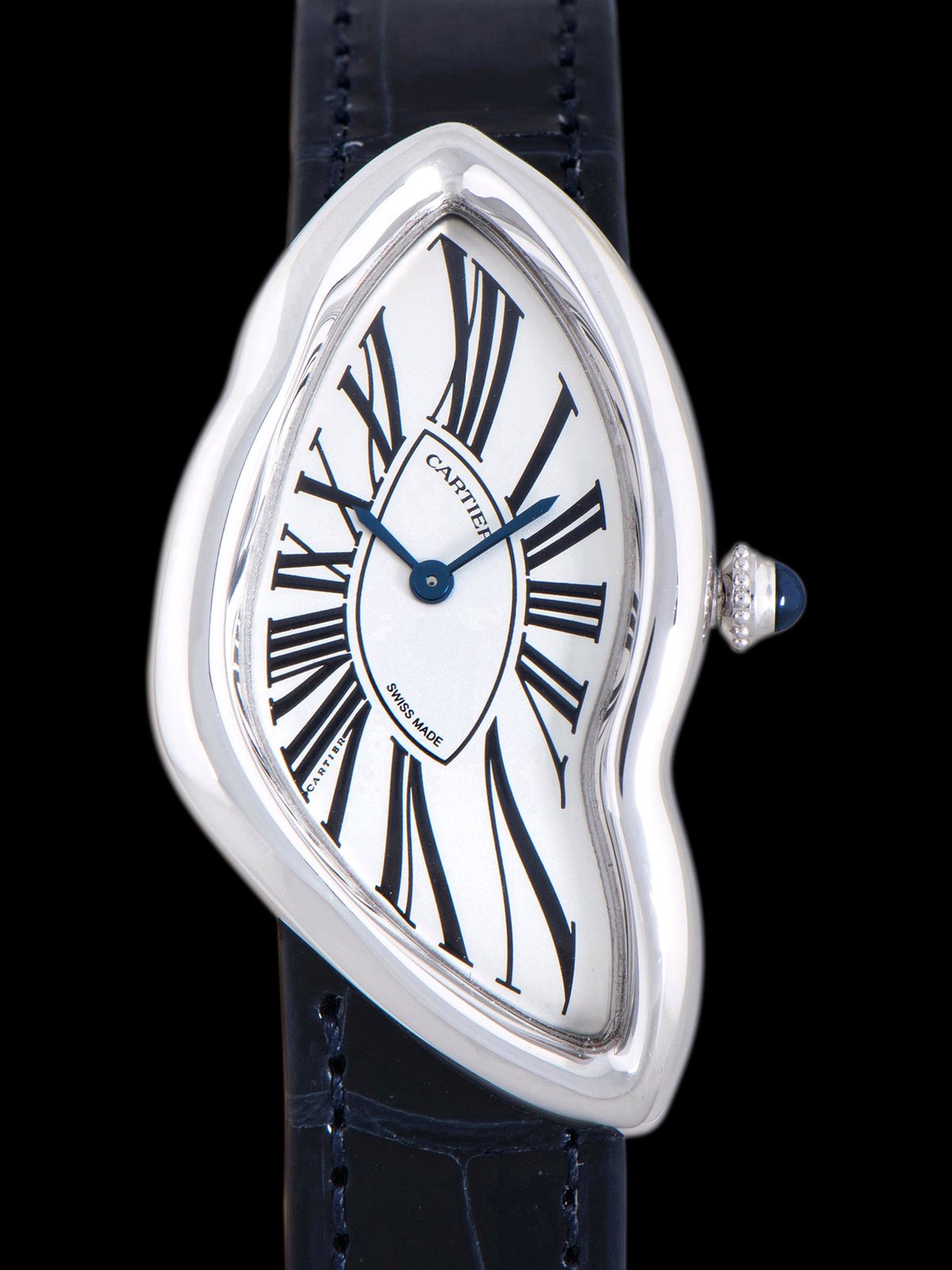
Cartier Crash 'NSO' 18K WG (Ref. WGCH0055), 2022
- Maker / attribution
- Cartier (maker)
- Date
- 2022
- Historical period
- Contemporary Horology (2010 – Present)
- Country of origin
- France
- Object type
- Wristwatch
- Stock no.
- CTRCRASH
- Credit line
- Dealer listing, Craft & Tailored (CTRCRASH)
- Catalogue title (original)
- 2022 Cartier Crash 'NSO' 18K WG (Ref. WGCH0055) W/ Full Set (English)
View the source record (dealer listing) ↗ (opens another website in a new tab)Suggest a correction
Record summary
Catalogued by Craft & Tailored (dealer), Los Angeles (stock number CTRCRASH), this is a wristwatch by Cartier, made in France, dated 2022. The Atlas places it in the Contemporary Horology period (2010 – Present) of its Wristwatches collection. The record is illustrated with 6 photographs.
Assembled from the source record's structured fields. Dates and attributions are given as the source states them; where a field is missing the Atlas leaves it blank rather than estimating.
Catalogue description
Dealer description — Craft & Tailored
The Cartier name is synonymous with luxury and has been since the brand's inception in 1847. Offering bespoke and unique jewelry to the world’s elite allowed Cartier to grow steadily through the 19th century. After the division of Cartier in the 1960s, the Paris, London, and New York stores began operating independently with each Maison creating new and unique designs for their respective locations. Of the 3 houses, it is understood by many collectors and historians that the Cartier London house was the most exciting, bold, and experimental in its designs, especially with wristwatches. The most famous of these Cartier London concepts, and arguably one of the most iconic wristwatch designs of all time, is the Cartier Crash. Introduced in 1967 from the London house, the origins of the Crash remained a mystery to the watch world for decades, with many speculating that the watch was inspired by a Cartier Baignoire Allongee that was deformed in a firey car crash, which is the origin of the name, or that it was inspired by the surrealist painting 'Persistence of Memory' from famous painter Salvidor Dali. However, with the release of the book The Cartiers by Francesca Cartier Brickell, we now understand the Crash design was the collaborative effort of Jean-Jacques Cartier and Rupert Emmerson playing with the idea of a distorted wristwatch to contrast the perceived design personality of the brand at the time. The very first London Crash iterations seldomly are presented for sale due to diminutive original production numbers, though the few that have surfaced have reached record numbers in recent auctions. In 1991, Cartier Paris reintroduced the Crash in a limited run of 400 pieces with a modestly modernized design, to which has found its own market and collector base. Since then, the Cartier Crash has been released in unique configurations with limited quantities, such as the skeletonized dial variations. The Cartier new special order watches, or 'NSO' watches, is a special custom design program for established Cartier clients to create their dream version of any Cartier wristwatch, within reason, and as long as the idea is approved by Cartier HQ. With that, this program has allowed Cartier collectors to introduce new ideas and concepts to the already established Cartier design offerings, bringing numerous unique or seemingly unique iterations to life. We are extremely proud to present this exceptionally beautiful, charming, and rarely seen Cartier Crash in 18K white gold, conceptualized from the Cartier NSO program in 2022, and one of less than 10 known white gold Crash to exist from the modern era. This example comes to us in exceptionally well-preserved, minimally worn condition, with its original box and papers set. Stock # CTRCRASH Brand Cartier Style Crash Model WGCH0055 Serial N/A Size Men's Material 18K White Gold Dial Silver W/ Exploding Roman Numerals Millimeters 23 x 42 Strap 2pc Cartier Blue Patent Alligator Leather Strap W/ 18K WG Cartier Crash Deployant Clasp CASE & BRACELET The 18K white gold case is in impressive, 'like new' condition, appearing to have only been worn a handful of times with only nominal elements of previous use present. The crystal displays no signs of use. The blue sapphire cabochon crown is in perfect condition. The case back retains its original factory stickers and shows no signs of use. The 2pc dark blue patent alligator leather Cartier strap is unworn and accents the timepiece perfectly. The watch comes with its original, and unique to the Crash, 18K white gold deployant buckle which is in perfect condition as well. DIAL & HANDS The stunning satin silver dial with exploding black Roman numbers is flawless. The original blued hands are flawless. ACCESSORIES
Historical context
Contemporary Horology (2010 – Present)
Silicon components, connected watches, optical-lattice research clocks and a thriving independent scene.
Smartwatches became the world's best-selling watches, while mechanical watchmaking focuses on craft, innovation (silicon components, new escapements) and independent makers.
Read the period in the timelineMore wristwatches from this periodEarlier: Mechanical Renaissance
Atlas type guide
Wristwatches
Bracelet watches were worn by women from the early nineteenth century — Breguet made one for Caroline Murat, Queen of Naples, in 1810–12 — but the wristwatch only became a man's instrument with military use and aviation in the early twentieth century. Between the World Wars it overtook the pocket watch; the 1920s and 1930s brought rectangular Art Deco cases, water-resistant cases and the first automatic winding systems.
After 1945 the wristwatch became a carrier of identity — dress watches, sports and dive watches, chronographs, calendars — produced by Swiss, American, Japanese, German, Soviet and Chinese industries. The quartz revolution after 1969 and the mechanical renaissance since the 1990s, including the rise of independent watchmakers, complete the story.
What to look for
- The reference number (between the lugs or inside the case back) and serial number, the starting point for dating.
- The calibre: its maker and number are often stamped under the dial or on the bridge.
- Originality of dial, hands and crown — refinished ('redial') dials are common.
- Case material marks: 18K/750, 14K/585, stainless steel, gold-filled, plated.
Dating clues
- Wire-lug cases: before c. 1925.
- Water-resistant screw-down cases: from 1926.
- Quartz movements: from 1969; sapphire crystals widespread after c. 1980.
General guidance written by the Atlas editors about this kind of object. It is not a statement about this particular piece; for that, rely on the source record above and on physical examination.
Related records

Clocks · 1863
Clock by Albert-Ernest Carrier-Belleuse, France, 1863
The Metropolitan Museum of Art, New York

Clocks · c. 1980s
Cartier "art Deco", c. 1980s
Antiquorum auction archive, Geneva

Clocks · c. 2000s
Cartier Desk Clock with Alarm, c. 2000s
Antiquorum auction archive, Geneva

Clocks · c. 2000s
Cartier Lacquer Arched Desk Clock with Alarm, ref. W0100037, c. 2000s
Antiquorum auction archive, Geneva
Wristwatches · c. 2010s
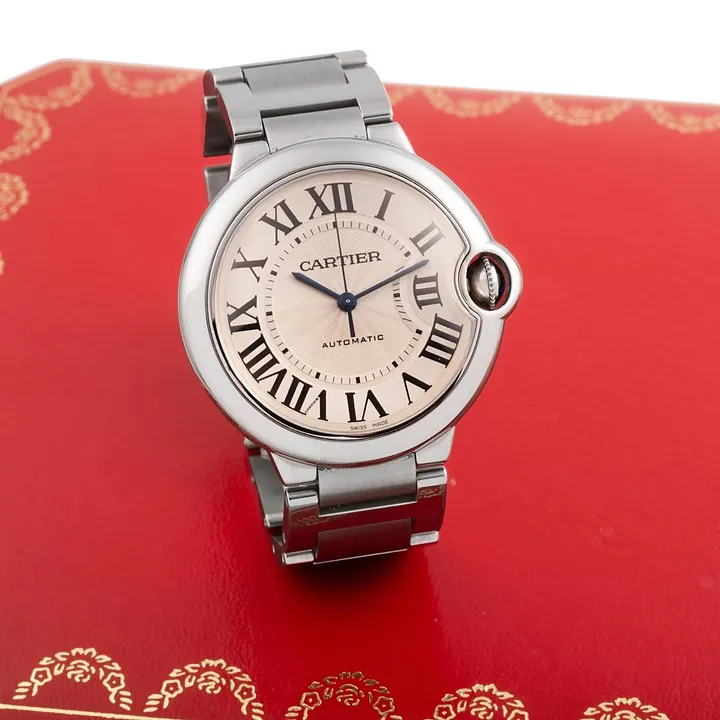
Cartier Ballon Bleu, ref. 3284, c. 2010s
Antiquorum auction archive, Geneva

Wristwatches · originally sold in December 2021 (per the lot record)
Cartier Tank Must, ref. CRWSTA0054, originally sold in December 2021
Antiquorum auction archive, Geneva
Wristwatches · originally sold in 2023 (per the lot record)
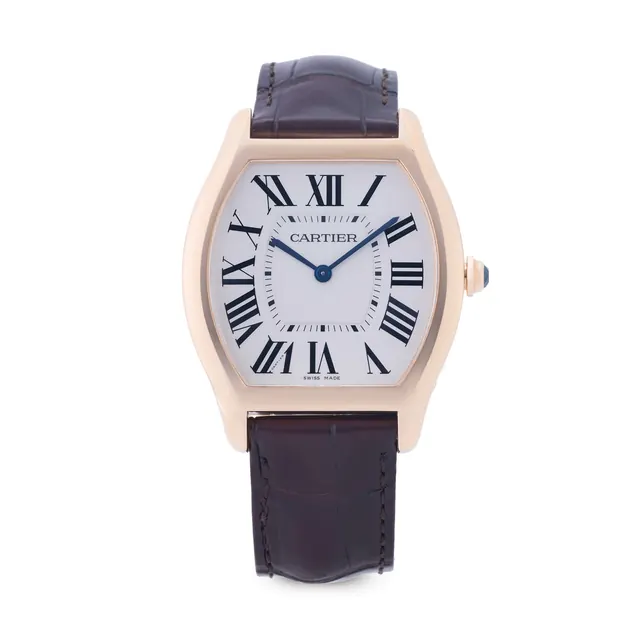
Cartier wristwatch, ref. WGTO0002, Tortue, originally sold in 2023
Antiquorum auction archive, Geneva
Wristwatches · c. 2020
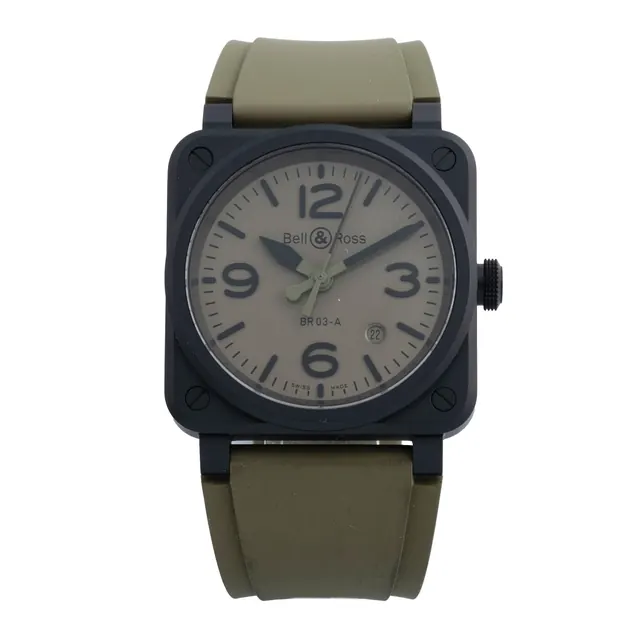
Bell & Ross wristwatch, ref. BR, Aviation Type, circa 2020
Antiquorum auction archive, Geneva