
Wristwatches · Wristwatch
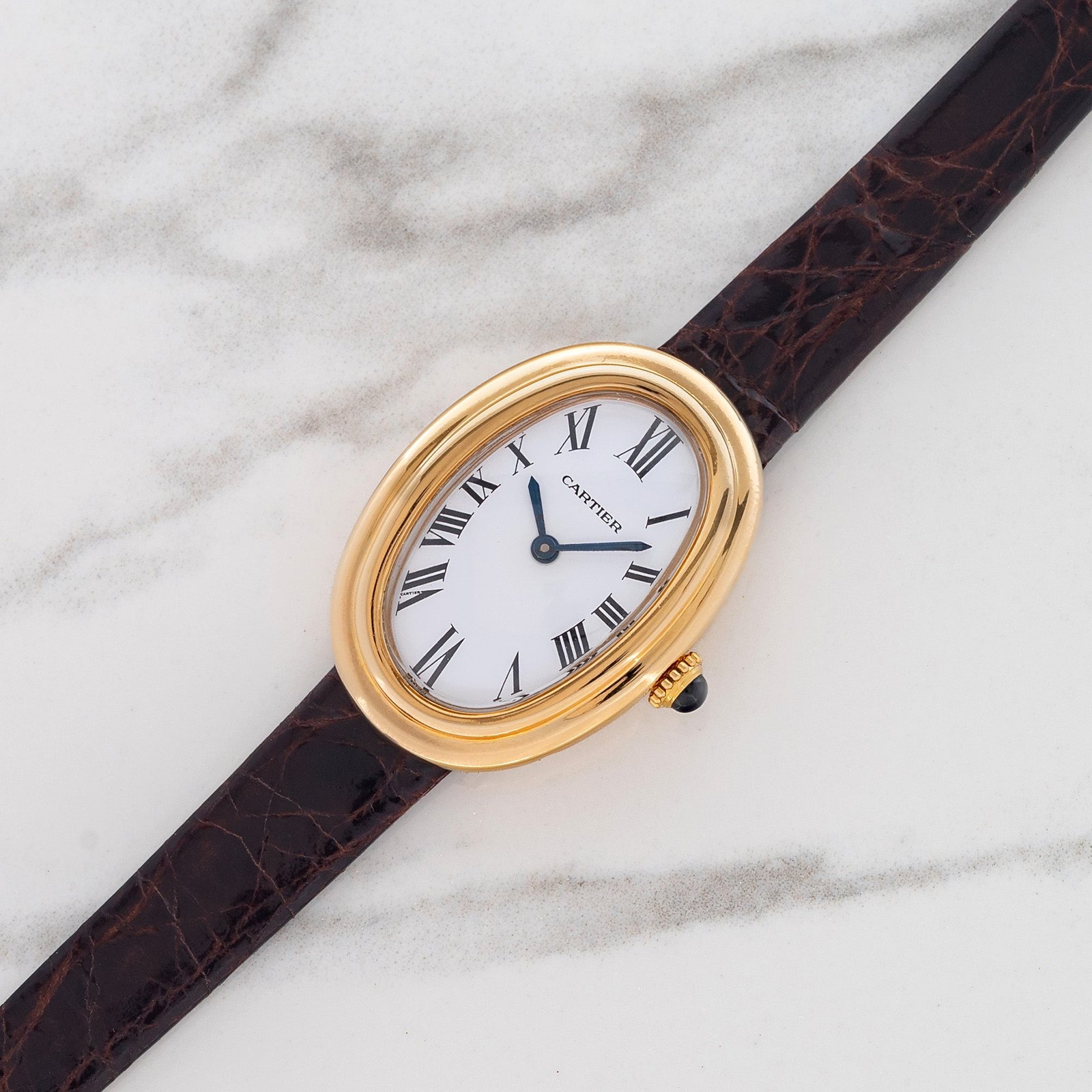
Cartier Baignoire 78094, Mechanical
- Maker / attribution
- Cartier (maker)
- Date
- c. 1970s
- Historical period
- Quartz Revolution (1969 – 1990)
- Country of origin
- France
- Object type
- Wristwatch
- Stock no.
- Product 10128019226900
- Credit line
- Dealer listing, Collectors Corner NY (product 10128019226900)
- Catalogue title (original)
- Cartier Baignoire 78094 - Mechanical (English)
View the source record (dealer listing) ↗ (opens another website in a new tab)Suggest a correction
Record summary
Catalogued by Collectors Corner NY (dealer), New York (stock number Product 10128019226900), this is a wristwatch by Cartier, made in France, dated c. 1970s. The Atlas places it in the Quartz Revolution period (1969 – 1990) of its Wristwatches collection. The record is illustrated with 6 photographs.
Assembled from the source record's structured fields. Dates and attributions are given as the source states them; where a field is missing the Atlas leaves it blank rather than estimating.
Catalogue description
Dealer description — Collectors Corner NY
Cartier's Baignoire (bathtub in French) was first created by Louis Cartier specifically for the Grand Duchess Pavlonva of Russia in 1912, pre-dating the Tank Louis. It wasn't till the '58 that the design was trademarked and later in '73 that Baignoire became its official model name. This unique and highly elegant oval shape was a bold departure from the mostly round case shapes of its time and remains one of Cartier's most beloved designs. Throughout the decades, Baignoire watches have been documented on the wrists of notable figures Jeanne Moreau to George Harrison, Tyler The Creator and many more. Today, Cartier feels more relevant in the worlds of fashion, music and popular culture than ever before. This particular example, circa 1970s is a very desirable mechanical version, easily identified by its "stepped" case. It has remained in stunning vintage condition with a highly well-preserved "Swiss" dial with hidden Cartier signature at 7 o-clock. It shows no crazing in its lacquer which is difficult to find in this era. The case is equally stunning with well defined stepped edges. All of the caseback markings remain clearly legible with deep, crisp hallmarks and a correct crown. For anyone looking for a top grade and unique case shape among Cartier watches , this Baignoire is fit for a collection of any level.
Historical context
Quartz Revolution (1969 – 1990)
Seiko's Astron begins mass quartz timekeeping; traditional industries contract sharply.
Quartz and digital watches transformed the market after 1969. Swiss employment collapsed, Japanese and Hong Kong production soared, and the Swatch (1983) helped the Swiss industry recover; mechanical watches survived as luxury goods.
Read the period in the timelineMore wristwatches from this periodEarlier: Modern Mechanical Horology
Atlas type guide
Wristwatches
Bracelet watches were worn by women from the early nineteenth century — Breguet made one for Caroline Murat, Queen of Naples, in 1810–12 — but the wristwatch only became a man's instrument with military use and aviation in the early twentieth century. Between the World Wars it overtook the pocket watch; the 1920s and 1930s brought rectangular Art Deco cases, water-resistant cases and the first automatic winding systems.
After 1945 the wristwatch became a carrier of identity — dress watches, sports and dive watches, chronographs, calendars — produced by Swiss, American, Japanese, German, Soviet and Chinese industries. The quartz revolution after 1969 and the mechanical renaissance since the 1990s, including the rise of independent watchmakers, complete the story.
What to look for
- The reference number (between the lugs or inside the case back) and serial number, the starting point for dating.
- The calibre: its maker and number are often stamped under the dial or on the bridge.
- Originality of dial, hands and crown — refinished ('redial') dials are common.
- Case material marks: 18K/750, 14K/585, stainless steel, gold-filled, plated.
Dating clues
- Wire-lug cases: before c. 1925.
- Water-resistant screw-down cases: from 1926.
- Quartz movements: from 1969; sapphire crystals widespread after c. 1980.
General guidance written by the Atlas editors about this kind of object. It is not a statement about this particular piece; for that, rely on the source record above and on physical examination.
Related records

Clocks · 1863
Clock by Albert-Ernest Carrier-Belleuse, France, 1863
The Metropolitan Museum of Art, New York

Clocks · c. 1980s
Cartier "art Deco", c. 1980s
Antiquorum auction archive, Geneva

Clocks · c. 2000s
Cartier Desk Clock with Alarm, c. 2000s
Antiquorum auction archive, Geneva

Clocks · c. 2000s
Cartier Lacquer Arched Desk Clock with Alarm, ref. W0100037, c. 2000s
Antiquorum auction archive, Geneva
Wristwatches · c.1989
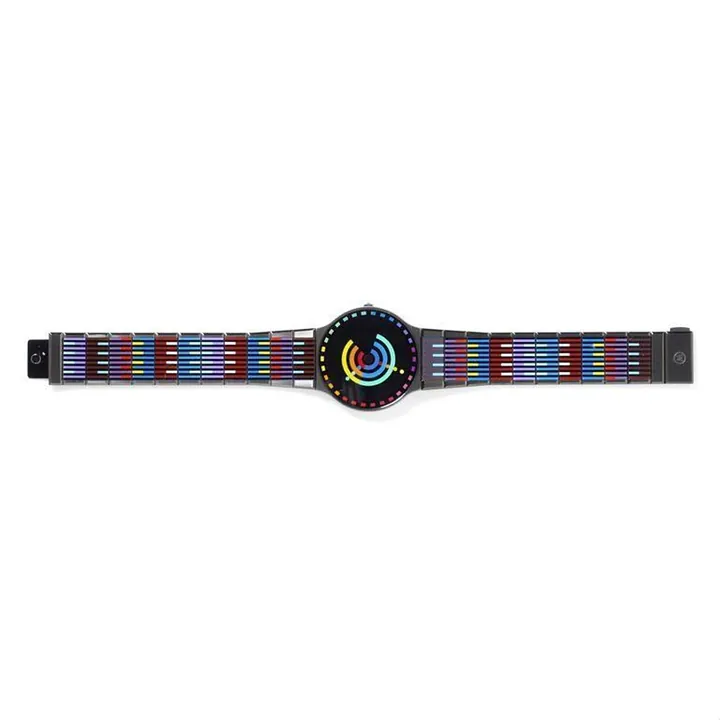
Steel, France and Switzerland, 1989; designed by Yaacov Agam (born 1928) for a limited edition by Movado
Victoria and Albert Museum, London
Wristwatches · c. 1972
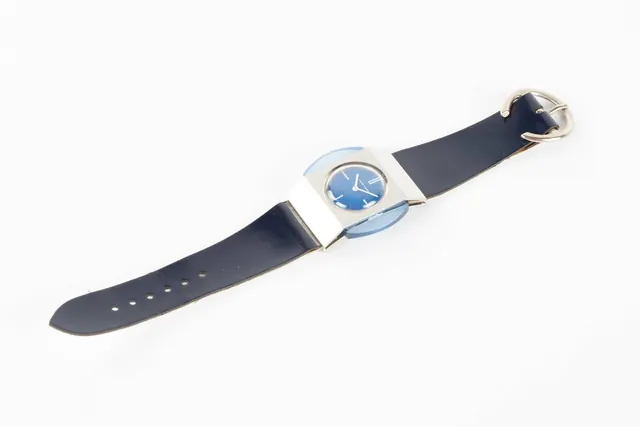
Wristwatch, France, c. 1972
German Clock Museum

Wristwatches · 1986
Wristwatch, France, 1986
Työväenmuseo Werstas
Wristwatches · c. 1970-1980s
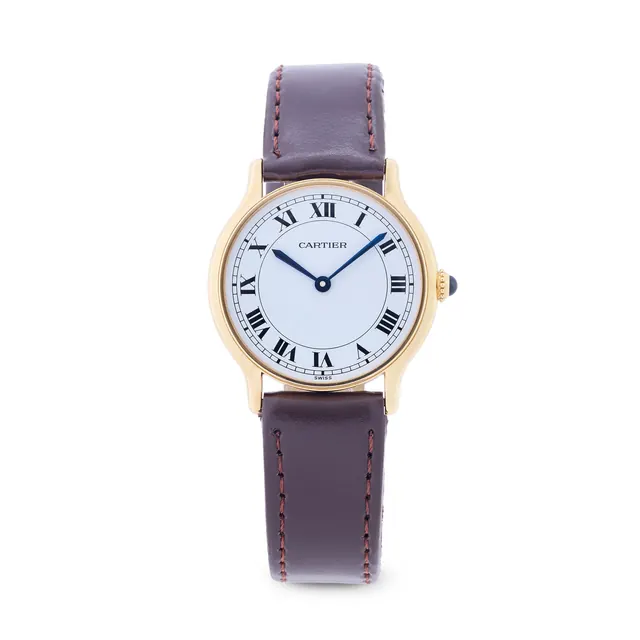
Cartier wristwatch, ref. 10713, Riviera, circa 1970-1980s
Antiquorum auction archive, Geneva