
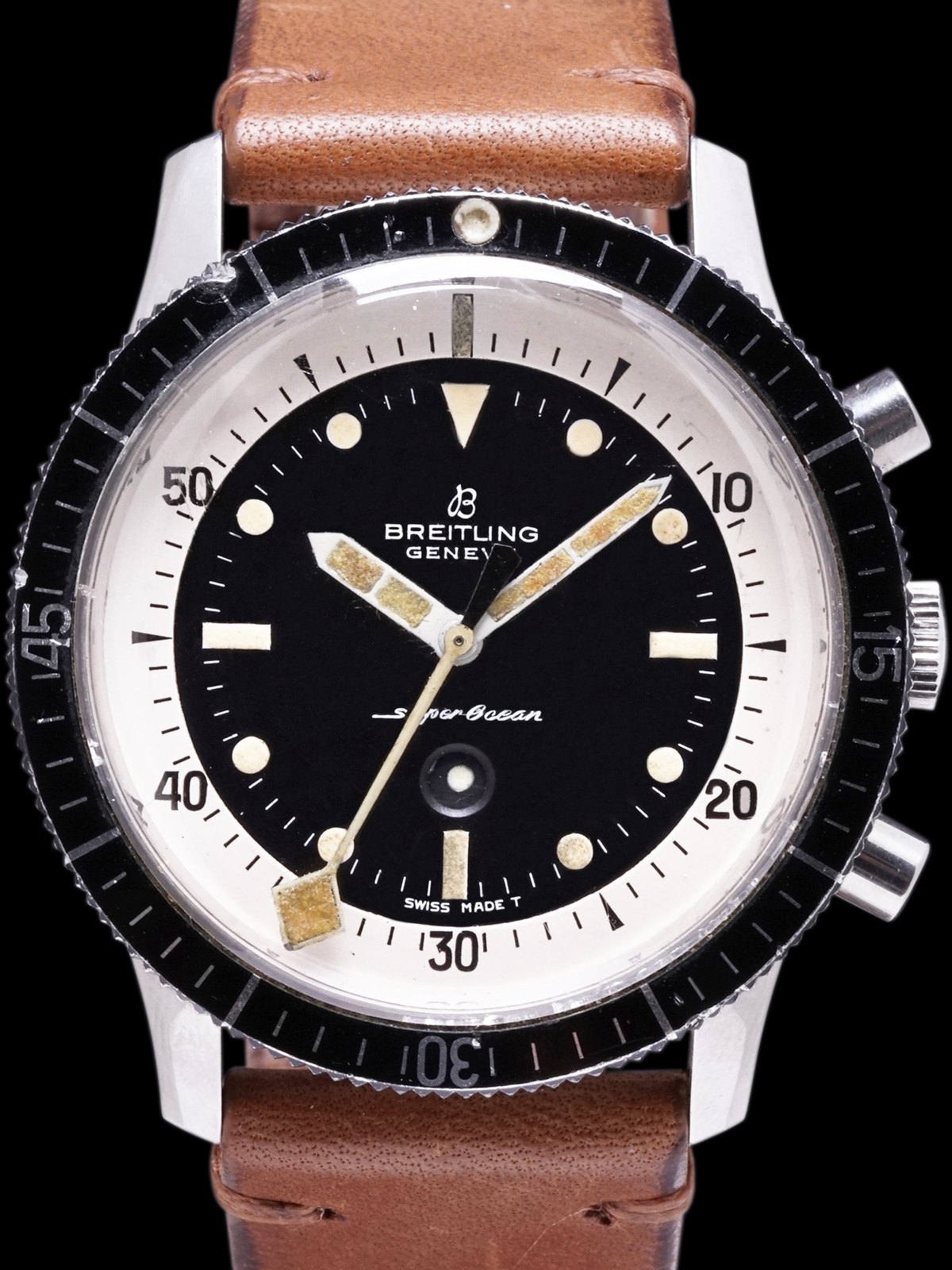
Wristwatches · Wristwatch
Breitling SuperOcean Chronograph (Ref. 2005) "Minute Creeper", 1965
- Maker / attribution
- Breitling (maker)
- Date
- 1965
- Historical period
- Modern Mechanical Horology (1945 – 1969)
- Country of origin
- Switzerland
- Object type
- Wristwatch
- Dimensions
- Case 42 mm
- Stock no.
- BRLSOMC2005
- Credit line
- Dealer listing, Craft & Tailored (BRLSOMC2005)
- Catalogue title (original)
- 1965 Breitling SuperOcean Chronograph (Ref. 2005) "Minute Creeper" (English)
View the source record (dealer listing) ↗ (opens another website in a new tab)Suggest a correction
Record summary
Catalogued by Craft & Tailored (dealer), Los Angeles (stock number BRLSOMC2005), this is a wristwatch by Breitling, made in Switzerland, dated 1965. The Atlas places it in the Modern Mechanical Horology period (1945 – 1969) of its Wristwatches collection. Recorded dimensions: Case 42 mm. The record is illustrated with 6 photographs.
Assembled from the source record's structured fields. Dates and attributions are given as the source states them; where a field is missing the Atlas leaves it blank rather than estimating.
Catalogue description
Dealer description — Craft & Tailored
Breitling, as you may already know, is a watch company that is better known for its aviation-based chronographs and not dive watches. However, Breitling did produce a limited offering of dive watches starting in the 1950s. Tool watches and more specifically, dive watches, need to be highly visible and practical. Breitling wanted to build a reliable diving chronograph, and in 1965 the result of this ambition was the SuperOcean reference 2005. Don't let the lack of the stereotypical chronograph subdials and hands fool you. This is a chronograph through and through and one of the most interesting watches to have ever come from Breitling. The nickname "minute creeper" or more commonly known as a “slow counter” chronograph is in direct reference to the ref. 2005’s unusual form of operating. The chronograph hand advances by the minute, instead of by the second, resulting in a much slower revolution of the center chronograph hand. That being said, this chronograph tracks time in an extremely legible way. Indicated by a large, luminous, diamond-shaped hand. The SuperOcean Ref. 2005 is powered by a Breitling modified high-grade Venus cal. 188 manual winding chronograph movement. Even more interestingly, due to the lack of constant motion in measuring minutes and not seconds, Breitling added another unusual feature. A chronograph function indicator, located in a circular window above the six o’clock marker. This function indicator acts as a visual complication that allows the wearer to tell whether the chronograph function is activated and in what mode of operation. When the chronograph is activated, the window shows a full luminous circular indication, and when the chronograph is paused, there is a smaller circular indication. Once the chronograph hand is reset, the indicator is entirely black again. The oversized 42mm case wears nicely while on the wrist. Since Breitling's main focus wasn't diving watches, the SuperOcen Ref. 2005's were produced in minimal numbers, making them extremely rare and hard to find. Additionally, finding one in good condition is an even harder task making them highly desirable. The black and white contrasting color of the dial paired with the unique hands really sets off the look of this unique and interesting chronograph! Stock # BRLSOMC2005 Brand Breitling Style Super-Ocean Chronograph Model 2005 Serial 105XXXX Size Men's Material Stainless Steel Dial Black Gloss Millimeters 42mm Strap 2pc Leather Strap CASE & BRACELET The case shows the original factory finishing and case chamfering believed to be unpolished. The pushers and crown are early, and original to the watch as most examples from 1965 possess a non-signed crown. The bezel remains black and shows a very light patina from light use. The Breitling SuperOcean engraved caseback, and reference numbers are deep and highly visible, further confirming the case's unpolished condition. The watch will come supplied on a handmade two-piece leather strap. DIAL & HANDS The highly visible "panda" like dial remains in wonderful vintage condition showing no scratches or blemishes. The matte black center portion of the dial paired with the bright white outer minute track is downright stunning. The chronograph function indicator located above the 6 o'clock marker remains in wonderful condition showing no lume degradation or discoloration when inspected under UV light. The lume plots on the dial remain fully intact and have achieved a warm patina. The hands appear to have been relumed on the surface in the past with tritium. We chose to leave the hands as finding replacements is nearly impossible, and it also adds to the watches' story and visual history. ACCESSORIES None. The watch is in perfect working order; previous service history is unknown.
Historical context
Modern Mechanical Horology (1945 – 1969)
Tool watches for divers, pilots and astronauts; electric watches anticipate the electronic age.
The classic era of the mechanical wristwatch: dive watches, chronographs for motor racing and space flight, GMT watches for jet travel, slim dress watches, automatic calendars, and the rise of Japanese manufacturers alongside Swiss, American, German and Soviet industries.
Read the period in the timelineMore wristwatches from this periodEarlier: Golden Age of Mechanical Watchmaking
Atlas type guide
Chronographs and split-seconds watches
A chronograph is a watch with an additional seconds hand that can be started, stopped and returned to zero independently of the timekeeping. Louis Moinet built an early example in 1816 and Nicolas Rieussec a recording 'chronographe' in 1821; Adolphe Nicole's heart-shaped reset cam (patented 1862) made the modern return-to-zero possible. Split-seconds (rattrapante) chronographs add a second hand that can be stopped for intermediate times; flyback chronographs restart instantly.
Chronographs were essential tools for doctors (pulsometer scales), artillery (telemeter), engineers and sport. In wristwatches, Valjoux, Venus, Lemania and later the automatic chronographs of 1969 (Zenith El Primero, the Chronomatic Calibre 11 group and Seiko 6139) are milestones.
What to look for
- Push-pieces on the case band or a single button in the crown (monopusher).
- Subsidiary registers for minutes and hours; tachymeter, telemeter or pulsometer scales.
- Column wheel versus cam control visible in the movement.
- Calibre markings of specialist makers (Valjoux, Lemania, Venus, Landeron).
Dating clues
- Pocket chronographs with heart cam reset: after 1862.
- Wrist chronographs: from c. 1910; two-button designs from the 1930s.
- Automatic chronographs: from 1969.
General guidance written by the Atlas editors about this kind of object. It is not a statement about this particular piece; for that, rely on the source record above and on physical examination.
Read next:Flyback chronographChronograph
Related records
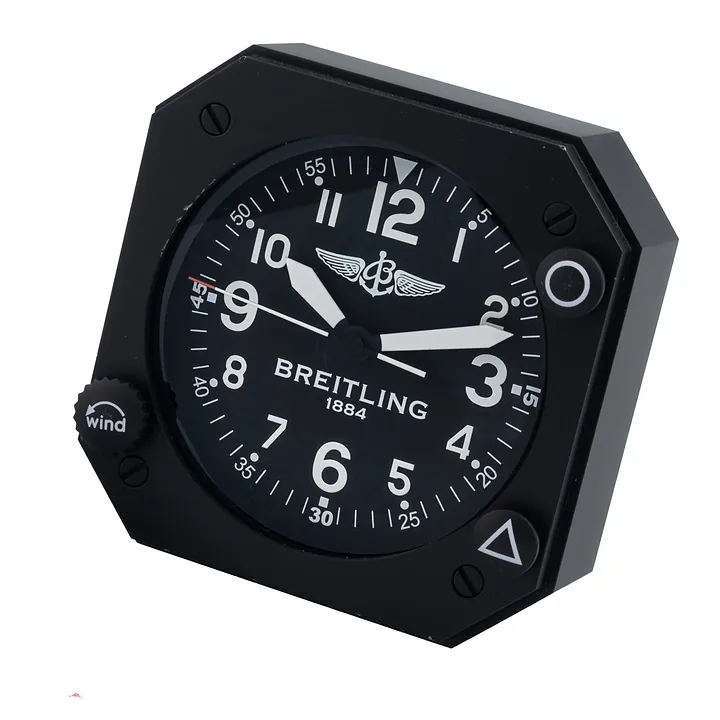
Clocks · c. 1990s
Breitling clock, c. 1990s (Antiquorum Lot 389-18)
Antiquorum auction archive, Geneva
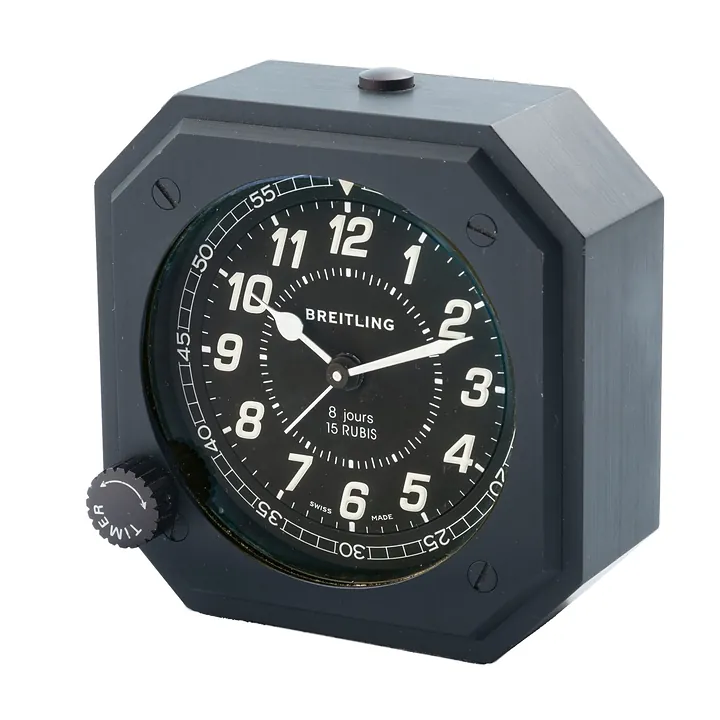
Clocks · c. 1990s
Breitling clock, c. 1990s (Antiquorum Lot 389-20)
Antiquorum auction archive, Geneva
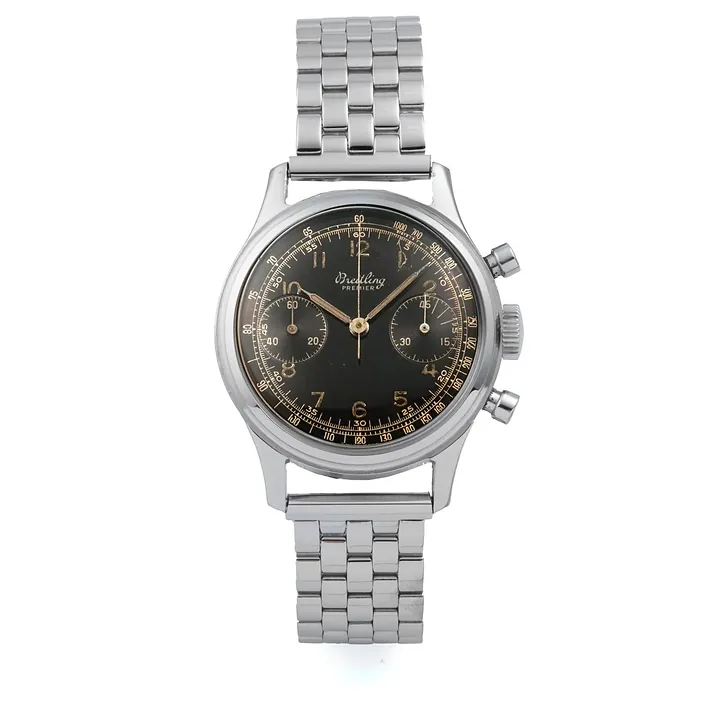
Wristwatches · c. 1940s
Breitling Premier, ref. 790, c. 1940s
Antiquorum auction archive, Geneva

Wristwatches · c. 1945
Breitling Premier, ref. 790, c. 1945
Antiquorum auction archive, Geneva

Wristwatches · 1945
Wristwatch by Eterna, 1945
Museum Rotterdam

Wristwatches · c. 1945
Universal Genève Uni-Compax, ref. 22492, c. 1945
Antiquorum auction archive, Geneva

Wristwatches · c. 1950s
Baume & Mercier wristwatch, c. 1950s
Antiquorum auction archive, Geneva
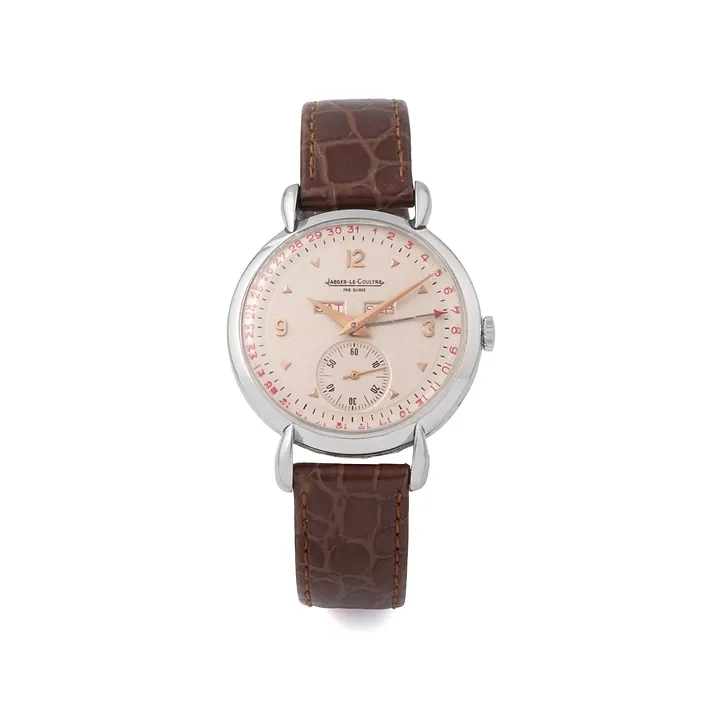
Wristwatches · c. 1950
Jaeger Lecoultre Triple Calendar, c. 1950
Antiquorum auction archive, Geneva