
Wristwatches · Wristwatch
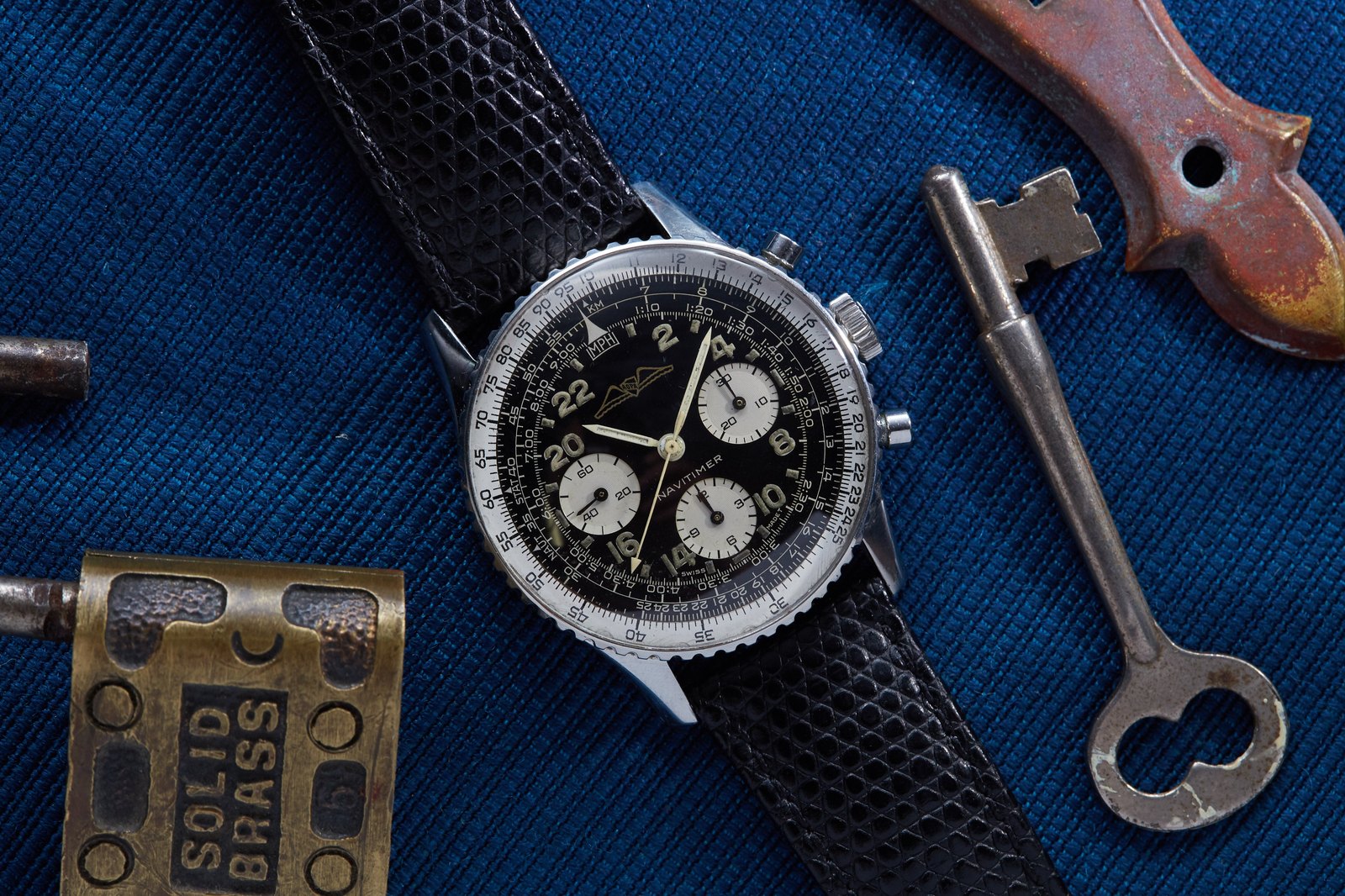
Breitling Navitimer Cosmonaute, c. 1965
- Maker / attribution
- Breitling (maker)
- Date
- c. 1965
- Historical period
- Modern Mechanical Horology (1945 – 1969)
- Country of origin
- Switzerland
- Object type
- Wristwatch
- Stock no.
- Product 1389195919447
- Credit line
- Dealer listing, Analog/Shift (product 1389195919447)
- Catalogue title (original)
- Breitling Navitimer Cosmonaute (English)
View the source record (dealer listing) ↗ (opens another website in a new tab)Suggest a correction
Record summary
Catalogued by Analog/Shift (dealer), New York (stock number Product 1389195919447), this is a wristwatch by Breitling, made in Switzerland, dated c. 1965. The Atlas places it in the Modern Mechanical Horology period (1945 – 1969) of its Wristwatches collection. The record is illustrated with 6 photographs.
Assembled from the source record's structured fields. Dates and attributions are given as the source states them; where a field is missing the Atlas leaves it blank rather than estimating.
Catalogue description
Dealer description — Analog/Shift
Why We Love it How many watches can you spot from a mile away? How many watches have come to singularly define their genre? Not too many. Not too many at all. The Breitling Cosmonaute is one of the most instantly recognizable models from the aviation-centric brand, in no small part due to because of it’s close resemblance to the Navitimer, with which it shares a case, movement, and most of its design elements. The main disparity between the Ref. 806 Navitimer and the Ref. 809 Navitimer Cosmonaute is in the latter's modified movement and dial - designed to convey time in a 24-Hour day, instead of 12. These special modifications were designed specifically for use in space. Breitling has been making Navitimers consistently since the 1950s, so we can’t say that vintage examples are a rare find. Yet while there are a lot of them out there, finding one in good condition is not an easy task. Most were not treated very well by their original owners and are now in a sad shape, which is an unfortunate fate for any watch, let alone one of the most iconic pieces ever made. Refinished dials run rampant, and calling the wear found on most dials “patina” is often a generous use of the term. Lucky for you, this example is an entirely untouched and well preserved example of the Ref. 809 that is worthy of a place of pride in your collection. Featuring an early AOPA signed dial (Aircraft Owners & Pilots Association), this 809 dates to approximately 1965. If you’re looking for a serious pilot's watch, the Navitimer Cosmonaute is a worthy consideration. This example just happens to be one of the best on the market, so if you’ve ever had any inclination to pick up a Cossie, this is the one to get! The Story When Breitling designed the Navitimer in the early 1950s, the concept of a civilian tool watch was a novel idea. Watch companies produced a few purpose-designed pieces for military use in the early 20th century, but most watches that were sold at retailers were designed with purely fashion in mind. In the 1950s and 1960s, the tool watch market exploded, fueled by the popularity of SCUBA diving and the growing interest in aviation. Breitling was one of the earliest manufactures to respond to the trend when they released the Navitimer in 1954. Most passers-by would refer to the Navitimer as a watch, but that’s not quite right. This is a wrist-worn navigational computer. The Navitimer’s most distinctive feature, the slide rule bezel, is used by pilots to calculate airspeed, ascent and decent rates, flight time, distance traveled, fuel consumption and even imperial to metric unit conversions. The Navitimer truly is a computer, and also happens to be one of the best damn looking watches out there. On the 24th May 1962, the Astronaut Scott Carpenter orbited the Earth three times in the Aurora 7 space capsule. Aiding him in his endeavours was a Breitling Navitimer Cosmonaute with 24-hour dial. The special design in place of the usual 12-hour denomination was suggested by the astronaut as it was not possible to distinguish between day and night when in orbit. As a result of this connection, collectors now refer to the reference 809 with 24-hour dial as the “Scott Carpenter” and is viewed as an attractive alternative to the Omega Speedmaster to acquire a manually wound chronograph with a connection to space travel.
Historical context
Modern Mechanical Horology (1945 – 1969)
Tool watches for divers, pilots and astronauts; electric watches anticipate the electronic age.
The classic era of the mechanical wristwatch: dive watches, chronographs for motor racing and space flight, GMT watches for jet travel, slim dress watches, automatic calendars, and the rise of Japanese manufacturers alongside Swiss, American, German and Soviet industries.
Read the period in the timelineMore wristwatches from this periodEarlier: Golden Age of Mechanical Watchmaking
Atlas type guide
Wristwatches
Bracelet watches were worn by women from the early nineteenth century — Breguet made one for Caroline Murat, Queen of Naples, in 1810–12 — but the wristwatch only became a man's instrument with military use and aviation in the early twentieth century. Between the World Wars it overtook the pocket watch; the 1920s and 1930s brought rectangular Art Deco cases, water-resistant cases and the first automatic winding systems.
After 1945 the wristwatch became a carrier of identity — dress watches, sports and dive watches, chronographs, calendars — produced by Swiss, American, Japanese, German, Soviet and Chinese industries. The quartz revolution after 1969 and the mechanical renaissance since the 1990s, including the rise of independent watchmakers, complete the story.
What to look for
- The reference number (between the lugs or inside the case back) and serial number, the starting point for dating.
- The calibre: its maker and number are often stamped under the dial or on the bridge.
- Originality of dial, hands and crown — refinished ('redial') dials are common.
- Case material marks: 18K/750, 14K/585, stainless steel, gold-filled, plated.
Dating clues
- Wire-lug cases: before c. 1925.
- Water-resistant screw-down cases: from 1926.
- Quartz movements: from 1969; sapphire crystals widespread after c. 1980.
General guidance written by the Atlas editors about this kind of object. It is not a statement about this particular piece; for that, rely on the source record above and on physical examination.
Related records
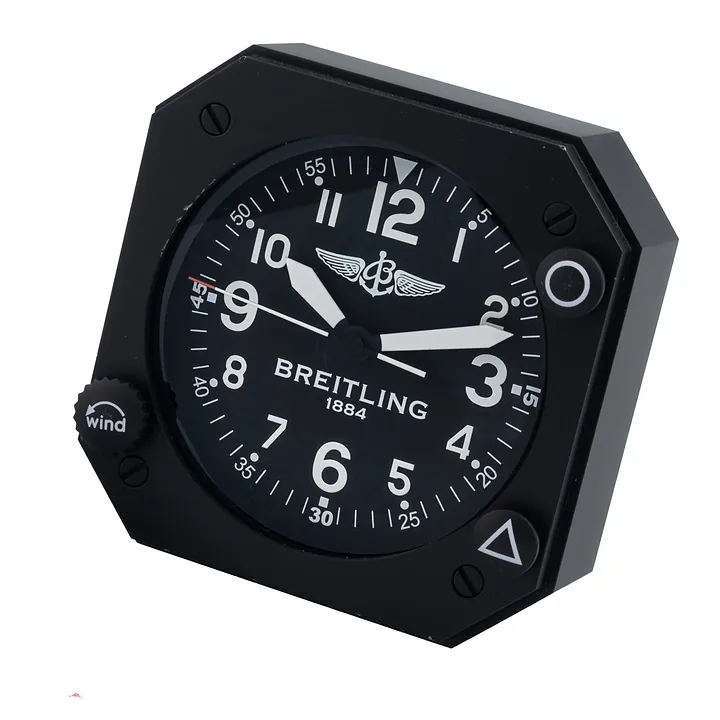
Clocks · c. 1990s
Breitling clock, c. 1990s (Antiquorum Lot 389-18)
Antiquorum auction archive, Geneva
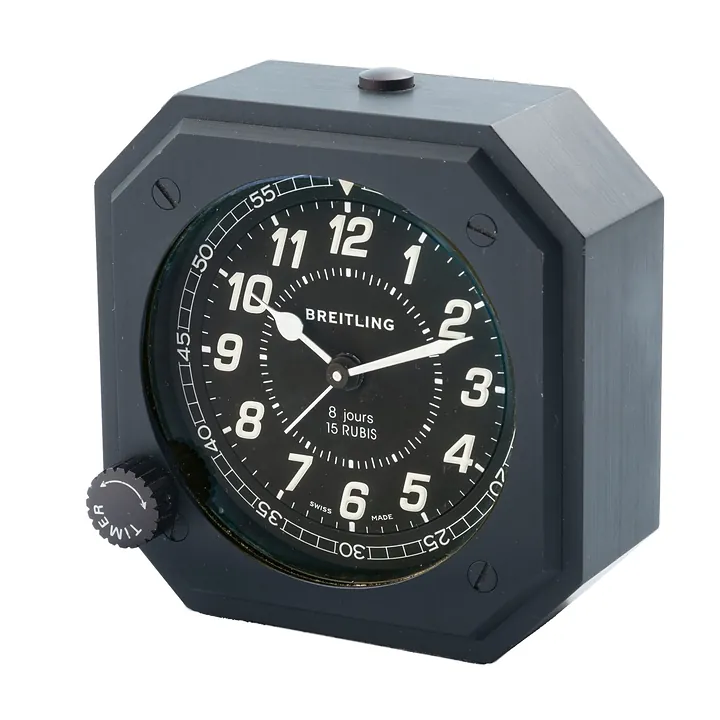
Clocks · c. 1990s
Breitling clock, c. 1990s (Antiquorum Lot 389-20)
Antiquorum auction archive, Geneva
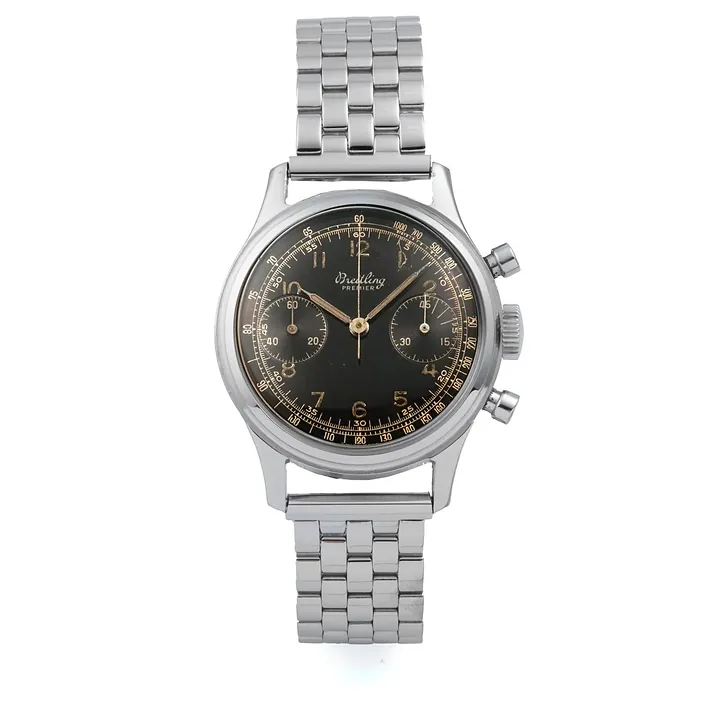
Wristwatches · c. 1940s
Breitling Premier, ref. 790, c. 1940s
Antiquorum auction archive, Geneva

Wristwatches · c. 1945
Breitling Premier, ref. 790, c. 1945
Antiquorum auction archive, Geneva

Wristwatches · 1945
Wristwatch by Eterna, 1945
Museum Rotterdam

Wristwatches · c. 1945
Universal Genève Uni-Compax, ref. 22492, c. 1945
Antiquorum auction archive, Geneva

Wristwatches · c. 1950s
Baume & Mercier wristwatch, c. 1950s
Antiquorum auction archive, Geneva
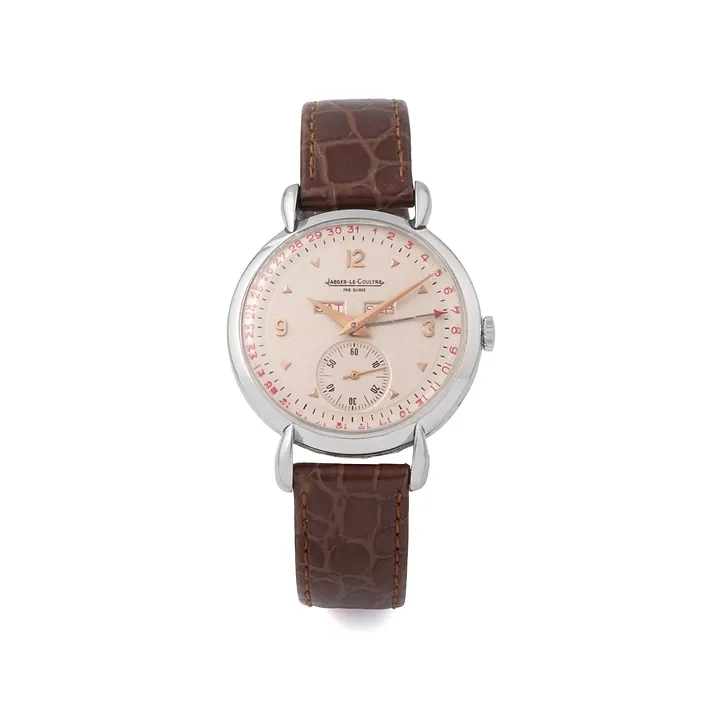
Wristwatches · c. 1950
Jaeger Lecoultre Triple Calendar, c. 1950
Antiquorum auction archive, Geneva