
Wristwatches · Wristwatch
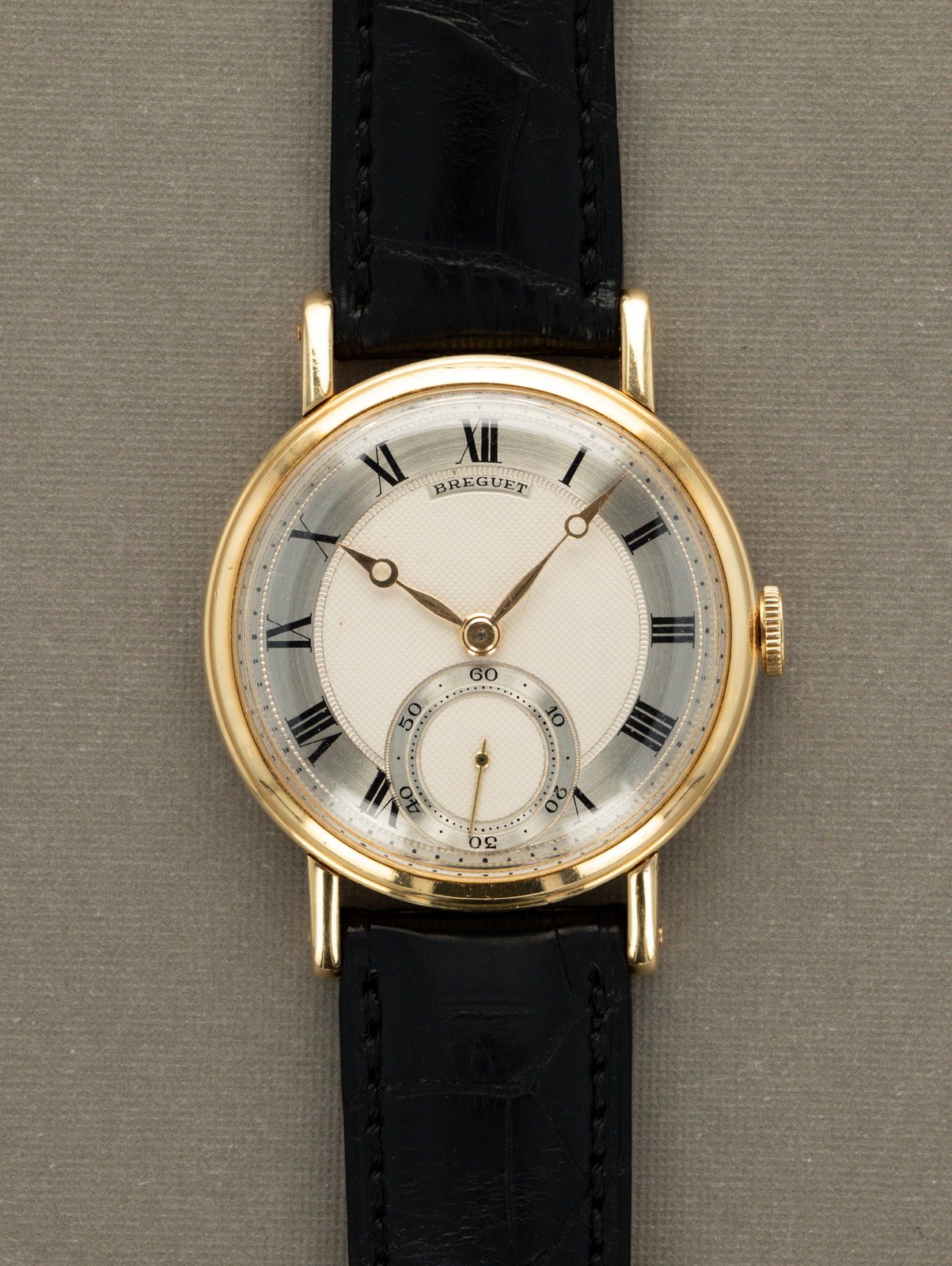
Breguet Empire 35mm
- Maker / attribution
- Breguet (maker)
- Date
- c. 1969
- Historical period
- Quartz Revolution (1969 – 1990)
- Country of origin
- France
- Object type
- Wristwatch
- Dimensions
- Case 35 mm
- Stock no.
- OC3338
- Credit line
- Dealer listing, Oliver & Clarke (OC3338)
- Catalogue title (original)
- Breguet Empire 35mm - Silver 'Guilloché' Dial w/ Peseux 260 & Extract (English)
View the source record (dealer listing) ↗ (opens another website in a new tab)Suggest a correction
Record summary
Catalogued by Oliver & Clarke (dealer), United Kingdom (stock number OC3338), this is a wristwatch by Breguet, made in France, dated c. 1969. The Atlas places it in the Quartz Revolution period (1969 – 1990) of its Wristwatches collection. Recorded dimensions: Case 35 mm. The record is illustrated with 6 photographs.
Assembled from the source record's structured fields. Dates and attributions are given as the source states them; where a field is missing the Atlas leaves it blank rather than estimating.
Catalogue description
Dealer description — Oliver & Clarke
Parisian manufacturer Breguet, named after its founder, Abraham-Louis Breguet, was founded in 1775 and is one of the most stored and historically significant manufacturers in the world of horology. With a number of firsts, including *ahem* what many consider to be the first known wristwatch, Breguet is primarily known today for its stunning silver 'guilloche' dials, innovations in complications, and outstanding build quality. The 35mm dress watch that we have here is something incredibly special and important. Called an 'Empire', it dates to circa 1969 and in addition to being rare in in its own right as all Breguet timepieces from this era are, it is both the condition of this particular example and the movement powering it that further adds to its horological significance. Coming in at the larger of two available sizes, 35mm in diameter, it features a very Breguet coin-edge case design with 'officer'-style lugs, and a snapback caseback, and a yellow gold crown. As with virtually all Breguet dress watches, the dial within is an absolute delight to behold, and this piece is no exception. Silver in color, it features a variety of guilloché finishing techniques, black printed indices, a subsidiary seconds register at the 6 o'clock position, and of course, a 'Breguet' handset executed in yellow gold. Simplicity executed on the highest level. The condition of this piece is exceptional. Seemingly spared of any previous polishing, it features strong factory finishing throughout, with clear hallmarks and engravings, and a beautifully preserved dial within — once again contributing to the attractiveness of this package. Last but not least, the movement inside. Designed specifically for Observatory chronometer competition trials to be as accurate as possible, the Peseux Cal. 260 is generally regarded as one of the finest time-only chronometer watch movements of the 20th century. It was produced for about 23 years with approximately 3,300 units made, and allegedly, never sold to the public. Instead, these were distributed to high-end brand such as Leroy, CYMA, and Breguet. Additionally, accompanying this piece is an extract from Breguet's archives confirming the original date of sale in 1969. We cannot overstate how special it is to be able to offer not only a stunning example of a rare and timeless watch, but one with supporting documentation like what we have here, and from one of the most prestigious brands on earth. How can you go wrong?
Historical context
Quartz Revolution (1969 – 1990)
Seiko's Astron begins mass quartz timekeeping; traditional industries contract sharply.
Quartz and digital watches transformed the market after 1969. Swiss employment collapsed, Japanese and Hong Kong production soared, and the Swatch (1983) helped the Swiss industry recover; mechanical watches survived as luxury goods.
Read the period in the timelineMore wristwatches from this periodEarlier: Modern Mechanical Horology
Atlas type guide
Wristwatches
Bracelet watches were worn by women from the early nineteenth century — Breguet made one for Caroline Murat, Queen of Naples, in 1810–12 — but the wristwatch only became a man's instrument with military use and aviation in the early twentieth century. Between the World Wars it overtook the pocket watch; the 1920s and 1930s brought rectangular Art Deco cases, water-resistant cases and the first automatic winding systems.
After 1945 the wristwatch became a carrier of identity — dress watches, sports and dive watches, chronographs, calendars — produced by Swiss, American, Japanese, German, Soviet and Chinese industries. The quartz revolution after 1969 and the mechanical renaissance since the 1990s, including the rise of independent watchmakers, complete the story.
What to look for
- The reference number (between the lugs or inside the case back) and serial number, the starting point for dating.
- The calibre: its maker and number are often stamped under the dial or on the bridge.
- Originality of dial, hands and crown — refinished ('redial') dials are common.
- Case material marks: 18K/750, 14K/585, stainless steel, gold-filled, plated.
Dating clues
- Wire-lug cases: before c. 1925.
- Water-resistant screw-down cases: from 1926.
- Quartz movements: from 1969; sapphire crystals widespread after c. 1980.
General guidance written by the Atlas editors about this kind of object. It is not a statement about this particular piece; for that, rely on the source record above and on physical examination.
Related records
Pocket Watches · 1700–1799
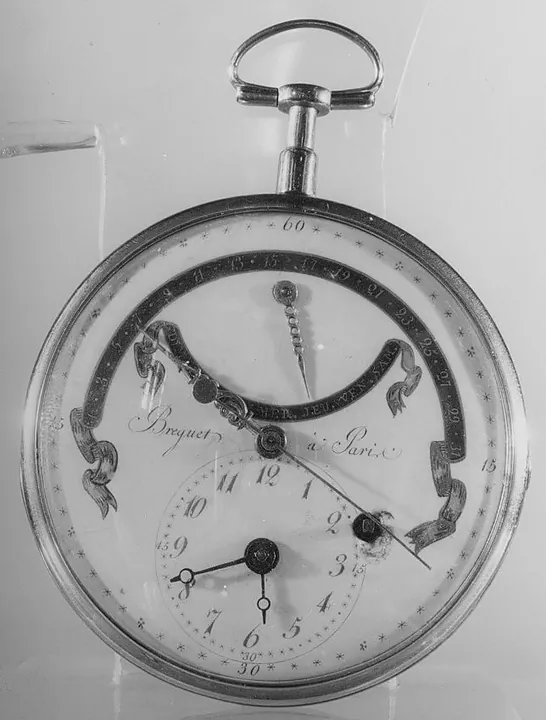
Pocket watch by Breguet, Belgium, 1700–1799
Royal Institute for Cultural Heritage
Pocket Watches · 1700–1799
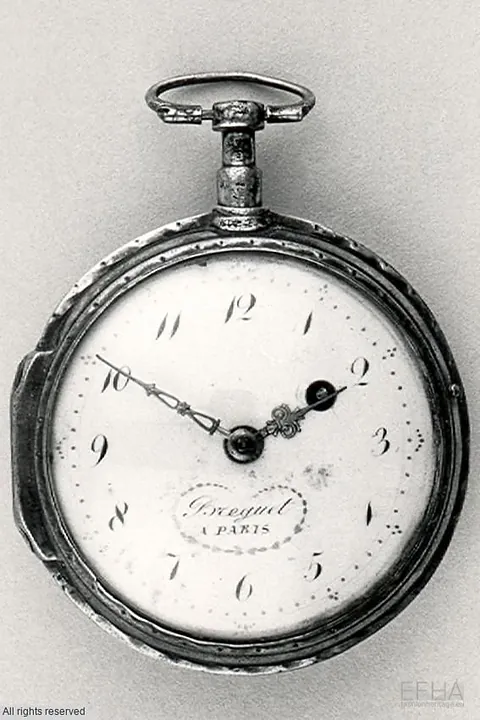
Pocket watch by Breguet, France, 1700–1799
Fashion Museum of Antwerp
Pocket Watches · c. 1790
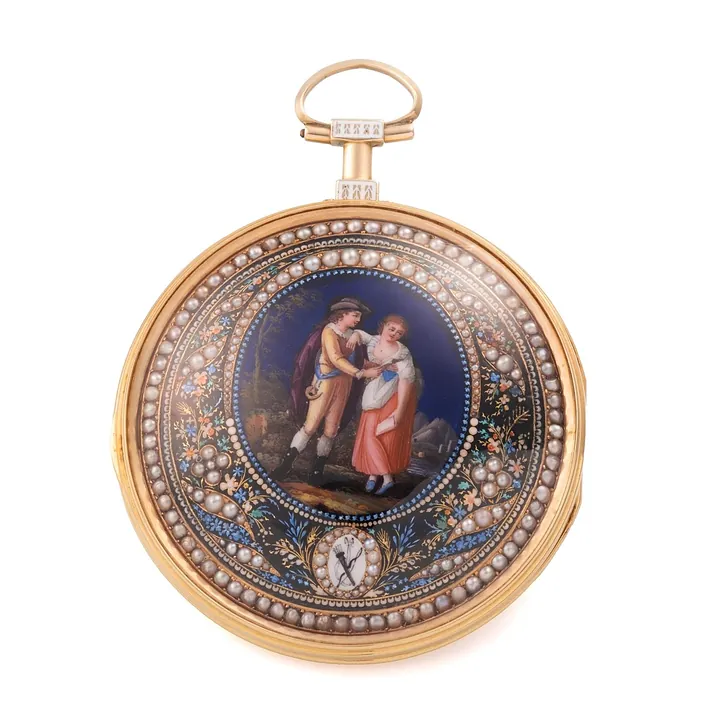
Breguet Love Letter, c. 1790
Antiquorum auction archive, Geneva
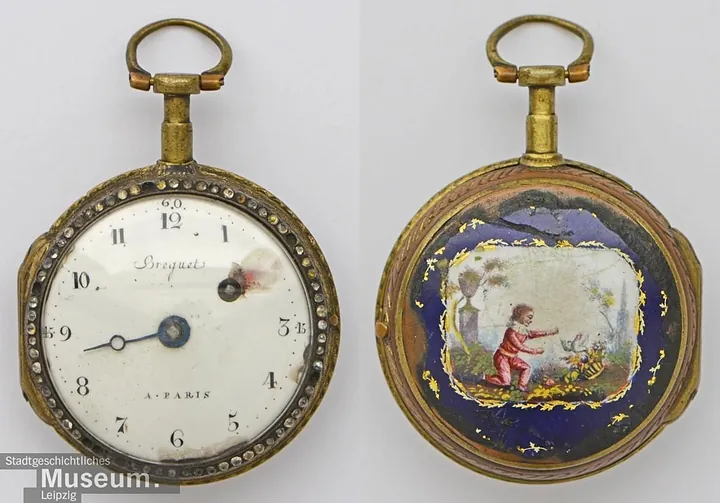
Pocket Watches · 1790
Pocket watch possibly by Breguet, France, 1790
Museum of City History Leipzig
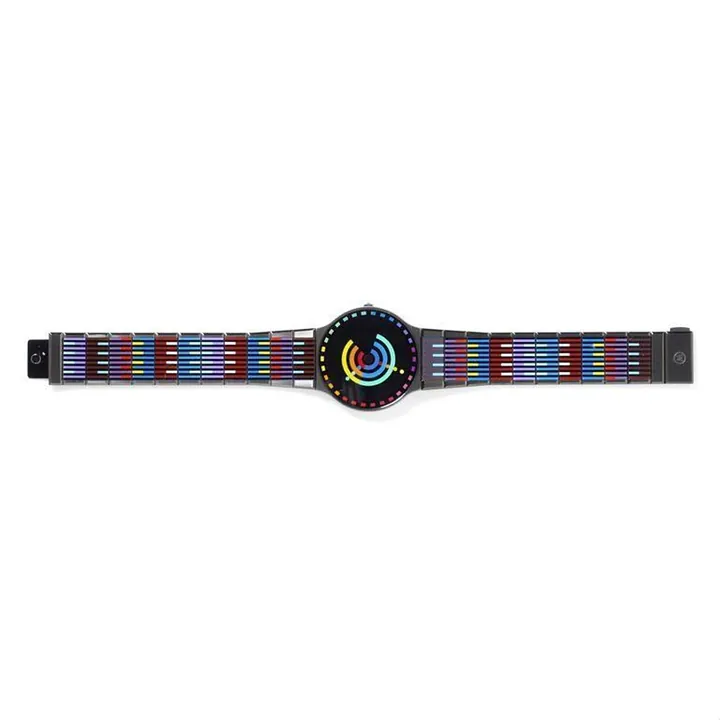
Wristwatches · c.1989
Steel, France and Switzerland, 1989; designed by Yaacov Agam (born 1928) for a limited edition by Movado
Victoria and Albert Museum, London
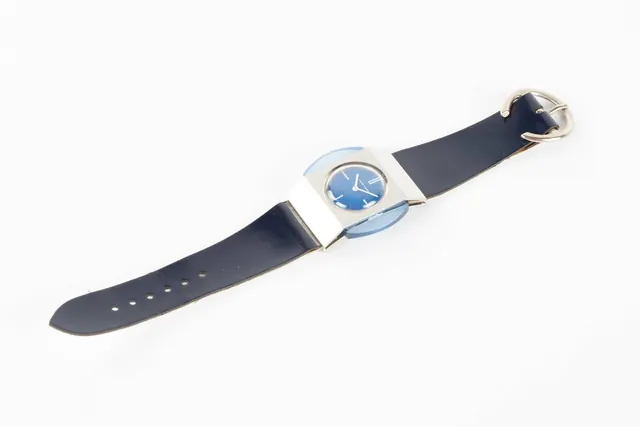
Wristwatches · c. 1972
Wristwatch, France, c. 1972
German Clock Museum
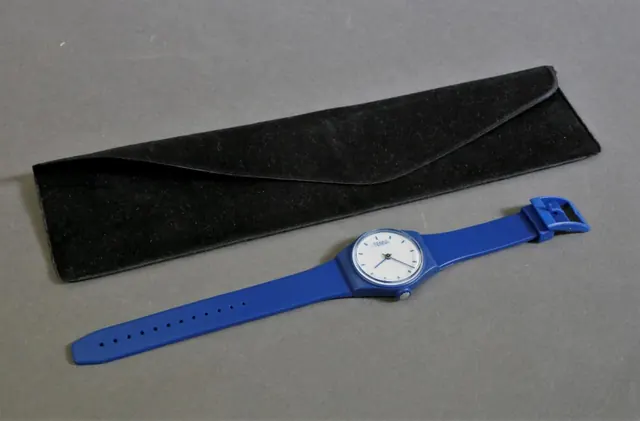
Wristwatches · 1986
Wristwatch, France, 1986
Työväenmuseo Werstas
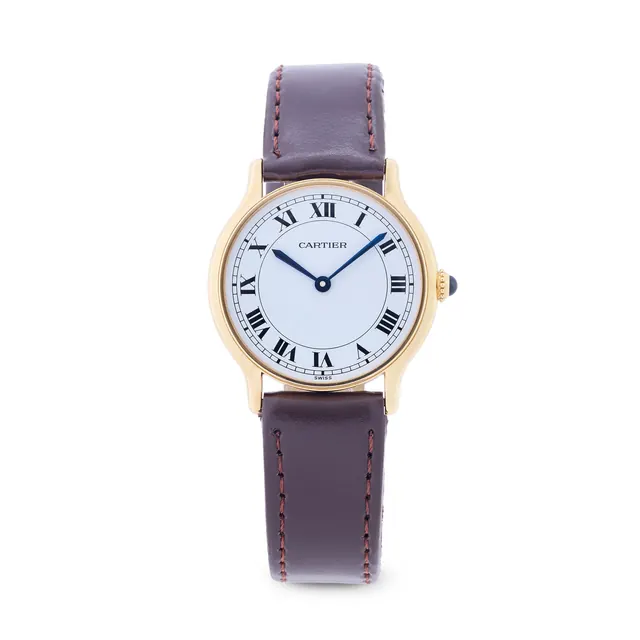
Wristwatches · c. 1970-1980s
Cartier wristwatch, ref. 10713, Riviera, circa 1970-1980s
Antiquorum auction archive, Geneva