Clocks · Clock
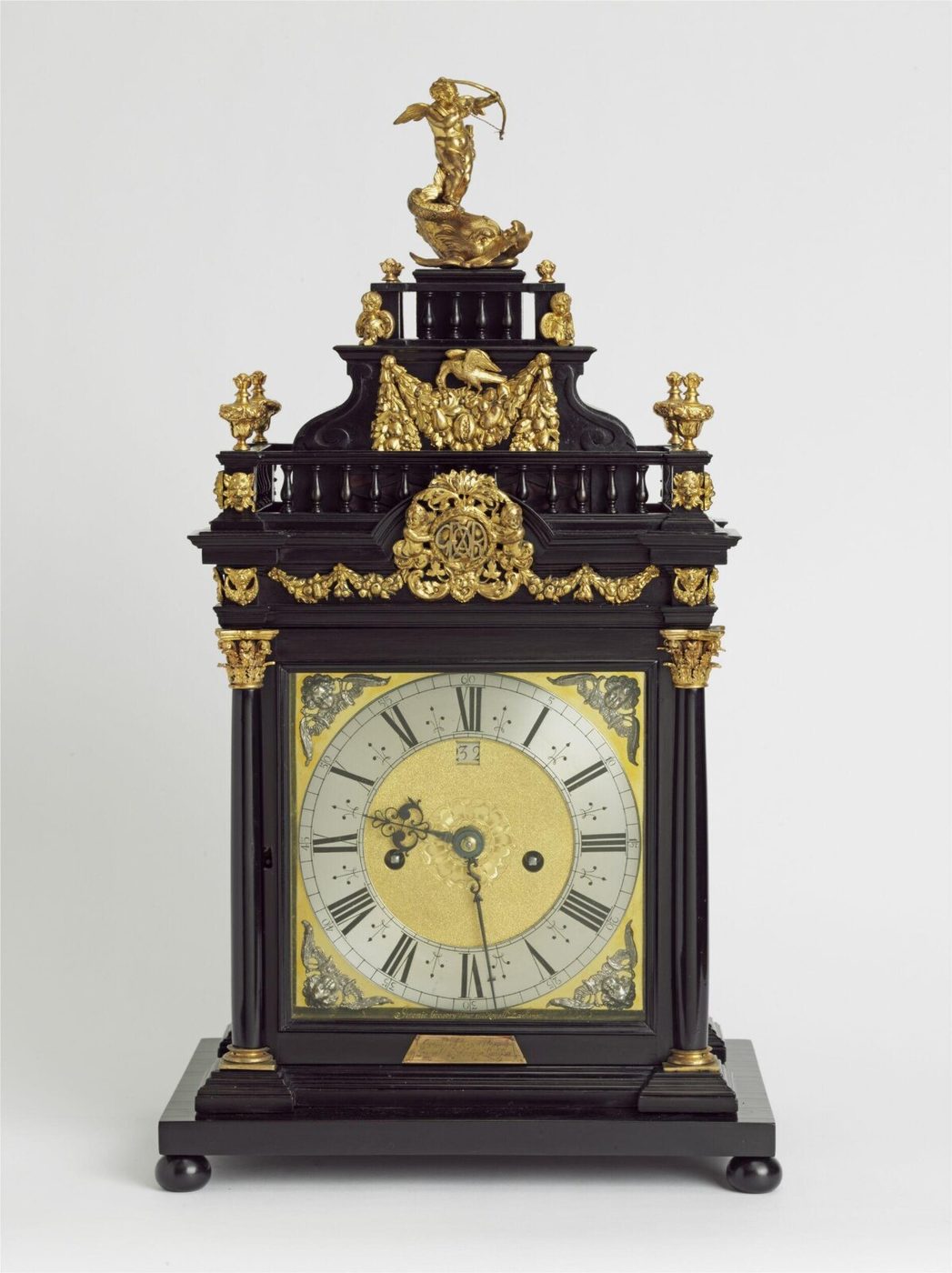
BRACKET CLOCK Ebony veneer on an oak carcase, with gilt bronze and glass London, Jeremie Gregory (worked 1652-1685); about 1685
- Maker / attribution
- Jeremie Gregory (made)
- Date
- c.1685
- Historical period
- Early Modern Horology (1600 – 1750)
- Country of origin
- England
- Place
- London
- Object type
- Clock
- Materials / technique
- Oak case veneered in ebony and decorated with turned ebony elements, and applied gilt-brass and silver mounts.
- Dimensions
- Height: 66 cm; Width: 37 cm; Depth: 25 cm; Height: 12 cm (of Cupid group); Width: 7 cm (of Cupid group); Depth: 5 cm (of Cupid group)
- Holding institution
- Victoria and Albert Museum, London
- Accession / object no.
- W.35-1976
- Credit line
- Purchased with the assistance of the Brigadier Clark Fund and an anonymous donor through The Art Fund
Record summary
Held and catalogued by Victoria and Albert Museum, London (object number W.35-1976), this is a clock by Jeremie Gregory, made in London, England, dated c.1685. The Atlas places it in the Early Modern Horology period (1600 – 1750) of its Clocks collection. Materials and techniques recorded by the source: Oak case veneered in ebony and decorated with turned ebony elements, and applied gilt-brass and silver mounts. Recorded dimensions: Height: 66 cm; Width: 37 cm; Depth: 25 cm; Height: 12 cm (of Cupid group); Width: 7 cm (of Cupid group); Depth: 5 cm (of Cupid group). The record is illustrated with 4 photographs.
Assembled from the source record's structured fields. Dates and attributions are given as the source states them; where a field is missing the Atlas leaves it blank rather than estimating.
Catalogue description
V&A — Summary
The impact of this impressive clock is made by the towering architectural cresting embellished with extremely fine gilt-brass mounts, and surmounted by a cast and gilt figure of Cupid riding on a stylised dolpin and firing his bow. The brightness of the gilding contrasts with the black, ebony-veneered structure of the clock case. Only a few clocks and watches known are known to be made by the clockmaker Jeremie (sometimes spelt Jeremiah) Gregory, who was trained as a goldsmith. He was Master of the Worshipful Company of Clockmakers for four years. This clock is said to have been acquired by the Royal Collection during the reign of George I, and it seems likely that at that time, several of the mounts were replaced and added. The cipher above the clock face reads: ‘GEO:REX:D:G:A’. MEANING ‘George, by the Grace of God, King of England’.
V&A — Physical description
Summary description A large bracket clock in solid oak and veneered in ebony decorated with gilt brass mounts and surmounted by a figure of Cupid standing on the back of a dolphin. The clock is architectural in form with two tiers of balustrading and is decorated on all four sides. Above the clock face is a cartouche enclosing a royal cypher. Decorative scheme The rectangular clock case, glazed on all four sides, is articulated by four Corinthian columns with gilt brass capitals and bases, outset at the corners, and stands on a plain rectangular plinth raised on four ball feet. The dial has an engraved rose in the centre, a silvered dial ring and silver winged cherubs in the spandrels. The lacquered brass back plate of the clock movement is finely engraved with tulips arising from a Neoclassical urn. The clock has an elaborate superstructure comprising four tiers of finely cast gilt-brass mounts set against an ebony background, surmounted by a cast bronze or brass group of a naked and winged Cupid, blindfolded and holding a bow in his outstretched arm, standing on the back of stylised dolphin. The columns are surmounted by an entablature comprising a small cornice, a frieze, and a larger arched cornice, each cornice with outset corners. The frieze is decorated with gilt-brass swags of fruit, and with a small swagged lion mask at each end, above the columns. On the front and back of the clock, the swags are centred on a circular medallion, which is enclosed in a laurel wreath, supported by cherubs, with an acanthus cresting, a mask below and swags of fruit and leaves on either side. Within the cartouche is a royal cipher which appears to relate to King George I, but which is evidently a later addition of uncertain date. The entablature is surmounted by a balustrade, framed by outset plinths at the corners and moulded rails above and below. The outer faces of the plinths have applied gilt-brass grotesque masks, possibly 'green men' with horns, pointed ears and sprouting leaves. Each plinth supports an urn decorated with leaves and flowers and surmounted by a leaf finial. Behind the balustrade is a platform with voluted sides, and with a gilt-brass relief on the front and back faces comprising a swag of leaves and fruit, with pears, grapes and a central pomegranate. A bird stands on the top of the swag pecking at a piece of fruit. This platform supports a second, smaller plinth, enclosed by a second, narrower balustrade formed of turned ebony balusters, the small corner plinths embellished with winged cherubs and supporting leaf finials. On the plinth stands the figurative group. Structure and materials The structure of the clock case is oak painted black inside and veneered in ebony on the outside. All the turned parts, such as the corner columns and small balusters, are in solid ebony. There appears to be a surface coating possibly of dark-coloured wax to deepen the colour of the ebony, which is rubbing off in places revealing the marginally lighter wood underneath. The columns are each rebated on their inside back edge to fit around the square corners of the case. The clock case rotates on a plinth veneered in ebony. The figure of cupid on a dolphin was made in two parts, soldered together at the feet and the dolphin's tail. The internal iron armature can be glimpsed where a section of wing is slightly broken. A wooden peg is fitted into the bottom of the dolphin for attaching it to the clock case. Repairs, alterations and problems Ronald Lee, the antique dealer who sold the clock to the Museum, listed his repairs. The plinth forming the turntable was a modern replacement copied from a contemporary example. Some of the mouldings and balustrades were replaced where damaged. The applied ebony scrolls either side of the bird mount had been replaced. One winged cherub metal mount, the small finials on the top gallery and the vase finials were replaced. New hour and minute hands in blued steel were fitted and the movement was reconverted from an anchor escapement to verge. Ronald Lee, the major clock dealer in Britain of the 20th century, often extensively repaired and improved his clocks. Close examination and discussion of the clock in preparation for display in 2012 have raised various issues. Any alterations were done with expertise and skill, possibly suggesting that they were carried out relatively late, in the 20th century, when expertise was available. Many of the mounts may be later replacements or additions. Firstly it is unusual for the back of a clock to be fitted with mounts. The fruit swag on the back of the clock differs in detail from that on the front and is not such high quality, so may be a later addition. The mounts themselves vary widely in quality; the Corinthian capitals are very high quality, and are evidently original. There is a small group of clocks of this date with very similar gilt brass capitals. However there are no parallels with the mounts applied to the sides of the small corner pedestals, and the grotesque masks applied there are poorly chased, suggesting that they may be later additions. Cupid's bow is evidently a replacement as it is rather crudely made and is without an arrow. The engraved name plate attached to the front of the case is unusual for its date and could have been moved from another clock. Analysis shows that the brass used for the name plate is 20% zinc to 80% copper, a ratio usually associated with 19th century brass, and it is not gilded as are all the other mounts. The clock case itself looks authentically 17th century, (except for alterations to the superstructure mentioned by Ronald Lee), but has cuts and niches inside which are not explained by the current arrangement of the movement. The hinges of the door at the back have been renewed. Much of the superstructure looks very fresh, so perhaps this was replaced or even augmented to make the clock more impressive. The underside of the case has holes in the four corners, presumably for…
V&A — Historical context
Clocks of these dimensions were called 'table clocks' in the 17th century, but in the 18th century became known as bracket clocks, in reference to the wall brackets on which they were sometimes placed. This has become the accepted term. A more modest bracket clock with a backplate engraved with tulips similar to the V&A clock, and inscribed 'Jeremie Gregory near ye Royall Exchang [sic] London' was sold at Sotheby's, London, on 28th April 2010, lot 688. The V&A also has a watch made by Gregory in the Metalwork collection. It has a silver case engraved on the face 'Gregorye London', and dates from 1660-1670 (M.96-1912).
V&A — Object history
The clock-maker, watch-maker and goldsmith Jeremie Gregory (1621-1686) was born in London and apprenticed in the Goldsmith's Company in 1638 to Jeremy East, brother to the leading clockmaker Edward East. He was Master of the Clockmakers' Company in 1665, 1666, 1667 and again in 1676 and died a wealthy man. Between 1647 and 1680 he had up to five apprentices at any one time, as recorded in the Clockmakers Company records. Several Freemen of the company complained that he employed foreigners, such as Jacob Renon in 1655 and Jacques Patte from Geneva. Little is recorded about his career, and very few clocks or watches signed by Gregory are known. Those that are signed by him bear variants of his first name, 'Jeremie', 'Jeremiah' or 'Jerimie'. His grandson, also Jeremiah Gregory, was also a clockmaker, apprenticed in 1686 and made a freeman of the Clockmakers' Company in 1694. No clocks by the younger Gregory are recorded. Complex clocks such as this are the product of many different workshops, involving up to fifty craftsmen, and would have taken about six months to make. The wooden carcase was probably made in a specialist workshop, and the mounts supplied by small specialist workshops. Jeremie Gregory's premises are given on this clock as 'Near ye royall Exchange'. The Royal Exchange, a centre of commerce for the City of London, was positioned between Cornhill and Threadneedle Street. A later building on the same site, still known as the Royal Exchange, is now used as a shopping centre. Gregory is also recorded as working in Cornhill in 1662, and in 1663 as a 'watchmaker near the Castle Tavern in Cornhill' (B. Loomes, Early Clockmakers, 1981). The original owner and later provenance of this exceptionally fine clock are not known prior to its purchase by the V&A in 1976. The royal cipher, which is evidently a later addition and has not yet been dated, could relate to George I (reigned 1714-1727) but this does not imply that the clock was at one time in the royal collection. The turned ebony columns with gilt-brass corinthian capitals are found on a small group of contemporary clocks by makers such Ahasuerus Fromanteel and Edward East. The Corinthian capital mounts for this group were probably supplied by the same workshop. The cast gilt-bronze Cupid on a Dolphin mount follows a model designed by made by the Italian sculptor Francesco Fanelli (born in Florence 1577, died about 1661). Fanelli worked at the court of Charles I from about 1635, The model exists in other forms, such as a statuette in the V&A (Museum number A.103-1910, 12.5 cm high), which is attributed to Fanelli himself. The Cupid group on the clock is unusually finely finished. It was probably made after Fanelli's death; possibly his English workshop continued in business after he left the country. It is probable that it was made by Fanelli's third son, Giovanni Battista Fanelli, (1605- after 1663) who is recorded as receiving a pension from Charles II in London in 1663 (Wengraf 2004). Cupid, the Roman god of love, is traditionally shown riding on a dolphin, the attribute of his mother, Venus, who was born from the sea.
V&A — Production note
Clock inscribed both 'Jeremie Gregory' and 'Jeremiah Gregory', presumably alternative spellings
V&A gallery label
Bracket Clock English; about 1685 London, Jeremie Gregory (active from 1652, died 1685) Ebony solid and veneer, oak carcase, gilt bronze, and glass. W.35-1976 Purchased by the Brigadier Clark Fund, with an anonymous contribution, both through the National Arts Collection Fund. This clock is said to have been acquired by the Royal Collection during the reign of George I, and it seems likely that at that time, several of the mounts were replaced and added. The cipher, above the clock face, reads GEO : REX : D : G : A which reads for George, by the Grace of God, King of England. The works and movement were produced by Gregory who was Master of the Clockmakers Company in 1665 and again in 1676. The quality of the workmanship is shown by the use of ebony veneers and solids for the case. Ebony was imported from the island of Madagascar and other southern African regions. Because of its exotic nature, its colour was often imitated by other woods, such as ebonized pearwood.
V&A gallery label
Clock About 1670, with some later alterations Signed by Jeremie Gregory (1621–86) England (London) Case: oak with ebony veneers and turned elements, and glass Movement: silver mounts and engraved brass plates Mounts: gilded brass Purchased with the assistance of the Brigadier Clark Fund and an anonymous donor through the Art Fund Museum no. W.35-1976 The most expensive element of this luxury clock was not the spectacular mounts but the complex movement made in the workshop of Jeremie Gregory. Although Gregory was a goldsmith as well as a clockmaker, he probably bought stocks of the various types of mount from specialist makers. The veneered and glazed case would have been sub-contracted to a cabinet-maker.
Inscriptions & marks
Jeremiah Gregory Near Ye Royall Exchange London; Jeremie Gregory Near The Royall Exchange; GEO D G REX A[?]
Historical context
Early Modern Horology (1600 – 1750)
Huygens' pendulum and balance spring transform accuracy; English makers develop the anchor and deadbeat escapements.
Huygens's pendulum (1656–57) improved clock accuracy from about a quarter of an hour to under a minute a day. The anchor escapement (c. 1670) and the long seconds pendulum created the longcase clock; London makers such as Fromanteel, Knibb, Tompion and Quare led European clockmaking, and French makers created the Boulle pendule.
Read the period in the timelineMore clocks from this periodEarlier: Renaissance Horology
Atlas type guide
Bracket, table and spring-driven clocks
Spring-driven clocks freed timekeeping from the hanging weight. The coiled mainspring, documented from the fifteenth century, made portable table clocks possible; to even out its declining force, makers used the fusee, a conical pulley connected to the barrel by a gut line or chain. Renaissance table clocks from Augsburg and Nuremberg — drum-shaped, square or tower-shaped in gilt brass — were luxury scientific objects, often with astronomical dials and alarms.
After the pendulum, English makers developed the bracket clock: a wooden case with a carrying handle, a short pendulum with a verge escapement, and often repeating work to sound the hours on demand at night. Later examples use the anchor escapement. In the nineteenth century, 'table clock' became a broad term for spring clocks of every nationality.
What to look for
- A fusee in the movement (cone-shaped pulley) and the type of line — gut or chain.
- Verge escapement with a short bob pendulum, often with a decoratively engraved backplate.
- Repeat cords or buttons that make the clock strike again on demand.
- Gilt-brass engraved cases and horizontal dials on Renaissance pieces.
- Case shapes: inverted bell, bell top, break-arch, lancet or balloon.
Dating clues
- Drum and tower table clocks: c. 1520–1650.
- Ebony veneered English bracket clocks with verge escapements: c. 1670–1800.
- Engraved backplates were usual on English clocks until c. 1800, then generally plain.
General guidance written by the Atlas editors about this kind of object. It is not a statement about this particular piece; for that, rely on the source record above and on physical examination.
Read next:Fusee
Related records
Clocks · 1598-1603
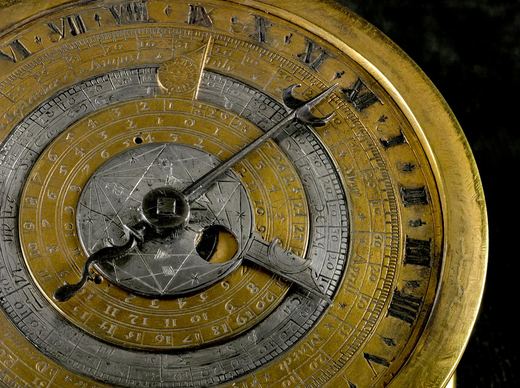
Circular table-clock with calendrical and lunar indications made by Nicholas Vallin in London between 1598 and 1603.
Science Museum Group, London
Clocks · 1611
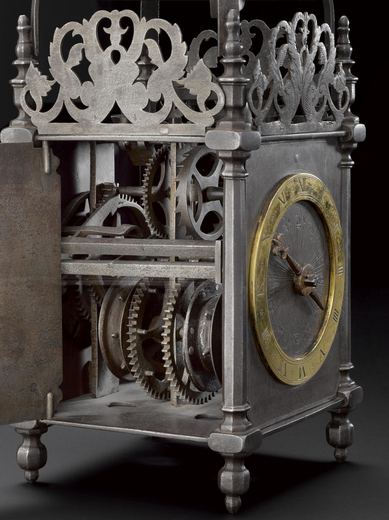
English iron lantern clock, with wheel balance, by John Holloway, Market Lavington, Wiltshire, England, 1611.
Science Museum Group, London
Clocks · 1630
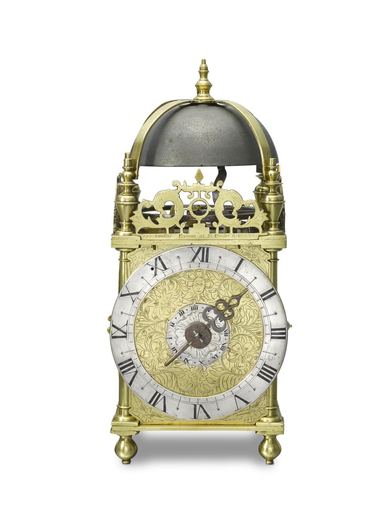
Lantern clock by Forman, Francis, England, 1630
Science Museum Group, London
Clocks · 1632-1640
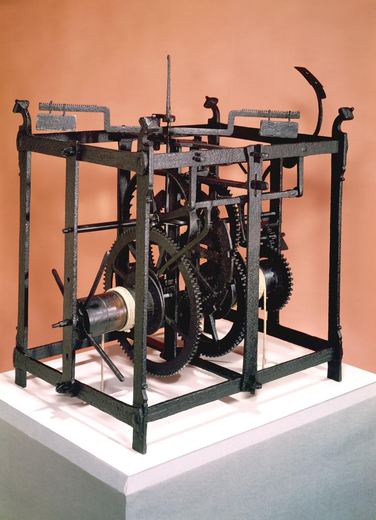
Turret clock, England, 1632-1640
Science Museum Group, London
Clocks · 1645-1655
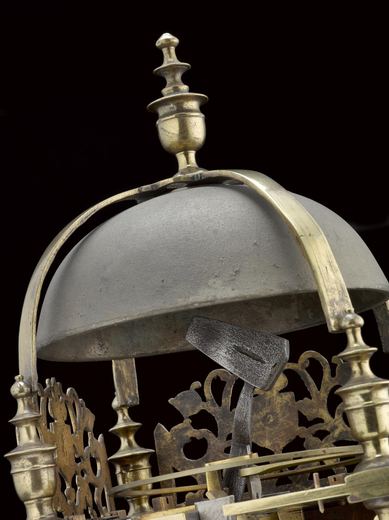
Balance-wheel brass lantern clock, with two driving weights and one counterweight, by Thomas Knifton, Cross Keys, Lothbury, London, England, 1645-1655.
Science Museum Group, London
Clocks · ca. 1650
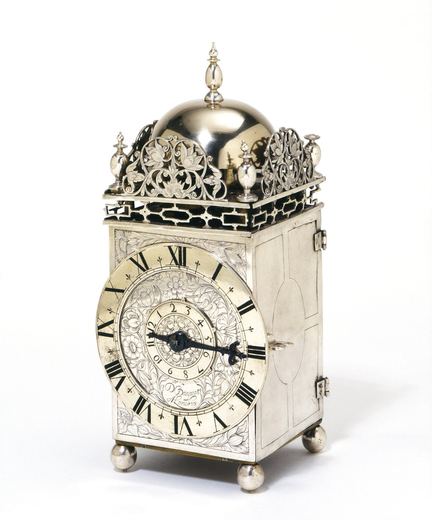
Lantern alarm clock, silver, by David Bouquet, circa 1650
Victoria and Albert Museum, London
Clocks · 1650-1660
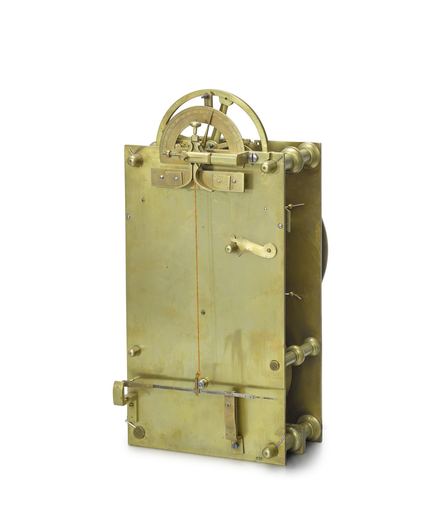
Lantern clock by Closon, Peter, England, 1650-1660
Science Museum Group, London
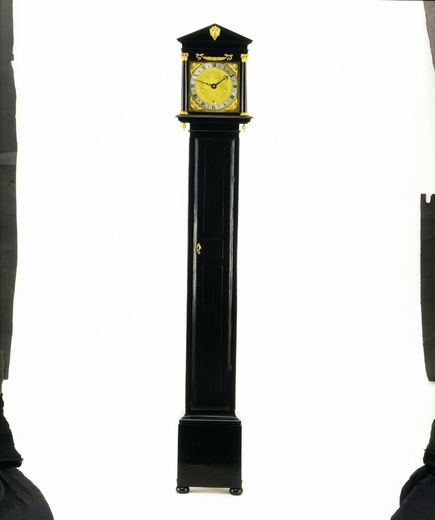
Clocks · ca. 1660
Longcase clock, ca. 1660, English, made by Ahasuerus Fromanteel
Victoria and Albert Museum, London