
Wristwatches · Wristwatch
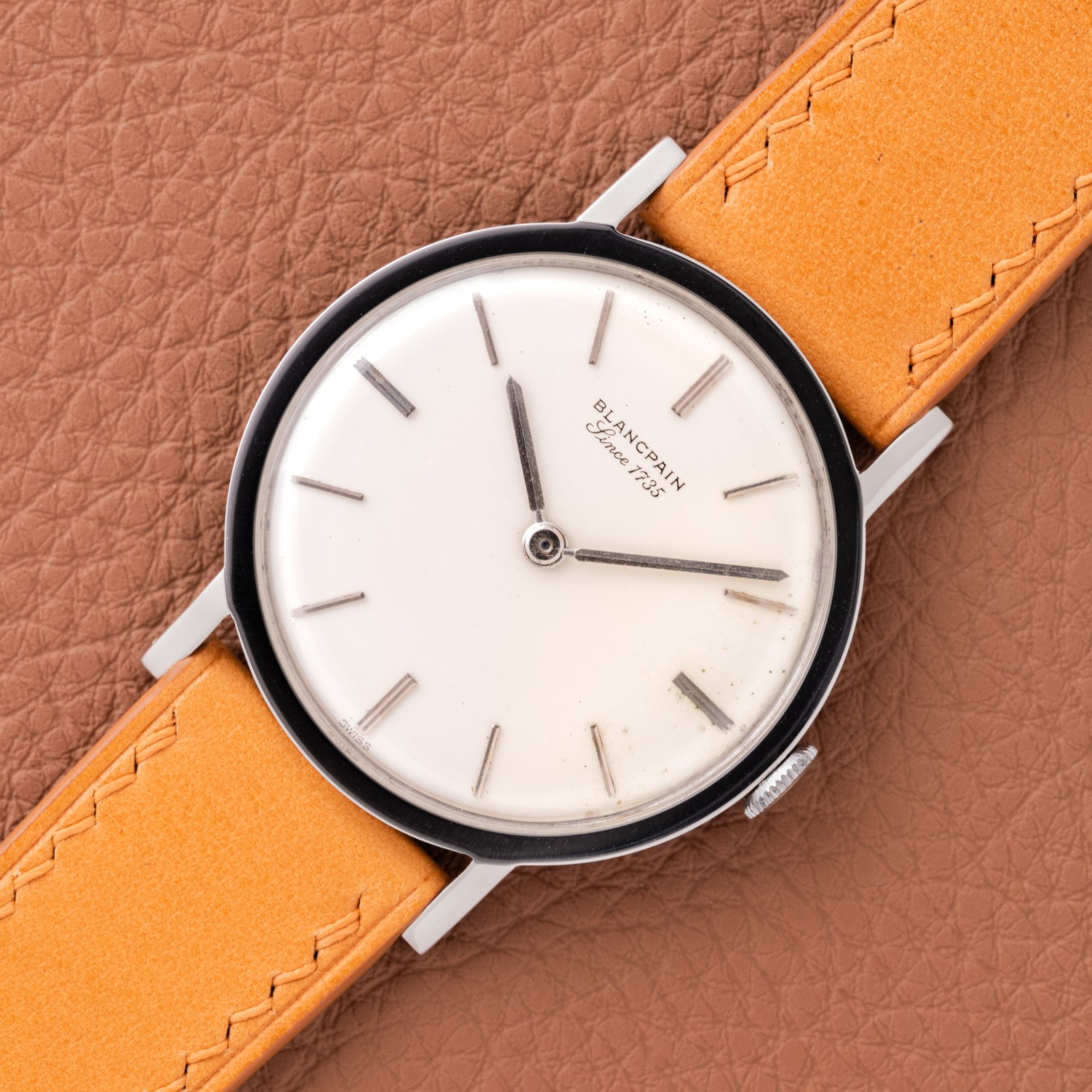
Blancpain Rayville Ultra Thin Dress Watch, 1960s
- Maker / attribution
- Blancpain (maker)
- Date
- 1960s
- Historical period
- Modern Mechanical Horology (1945 – 1969)
- Country of origin
- Switzerland
- Object type
- Wristwatch
- Dimensions
- Case 34 mm
- Stock no.
- Product 8834744811703
- Credit line
- Dealer listing, Huntington Company (product 8834744811703)
- Catalogue title (original)
- 1960s Blancpain Rayville Ultra Thin Dress Watch (English)
View the source record (dealer listing) ↗ (opens another website in a new tab)Suggest a correction
Record summary
Catalogued by Huntington Company (dealer) (stock number Product 8834744811703), this is a wristwatch by Blancpain, made in Switzerland, dated 1960s. The Atlas places it in the Modern Mechanical Horology period (1945 – 1969) of its Wristwatches collection. Recorded dimensions: Case 34 mm. The record is illustrated with 6 photographs.
Assembled from the source record's structured fields. Dates and attributions are given as the source states them; where a field is missing the Atlas leaves it blank rather than estimating.
Catalogue description
Dealer description — Huntington Company
History and Significance Long before Blancpain became widely associated with the Fifty Fathoms, the manufacture had already established a reputation for producing elegant and technically accomplished mechanical watches. Founded in 1735, Blancpain developed a rich history of traditional Swiss watchmaking, with a particular emphasis on mechanical movements and refined designs. The Rayville name occupies an interesting place within that history, having been closely connected to the manufacture during the twentieth century. Watches bearing the Rayville name offer an intriguing glimpse into a period when Blancpain was producing some exceptionally understated dress watches. The pursuit of thin mechanical watches was an important part of Swiss watchmaking throughout the mid-twentieth century. Creating a slender wristwatch required careful consideration of movement architecture, case construction, and overall proportions. While complicated watches demonstrated technical achievement through additional functions, ultra-thin watches represented a different kind of accomplishment, one centered on mechanical refinement and efficiency. Blancpain participated in this tradition with elegant dress watches that emphasized comfort, discretion, and classical styling. The 1960s were a particularly interesting period for traditional dress watches. Swiss manufacturers were experimenting with increasingly refined case designs, cleaner dials, and slimmer profiles as wristwatches became an essential part of everyday attire. The Rayville Ultra Thin reflects that era beautifully, offering the kind of restrained design that characterized many of the finest dress watches of the period. Its simplicity is part of its charm, allowing the proportions and overall construction to define the watch rather than elaborate decorative elements. Writer’s Thoughts The Blancpain Rayville Ultra Thin is a wonderful example of the understated elegance associated with vintage Swiss watchmaking. There is something particularly appealing about a watch that relies almost entirely on its proportions and simplicity to create a distinctive personality. The Rayville name also introduces an interesting historical element, connecting the watch to a lesser-discussed chapter of Blancpain's history. It is precisely the kind of vintage dress watch that becomes more interesting with a deeper appreciation of the manufacturer's past. Another attractive quality of the Rayville Ultra Thin is its versatility. The restrained design feels entirely appropriate for the 1960s, yet the overall aesthetic remains remarkably relevant today. Unlike more elaborate vintage watches, the appeal of a traditional mechanical dress watch comes from its quiet confidence . For collectors interested in lesser-known examples of mid-century Swiss watchmaking, the Rayville Ultra Thin offers plenty of character. Our Promise Every watch is thoroughly vetted, carefully described with complete transparency, and guaranteed authentic. Each piece is offered in honest condition, ensuring collectors receive a timepiece that reflects both originality and integrity. Specifications Brand: Blancpain Model: Rayville Ultra Thin Year: 1960s Case Material: Stainless Steel Case Size: 34mm Dial: Silver-Tone Dial Movement: Mechanical Movement Strap/Buckle: New Leather Strap Buckle/Clasp: Generic Buckle Contents: Watch only Condition Case: Stainless steel case retains its slender profile and attractive vintage proportions. Dial: Silver-tone dial retains its original vintage character and appearance with signs of wear mainly on the right side. Hands: Hands remain consistent with the overall age and character of the watch. Crystal: Crystal retains a clear appearance. Strap/Buckle: Newly fitted leather strap is in excellent condition. Buckle/Clasp: Generic buckle is in good condition.
Historical context
Modern Mechanical Horology (1945 – 1969)
Tool watches for divers, pilots and astronauts; electric watches anticipate the electronic age.
The classic era of the mechanical wristwatch: dive watches, chronographs for motor racing and space flight, GMT watches for jet travel, slim dress watches, automatic calendars, and the rise of Japanese manufacturers alongside Swiss, American, German and Soviet industries.
Read the period in the timelineMore wristwatches from this periodEarlier: Golden Age of Mechanical Watchmaking
Atlas type guide
Wristwatches
Bracelet watches were worn by women from the early nineteenth century — Breguet made one for Caroline Murat, Queen of Naples, in 1810–12 — but the wristwatch only became a man's instrument with military use and aviation in the early twentieth century. Between the World Wars it overtook the pocket watch; the 1920s and 1930s brought rectangular Art Deco cases, water-resistant cases and the first automatic winding systems.
After 1945 the wristwatch became a carrier of identity — dress watches, sports and dive watches, chronographs, calendars — produced by Swiss, American, Japanese, German, Soviet and Chinese industries. The quartz revolution after 1969 and the mechanical renaissance since the 1990s, including the rise of independent watchmakers, complete the story.
What to look for
- The reference number (between the lugs or inside the case back) and serial number, the starting point for dating.
- The calibre: its maker and number are often stamped under the dial or on the bridge.
- Originality of dial, hands and crown — refinished ('redial') dials are common.
- Case material marks: 18K/750, 14K/585, stainless steel, gold-filled, plated.
Dating clues
- Wire-lug cases: before c. 1925.
- Water-resistant screw-down cases: from 1926.
- Quartz movements: from 1969; sapphire crystals widespread after c. 1980.
General guidance written by the Atlas editors about this kind of object. It is not a statement about this particular piece; for that, rely on the source record above and on physical examination.
Related records
Clocks · c. 2010
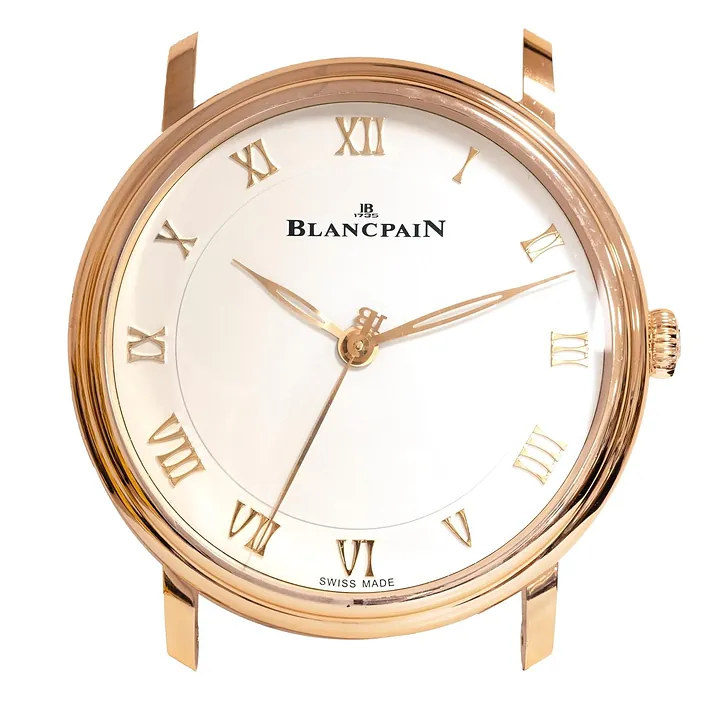
Blancpain clock, c. 2010
Antiquorum auction archive, Geneva
Wristwatches · c. 1930
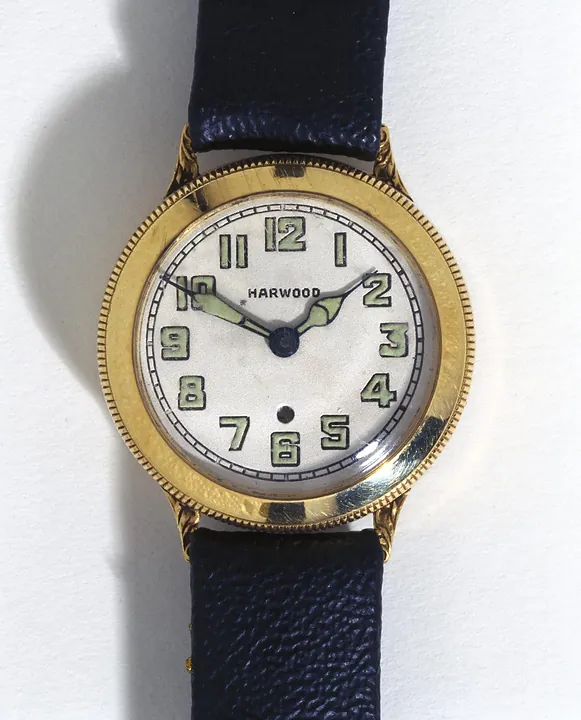
Wristwatch by J. Harwood and Son and Blancpain, Switzerland, c. 1930
Science Museum Group, London
Wristwatches · c. 1930
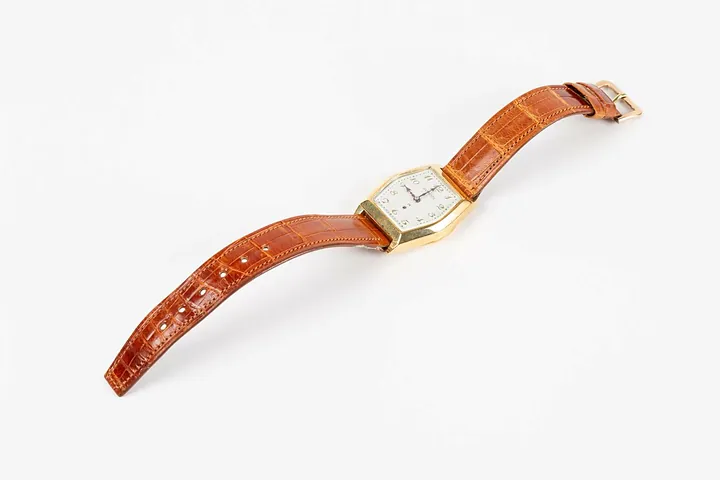
Wristwatch by Harwood (Société Centrale de la Montre Sans Remontoir), Switzerland, c. 1930 (no. 58042)
German Clock Museum
Wristwatches · c. 1932
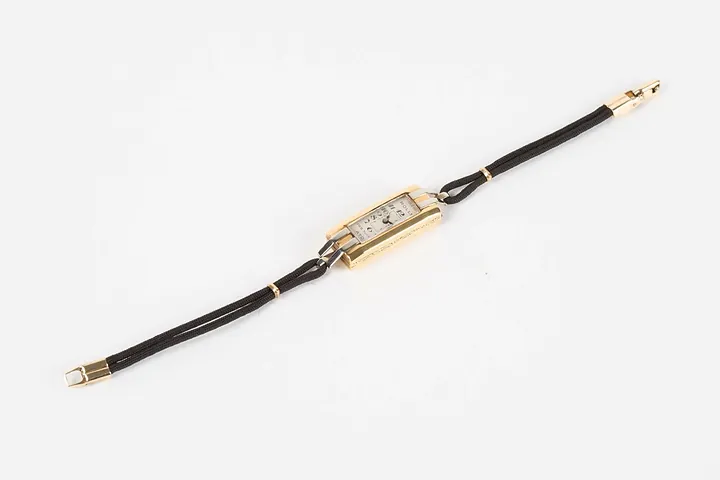
Wristwatch by Blancpain, Switzerland, c. 1932
German Clock Museum

Wristwatches · 1945
Wristwatch by Eterna, 1945
Museum Rotterdam

Wristwatches · c. 1945
Breitling Premier, ref. 790, c. 1945
Antiquorum auction archive, Geneva

Wristwatches · c. 1945
Universal Genève Uni-Compax, ref. 22492, c. 1945
Antiquorum auction archive, Geneva

Wristwatches · c. 1950s
Baume & Mercier wristwatch, c. 1950s
Antiquorum auction archive, Geneva