
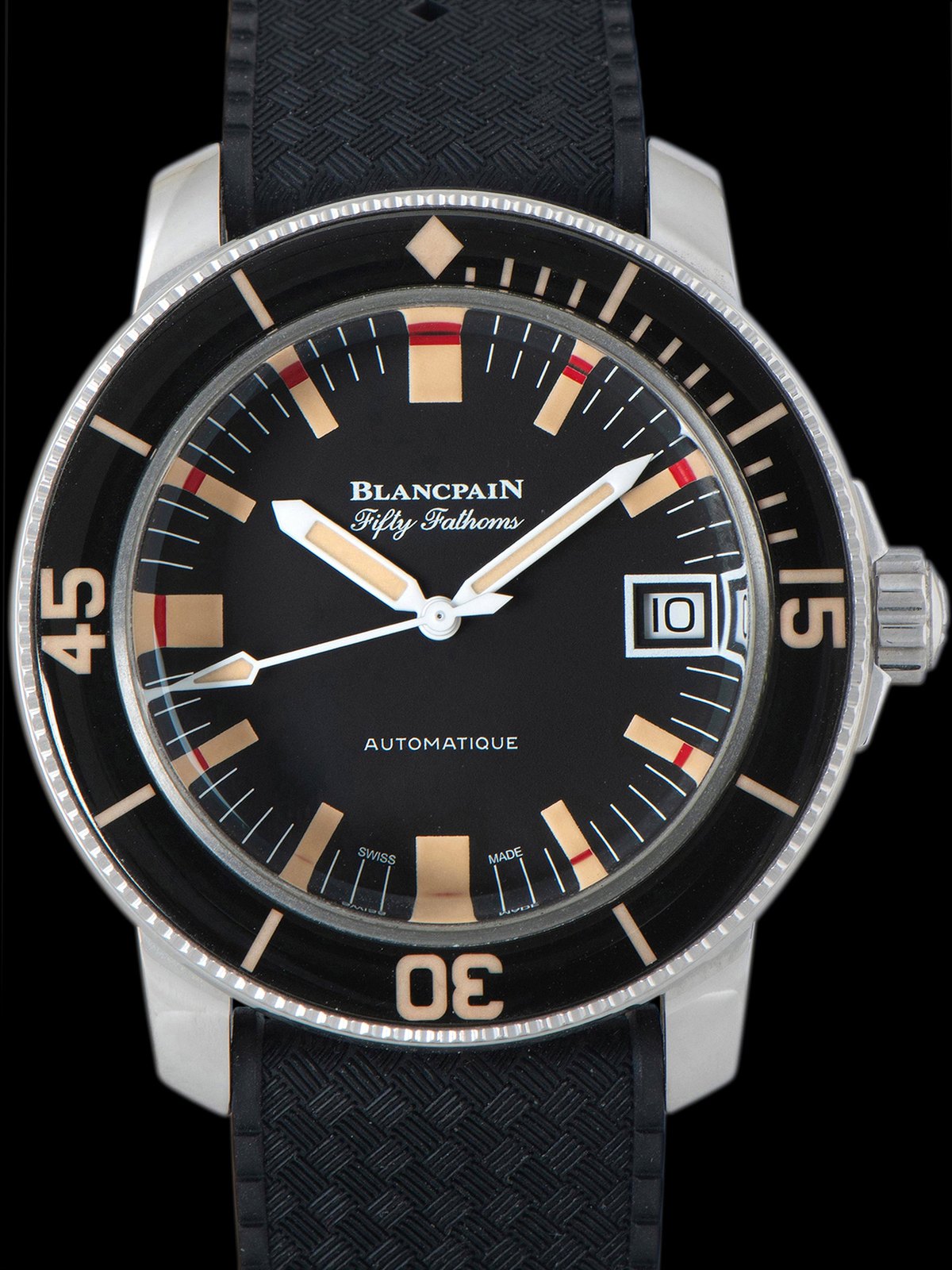
Wristwatches · Wristwatch
Blancpain Fifty-Fathoms "Barakuda Limited Edition" (Ref. 5008B 1130 B52A), 2019
- Maker / attribution
- Blancpain (maker)
- Date
- 2019
- Historical period
- Contemporary Horology (2010 – Present)
- Country of origin
- Switzerland
- Object type
- Wristwatch
- Stock no.
- BLCPFFBLTD
- Credit line
- Dealer listing, Craft & Tailored (BLCPFFBLTD)
- Catalogue title (original)
- 2019 Blancpain Fifty-Fathoms "Barakuda Limited Edition" (Ref. 5008B 1130 B52A) W/ Full Set (English)
View the source record (dealer listing) ↗ (opens another website in a new tab)Suggest a correction
Record summary
Catalogued by Craft & Tailored (dealer), Los Angeles (stock number BLCPFFBLTD), this is a wristwatch by Blancpain, made in Switzerland, dated 2019. The Atlas places it in the Contemporary Horology period (2010 – Present) of its Wristwatches collection. The record is illustrated with 6 photographs.
Assembled from the source record's structured fields. Dates and attributions are given as the source states them; where a field is missing the Atlas leaves it blank rather than estimating.
Catalogue description
Dealer description — Craft & Tailored
Few modern companies carry a history that can rival Blancpain SA, which is recognized as being the first watch brand dating back to 1735 with an extensive pedigree of inventions and innovations within the now vast world of horology. The Blancpain dive watches are one of the most important innovations of the brand's history. The idea for the Blancpain Fifty Fathoms was conceived in 1952, when French Navy members requested a wristwatch that was waterproof enough to withstand the pressures endured during the diving missions required of the elite team of combat “Frogmen” divers, also known today as a dive watch. The task of finding this watch was famously taken on by French Navy officers Captain Robert “Bob” Maloubier & Lieutenant Claude Riffaud, who after testing numerous "waterproof" watches at the time failed to find a fit for their tactical requirements. While these requirements may seem stock-standard today, in 1952 they were groundbreaking. A wristwatch that was water-resistant enough to survive a diving-based combat mission, but was also visible enough to be easily read underwater, even at night. Since no watch like this existed at the time, Capt. Maloubier created the blueprints for what would become the world's first diving watch, and sent them to various notable watchmakers to manufacture. Though, at the time most watchmaking brands were focused on manufacturing aviation watches, and weren't interested in making hyper-waterproof watches. However, their luck would come to fruition when Capt. Maloubier and Lt. Riffaud engaged with Jean-Jacques Fiechter, the CEO of Blancpain SA from 1950 to 1980. Being a diver himself, Fiechter not only accepted the requirements to produce the timepiece for the elite combat diving team but improved upon the design, resulting in a product that not only adhered to the specifications set forth by the French Navy but innovated the watch industry as a whole. The Fifty Fathoms "Barakuda" was originally issued to the German Navy—known as the Bundesmarine until its post-reunification renaming to Deutsche Marine in 1995—this special variant of the Blancpain Fifty Fathoms was delivered via the German aquatic equipment supplier Barakuda. While intended for military use, the watch later made its way into civilian retail channels. Though exact production numbers remain unconfirmed, it's widely believed that only 150 examples were ever produced. Distinctive for its two-tone hour markers, the "Barakuda" stands out thanks to the striking red accents at the base of each index—adding an unexpected burst of color to an otherwise purposefully subdued design. This unique aesthetic, coupled with its military heritage, has made the Barakuda one of the most sought-after Fifty Fathoms references among collectors. (Capt. Bob Maloubier wearing a Blancpain Fifty Fathoms) The term "limited-edition" is all too often overused as a marketing tool by brands that it is actually rare when a truly exclusive limited-edition timepiece makes its way onto the scene. This is why we are happy to offer the Blancpain Fifty-Fathoms "Barakuda" as a truly exclusive offering of only 500 pieces made in total with the result being one of the most tasteful and sought-after modern watches recently produced. The Blancpain Fifty-Fathoms feels authentically Blancpain with a blending aesthetic of the brand's modern style and its vintage history and comes complete in a wonderful presentation featuring a specially made Pelican case and accessories. SPECS Stock # BLCPFFBLTD Brand Blancpain Style Fifty-Fathoms "Barakuda" Model 5008B 1130 B52A Serial 27X/100 Size Men's Material Stainless Steel Dial Matte Black W/ Red Accents Millimeters 40 Strap 2pc Blancpain Rubber CASE & BRACELET The excellent and unpolished case is in near-perfect condition and appears to have only been worn a handful of times as it retains its strong angles and finishing with almost no signs of previous use. The sapphire bezel is flawless. The sapphire crystal is flawless. The sapphire case back is also flawless, displaying the beautiful Cal. 1153 movement. The watch comes on its original 2pc Blancpain rubber strap. DIAL & HANDS The matte black dial with red accents and cream-colored super luminova lume is flawless. The matching Super Luminova hands are flawless. ACCESSORIES
Historical context
Contemporary Horology (2010 – Present)
Silicon components, connected watches, optical-lattice research clocks and a thriving independent scene.
Smartwatches became the world's best-selling watches, while mechanical watchmaking focuses on craft, innovation (silicon components, new escapements) and independent makers.
Read the period in the timelineMore wristwatches from this periodEarlier: Mechanical Renaissance
Atlas type guide
Wristwatches
Bracelet watches were worn by women from the early nineteenth century — Breguet made one for Caroline Murat, Queen of Naples, in 1810–12 — but the wristwatch only became a man's instrument with military use and aviation in the early twentieth century. Between the World Wars it overtook the pocket watch; the 1920s and 1930s brought rectangular Art Deco cases, water-resistant cases and the first automatic winding systems.
After 1945 the wristwatch became a carrier of identity — dress watches, sports and dive watches, chronographs, calendars — produced by Swiss, American, Japanese, German, Soviet and Chinese industries. The quartz revolution after 1969 and the mechanical renaissance since the 1990s, including the rise of independent watchmakers, complete the story.
What to look for
- The reference number (between the lugs or inside the case back) and serial number, the starting point for dating.
- The calibre: its maker and number are often stamped under the dial or on the bridge.
- Originality of dial, hands and crown — refinished ('redial') dials are common.
- Case material marks: 18K/750, 14K/585, stainless steel, gold-filled, plated.
Dating clues
- Wire-lug cases: before c. 1925.
- Water-resistant screw-down cases: from 1926.
- Quartz movements: from 1969; sapphire crystals widespread after c. 1980.
General guidance written by the Atlas editors about this kind of object. It is not a statement about this particular piece; for that, rely on the source record above and on physical examination.
Related records
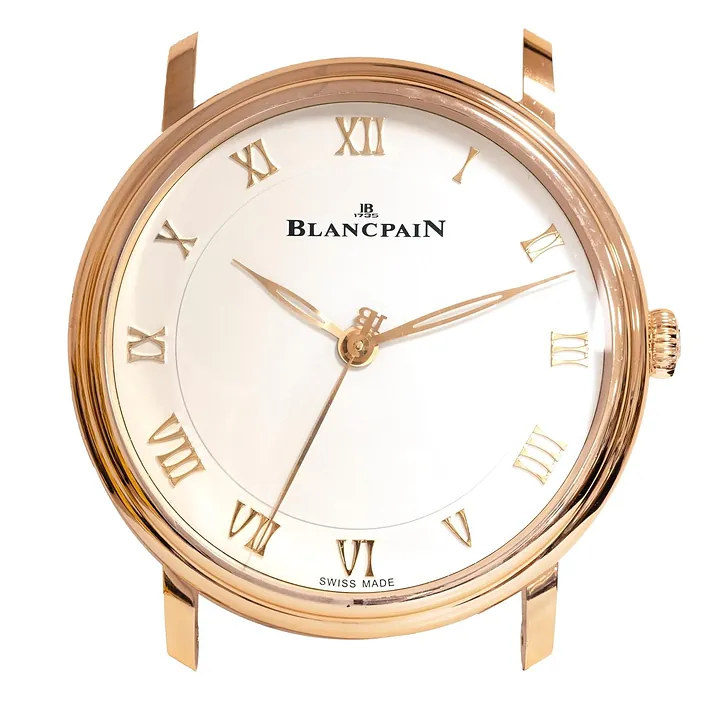
Clocks · c. 2010
Blancpain clock, c. 2010
Antiquorum auction archive, Geneva
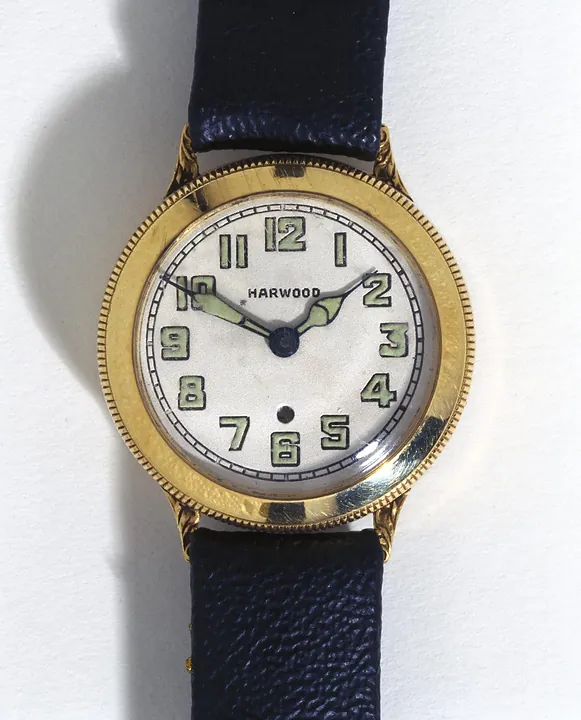
Wristwatches · c. 1930
Wristwatch by J. Harwood and Son and Blancpain, Switzerland, c. 1930
Science Museum Group, London
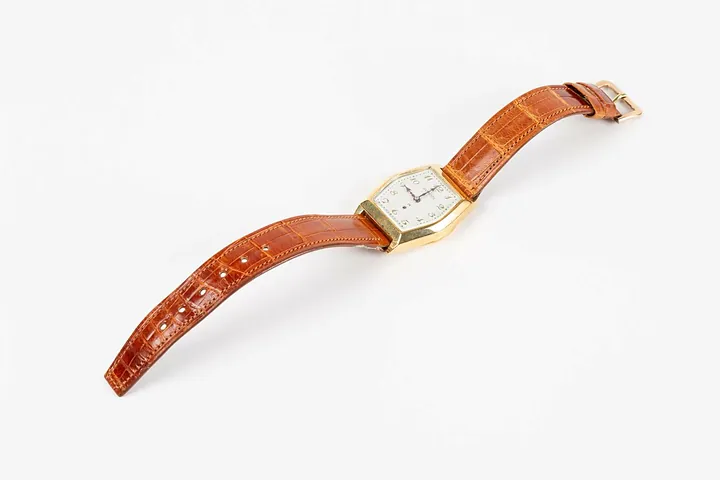
Wristwatches · c. 1930
Wristwatch by Harwood (Société Centrale de la Montre Sans Remontoir), Switzerland, c. 1930 (no. 58042)
German Clock Museum
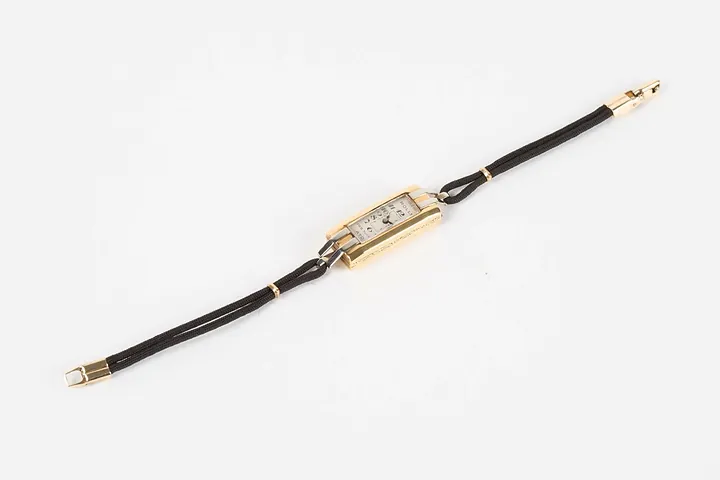
Wristwatches · c. 1932
Wristwatch by Blancpain, Switzerland, c. 1932
German Clock Museum

Wristwatches · c. 2010s
Breguet Type XXI, ref. 3810, c. 2010s (Antiquorum Lot 381-24)
Antiquorum auction archive, Geneva

Wristwatches · c. 2010s
Breguet Type XXI, ref. 3810, c. 2010s (Antiquorum Lot 386-229)
Antiquorum auction archive, Geneva

Wristwatches · Sold in September 2010
Breitling Cosmonaute, ref. A 22322, Sold in September 2010
Antiquorum auction archive, Geneva

Wristwatches · c. 2010
Corum Bubble Chrono, ref. 396.150.20, c. 2010
Antiquorum auction archive, Geneva