
Wristwatches · Wristwatch
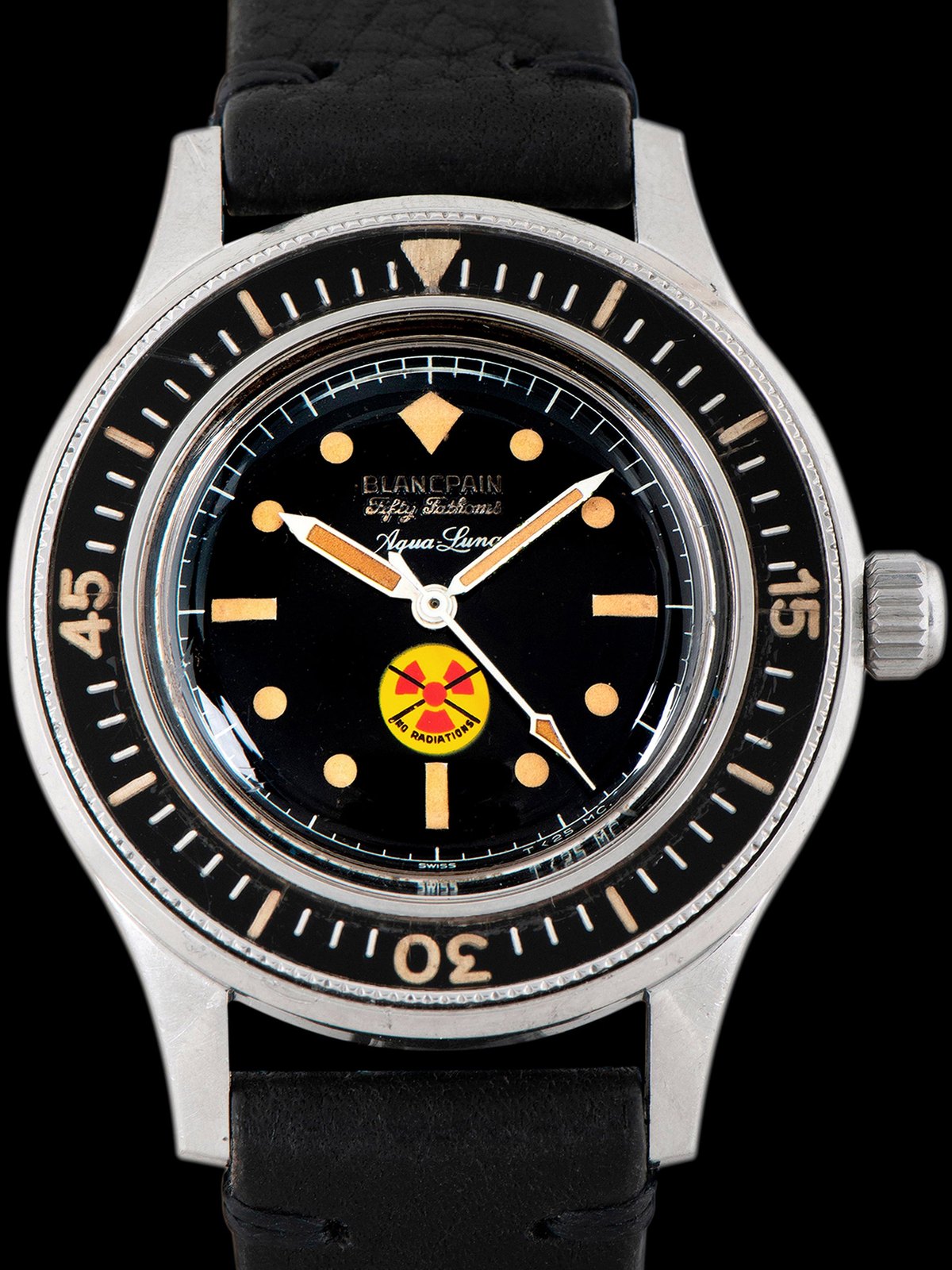
Blancpain Fifty Fathoms Aqua-Lung "No Radiations", 1960s
- Maker / attribution
- Blancpain (maker)
- Date
- 1960s
- Historical period
- Modern Mechanical Horology (1945 – 1969)
- Country of origin
- Switzerland
- Object type
- Wristwatch
- Stock no.
- BLNCFFALNORAD
- Credit line
- Dealer listing, Craft & Tailored (BLNCFFALNORAD)
- Catalogue title (original)
- 1960s Blancpain Fifty Fathoms Aqua-Lung "No Radiations" (English)
View the source record (dealer listing) ↗ (opens another website in a new tab)Suggest a correction
Record summary
Catalogued by Craft & Tailored (dealer), Los Angeles (stock number BLNCFFALNORAD), this is a wristwatch by Blancpain, made in Switzerland, dated 1960s. The Atlas places it in the Modern Mechanical Horology period (1945 – 1969) of its Wristwatches collection. The record is illustrated with 6 photographs.
Assembled from the source record's structured fields. Dates and attributions are given as the source states them; where a field is missing the Atlas leaves it blank rather than estimating.
Catalogue description
Dealer description — Craft & Tailored
Few modern watchmakers can claim a heritage as profound as Blancpain SA, widely recognized as the world’s oldest watch brand, with origins tracing back to 1735. Over nearly three centuries, Blancpain has been at the forefront of horological innovation, with its dive watches standing among the most defining achievements in the brand’s storied history. The idea for the Blancpain Fifty Fathoms was conceived in 1952, when members of the French Navy sought a wristwatch robust enough to withstand the pressures of underwater combat missions. Tasked with this challenge were Captain Robert “Bob” Maloubier and Lieutenant Claude Riffaud—leaders of the elite combat diver unit known as the “Frogmen.” After testing numerous so-called waterproof watches, they found none suitable for the extreme conditions of their operations. At the time, the specifications they required—exceptional water resistance, legibility underwater, and reliability in darkness—were unprecedented. With no existing watch meeting these standards, Capt. Maloubier drafted detailed blueprints for the ideal diver’s watch and approached various Swiss manufacturers. Most brands, however, were focused on aviation or dress timepieces and declined to take on the project. Their search ultimately led to Jean-Jacques Fiechter, Blancpain’s visionary CEO from 1950 to 1980. Himself an avid diver, Fiechter immediately understood the importance of the concept and not only accepted the challenge but refined and enhanced the design. The result was the Blancpain Fifty Fathoms—a groundbreaking timepiece that set the benchmark for all future dive watches. The model was quickly adopted by naval forces worldwide, including the French and U.S. Navies, as well as early underwater explorers such as Jacques Cousteau, who famously wore the Fifty Fathoms during his expeditions. Early examples of the Fifty Fathoms utilized radium-based luminous material, standard practice in the 1950s. However, as awareness of radiation hazards grew during the Cold War, Blancpain—like many Swiss brands—transitioned to safer tritium-based luminescence. To emphasize this shift, Blancpain boldly introduced a new dial design featuring a bright red and yellow radiation symbol crossed out in black, along with the words “No Radiations”. This now-iconic dial configuration first appeared on the Fifty Fathoms and was later carried over to the Aqua-Lung models of the 1960s. A third, exceptionally rare variation, known among collectors as the “triple-signed” dial, combined all three inscriptions—Fifty Fathoms, Aqua-Lung, and No Radiations—making it one of the most coveted configurations in Blancpain’s storied dive watch lineage. SPECS Stock # BLNCFFALNORAD Brand Blancpain Style Fifty Fathoms Aqua-Lung Model N/A Serial 30XXXX Size Men's Material Stainless Steel Dial Glossy Black "No Radiations" Millimeters 41 Strap 2pc Handmade Leather Strap CASE & BRACELET The long, broad-lugged case is exceptionally well preserved, maintaining strong factory dimensions and crisp finishing throughout, with only minimal evidence of past polishing. Light, honest wear is visible, consistent with careful use, yet no notable damage or dents are present. The original bakelite bezel remains in excellent condition, showing only minor expected aging, including faint cracking and subtle delamination, but with no structural compromises or major points of failure. The watch retains its original unsigned crown, complete with its factory nylon gasket. The case back displays all original factory engravings, which remain deep and sharply defined, with no notable wear. The watch is offered on a handmade two-piece leather strap. DIAL & HANDS The original glossy black triple-signed dial features embossed Blancpain and Fifty Fathoms logos, with the Aqua-Lung text printed in white script below, and the No Radiations emblem positioned just above the 6 o’clock marker. The dial remains exceptionally well preserved, displaying no notable damage and only a light, evenly dispersed speckled patina across the black lacquer surface—an attractive testament to its age. The tritium lume plots have developed a rich golden-orange patina and exhibit no signs of degradation under UV light inspection. The original tritium hands complement the dial beautifully, with the hour and seconds hands showing a slightly deeper hue to the patina. All luminous elements remain stable and consistent under UV examination ACCESSORIES None. The watch is keeping time, but the service history is unknown. A movement service can be provided upon request.
Historical context
Modern Mechanical Horology (1945 – 1969)
Tool watches for divers, pilots and astronauts; electric watches anticipate the electronic age.
The classic era of the mechanical wristwatch: dive watches, chronographs for motor racing and space flight, GMT watches for jet travel, slim dress watches, automatic calendars, and the rise of Japanese manufacturers alongside Swiss, American, German and Soviet industries.
Read the period in the timelineMore wristwatches from this periodEarlier: Golden Age of Mechanical Watchmaking
Atlas type guide
Dive and water-resistant watches
Keeping water and dust out of a wristwatch was a long-standing challenge. Rolex's screw-down Oyster case (1926) and Omega's Marine (1932) were landmarks; in the early 1950s Blancpain's Fifty Fathoms and Rolex's Submariner defined the professional dive watch with rotating bezels for timing dives, luminous dials and high water resistance. The ISO 6425 standard (1982) later codified what a 'diver's watch' must do.
Dive watches became icons of post-war design and exploration, and their evolution — helium escape valves, ceramic bezels, saturation-diving depth ratings — records the history of underwater work.
What to look for
- Unidirectional or bidirectional rotating bezel with minute markings.
- Screw-down crown and case back; depth rating printed on the dial.
- Luminous hands and markers (radium before c. 1960, tritium c. 1960–1998, then Super-LumiNova).
- Reference numbers on the case between the lugs or inside the back.
Dating clues
- Screw-down Oyster cases: from 1926.
- Professional dive watches: from 1953.
- Tritium 'T' marks on dials: c. 1960–1998.
General guidance written by the Atlas editors about this kind of object. It is not a statement about this particular piece; for that, rely on the source record above and on physical examination.
Related records
Clocks · c. 2010
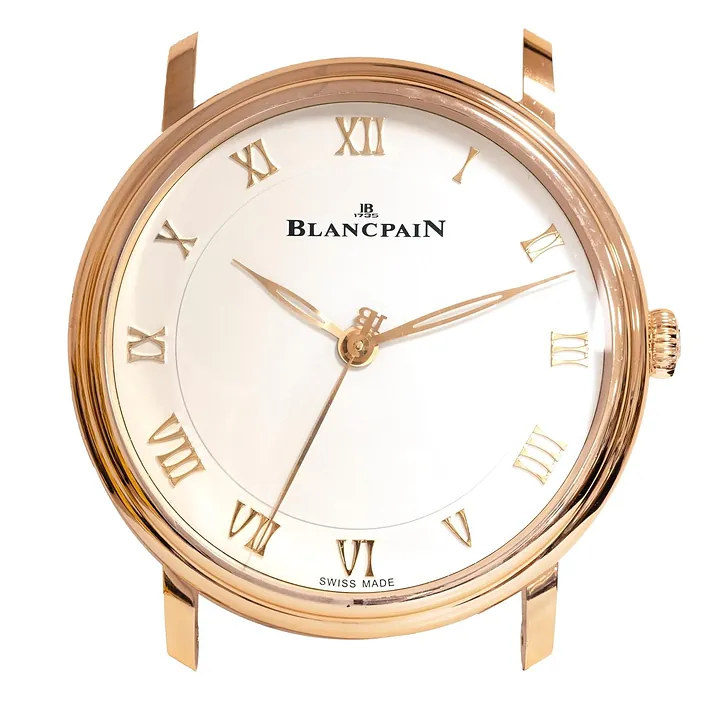
Blancpain clock, c. 2010
Antiquorum auction archive, Geneva
Wristwatches · c. 1930
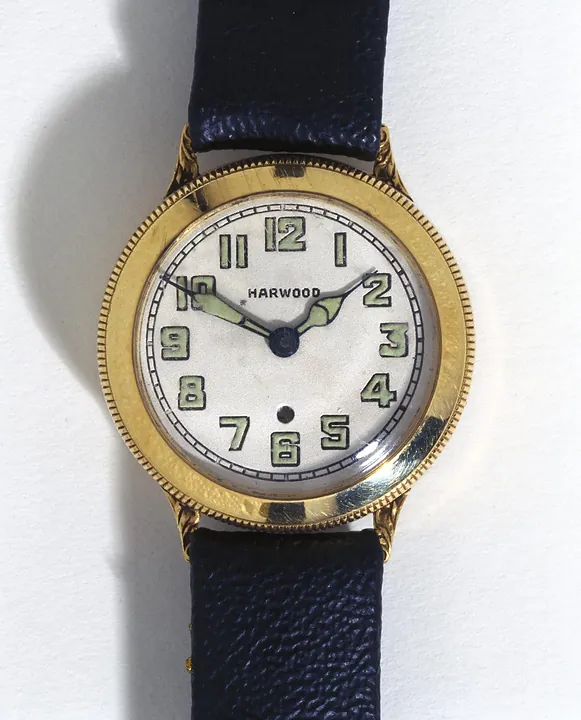
Wristwatch by J. Harwood and Son and Blancpain, Switzerland, c. 1930
Science Museum Group, London
Wristwatches · c. 1930
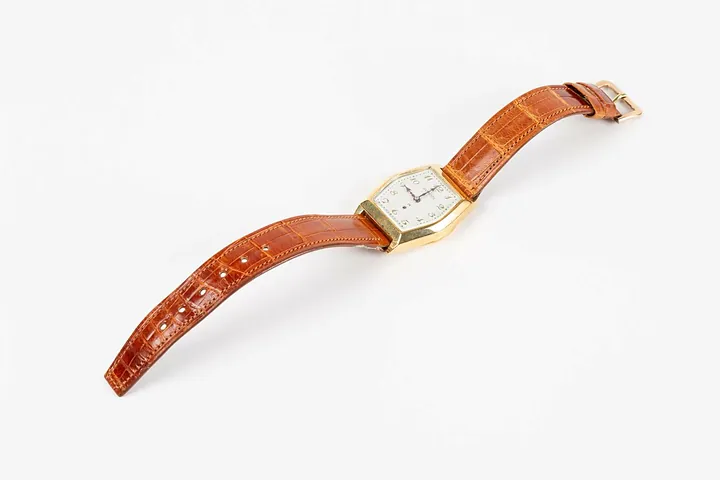
Wristwatch by Harwood (Société Centrale de la Montre Sans Remontoir), Switzerland, c. 1930 (no. 58042)
German Clock Museum
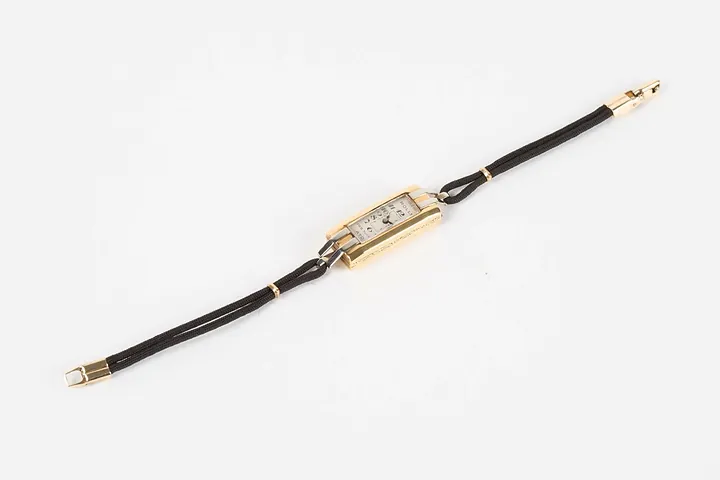
Wristwatches · c. 1932
Wristwatch by Blancpain, Switzerland, c. 1932
German Clock Museum

Wristwatches · 1945
Wristwatch by Eterna, 1945
Museum Rotterdam

Wristwatches · c. 1945
Breitling Premier, ref. 790, c. 1945
Antiquorum auction archive, Geneva

Wristwatches · c. 1945
Universal Genève Uni-Compax, ref. 22492, c. 1945
Antiquorum auction archive, Geneva

Wristwatches · c. 1950s
Baume & Mercier wristwatch, c. 1950s
Antiquorum auction archive, Geneva