
Wristwatches · Wristwatch
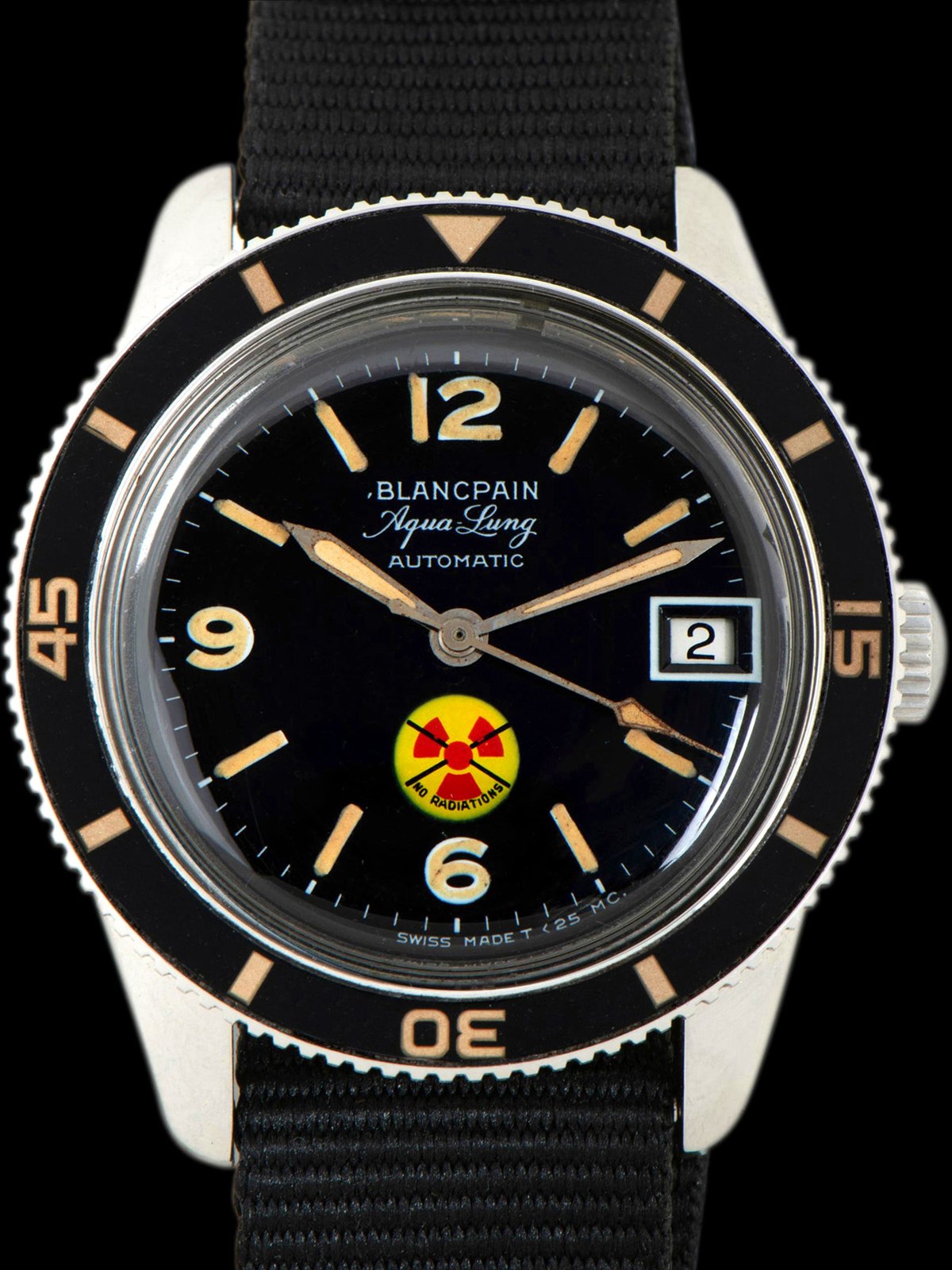
Blancpain Aqua Lung "No Radiations", 1960s
- Maker / attribution
- Blancpain (maker)
- Date
- 1960s
- Historical period
- Modern Mechanical Horology (1945 – 1969)
- Country of origin
- Switzerland
- Object type
- Wristwatch
- Stock no.
- BLNCALNORAD
- Credit line
- Dealer listing, Craft & Tailored (BLNCALNORAD)
- Catalogue title (original)
- 1960s Blancpain Aqua Lung "No Radiations" (English)
View the source record (dealer listing) ↗ (opens another website in a new tab)Suggest a correction
Record summary
Catalogued by Craft & Tailored (dealer), Los Angeles (stock number BLNCALNORAD), this is a wristwatch by Blancpain, made in Switzerland, dated 1960s. The Atlas places it in the Modern Mechanical Horology period (1945 – 1969) of its Wristwatches collection. The record is illustrated with 6 photographs.
Assembled from the source record's structured fields. Dates and attributions are given as the source states them; where a field is missing the Atlas leaves it blank rather than estimating.
Catalogue description
Dealer description — Craft & Tailored
Few modern companies carry a history that can rival Blancpain SA, which is recognized as being the first watch brand dating all the way back to 1735 with an extensive pedigree of inventions and innovations within the now vast world of horology. The Blancpain dive watches are one of the most important innovations of the brand's history. The idea for the Blancpain Fifty Fathoms was conceived in 1952, when French Navy members requested a wristwatch that was waterproof enough to withstand the pressures endured during the diving missions required of the elite team of combat “Frogmen” divers, also known today as a dive watch. The task of finding this watch was famously taken on by French Navy officers Captain Robert “Bob” Maloubier & Lieutenant Claude Riffaud, who after testing numerous "waterproof" watches at the time failed to find a fit for their tactical requirements. While these requirements may seem stock-standard today, in 1952 they were groundbreaking. A wristwatch that was water-resistant enough to survive a diving-based combat mission, but was also visible enough to be easily read underwater, even at night. Since no watch like this existed at the time, Capt. Maloubier created the blueprints for what would become the world's first diving watch, and sent them to various notable watchmakers to manufacture. Though, at the time most watchmaking brands were focused on manufacturing aviation watches, and weren't interested in making hyper-waterproof watches. Though their luck would come to fruition when Capt. Maloubier and Lt. Riffaud engaged with Jean-Jacques Fiechter, the CEO of Blancpain SA from 1950 to 1980. Being a diver himself, Fiechter not only accepted the requirements to produce the timepiece for the elite combat diving team but improved upon the design, resulting in a product that not only adhered to the specifications set forth by the French Navy but innovated the watch industry as a whole. Armed forces from around the world were early adopters of Blancpain dive watches, including the French and American Navies. Early underwater explorers adopted the new dive watch as well, most notably Jacque Cousteau became a major proponent for Blancpain among many others. The early versions of the Fifty-Fathoms utilized radium luminous material, which was commonplace in early watchmaking and wristwatches of the 1950s. But as the Cold War heightened throughout the 1960s, so did the awareness of the harmful properties of radiation. As a result, watch manufacturers began experimenting with different luminous compounds, though tritium became the most widely employed material across Swiss brands. Blancpain marketed this transition loudly and boldly so as to verbalize the safety of their products to the masses, resulting in dials that bore bright red and yellow radiation symbols with a black X through the logo and the text "No Radiation". This dial printing was first seen on the Fifty-Fathoms model and was kept in the transition to the improved Aqua Lung of the 1960s. The "No Radiations" Blancpain Aqua Lung presented here is one of the best-preserved examples we've ever seen. From the impressive bakelite bezel, near-perfect dial, and well-maintained case, we would be hard-pressed to find another example that matches the condition of this one. SPECS Stock # BLNCALNORAD Brand Blancpain Style Aqua Lung Model N/A Serial 20XXXXX Size Men's Material Stainless Steel Dial Glossy Black "No Radiations" Millimeters 37 Strap Black NATO Strap CASE & BRACELET The excellent case retains its original shape and design, with the broad factory chamfers fully present. The case exhibits minimal wear and only gentle signs of previous polishing. The original and exceptional black bakelite bezel remains in near-flawless condition, though there is a hairline fracture that perfectly aligns with the "50" dash maker and is nearly invisible to the naked eye, otherwise, the bezel is clean from any other damage or discoloration. The tritium lume in the bezel has achieved a warm golden-tan patina that coordinates with the dial almost perfectly, with no degradation present when inspected under U.V. light. The unsigned crown is believed to be original to the watch. The case back retains all its factory markings in deep and crisp condition. The watch comes supplied on a black NATO strap. DIAL & HANDS The glossy black "No Radiations" dial is genuinely exceptional with no damage or notable signs of age present. The "No Rad" logo remains bright, colorful, and in excellent condition. The tritium lume plots have achieved a lovely golden patina with no visible degradation present when inspected under U.V. light. The original tritium hands match the dial perfectly and exhibit no degradation under U.V. light inspection. ACCESSORIES
Historical context
Modern Mechanical Horology (1945 – 1969)
Tool watches for divers, pilots and astronauts; electric watches anticipate the electronic age.
The classic era of the mechanical wristwatch: dive watches, chronographs for motor racing and space flight, GMT watches for jet travel, slim dress watches, automatic calendars, and the rise of Japanese manufacturers alongside Swiss, American, German and Soviet industries.
Read the period in the timelineMore wristwatches from this periodEarlier: Golden Age of Mechanical Watchmaking
Atlas type guide
Wristwatches
Bracelet watches were worn by women from the early nineteenth century — Breguet made one for Caroline Murat, Queen of Naples, in 1810–12 — but the wristwatch only became a man's instrument with military use and aviation in the early twentieth century. Between the World Wars it overtook the pocket watch; the 1920s and 1930s brought rectangular Art Deco cases, water-resistant cases and the first automatic winding systems.
After 1945 the wristwatch became a carrier of identity — dress watches, sports and dive watches, chronographs, calendars — produced by Swiss, American, Japanese, German, Soviet and Chinese industries. The quartz revolution after 1969 and the mechanical renaissance since the 1990s, including the rise of independent watchmakers, complete the story.
What to look for
- The reference number (between the lugs or inside the case back) and serial number, the starting point for dating.
- The calibre: its maker and number are often stamped under the dial or on the bridge.
- Originality of dial, hands and crown — refinished ('redial') dials are common.
- Case material marks: 18K/750, 14K/585, stainless steel, gold-filled, plated.
Dating clues
- Wire-lug cases: before c. 1925.
- Water-resistant screw-down cases: from 1926.
- Quartz movements: from 1969; sapphire crystals widespread after c. 1980.
General guidance written by the Atlas editors about this kind of object. It is not a statement about this particular piece; for that, rely on the source record above and on physical examination.
Related records
Clocks · c. 2010
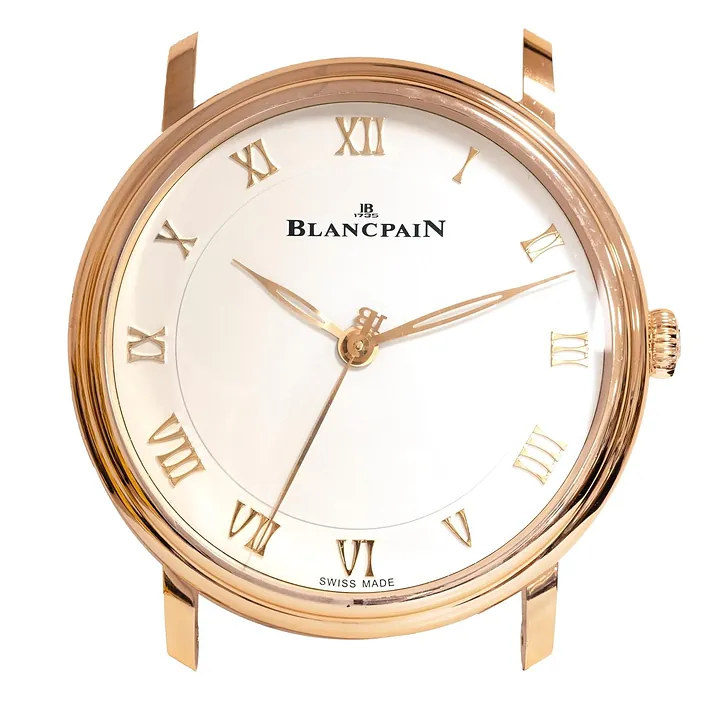
Blancpain clock, c. 2010
Antiquorum auction archive, Geneva
Wristwatches · c. 1930
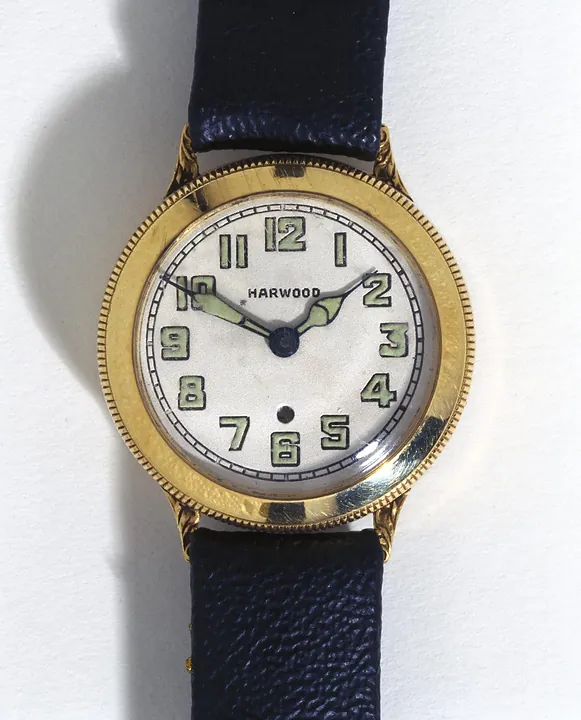
Wristwatch by J. Harwood and Son and Blancpain, Switzerland, c. 1930
Science Museum Group, London
Wristwatches · c. 1930
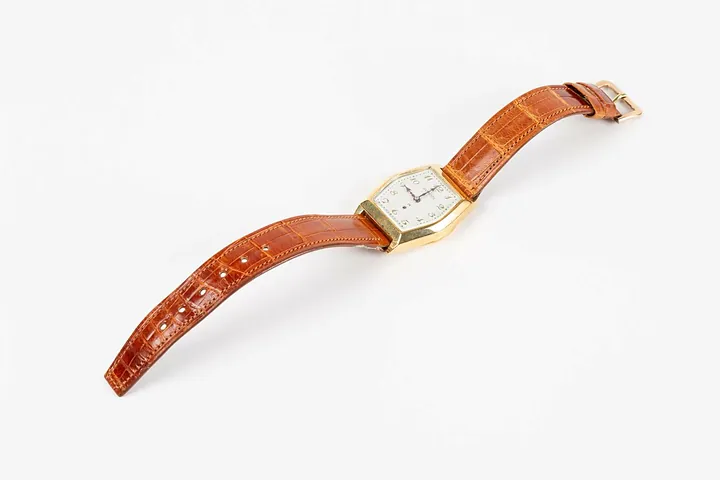
Wristwatch by Harwood (Société Centrale de la Montre Sans Remontoir), Switzerland, c. 1930 (no. 58042)
German Clock Museum
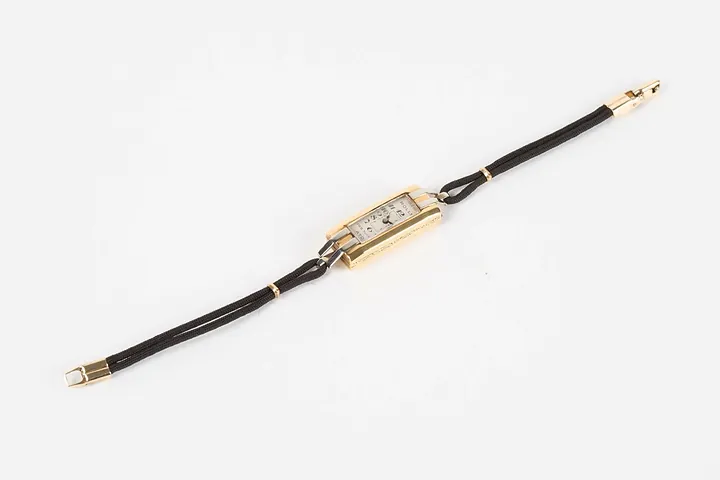
Wristwatches · c. 1932
Wristwatch by Blancpain, Switzerland, c. 1932
German Clock Museum

Wristwatches · 1945
Wristwatch by Eterna, 1945
Museum Rotterdam

Wristwatches · c. 1945
Breitling Premier, ref. 790, c. 1945
Antiquorum auction archive, Geneva

Wristwatches · c. 1945
Universal Genève Uni-Compax, ref. 22492, c. 1945
Antiquorum auction archive, Geneva

Wristwatches · c. 1950s
Baume & Mercier wristwatch, c. 1950s
Antiquorum auction archive, Geneva