
Wristwatches · Wristwatch
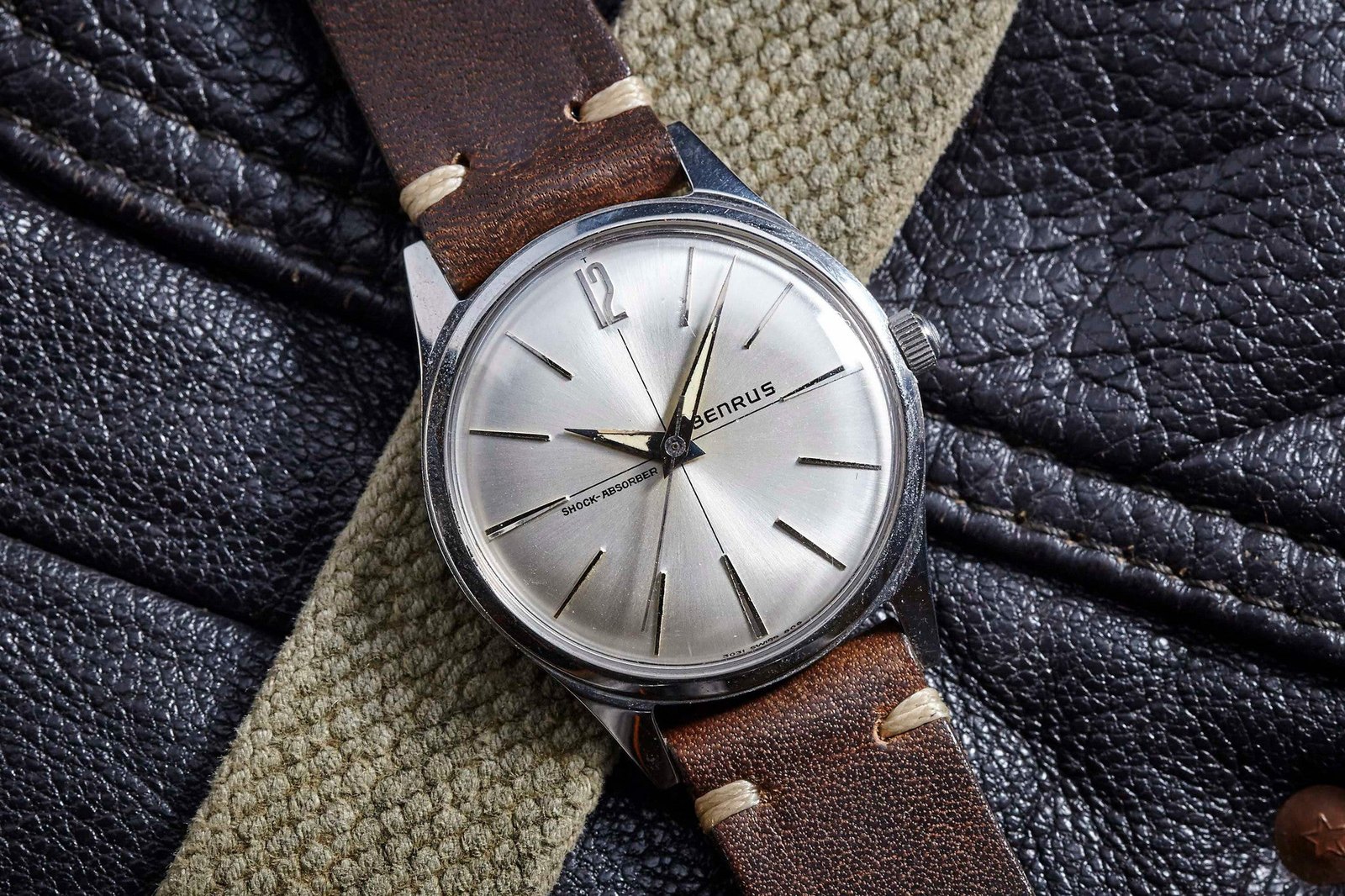
Benrus 3021 Crosshair, late 1950
- Maker / attribution
- Benrus (maker)
- Date
- late 1950
- Historical period
- Modern Mechanical Horology (1945 – 1969)
- Country of origin
- United States
- Object type
- Wristwatch
- Dimensions
- Case 34 mm
- Stock no.
- Product 3573077889
- Credit line
- Dealer listing, Analog/Shift (product 3573077889)
- Catalogue title (original)
- Benrus 3021 Crosshair (English)
View the source record (dealer listing) ↗ (opens another website in a new tab)Suggest a correction
Record summary
Catalogued by Analog/Shift (dealer), New York (stock number Product 3573077889), this is a wristwatch by Benrus, made in United States, dated late 1950. The Atlas places it in the Modern Mechanical Horology period (1945 – 1969) of its Wristwatches collection. Recorded dimensions: Case 34 mm. The record is illustrated with 6 photographs.
Assembled from the source record's structured fields. Dates and attributions are given as the source states them; where a field is missing the Atlas leaves it blank rather than estimating.
Catalogue description
Dealer description — Analog/Shift
We’ve joined forces with our friends at 10:25 Vintage, a New York-based operation with a shared enthusiasm for interesting vintage timepieces, to bring you a robust handpicked collection that is both exceptional and affordable. Perfect for the discerning collector on a budget, these pieces provide an excellent entry point to the joys of vintage watches. The Benrus Watch Company, founded in New York City in 1921, has long been linked to its war-time watches that were produced for the U.S. government during both WWII and Vietnam. With large assembly efforts in the U.S., including a case factory in Waterbury, CT, Benrus was an honest-to-goodness American watch company, 2 nd only to Hamilton during this time period. It's safe to say that their civilian and military efforts were very much intertwined, and pieces like this help us connect the dots between the two. Dating to the late 1950’s, this piece is housed in a 34mm Series 3021 one-piece stainless steel case, the very same case used for the well-known pilot watches of the Vietnam era. While the military versions had a corrosion-resistant matte gray finish and lacked any brand markings, this civilian version proudly features the Benrus name and beautiful brushed and polished surfaces all around. Inside, the Benrus DR2-F1 movement is a close cousin of those found in the military watches as well, lacking only a hacking mechanism. Despite Benrus’s recent reincarnation, these vintage versions are notoriously difficult to find in such good condition, and with their military cousins drawing serious attention across the board, they sneak quietly under the radar.
Historical context
Modern Mechanical Horology (1945 – 1969)
Tool watches for divers, pilots and astronauts; electric watches anticipate the electronic age.
The classic era of the mechanical wristwatch: dive watches, chronographs for motor racing and space flight, GMT watches for jet travel, slim dress watches, automatic calendars, and the rise of Japanese manufacturers alongside Swiss, American, German and Soviet industries.
Read the period in the timelineMore wristwatches from this periodEarlier: Golden Age of Mechanical Watchmaking
Atlas type guide
Wristwatches
Bracelet watches were worn by women from the early nineteenth century — Breguet made one for Caroline Murat, Queen of Naples, in 1810–12 — but the wristwatch only became a man's instrument with military use and aviation in the early twentieth century. Between the World Wars it overtook the pocket watch; the 1920s and 1930s brought rectangular Art Deco cases, water-resistant cases and the first automatic winding systems.
After 1945 the wristwatch became a carrier of identity — dress watches, sports and dive watches, chronographs, calendars — produced by Swiss, American, Japanese, German, Soviet and Chinese industries. The quartz revolution after 1969 and the mechanical renaissance since the 1990s, including the rise of independent watchmakers, complete the story.
What to look for
- The reference number (between the lugs or inside the case back) and serial number, the starting point for dating.
- The calibre: its maker and number are often stamped under the dial or on the bridge.
- Originality of dial, hands and crown — refinished ('redial') dials are common.
- Case material marks: 18K/750, 14K/585, stainless steel, gold-filled, plated.
Dating clues
- Wire-lug cases: before c. 1925.
- Water-resistant screw-down cases: from 1926.
- Quartz movements: from 1969; sapphire crystals widespread after c. 1980.
General guidance written by the Atlas editors about this kind of object. It is not a statement about this particular piece; for that, rely on the source record above and on physical examination.
Related records
Wristwatches · c. 1960
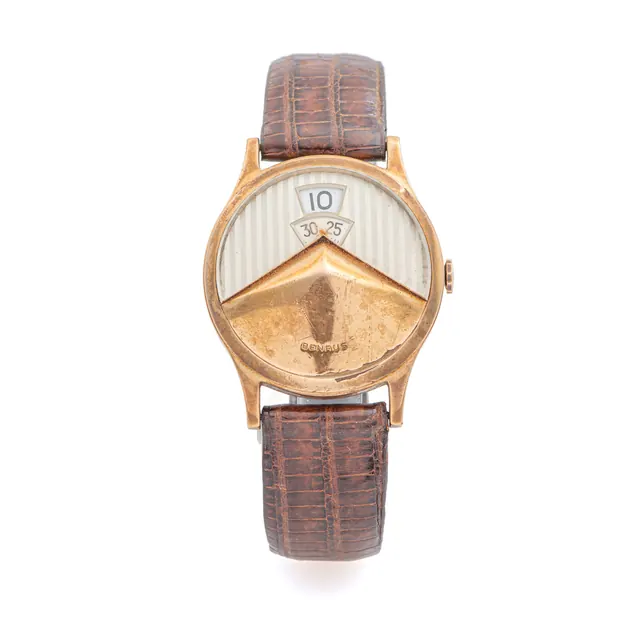
Benrus wristwatch, Dial-O-Rama Digital Jump Hour, circa 1960
Antiquorum auction archive, Geneva
Wristwatches · 1970s
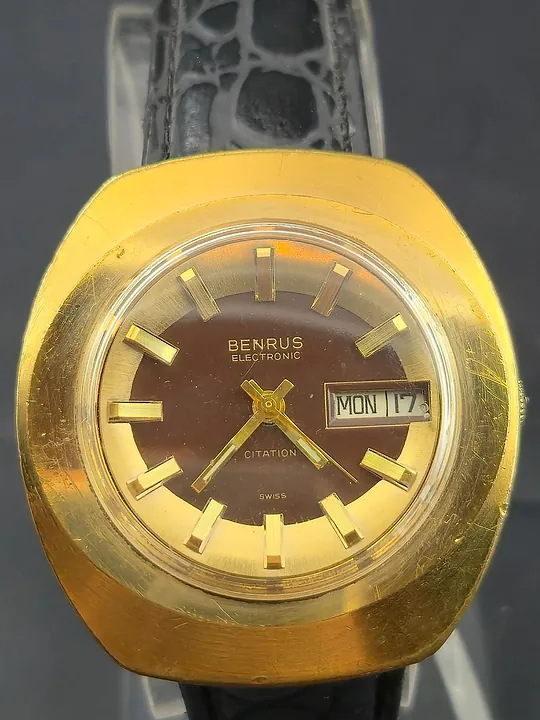
1970s Benrus Citation Electronic HS19 7J Day-Date Wristwatch, Gold-Tone Case, New Battery, Running
LiveAuctioneers auction archive
Wristwatches · 1950s
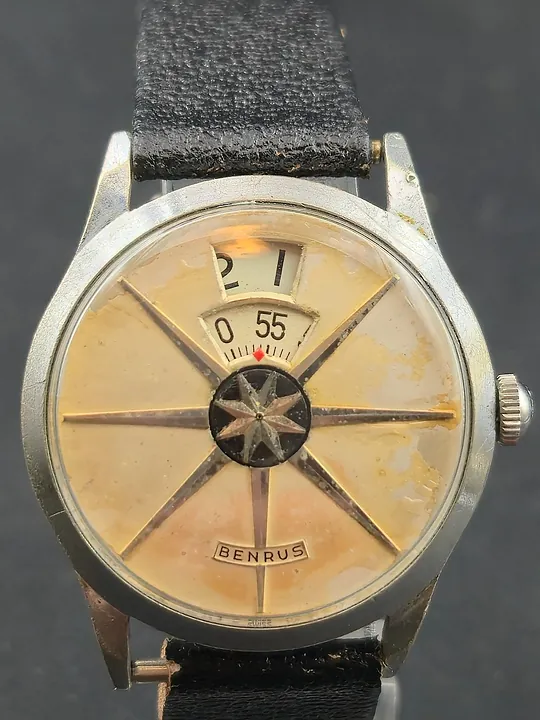
1950s Benrus “Dial-O-Rama” Jump Hour 17J Manual Wind Watch, 33 mm – Runs
LiveAuctioneers auction archive
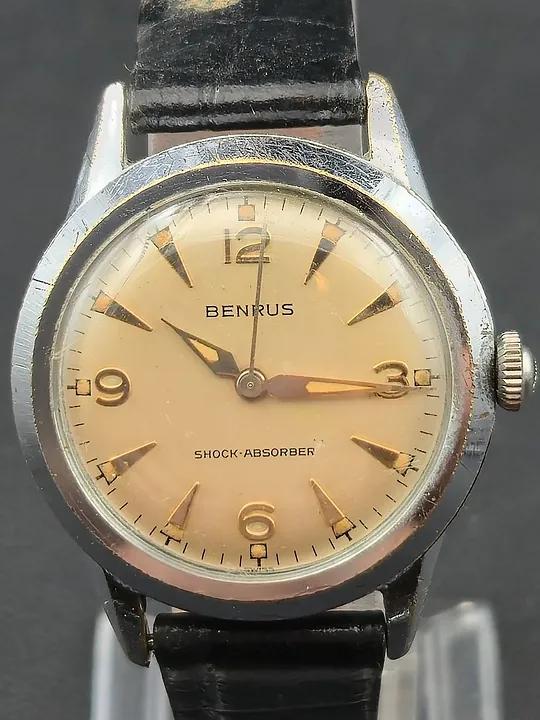
Wristwatches · 1940s
1940s Benrus Shock Absorber 17J U.S. Zone Germany 32mm Runs
LiveAuctioneers auction archive
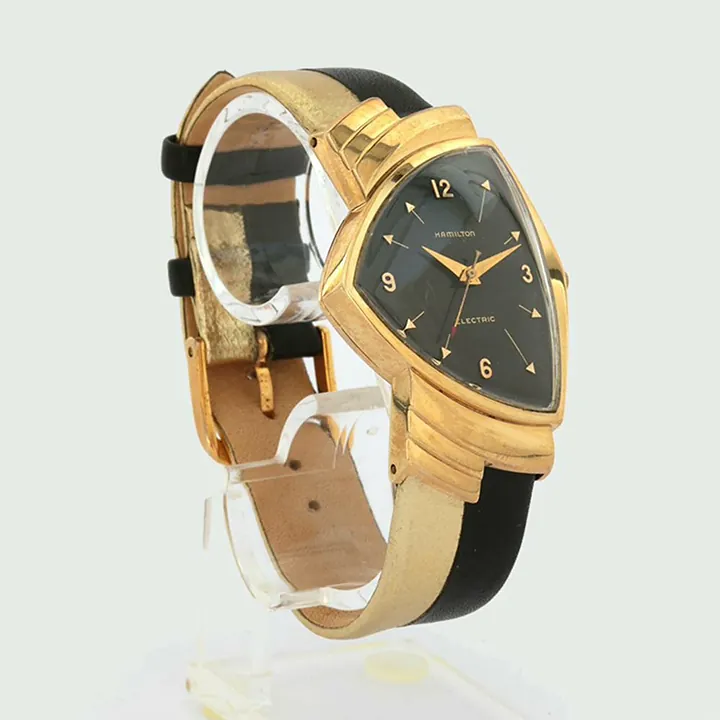
Wristwatches · c. 1957
Wristwatch by Richard H. Arbib, United States, c. 1957
German Clock Museum
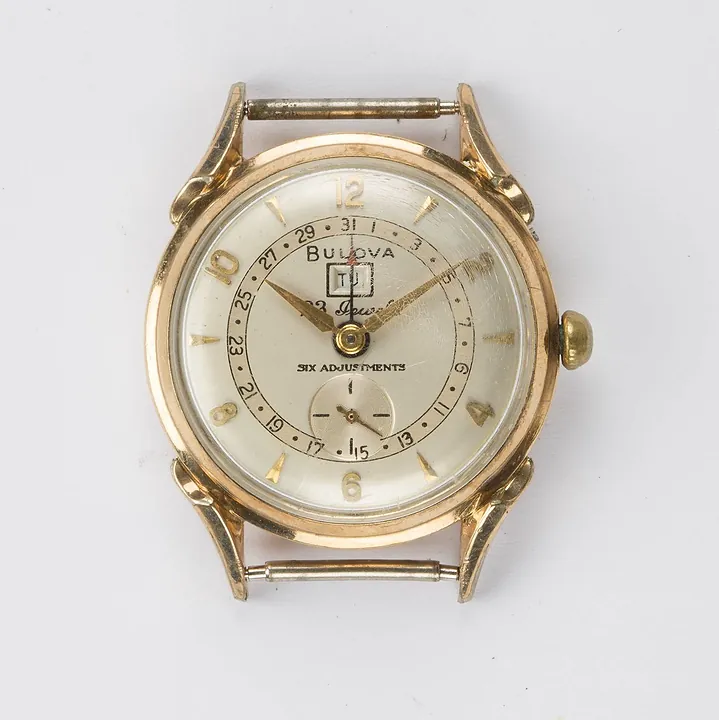
Wristwatches · 1959
Wristwatch by Josef Bulova, United States, 1959
German Clock Museum
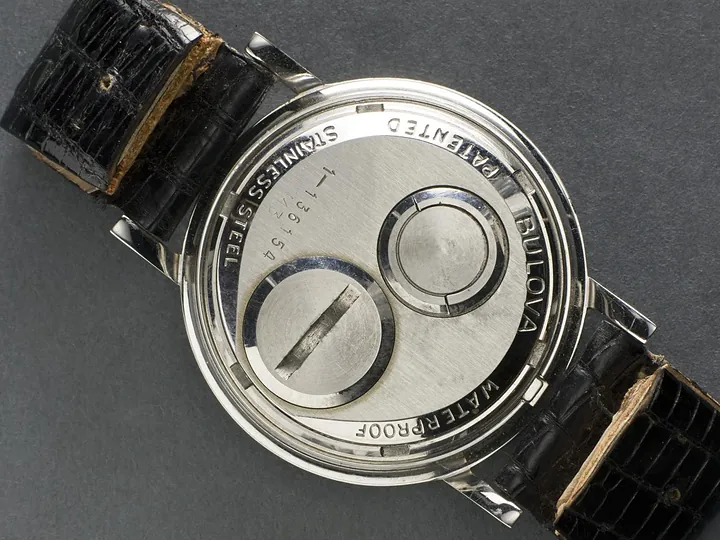
Wristwatches · 1960–1963
Bulova Accutron tuning-fork wristwatch on a demonstration stand, designed by Max Hetzel, United States, 1960–1963
Science Museum Group, London
Wristwatches · 1964
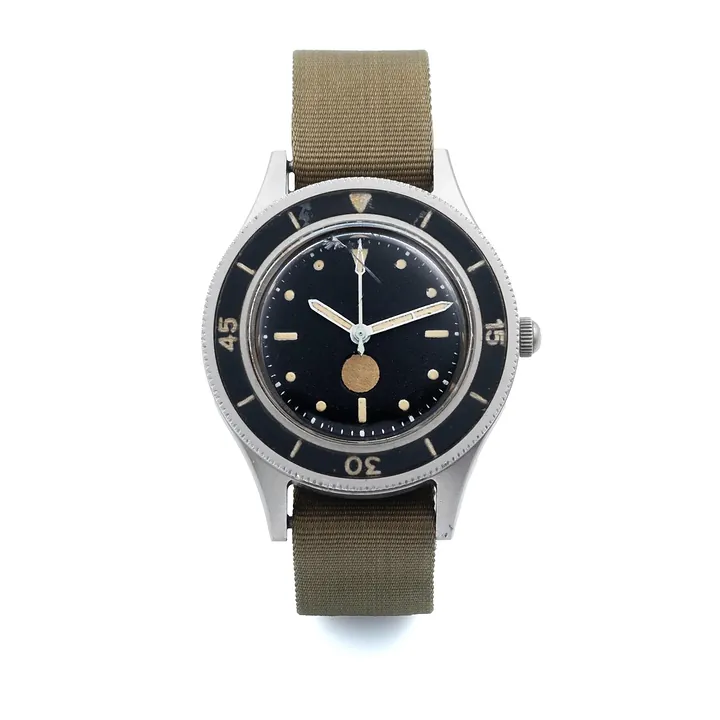
Tornek-Rayville wristwatch, ref. TR 900, 1964
Antiquorum auction archive, Geneva