Clocks · Clock
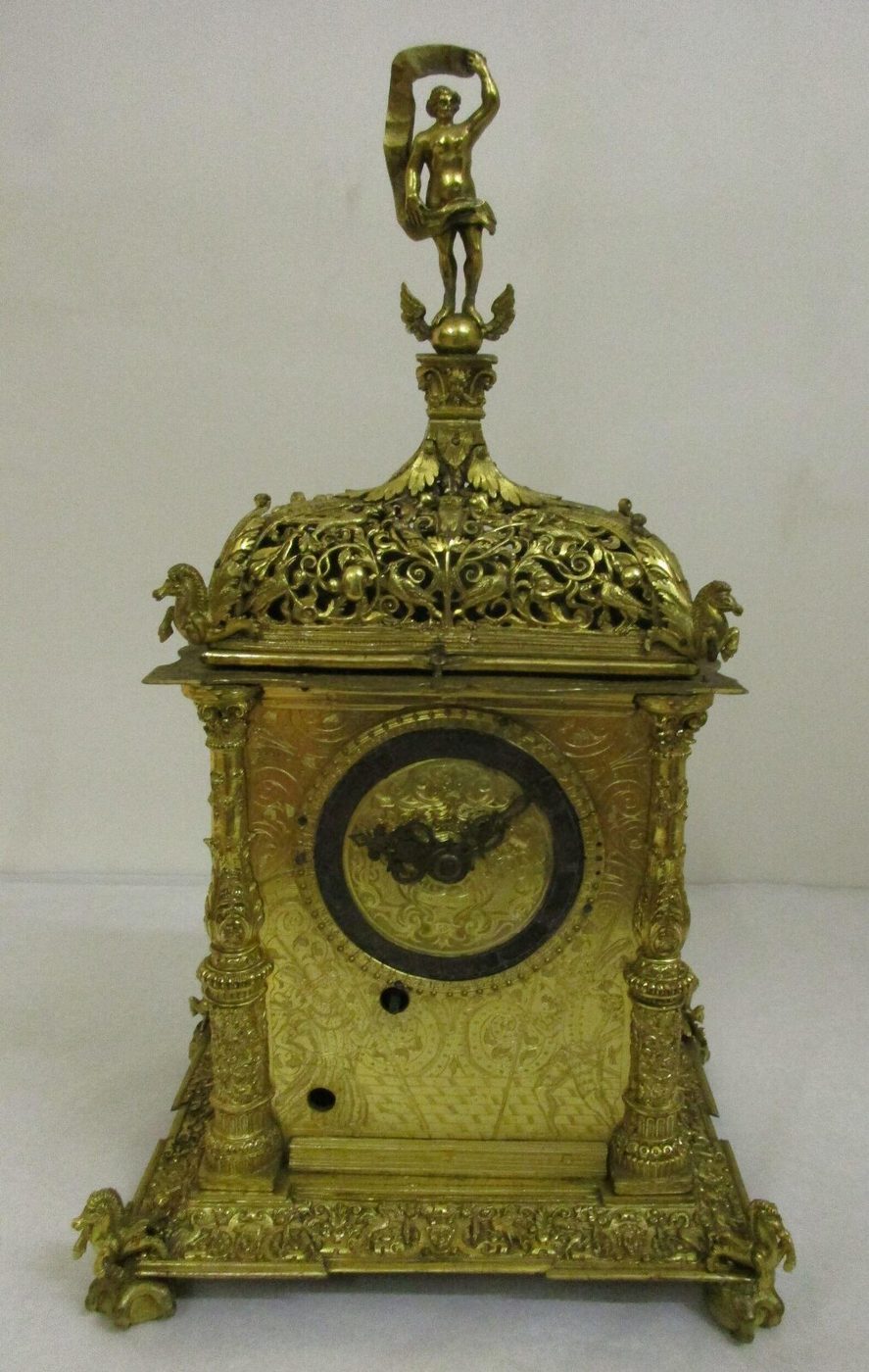
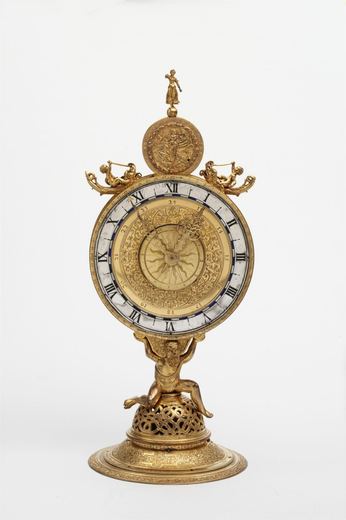
Astronomical tabernacle clock, gilt metal, cast, pierced and engraved, Austrian or South German, late 16th Century.
- Maker / attribution
- Unrecorded in source
- Date
- 1585-1600
- Historical period
- Renaissance Horology (1400 – 1600)
- Country of origin
- Germany
- Place
- Southern Germany, Munich
- Object type
- Clock
- Materials / technique
- Gilt copper alloy, cast, chased and engraved
- Dimensions
- Height: 34.2 cm; Width: 20.3 cm (maximum width); Depth: 15.1 cm; Weight: 5367.8 g
- Holding institution
- Victoria and Albert Museum, London
- Accession / object no.
- 2379-1855
- Credit line
- Purchased at the sale of Ralph Bernal's Collection, 1855
Record summary
Held and catalogued by Victoria and Albert Museum, London (object number 2379-1855), this is a clock, made in Southern Germany, Munich, dated 1585-1600. The Atlas places it in the Renaissance Horology period (1400 – 1600) of its Clocks collection. Materials and techniques recorded by the source: Gilt copper alloy, cast, chased and engraved. Recorded dimensions: Height: 34.2 cm; Width: 20.3 cm (maximum width); Depth: 15.1 cm; Weight: 5367.8 g. The record is illustrated with 4 photographs.
Assembled from the source record's structured fields. Dates and attributions are given as the source states them; where a field is missing the Atlas leaves it blank rather than estimating.
Catalogue description
V&A — Summary
A gilt-metal architectural cased clock surmounted by a cupola with a statuette representing Fortune. There are ornamental columns at each corner and the lower section is chased with masks and ornamental cartouches. The cupola formed cover encloses two bells and is pierced and chased with scrolls and birds. The lower corners are decorated with sea horses. The disc in the centre of the dial is inscribed 'Friede En Munich 1587'; Peace in Munich 1587. The clock was acquired at the sale of the collection of lawyer and politician Ralph Bernal in 1855.
V&A — Physical description
Square clock of gilded brass surmounted by a cast, gilded finial representing Fortune, supported by four ball and claw feet surmounted by sea horses. The sides and dial are engraved, gilded plaques framed by cast metal, gilded, columns. The base is cast and chased with grotesque ornament, the pierced cover cast with scrolls and birds. Case: Rectangular gilt copper alloy case of architectural form on flanged base supported by four ball-and-claw feet (probably later additions). The base is cast and chased in relief with strapwork, foliage, birds, grotesque figures and mascerons. Applied hippocamps at the lower corners. At the corners above are multiple baluster-shaped three-quarter columns with Corinthian capitals decorated in relief with acanthus and other foliage and swags held in the mouths of the mascerons. The sides of the case and flanges of the dial are engraved with arabesques and strapwork, framing on the front; two landesknechts in 16th century dress and armour with halberds; on the back; David and Goliath; on the sides; paired figures in arches possibly representing the quadrivium of the Liberal Arts, Geometry, Arithmetic, Astronomy and Music. Above the cornice, a rectangular ogee-shaped cupola is pierced with interlaced foliage and birds. Dials: The Front dial is 8.9 cm in diameter. The outer minute ring with a touch pin for each number; inside this; an inset silver chapter-ring 0.6 cm broad with Roman numerals I-XII and minute marks (a later replacement). The central brass disc signed 'Friede En Munich 1587'. The hands are pierced brass. The rear dial is 10.2 cm diameter. The outer ring with I to XII in Roman numerals with touch points 1 to 24 in arabic inside. The central disc of the dial 6.3 cm inches diameter now missing, probably an astronomical dial. The hands are missing. Movement: The going train in the centre, now with brass wheels and anchor escapement. The crutch with pin and pendulum missing. The fusee and chain wound through a gearing through a hole in the front plate. Drive to the hour-hand through reduction gearing from the fusee. Step-up drive to the minute hand. The drive to the rear dial now missing. In left part of the movement, locking-plate, striking rain, placed transversely, with brass barrel, iron fusee and chain and iron wheels. Brass count wheel and click, probably somewhat later replacements. Striking on larger bell. In right part of movement; chime train, also transverse, with brass barrel, iron fusee, chain and wheels. Chiming on smaller bell. Brass count-wheel, probably later replacement. Probablyu a former alarm train at lower left of movement. Striking winding hole marked S; quarter chime wind hole marked V
V&A — Object history
Nothing is known of the clock's early owners. It was acquired by the lawyer, politician and collector Ralph Bernal. Following his death in 1854, the clock was bought by the Museum on the 29th day of the sale of Bernal's large and important art collection in 1855. The shape of the clock case is characteristic of those made in the second half of the 16th century in Augsburg, Nuremberg, Munich and Vienna. The rectangular plan; the profiled base, ornamental reliefs, richly ornamented columns with cylindrical and baluster segments and the sculpturally worked pierced cupola (although this too may be a replacement). (The clock by Hans Gasteiger, 1562-3 from the Munich collection of Alfred Pringsheim Sotheby's London 2 July 2013 provides an interesting comparison. The strapwork decoration and the engravings of the Liberal Arts are likely to be contemporary. The finial figure of Fortuna is a later marriage as it is too large in proportion to the case. It is probably that the case is made up from several 16th century clock cases - the dial would not normally touch the top of the case. Lorenz Seelig has suggested that the clock may have been made in Munich. The inscription 'Friede En Munich 1587' indicates that 'it is peaceful in Munich in 1587' during the reign of duke Wilhelm V known as the 'Pious'. In 1583 the Wittelsbach dynasty conquered the 'Erzstift' the secular territory of the archbishopric of Cologne - thus the 'war of Cologne' ended and duke Ernst of Bavaria, younger brother of duke Wilhelm V, became elector and archbishop of Cologne. William V tried to establish a confederation of Catholic German princes and territories including Protestant representatives in 1587; which did not succeed. Provenance Ralph Bernal (1783-1854) was a renowned collector and objects from his collection are now in museums across the world, including the V&A. He was born into a Sephardic Jewish family of Spanish descent, but was baptised into the Christian religion at the age of 22. Bernal studied at Christ's College, Cambridge, and subsequently became a prominent Whig politician. He built a reputation for himself as a man of taste and culture through the collection he amassed and later in life he became the president of the British Archaeological Society. Yet the main source of income which enabled him to do this was the profits from enslaved labour. In 1811, Bernal inherited three sugar plantations in Jamaica, where over 500 people were eventually enslaved. Almost immediately, he began collecting works of art and antiquities. After the emancipation of those enslaved in the British Caribbean in the 1830s, made possible in part by acts of their own resistance, Bernal was awarded compensation of more than £11,450 (equivalent to over £1.5 million today). This was for the loss of 564 people enslaved on Bernal's estates who were classed by the British government as his 'property'. They included people like Antora, and her son Edward, who in August 1834 was around five years old (The National Archives, T 71/49). Receiving the money appears to have led to an escalation of Bernal's collecting. When Bernal died in 1855, he was celebrated for 'the perfection of his taste, as well as the extent of his knowledge' (Christie and Manson, 1855). His collection was dispersed in a major auction during which the Museum of Ornamental Art at Marlborough House, which later became the South Kensington Museum (now the V&A), was the biggest single buyer.
V&A gallery label
Clock. Gilt metal, square, with an ornamental columns at each angle, the basement chased with masks and cartouche ornaments; a cover enclosing two bells, pierced and chased with scrolls and birds; sea horses at the angles, surmounted by a statuette of Fortune. German (Munich). Dated 1587. H. 13 1/2 in., W. 8 1/4 in. by 6 in. Bought (Bernal coll.), 90l. 2379-'55
Inscriptions & marks
Friede En Munich 1587
Historical context
Renaissance Horology (1400 – 1600)
Spring power makes clocks portable; Nuremberg and Augsburg produce the first watches; the Prague Orloj is built.
Spring power made the domestic clock portable. Augsburg and Nuremberg produced gilt-brass table clocks, often with astronomical dials and alarms; weight-driven Gothic wall clocks and English lantern clocks served households. Clocks of this period have foliot or balance-wheel control and usually only an hour hand.
Read the period in the timelineMore clocks from this periodEarlier: Medieval Period
Atlas type guide
Bracket, table and spring-driven clocks
Spring-driven clocks freed timekeeping from the hanging weight. The coiled mainspring, documented from the fifteenth century, made portable table clocks possible; to even out its declining force, makers used the fusee, a conical pulley connected to the barrel by a gut line or chain. Renaissance table clocks from Augsburg and Nuremberg — drum-shaped, square or tower-shaped in gilt brass — were luxury scientific objects, often with astronomical dials and alarms.
After the pendulum, English makers developed the bracket clock: a wooden case with a carrying handle, a short pendulum with a verge escapement, and often repeating work to sound the hours on demand at night. Later examples use the anchor escapement. In the nineteenth century, 'table clock' became a broad term for spring clocks of every nationality.
What to look for
- A fusee in the movement (cone-shaped pulley) and the type of line — gut or chain.
- Verge escapement with a short bob pendulum, often with a decoratively engraved backplate.
- Repeat cords or buttons that make the clock strike again on demand.
- Gilt-brass engraved cases and horizontal dials on Renaissance pieces.
- Case shapes: inverted bell, bell top, break-arch, lancet or balloon.
Dating clues
- Drum and tower table clocks: c. 1520–1650.
- Ebony veneered English bracket clocks with verge escapements: c. 1670–1800.
- Engraved backplates were usual on English clocks until c. 1800, then generally plain.
General guidance written by the Atlas editors about this kind of object. It is not a statement about this particular piece; for that, rely on the source record above and on physical examination.
Read next:Verge escapement
Related records
Clocks · 1400–1499
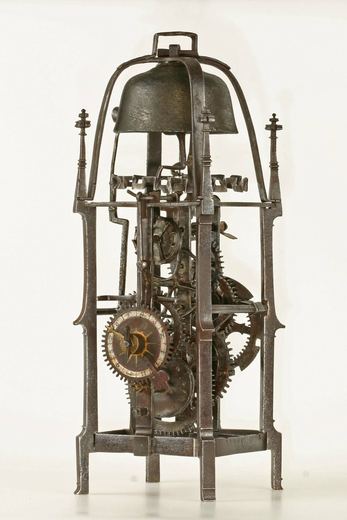
Alarm clock, Germany, 1400–1499
German Clock Museum
Clocks · 1400-1499
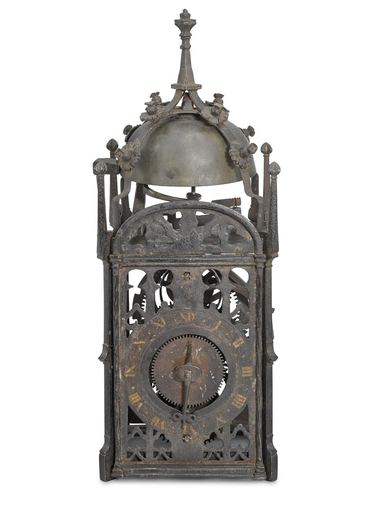
Lantern clock, Germany, 1400-1499
Science Museum Group, London
Clocks · 1500–1599
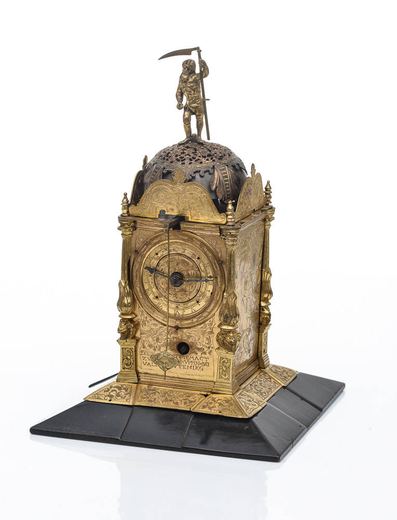
Table clock by Rutenieg, Valentin (um 1550) (Uhrmacher), Germany, 1500–1599
City Museum Berlin
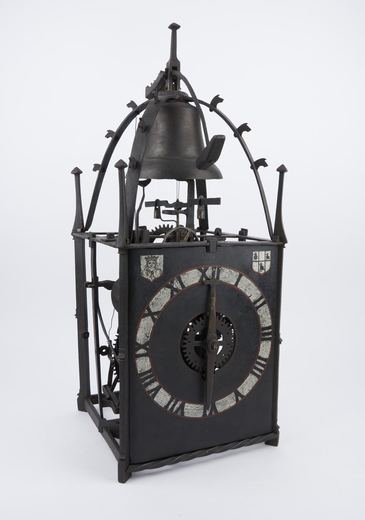
Clocks · 1501-1600
German 16th century iron chamber clock
Science Museum Group, London
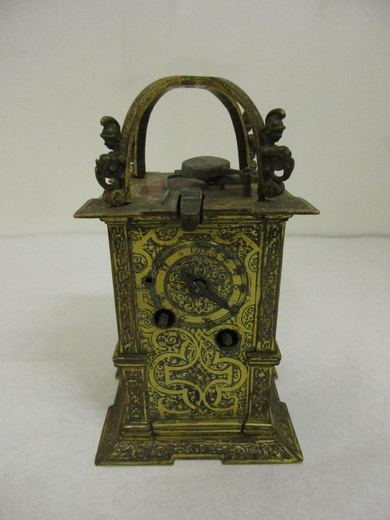
Clocks · ca.1550
Clock, a striking alarm clock in a gilt brass case, Germany, ca.1550.
Victoria and Albert Museum, London
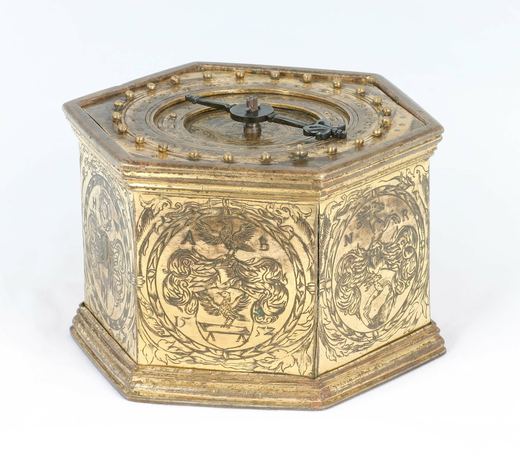
Clocks · 1552
Carriage / travel clock, Germany, 1552
German Clock Museum
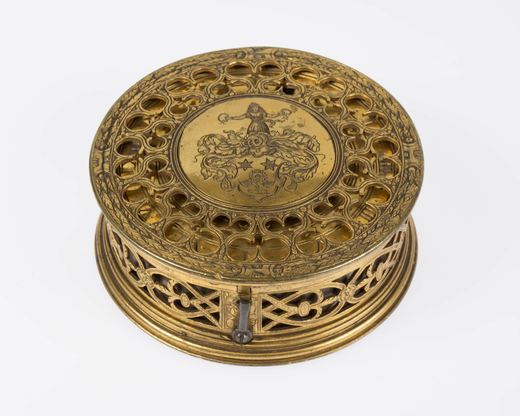
Clocks · 1560
Carriage / travel clock by HG, Germany, 1560
German Clock Museum
Clocks · 1564
Clock, gilt brass with enamelled silver dial ring, signed by Jeremias Metzger, Augsburg, southern Germany, dated 1564
Victoria and Albert Museum, London