Clocks · Astronomical clock
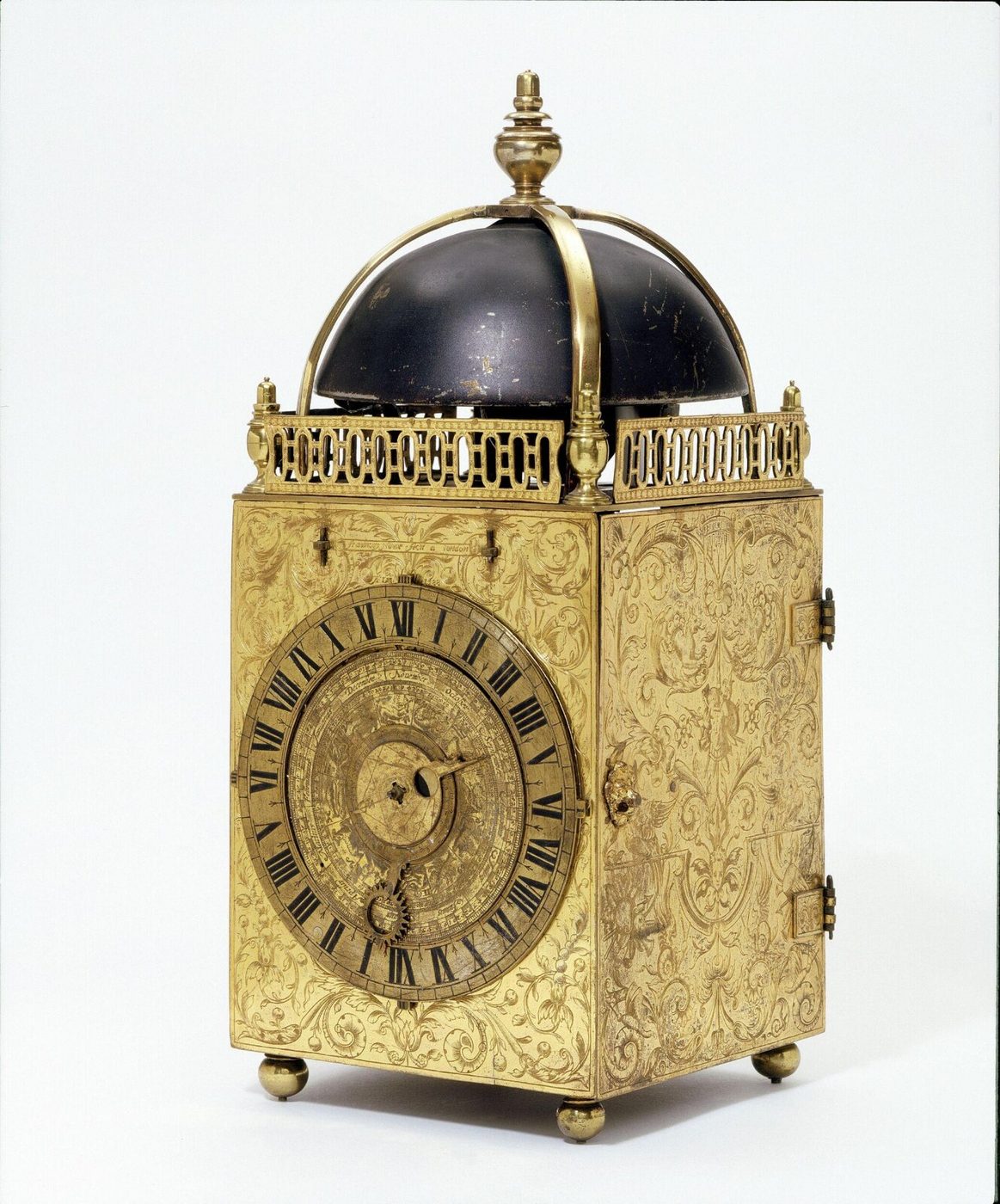
Astronomical clock by Francis Nowe, England, 1588
- Maker / attribution
- Francis Nowe (maker)
- Date
- 1588
- Historical period
- Renaissance Horology (1400 – 1600)
- Country of origin
- England
- Place
- London
- Object type
- Astronomical clock
- Materials / technique
- Engraved and gilded brass, steel bow hand
- Dimensions
- Height: 38.2 cm; Width: 15.7 cm; Depth: 15.9 cm
- Holding institution
- Victoria and Albert Museum, London
- Accession / object no.
- M.39:1 to 6-1959
Record summary
Held and catalogued by Victoria and Albert Museum, London (object number M.39:1 to 6-1959), this is an astronomical clock by Francis Nowe, made in London, England, dated 1588. The Atlas places it in the Renaissance Horology period (1400 – 1600) of its Clocks collection. Materials and techniques recorded by the source: Engraved and gilded brass, steel bow hand. Recorded dimensions: Height: 38.2 cm; Width: 15.7 cm; Depth: 15.9 cm. The record is illustrated with 4 photographs.
Assembled from the source record's structured fields. Dates and attributions are given as the source states them; where a field is missing the Atlas leaves it blank rather than estimating.
Catalogue description
V&A — Summary
Object Type This is one of the earliest weight-driven clocks recorded and is the earliest English clock to bear a date. The whole of the present movement dates from the late 17th century, when the clock was modernised. The original movement was probably similar to that in a clock in the British Museum, London, signed by Nicholas Vallin and dated 1598. Construction The gearing for the astronomical work provides for a minute hand rotating every hour, a sun pointer rotating once in a lunar day and an additional wheel that rotates in just over 24 hours. A central disc carries the moon pointer and an index showing the age of the moon and the time of high water at London Bridge. When the date disc is correctly set by hand, the sun and moon pointers show the positions of the sun and moon in the zodiac. The equinoxes are shown at 12 March and 12 September. Design & Maker The maker Francis Nowe - his surname is spelled in various ways - is probably the clockmaker of that name who was born in Hartick van Bourse in Brabant in the Low Countries. In 1571 he came to London, where this clock was made, to escape religious persecution. The very fine engraved ornament is based upon the designs of Etienne Delaune (1519-1583) and Abraham de Bruyn (1540-1587). A cup with London hallmarks for 1573-1574, the Magdalen cup, now in Manchester City Art Gallery, has similar engraved decoration. Francis Nowe died in London in 1593.
V&A — Physical description
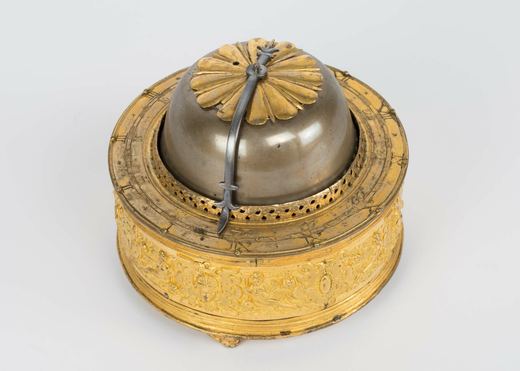
The case of gilt brass signed 'Frauncoy Nowe fecit a London A o DM o 1588' the engraved decoration probably based on designs by Etienne Delaune and Abraham de Bruyn. The brass frame formed of four simple Doric columns joined at top and bottom by square brass plates and mounted on four ball feet. This is original 16th century work. Upper top plate mounted on four small supports. Front and back plates pinned to the frame, side plates hinged and secured to front plate by spring latches. Front and side plates gilt and engraved with strapwork and foliage, trophies of arms, birds and grotesques, snails, butterflies and cherub heads. Case corners surmounted by original turned urn finials, between which at the front and sides runs an engraved and gilt cresting, pierced with egg and tongue decoration. Release buttons of door-latches cast in the form of lion masks and gilt. Three quarter-bells mounted between top-plate and upper top-plate; hour-bell above upper top-plate, screwed below a brass spider, with screw-head in the form of a fifth, larger urn finial. The bells are later replacements. Dial: Dial plate 8" x 6 1/4" (20.4 x 15.9 cms) with engraved chapter-ring 11.8 cm diameter, 1.3 cm broad, with roman hours I to XII and stars at the half hours. A ring 1.2" wide, now blank, surrounds the chapter ring. No hands. A later set of astronomical dials has been pinned over the original chapter-ring area but is now shown separately. This has an outer brass chapter-ring 14.5 cms diameter 2.2 cm broad, with roman hours I to XII, I to XII, outer ring of minute marks and small projections at the quarter-hours. Marked with roman numerals I to IIII. Within the ring a calendar disc of thinner brass (10.5 cm diameter), with an outer engraved ring of months and days and an inner set of pictorial zodiac signs with the number of degrees in each sign. The equinoxes are at March 12th and September 12th. Superposed on the calendar disc is a central rotating disc 2" diameter carrying a sun pointer in the form of a sunburst ring and graduated 1 to 12, 1 to 12, with an inner ring 1 to 29 1/2 for moon's age. A further superposed central disc 3.5 cms diameter carried the moon pointer and an index showing the moon's age and the time of high water at London Bridge. When the date disc is set by hand the sun and moon pointers show the positions of the sun and moon in the zodiac. The figure of Virgo is in late 16th century dress. The chapter ring and astronomical dial are later replacements. Movement: The whole present clock movement is of late 17th century date, with frame and wheels all of brass. Three weight driven trains and astronomical under-dial work. Going train in front, with anchor escapement, 30T escape wheel and pallets embracing 8 teeth. Crutch for long pendulum. Striking train in the middle, with locking-plate at rear of front compartment, released from a pin on the centre-wheel. Quarter-chiming - train at the rear, chiming on three bells and released from pins on the centre-wheel at the first, second and third quarters. Clicks on the striking and chiming train pulleys but not on that of the going train. The astromonical gearing provides for a minute-hand rotating once per hour, the sun-pointer rotating once in 24 hour, and a lunar pointer rotating once in a lunar day 24 x 59/57 hours. There is also a wheel which rotates once in 24 x 73/72 hours. This is in the form of a 72-T wheel cut and with an extra tooth inserted. With the clock there is a plain later17th century steel bow hand; a long pendulum with lenticular shaped brass, adjustable bob and brass attachment for the spring at the upper end; two cylindrical brass covered weights; small iron weight attached to a length of chord; two weight pulleys of iron and two lengths of modern iron chain.
V&A — Historical context
The clock was lent to the Exhibition of Works of Antient and Medieval Art at the Society of Arts in 1850 catalogue number 929 lent by R.T.Jopling of Landsown Villas, Brompton.
V&A — Object history
Made in London by Francis Nowe (born in Brabant, Belgium, died in London, 1593). Originally considered to be the earliesr surviving England lantern clock case, there is little of the 1588 clock that survives - just the outer case, Doric pillars, finials and feet. This is not sufficient evidence to regard this as a prototype lantern clock. The clock is recorded in the collection of R.T Jopling, Lansdown Villas, Brompton when it was lent in 1850 to an exhibition of 'Works of Antient and Medieval Art' at the Society of Arts, London, catalogue number 929. The clock was subsequently in the collection of the Christie family( of auctioneer fame) at the Manor House, Framingham Pigot, Norwich (see correspondence from James Christie to Claude Blair, March 1960 mounted in Bound Registe ) and was sold at auction by Christie's London 12 March 1959 lot 80. It was bought by Ronald Lee of Hampton Court for 240 guineas.
V&A — Production note
Dated 1588; the movement late 17th century
V&A gallery label
British Galleries: This is one of the earliest English weight-driven clocks to survive, and also the earliest dated English moveable clock. The clock uses different dials to indicate the age of the moon, the time of High Water at London Bridge, the positions of the sun and moon in the zodiac and the dates of the two equinoxes.
Inscriptions & marks
Inscribed 'Frauncoy Nowe fecit a London Ao Dino 1588'; Stamped on the back of the ring the mark of a lion rampant in a shaped shield is probably a plate maker's mark
Historical context
Renaissance Horology (1400 – 1600)
Spring power makes clocks portable; Nuremberg and Augsburg produce the first watches; the Prague Orloj is built.
Spring power made the domestic clock portable. Augsburg and Nuremberg produced gilt-brass table clocks, often with astronomical dials and alarms; weight-driven Gothic wall clocks and English lantern clocks served households. Clocks of this period have foliot or balance-wheel control and usually only an hour hand.
Read the period in the timelineMore clocks from this periodEarlier: Medieval Period
Atlas type guide
Astronomical, musical and automaton clocks
Astronomical clocks display more than the hour: the positions of the sun and moon in the zodiac, the phase of the moon, the calendar, sometimes the planets and eclipses. From Richard of Wallingford's and Giovanni de' Dondi's fourteenth-century clocks to the Prague Orloj and the Strasbourg cathedral clocks, they demonstrated the order of the cosmos. Renaissance makers in Augsburg and Nuremberg built celestial globe clocks and monstrance clocks as princely treasures.
Automaton and musical clocks entertained as well as informed: figures move, birds sing, organs and carillons play tunes from pinned cylinders. The eighteenth-century trade with China ('sing-songs') and Ottoman Turkey created a market for elaborate English, Swiss and French automata.
What to look for
- Subsidiary dials for moon phase, calendar, zodiac and planetary positions.
- Celestial globes or armillary spheres turned by the movement.
- Pinned cylinders, bellows and pipes or bells for music.
- Figures on cams and levers; separate trains for automaton work.
Dating clues
- Renaissance astronomical table and globe clocks: c. 1550–1650.
- English and Swiss automaton clocks for the Chinese market: c. 1760–1820.
- Picture clocks (clockwork pictures) are mostly nineteenth century.
General guidance written by the Atlas editors about this kind of object. It is not a statement about this particular piece; for that, rely on the source record above and on physical examination.
Read next:Verge escapementFusee
Related records
Clocks · 1400–1499
Alarm clock, Germany, 1400–1499
German Clock Museum
Clocks · Mid-15th century
Clock with iron movement in gilt brass case. Burgundian; mid-15th-century (with later restorations).
Victoria and Albert Museum, London
Clocks · 1400-1499
Lantern clock, Germany, 1400-1499
Science Museum Group, London
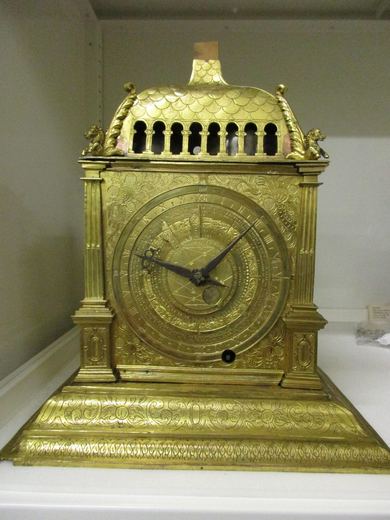
Clocks · 1500-1600
An astronomical clock in a gilt-bronze case, Venetian, sixteenth century.
Victoria and Albert Museum, London
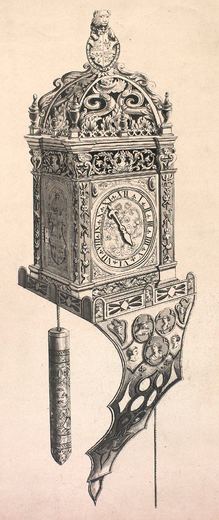
Clocks · 1500–1599
Bracket clock by Anne Boleyn, United Kingdom, 1500–1599
Archaeology Data Service
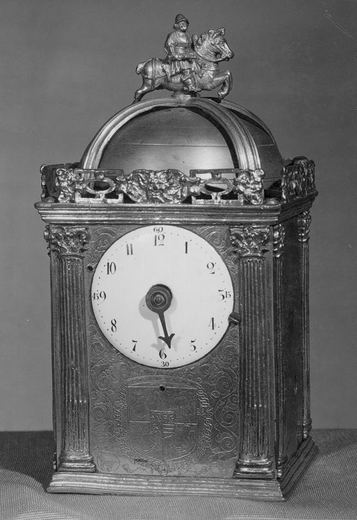
Clocks · 1500–1599
Clock by P. Plantart, Belgium, 1500–1599
Royal Institute for Cultural Heritage
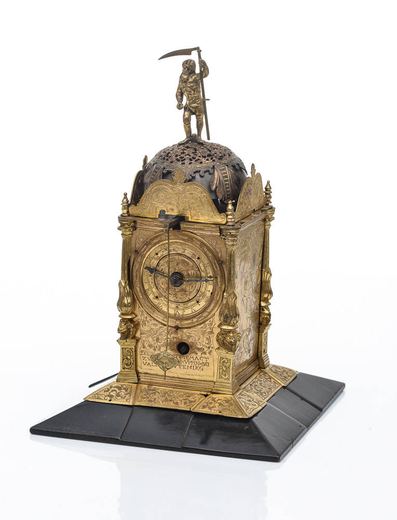
Clocks · 1500–1599
Table clock by Rutenieg, Valentin (um 1550) (Uhrmacher), Germany, 1500–1599
City Museum Berlin
Clocks · 1500–1599
Table clock, Denmark, 1500–1599
German Clock Museum