
Wristwatches · Wristwatch
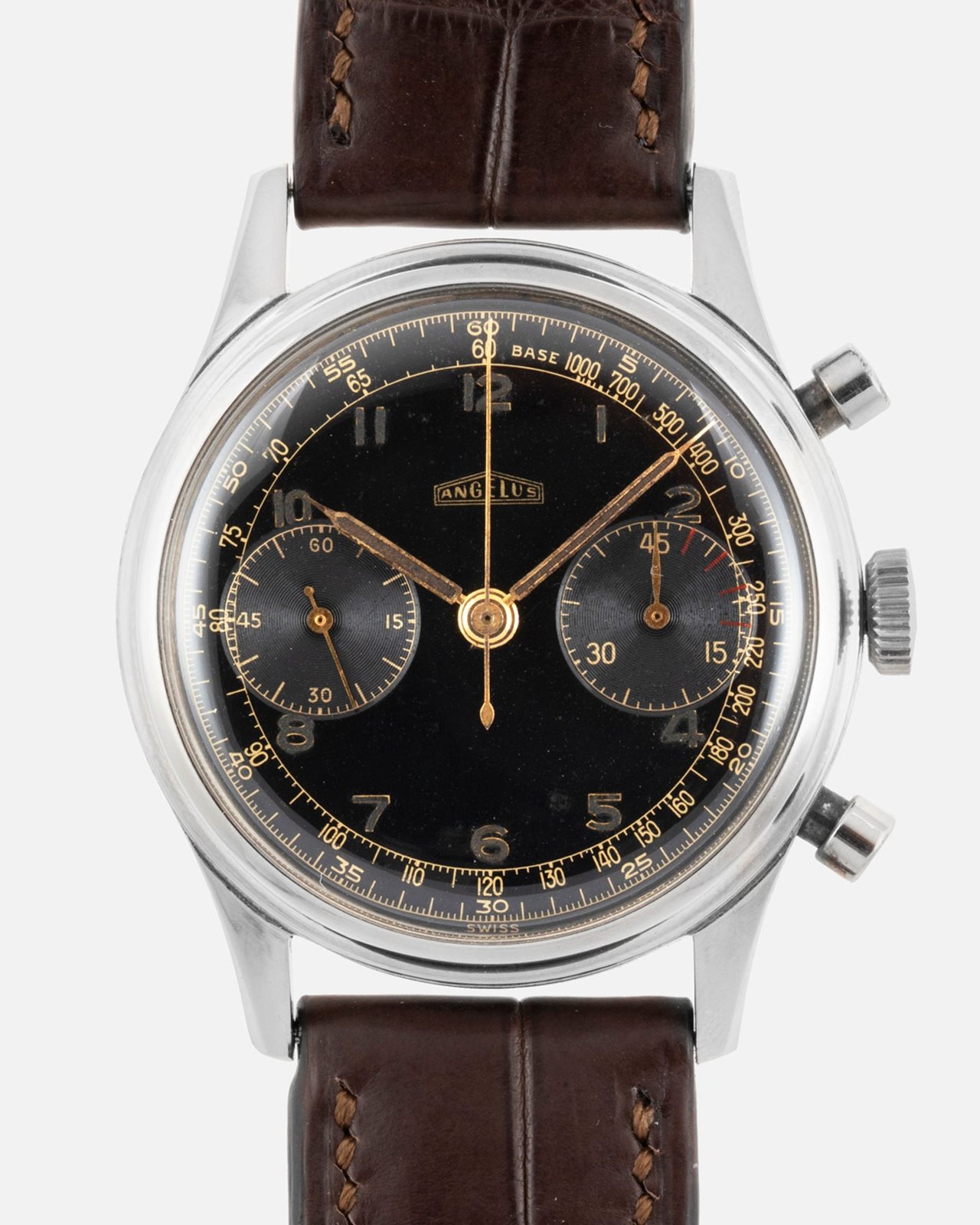
Angelus Cal. 215 L.E. Hungarian Air Force, 1950s
- Maker / attribution
- Angelus (maker)
- Date
- 1950s
- Historical period
- Modern Mechanical Horology (1945 – 1969)
- Country of origin
- Hungary
- Object type
- Wristwatch
- Dimensions
- Case 38 mm
- Stock no.
- Product 4368151216215
- Credit line
- Dealer listing, S.Song Watches (product 4368151216215)
- Catalogue title (original)
- Angelus Cal. 215 L.E. Hungarian Air Force (English)
View the source record (dealer listing) ↗ (opens another website in a new tab)Suggest a correction
Record summary
Catalogued by S.Song Watches (dealer), Seattle (stock number Product 4368151216215), this is a wristwatch by Angelus, made in Hungary, dated 1950s. The Atlas places it in the Modern Mechanical Horology period (1945 – 1969) of its Wristwatches collection. Recorded dimensions: Case 38 mm. The record is illustrated with 6 photographs.
Assembled from the source record's structured fields. Dates and attributions are given as the source states them; where a field is missing the Atlas leaves it blank rather than estimating.
Catalogue description
Dealer description — S.Song Watches
Back in the 20th century, there were only a few brands in the world that produced their own chronograph movements as it was a highly complex and costly thing to develop. Brands such as Omega, Minerva, Longines, Universal, Zenith, Movado and of course, Angelus were part of a handful of manufacturers that did such a thing. Often with their own style and in a much higher quality than the mass-produced Valjouxs or Venuses, today, chronograph brands such as Angelus are some of the most collectible vintage pieces around. To give you some perspective, even brands like Patek Philippe, Rolex and Audemars Piguet used outsourced movements. The Angelus 215 is perhaps the brand's most iconic and desirable chronograph, with a hugely oversized 38mm stainless steel case (for the era) and a beautiful black gilt printed, gloss dial, it is not hard to see why vintage collectors highly regard these pieces. Furthermore, the Cal. 215 is considered one of the great movements of the previous century and taking one look at it, you will be able to see its beauty and complexity. Furthermore, what makes this example so special is that while most examples were sold to the public, some were military issued to the Hungarian Air Force, denoted by the ‘L.E.’ engraving on the case back. While the Angelus archives were destroyed a long time ago, we have been able to establish that ‘L.E’ stands for Legi Ero, or Air Forces in English. In fact, the fact that these pieces were used by pilots explains the oversized case as legibility was of utmost importance during flight. With this Angelus 215, what you get is a very attractive watch with a historically important movement from one of the premier chronograph makers in the 20th century, and also a significant piece of military memorabilia.
Historical context
Modern Mechanical Horology (1945 – 1969)
Tool watches for divers, pilots and astronauts; electric watches anticipate the electronic age.
The classic era of the mechanical wristwatch: dive watches, chronographs for motor racing and space flight, GMT watches for jet travel, slim dress watches, automatic calendars, and the rise of Japanese manufacturers alongside Swiss, American, German and Soviet industries.
Read the period in the timelineMore wristwatches from this periodEarlier: Golden Age of Mechanical Watchmaking
Atlas type guide
Military, pilot and travel watches
The wristwatch owes much of its adoption by men to warfare and aviation. Wristlets — small pocket watches soldered with lugs and worn on a strap — were used in colonial campaigns and became standard equipment in the First World War, with protective grilles over the crystal ('shrapnel guards'). Louis Cartier's Santos (1904), designed for the aviator Alberto Santos-Dumont, is often cited as an early purpose-made pilot's watch.
In the Second World War governments specified watches in detail: the German B-Uhr observation watches, the American A-11, and the British 'W.W.W.' (the 'Dirty Dozen' set of 1945). After the war, jet travel brought GMT and world-time watches, which show two or more time zones at once — Louis Cottier's world-time mechanism and the Rolex GMT-Master (1955) are examples.
What to look for
- Military markings on the case back: broad arrow, issue numbers, 'W.W.W.', 'A.T.P.'
- High-legibility black dials with luminous Arabic numerals; oversized crowns for gloved hands.
- 24-hour hands and rotating 24-hour bezels or city rings on GMT/world-time watches.
- Wire lugs on early wristlets converted from pocket watches.
Dating clues
- Wire-lug wristlets: c. 1900–1925.
- Military specifications of the Second World War: 1939–1945.
- GMT and world-time wristwatches: mainly after 1950.
General guidance written by the Atlas editors about this kind of object. It is not a statement about this particular piece; for that, rely on the source record above and on physical examination.
Related records
Clocks · c. 1950
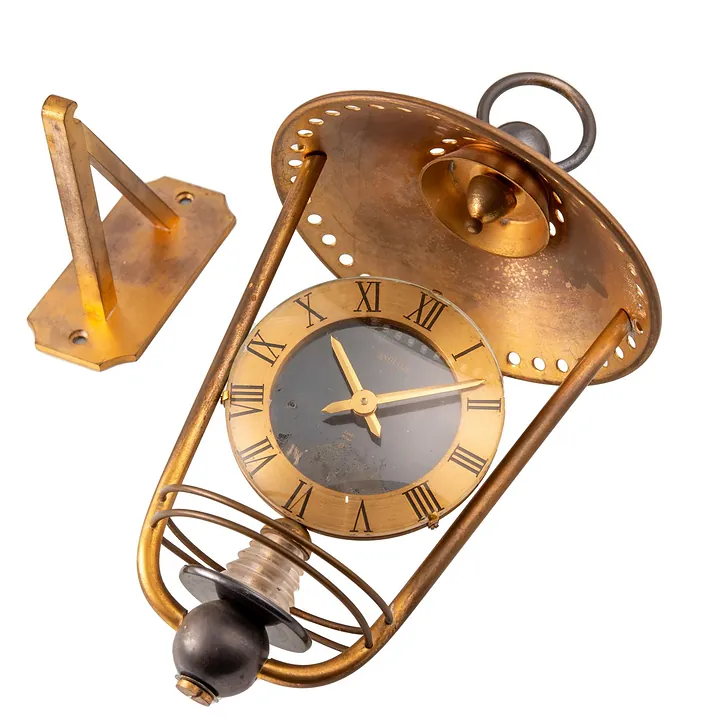
Angelus Retailed by Gobbi, Milano, c. 1950
Antiquorum auction archive, Geneva
Clocks · c. 1940s
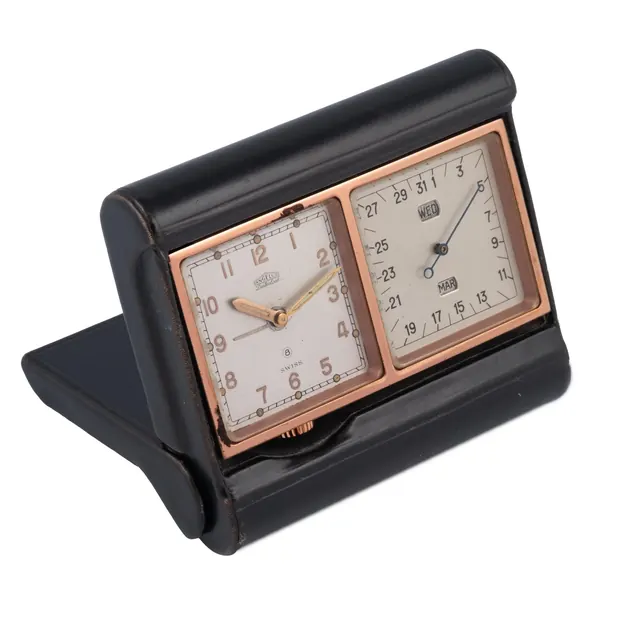
Angelus clock, Dateclock Gilt Brass, circa 1940's
Antiquorum auction archive, Geneva
Wristwatches · c. 1950
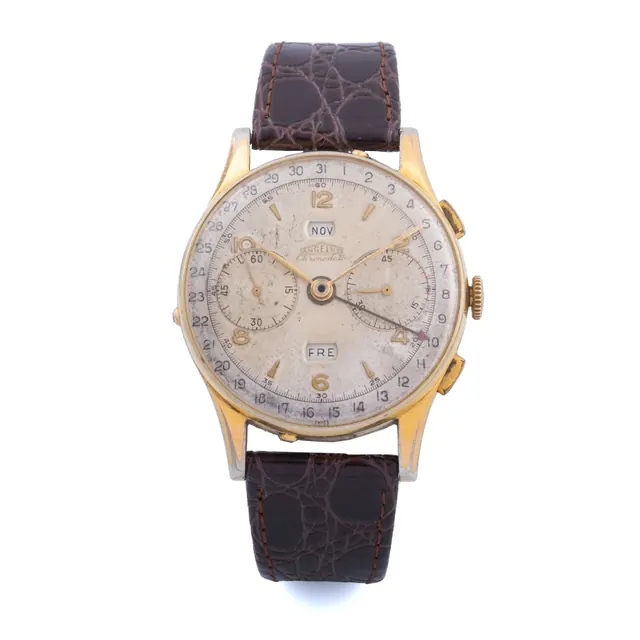
Angelus wristwatch, Swiss Crhronodato, circa 1950
Antiquorum auction archive, Geneva
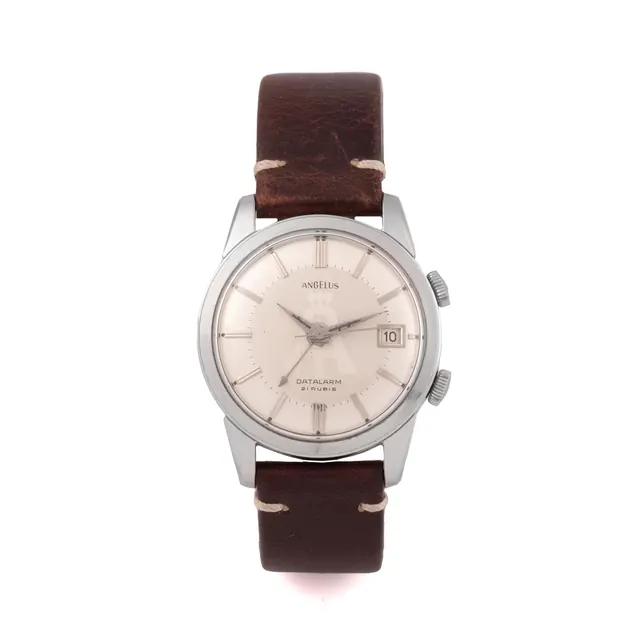
Wristwatches · c. 1960
Angelus wristwatch, ref. 10/11, Datalarm with Angelus Bell Logo On the Dial, circa 1960
Antiquorum auction archive, Geneva
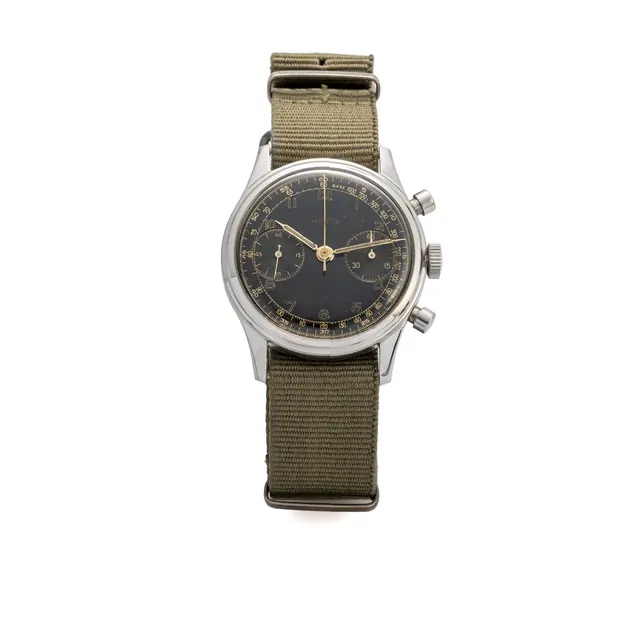
Wristwatches · c. 1950
Angelus wristwatch, Hungarian Air Force (L.E.) Chronograph, circa 1950
Antiquorum auction archive, Geneva

Wristwatches · 1945
Wristwatch by Eterna, 1945
Museum Rotterdam

Wristwatches · c. 1945
Breitling Premier, ref. 790, c. 1945
Antiquorum auction archive, Geneva

Wristwatches · c. 1945
Universal Genève Uni-Compax, ref. 22492, c. 1945
Antiquorum auction archive, Geneva