
Wristwatches · Wristwatch
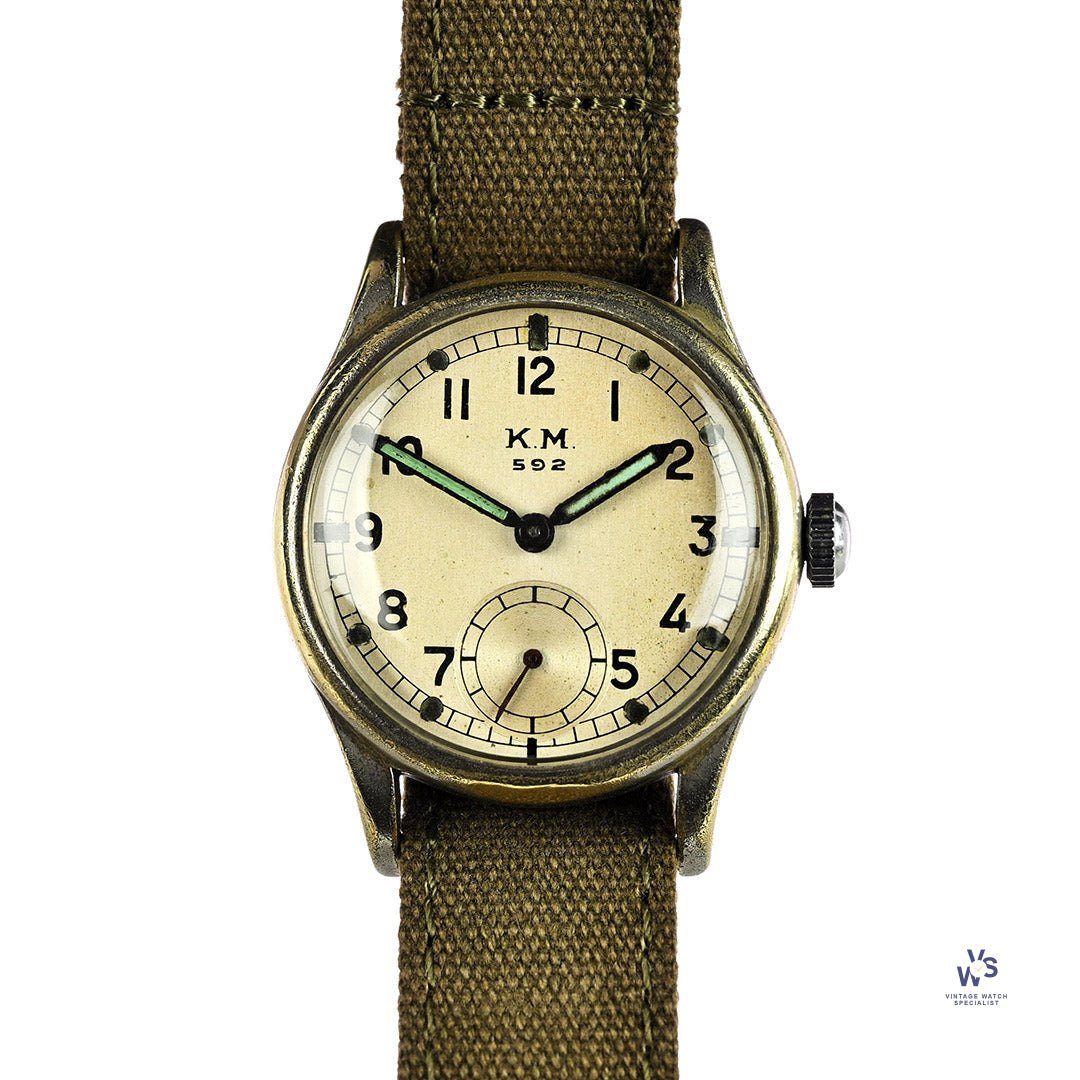
Alpina WWII Naval, KM Kriegsmarine Wristwatch, Calibre 592, circa 1944
- Maker / attribution
- Unrecorded in source
- Date
- c. 1944
- Historical period
- Golden Age of Mechanical Watchmaking (1900 – 1945)
- Country of origin
- Unrecorded in source
- Object type
- Wristwatch
- Dimensions
- Case 33 mm
- Stock no.
- vws3740
- Credit line
- Dealer listing, Vintage Watch Specialist (vws3740)
- Catalogue title (original)
- Alpina WWII Naval - KM Kriegsmarine Wristwatch - Calibre 592 - c.1944 (English)
View the source record (dealer listing) ↗ (opens another website in a new tab)Suggest a correction
Record summary
Catalogued by Vintage Watch Specialist (dealer), United Kingdom (stock number vws3740), this is a wristwatch, dated c. 1944. The Atlas places it in the Golden Age of Mechanical Watchmaking period (1900 – 1945) of its Wristwatches collection. Recorded dimensions: Case 33 mm. The record is illustrated with 6 photographs.
Assembled from the source record's structured fields. Dates and attributions are given as the source states them; where a field is missing the Atlas leaves it blank rather than estimating.
Catalogue description
Dealer description — Vintage Watch Specialist
A Very Well-Preserved WW2 Alpina Kriegsmarine Issued Watch in Original Condition with Nicely Aged Lume, c.1944 Alpina, founded in 1883, has a rich heritage in producing robust, precise timepieces. During the 1920s to 1940s, the brand supplied military-issued watches to various European armed forces. These watches were valued for their durability, legibility, and reliable in-house movements—traits essential for field use. Alpina’s commitment to functional design and rugged performance earned it a solid reputation among military personnel, laying the groundwork for its modern tool watches that continue to honor this legacy. What's on Offer We are pleased to offer this highly collectible and historically significant Alpina military-issued wristwatch, presented in well-preserved, original condition. Issued to the German Kriegsmarine (Navy) during World War II, this piece is marked K.M. 592 on the dial— K.M. indicating naval issue, and 592 referencing the movement calibre. The dial remains in excellent vintage condition, featuring bold Arabic numerals, a clear sub-seconds register, and luminous cathedral-style hands—classic hallmarks of mid-century military field watches designed for legibility and functionality. The lume on the hands has aged beautifully, adding to its authentic charm. The chrome-topped case shows only modest wear, entirely consistent with its age. At approximately 33mm, the watch wears well and retains its tool-watch presence, especially when paired with the rugged olive canvas strap. This is a rare opportunity to own an original Kriegsmarine-issued Alpina—an excellent addition for military watch collectors or vintage enthusiasts alike.
Historical context
Golden Age of Mechanical Watchmaking (1900 – 1945)
The wristwatch displaces the pocket watch; waterproof cases, self-winding and grand complications.
The wristwatch overtook the pocket watch. Military use in the First World War, aviation, water-resistant cases (1926), automatic winding (1923–31), rectangular Art Deco designs and early chronographs and calendars defined the period.
Read the period in the timelineMore wristwatches from this periodEarlier: Industrial Revolution
Atlas type guide
Dive and water-resistant watches
Keeping water and dust out of a wristwatch was a long-standing challenge. Rolex's screw-down Oyster case (1926) and Omega's Marine (1932) were landmarks; in the early 1950s Blancpain's Fifty Fathoms and Rolex's Submariner defined the professional dive watch with rotating bezels for timing dives, luminous dials and high water resistance. The ISO 6425 standard (1982) later codified what a 'diver's watch' must do.
Dive watches became icons of post-war design and exploration, and their evolution — helium escape valves, ceramic bezels, saturation-diving depth ratings — records the history of underwater work.
What to look for
- Unidirectional or bidirectional rotating bezel with minute markings.
- Screw-down crown and case back; depth rating printed on the dial.
- Luminous hands and markers (radium before c. 1960, tritium c. 1960–1998, then Super-LumiNova).
- Reference numbers on the case between the lugs or inside the back.
Dating clues
- Screw-down Oyster cases: from 1926.
- Professional dive watches: from 1953.
- Tritium 'T' marks on dials: c. 1960–1998.
General guidance written by the Atlas editors about this kind of object. It is not a statement about this particular piece; for that, rely on the source record above and on physical examination.
Related records
Wristwatches · 1900–1999
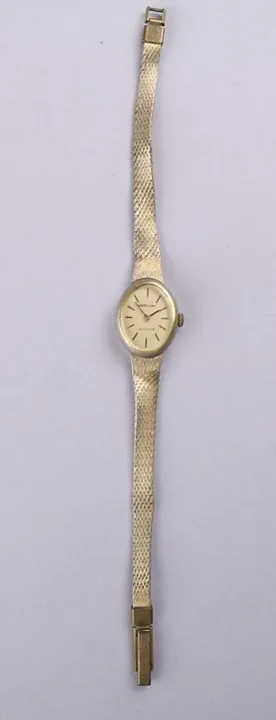
Wristwatch by Mercury, 1900–1999
Modemuseum Hasselt
Wristwatches · 1900–1999
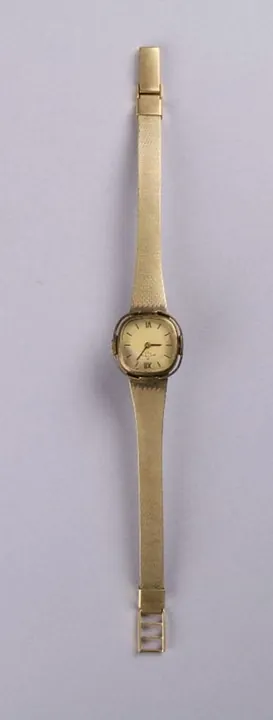
Wristwatch by Nutrix, 1900–1999
Modemuseum Hasselt

Wristwatches · 1920
Wristwatch, 1920
Modemuseum Hasselt

Wristwatches · 1931
Rolex 'Oyster Perpetual' rotor self-winding wrist-watch, lever escapement, in steel case with glass in back, Montres Rolex SA, Geneva, Switzerland, 1931
Science Museum Group, London
Wristwatches · c. 1936
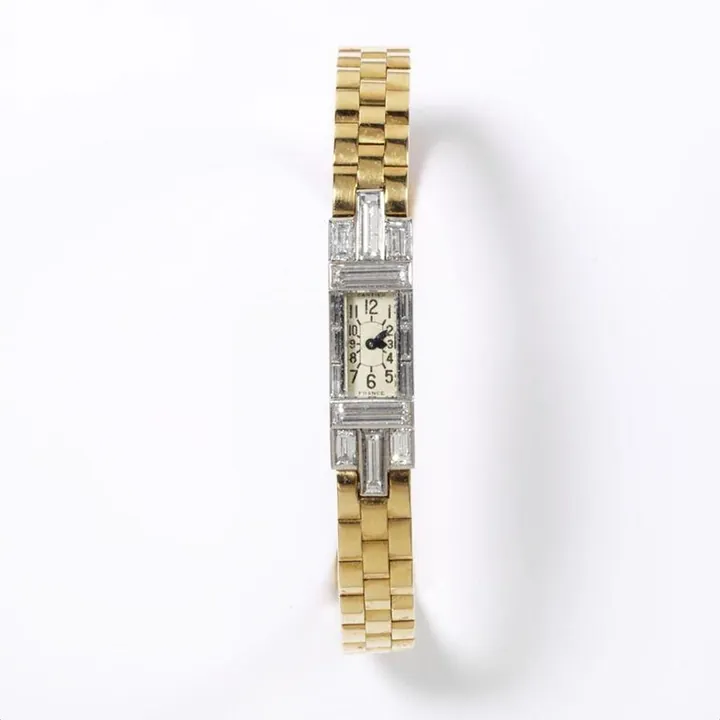
Watch with diamond-set platinum case and gold link bracelet, Cartier, Paris, c. 1936.
Victoria and Albert Museum, London
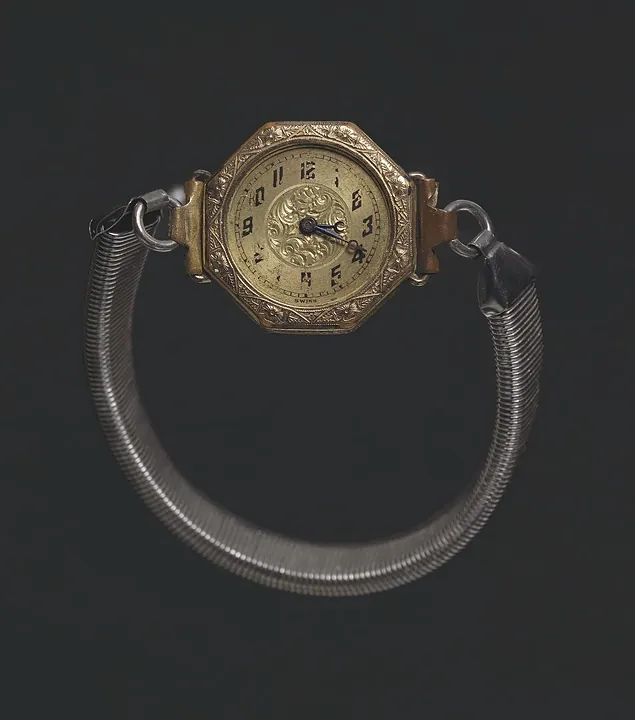
Wristwatches · early to mid 20th century
Woman's wristwatch worn by Harriette Vyda Simms Moore, early to mid 20th century
National Museum of African American History and Culture, Smithsonian Institution, Washington DC

Wristwatches · 1900–1999
Wristwatch by Certina, Switzerland, 1900–1999
Nordic Museum Foundation
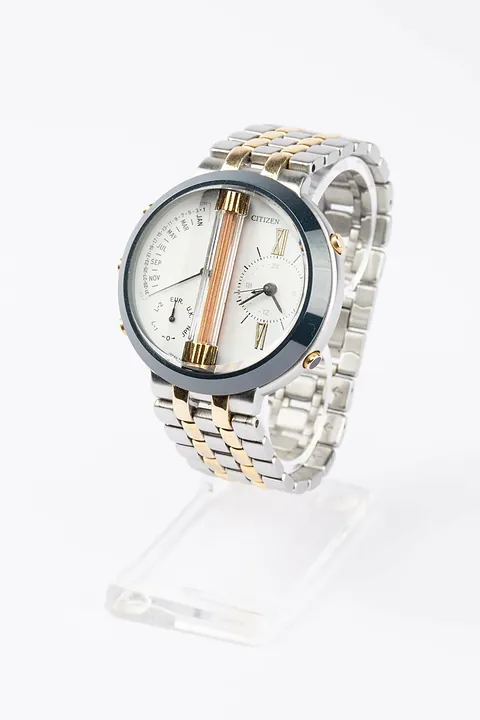
Wristwatches · 1900–1999
Wristwatch by Citizen, Japan, 1900–1999
German Clock Museum