Clocks · Alarm tabernacle clock
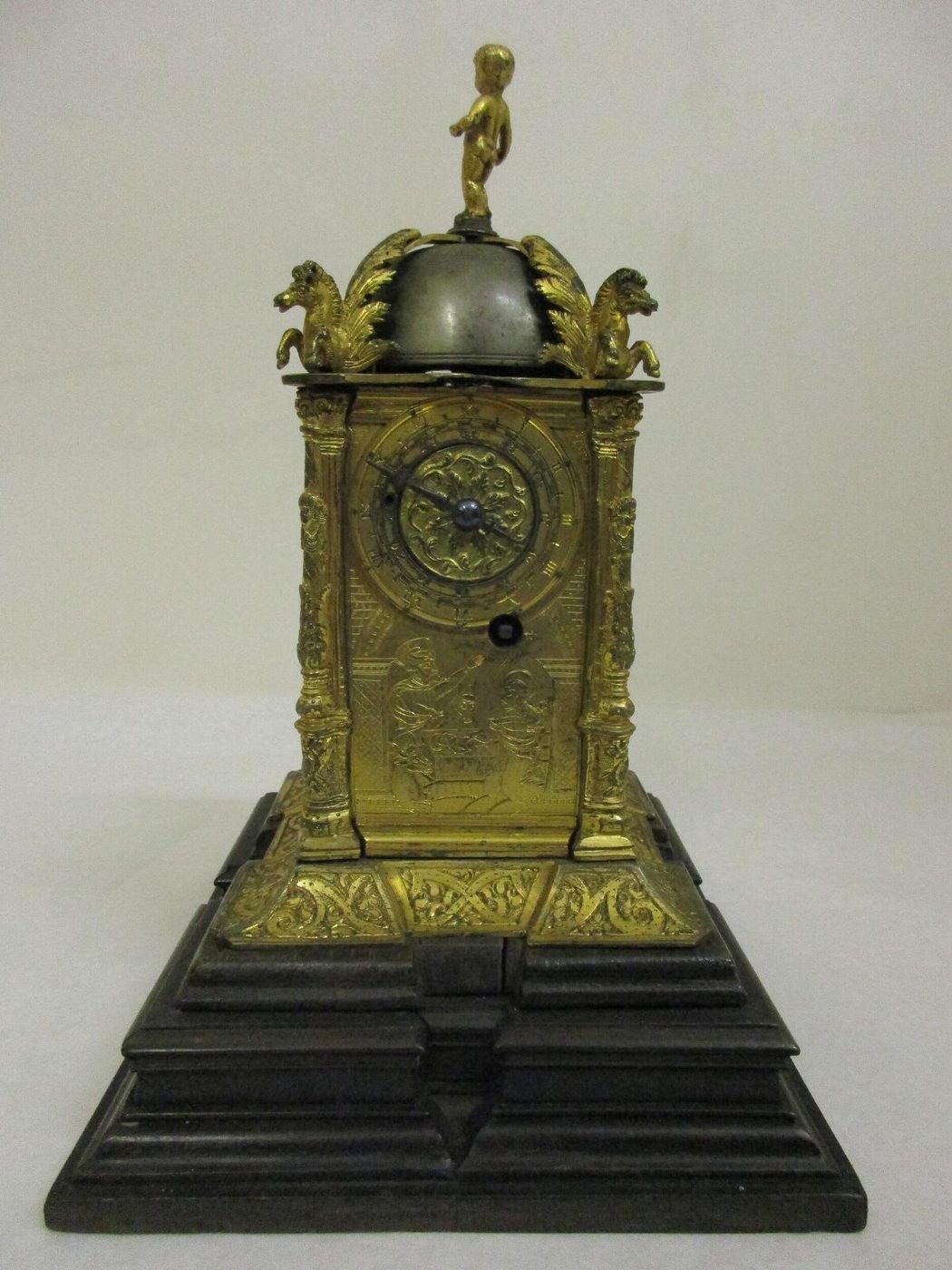
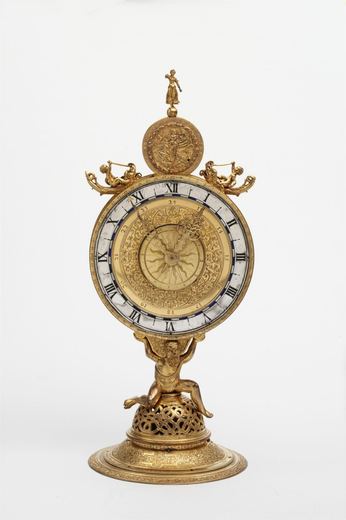
Alarm Tabernacle clock, German, about 1580.
- Maker / attribution
- Unrecorded in source
- Date
- 1580
- Historical period
- Renaissance Horology (1400 – 1600)
- Country of origin
- Germany
- Place
- Germany
- Object type
- Alarm tabernacle clock
- Materials / technique
- Gilt copper, iron, casting.
- Dimensions
- Height: 17.8 cm; Diameter: 14.6 cm; :
- Holding institution
- Victoria and Albert Museum, London
- Accession / object no.
- M.55-1952
- Credit line
- Given by Dr W.L. Hildburgh
Record summary
Held and catalogued by Victoria and Albert Museum, London (object number M.55-1952), this is an alarm tabernacle clock, made in Germany, dated 1580. The Atlas places it in the Renaissance Horology period (1400 – 1600) of its Clocks collection. Materials and techniques recorded by the source: Gilt copper, iron, casting. Recorded dimensions: Height: 17.8 cm; Diameter: 14.6 cm; :. The record is illustrated with 4 photographs.
Assembled from the source record's structured fields. Dates and attributions are given as the source states them; where a field is missing the Atlas leaves it blank rather than estimating.
Catalogue description
V&A — Physical description
Case: Upright case, framed by four three-quarter columns, set against fluted pilasters, the former cast and chased with an acanthus foliage and masks, rising from plinths cast and chased with trophies of arms. The sides of the case engraved with the Annunciation and the Birth of Christ and with figures symbolic of the sun and the moon. The splayed base with central recesses is engraved with strapwork and is mounted on a wooden base stained to imitate ebony. the clock is surmounted by the alarm which is enclosed withing a frame of four brass bell straps with the heads of winged horses whose rear portions develop into foliage. Above the bell and supported by the frame is a naked putto. The clock is mounted on a plinth of wood stained to imitate ebony. Dial: Applied brass dial ring, 4.4 cm diameter, 1.0 cm broad, engraved with hours and quarters with Roman hour-figures I to XII, each with a touch pin, outside and arabic hours 13 to 24 inside. The dial centre now a separate disc with cast leafy pattern, replacing the former alarm dial. A winding hole pierces the outer edge of the dial outside V 1/4. Iron hour-hand. A striking dial is engraved in arabic numerals 1 to 12 on the rear plate, with double-ended steel indicating hand. The dial is pierced by a winding hole near 8. The dial centre is engraved with arabesques. Movement: Movement and frame of iron, with sqaure corner pillars; the frame with top and bottom plates and narrow front, centre and rear plates. Going train at front, with fusee, chain and verge escapement, the bob pendulum at rear broken off. Brass spring barrel, and(later) contrate and crown wheels. The fusee and remaining wheels of this train are of steel. Locking-plate striking train at rear, with fusee and chain. The count-wheel mounted between rear movement plate and outer case backplate, driven by reduction gearing from the second wheel of the striking train. Brass spring barrel, the remaining train wheels of iron. The former alarm train at top left of movement is missing, but there is the corresponding winding-hole piercing the left side plate.
V&A — Historical context
The cast parts are of a higher quality than the engraved panels and were probably supplied from Augsburg or Nuremberg
V&A — Object history
One of five clocks given by Dr W.L.Hildburgh FSA. Dr Hildburgh had an endearing habit of giving the museum presents at Christmas and on his own birthday. Dr Hildburgh bought boxwood carvings, Spanish silver, the interiors of the Northumberland House Glass Drawing Room; and when he died bequeathed the rest of his collection. Given by Dr W L Hildburgh.
Historical context
Renaissance Horology (1400 – 1600)
Spring power makes clocks portable; Nuremberg and Augsburg produce the first watches; the Prague Orloj is built.
Spring power made the domestic clock portable. Augsburg and Nuremberg produced gilt-brass table clocks, often with astronomical dials and alarms; weight-driven Gothic wall clocks and English lantern clocks served households. Clocks of this period have foliot or balance-wheel control and usually only an hour hand.
Read the period in the timelineMore clocks from this periodEarlier: Medieval Period
Atlas type guide
Bracket, table and spring-driven clocks
Spring-driven clocks freed timekeeping from the hanging weight. The coiled mainspring, documented from the fifteenth century, made portable table clocks possible; to even out its declining force, makers used the fusee, a conical pulley connected to the barrel by a gut line or chain. Renaissance table clocks from Augsburg and Nuremberg — drum-shaped, square or tower-shaped in gilt brass — were luxury scientific objects, often with astronomical dials and alarms.
After the pendulum, English makers developed the bracket clock: a wooden case with a carrying handle, a short pendulum with a verge escapement, and often repeating work to sound the hours on demand at night. Later examples use the anchor escapement. In the nineteenth century, 'table clock' became a broad term for spring clocks of every nationality.
What to look for
- A fusee in the movement (cone-shaped pulley) and the type of line — gut or chain.
- Verge escapement with a short bob pendulum, often with a decoratively engraved backplate.
- Repeat cords or buttons that make the clock strike again on demand.
- Gilt-brass engraved cases and horizontal dials on Renaissance pieces.
- Case shapes: inverted bell, bell top, break-arch, lancet or balloon.
Dating clues
- Drum and tower table clocks: c. 1520–1650.
- Ebony veneered English bracket clocks with verge escapements: c. 1670–1800.
- Engraved backplates were usual on English clocks until c. 1800, then generally plain.
General guidance written by the Atlas editors about this kind of object. It is not a statement about this particular piece; for that, rely on the source record above and on physical examination.
Read next:Anchor (recoil) escapement
Related records
Clocks · 1400–1499
Alarm clock, Germany, 1400–1499
German Clock Museum
Clocks · 1400-1499
Lantern clock, Germany, 1400-1499
Science Museum Group, London
Clocks · 1500–1599
Table clock by Rutenieg, Valentin (um 1550) (Uhrmacher), Germany, 1500–1599
City Museum Berlin
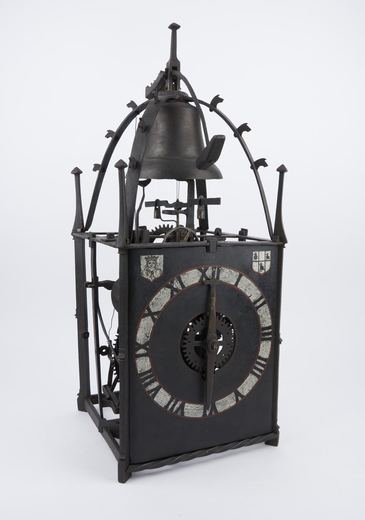
Clocks · 1501-1600
German 16th century iron chamber clock
Science Museum Group, London
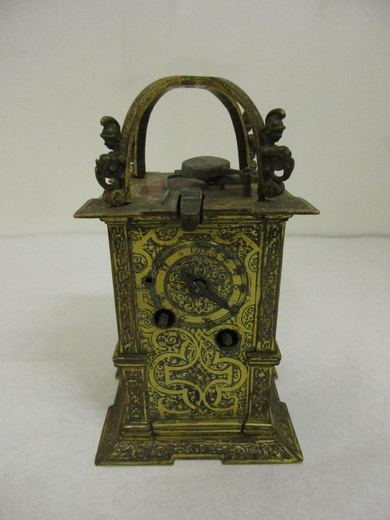
Clocks · ca.1550
Clock, a striking alarm clock in a gilt brass case, Germany, ca.1550.
Victoria and Albert Museum, London
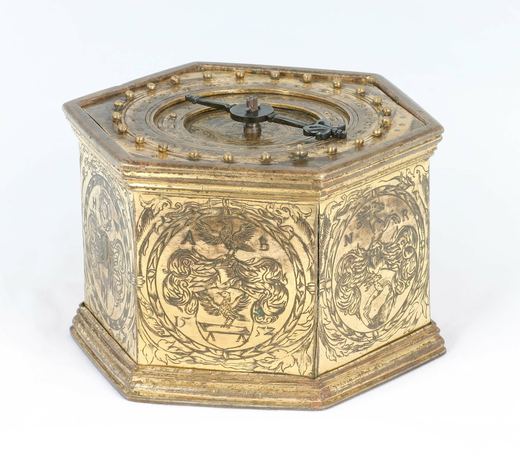
Clocks · 1552
Carriage / travel clock, Germany, 1552
German Clock Museum
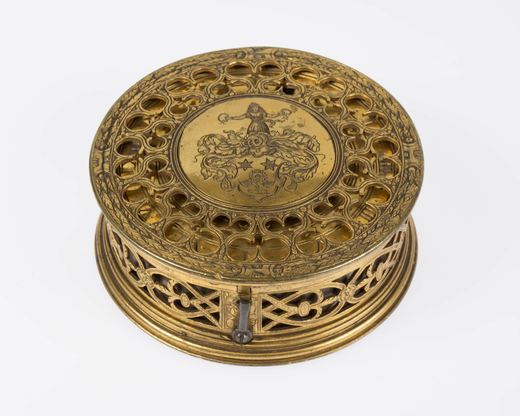
Clocks · 1560
Carriage / travel clock by HG, Germany, 1560
German Clock Museum
Clocks · 1564
Clock, gilt brass with enamelled silver dial ring, signed by Jeremias Metzger, Augsburg, southern Germany, dated 1564
Victoria and Albert Museum, London