Clocks · Alarm tabernacle clock
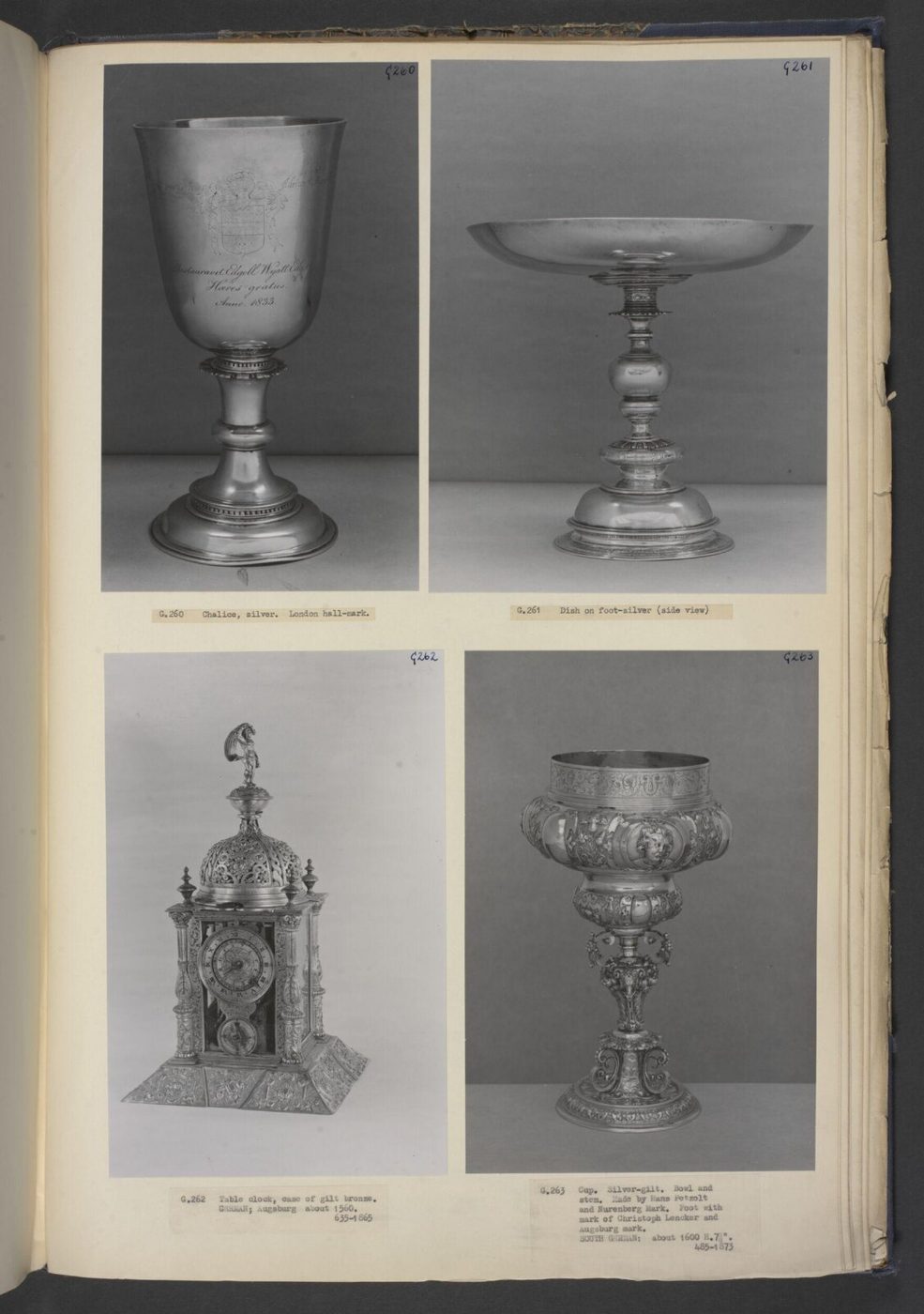
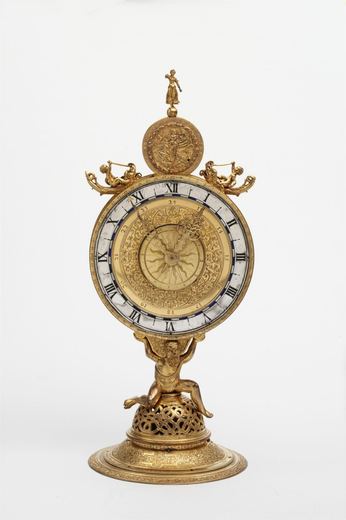
Alarm tabernacle clock by B.S., gilt-bronze, South German, 1580, Soulages Collection.
- Maker / attribution
- Unrecorded in source
- Date
- 1580
- Historical period
- Renaissance Horology (1400 – 1600)
- Country of origin
- Germany
- Place
- Southern Germany,
- Object type
- Alarm tabernacle clock
- Materials / technique
- Gilt-bronze case and brass dial
- Dimensions
- Height: 25.5 cm; Width: 6.75 in; Width: 16.2 cm
- Holding institution
- Victoria and Albert Museum, London
- Accession / object no.
- 635-1865
Record summary
Held and catalogued by Victoria and Albert Museum, London (object number 635-1865), this is an alarm tabernacle clock, made in Southern Germany,, dated 1580. The Atlas places it in the Renaissance Horology period (1400 – 1600) of its Clocks collection. Materials and techniques recorded by the source: Gilt-bronze case and brass dial. Recorded dimensions: Height: 25.5 cm; Width: 6.75 in; Width: 16.2 cm. The record is illustrated with 1 photograph.
Assembled from the source record's structured fields. Dates and attributions are given as the source states them; where a field is missing the Atlas leaves it blank rather than estimating.
Catalogue description
V&A — Physical description
Case: Gilt-bronze case with baluster-shaped columns at the angles, resting on a splayed brass base with repousse patterns of strapwork type. The case surmounted by a pierced dome cover , above which is a figure of Fortune. Finials above the columns. All four side panels of the case are glazed and removable; the brass dial is mounted on the outside of the front glazed panel, which measures 10.2 x 5.7 cm. The rear panels has two drilled winding holes, for going and striking, and the right-hand panel one, near the bottom,for the alarm. Dials: The engraved chapter ring is 6.0 cm diameter, with Roman hours with touch-pins and half-hour marks. Inside this is a revolving silvered moon disc with a ring of figures 1 to 29 and the phase shown in the circular aperture of a superposed brass disc 3.5 cm diameter numbered 1 to 12 anti-clockwise in arabic to the outside of which the steel hour-pointer is attached. The moon disc moves friction-tight with the brass disc but has four drilled holes at moon ages 2.5, 9.5, 17.5, and 25.5 for hand-setting. There is a short central iron hand for setting the alarm. Below the main dial is mounted a dial 3.2 cm diameter marked in Roman I, II, III, IIII with a simple brass hand with tail rotating once per hour. Movement: The frame consists of four sqaure corner posts, top and bottom plates with a further plate just above the top plate, and three vertical movement plates not of the full width of the frame. The upper top plate is signed: 15 BS 80. The going train is mounted in the front half of the frame. Engraved brass barrel, brass fusee and wheel, chain drive. Verge with attached "bob" pendulum now missing. There is now no sign of the centre plate of a potence for the lower end of the former vertical verge. The fusee rotates once every 4 hours, and has 6 turns. There are two dial train outside the front plate. (1) To the quarter-hour hand. A 40T wheel on the fusee arbor drives a wheel of 20T with two projecting pins which let off the hour-strike. The 20T wheel drives a 10T wheel coaxial with the quarter-hour hand (rotating once per hour) through an idle 10T wheel. (2) A 20T wheel on the fusee arbor drives a 60T wheel coaxial with the hour-disc and hand (1 rev. every 12 hours). The moon disc is coaxial through a sleeve with an untoothed brass disc which is partly inserted into a recess in the 60T hour-wheel and rotates friction-tight with it. There is now no moon gearing, though it could be added quite simply with the aid of a 59T wheel. The locking-plate striking train has an engraved brass barrel, a brass fusee of 6 turns and brass wheels. The outside count-wheel is driven by reduction gearing from the arbor of the second wheel of the striking train. This arbor and the third arbor of the same train are of turned baluster shape. The alarm train, low down at right in the front half of the movement, is wound from the side of the case. Its release mechanism is not quite complete.
V&A — Object history
Originally bought for £20.
Historical context
Renaissance Horology (1400 – 1600)
Spring power makes clocks portable; Nuremberg and Augsburg produce the first watches; the Prague Orloj is built.
Spring power made the domestic clock portable. Augsburg and Nuremberg produced gilt-brass table clocks, often with astronomical dials and alarms; weight-driven Gothic wall clocks and English lantern clocks served households. Clocks of this period have foliot or balance-wheel control and usually only an hour hand.
Read the period in the timelineMore clocks from this periodEarlier: Medieval Period
Atlas type guide
Bracket, table and spring-driven clocks
Spring-driven clocks freed timekeeping from the hanging weight. The coiled mainspring, documented from the fifteenth century, made portable table clocks possible; to even out its declining force, makers used the fusee, a conical pulley connected to the barrel by a gut line or chain. Renaissance table clocks from Augsburg and Nuremberg — drum-shaped, square or tower-shaped in gilt brass — were luxury scientific objects, often with astronomical dials and alarms.
After the pendulum, English makers developed the bracket clock: a wooden case with a carrying handle, a short pendulum with a verge escapement, and often repeating work to sound the hours on demand at night. Later examples use the anchor escapement. In the nineteenth century, 'table clock' became a broad term for spring clocks of every nationality.
What to look for
- A fusee in the movement (cone-shaped pulley) and the type of line — gut or chain.
- Verge escapement with a short bob pendulum, often with a decoratively engraved backplate.
- Repeat cords or buttons that make the clock strike again on demand.
- Gilt-brass engraved cases and horizontal dials on Renaissance pieces.
- Case shapes: inverted bell, bell top, break-arch, lancet or balloon.
Dating clues
- Drum and tower table clocks: c. 1520–1650.
- Ebony veneered English bracket clocks with verge escapements: c. 1670–1800.
- Engraved backplates were usual on English clocks until c. 1800, then generally plain.
General guidance written by the Atlas editors about this kind of object. It is not a statement about this particular piece; for that, rely on the source record above and on physical examination.
Read next:Anchor (recoil) escapement
Related records
Clocks · 1400–1499
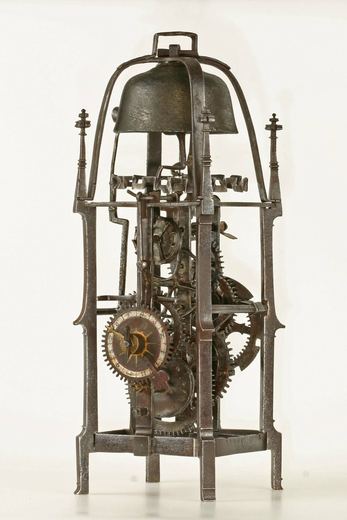
Alarm clock, Germany, 1400–1499
German Clock Museum
Clocks · 1400-1499
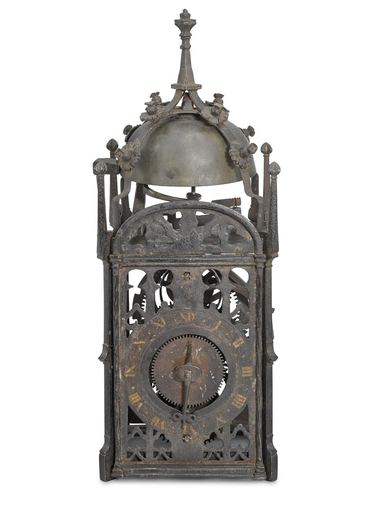
Lantern clock, Germany, 1400-1499
Science Museum Group, London
Clocks · 1500–1599
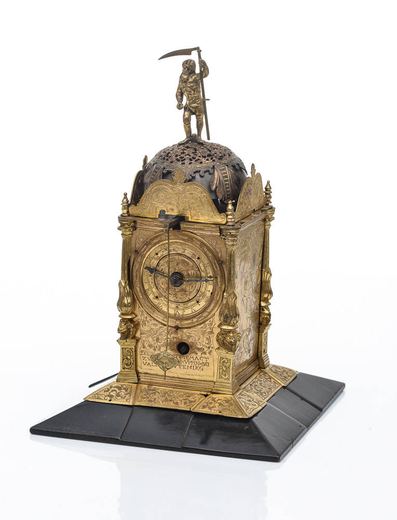
Table clock by Rutenieg, Valentin (um 1550) (Uhrmacher), Germany, 1500–1599
City Museum Berlin
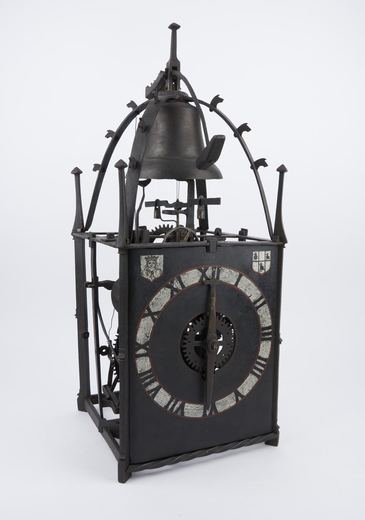
Clocks · 1501-1600
German 16th century iron chamber clock
Science Museum Group, London
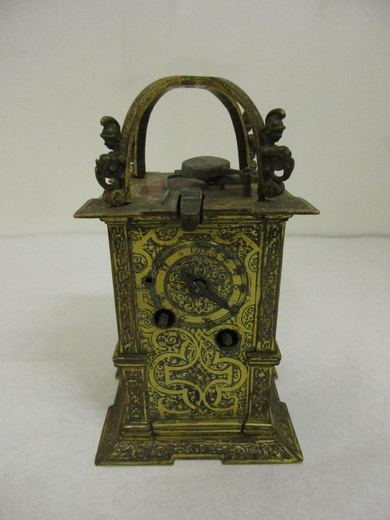
Clocks · ca.1550
Clock, a striking alarm clock in a gilt brass case, Germany, ca.1550.
Victoria and Albert Museum, London
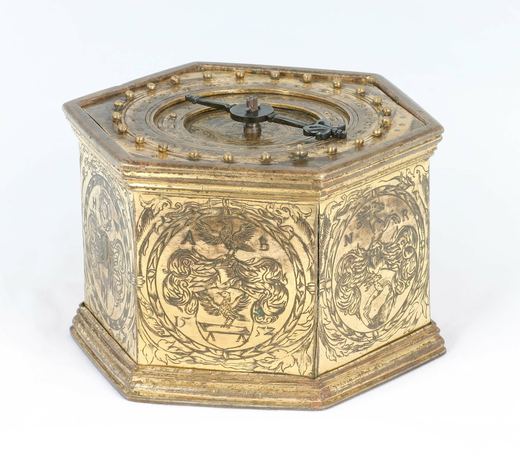
Clocks · 1552
Carriage / travel clock, Germany, 1552
German Clock Museum
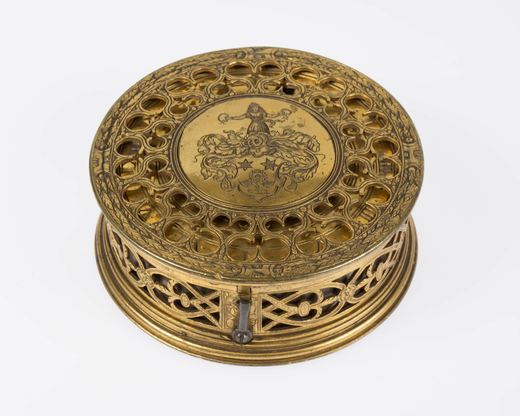
Clocks · 1560
Carriage / travel clock by HG, Germany, 1560
German Clock Museum
Clocks · 1564
Clock, gilt brass with enamelled silver dial ring, signed by Jeremias Metzger, Augsburg, southern Germany, dated 1564
Victoria and Albert Museum, London