
Pocket Watches · Pocket watch
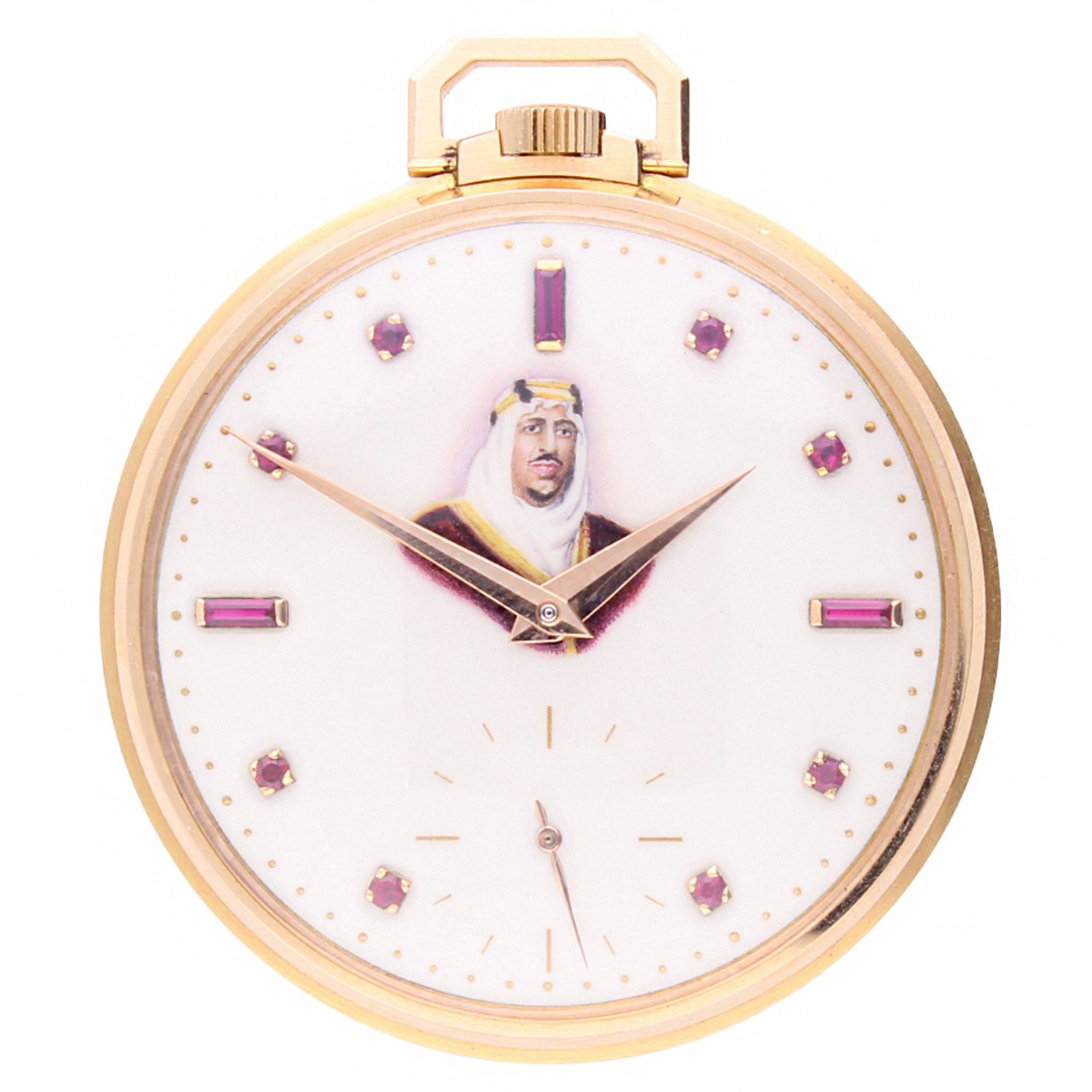
18ct rose gold Patek Philippe Open face pocket watch with enamel dial with portrait of King Ibn Saud, 1956
- Maker / attribution
- Patek Philippe (maker)
- Date
- 1956
- Historical period
- Modern Mechanical Horology (1945 – 1969)
- Country of origin
- Switzerland
- Object type
- Pocket watch
- Materials / technique
- rose gold
- Dimensions
- Case 44 mm
- Stock no.
- G3579
- Credit line
- Dealer listing, Somlo Antiques (G3579)
- Catalogue title (original)
- 18ct rose gold Patek Philippe Open face pocket watch with enamel dial with portrait of King Ibn Saud. Made 1956 (English)
View the source record (dealer listing) ↗ (opens another website in a new tab)Suggest a correction
Record summary
Catalogued by Somlo Antiques (dealer), London (stock number G3579), this is a pocket watch by Patek Philippe, made in Switzerland, dated 1956. The Atlas places it in the Modern Mechanical Horology period (1945 – 1969) of its Pocket Watches collection. Materials and techniques recorded by the source: rose gold. Recorded dimensions: Case 44 mm. The record is illustrated with 2 photographs.
Assembled from the source record's structured fields. Dates and attributions are given as the source states them; where a field is missing the Atlas leaves it blank rather than estimating.
Catalogue description
Dealer description — Somlo Antiques
Patek Philippe’s Saudi Arabian agent Abdul Rahman Serour commissioned a series of watches on behalf of the Saudi royal family in memory of “King Abdulaziz bin Abdul Rahman Al Saud” who passed away in 1953. King Abduaziz “Ibn Saud” (1875-1953) was the founder and the first monarch of Saudi Arabia. The pocket watches were referenced as a 600/1 and given as gifts to dignitaries and friends of his Majesty. There were 200 pocket watch examples with ivory-coloured enamel dial, ruby-set hour indices, and a polychrome enamel portrait of Abdulaziz “Ibn Saud”. An additional, 150 wristwatches using a reference 2481, were ordered with the same dial configuration. In both examples, none of the dials were signed by Patek Philippe. Brand: Patek Philippe Made: 1956 Model: Abdulaziz “Ibn Saud” Reference: 600/1 Calibre: 17-710 Movement: Manual winding Material: 18ct rose gold Features/complications: Polychrome enamel dial Dial: Enamel dial featuring applied ruby hour indices with 18ct rose gold Dauphine hands and subsidiary seconds with a portrait of King Ibn Saud of Saudi Arabia Case dimensions: 44mm Bracelet/strap: N/A Accessories: Original box and Extract from the Archives SKU: 3579
Historical context
Modern Mechanical Horology (1945 – 1969)
Tool watches for divers, pilots and astronauts; electric watches anticipate the electronic age.
After 1945 the pocket watch became a niche product — presentation and railway watches, inexpensive pin-lever watches, and commemorative pieces — while most innovation moved to the wrist.
Read the period in the timelineMore pocket watches from this periodEarlier: Golden Age of Mechanical Watchmaking
Atlas type guide
Hunter, half-hunter and open-face watches
In the nineteenth century the pocket watch case settled into a few standard forms. The hunter (French savonnette) has a hinged front lid protecting the crystal — reputedly for riders who could not risk broken glass — and is opened by pressing the crown or a push-piece. The half-hunter has a small window in the lid so the hands can be read when closed. The open-face (lépine) watch has no front cover, with the crown at 12; hunters normally carry the crown at 3.
Case types also changed with winding: key-wound watches gave way to keyless (stem-wound) mechanisms after Adrien Philippe's and others' designs of the 1840s, with pendant setting or lever setting.
What to look for
- Crown position relative to the seconds dial: at 3 for hunters, at 12 for open-face watches.
- Spring-loaded front cover with a push-piece in the pendant.
- Half-hunter chapter ring enamelled on the lid.
- Key holes in the inner dome (cuvette) versus keyless winding.
Dating clues
- Keyless winding spread after c. 1850 and became standard by c. 1890.
- English hallmarks inside gold and silver cases give the year of assay.
General guidance written by the Atlas editors about this kind of object. It is not a statement about this particular piece; for that, rely on the source record above and on physical examination.
Read next:Detached lever escapement
Related records
Clocks · 1965–1975
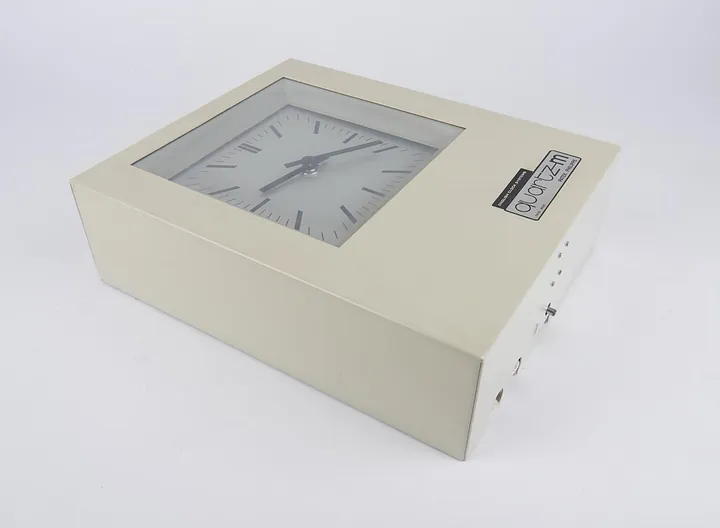
Quartz master clock QM 1, with movement by Patek Phillippe, Switzerland, 1965–1975. Supplied by English Clock Systems.
Science Museum Group, London
Instruments · 1965–1984
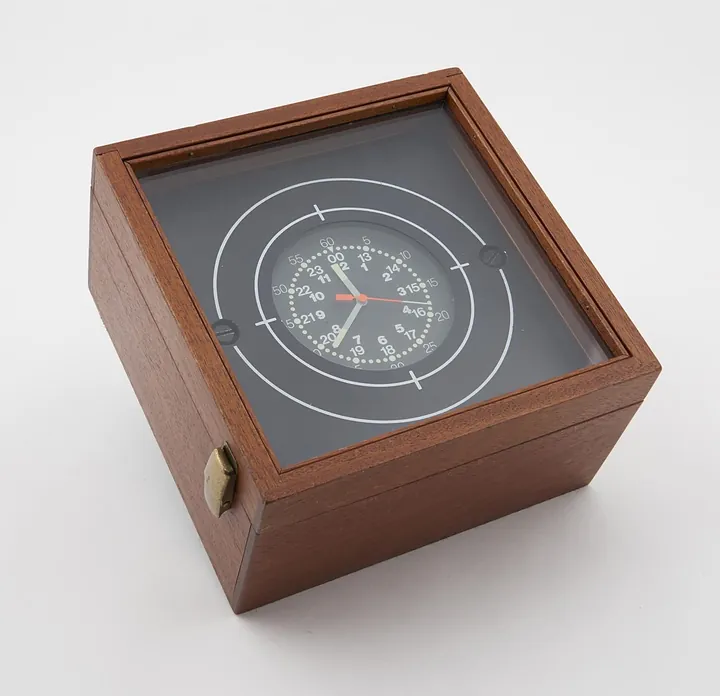
Chronometer by Patek Philippe and Kelvin Hughes, England, 1965–1984
Science Museum Group, London
Pocket Watches · c. 1895
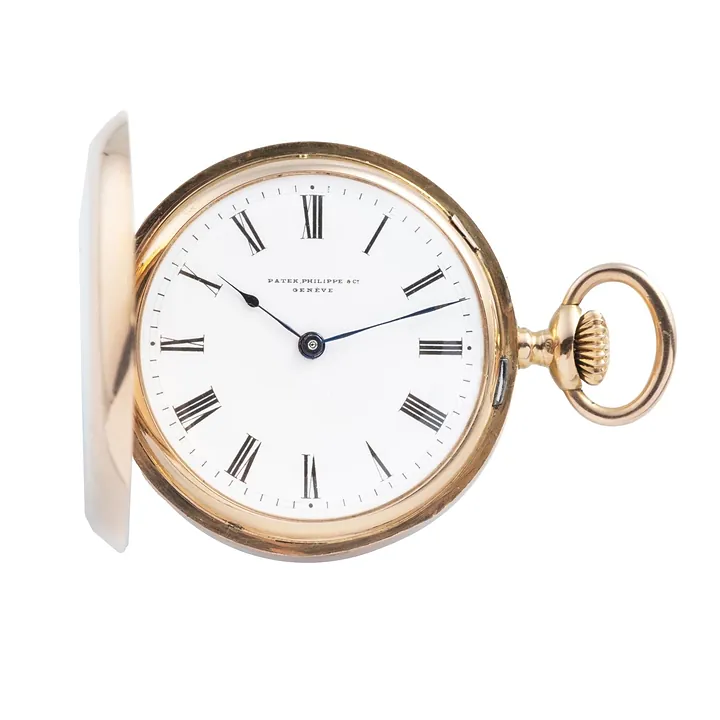
Patek Philippe pocket watch, c. 1895
Antiquorum auction archive, Geneva

Pocket Watches · c. 1900
Patek Philippe Chronometro Gondolo, c. 1900
Antiquorum auction archive, Geneva
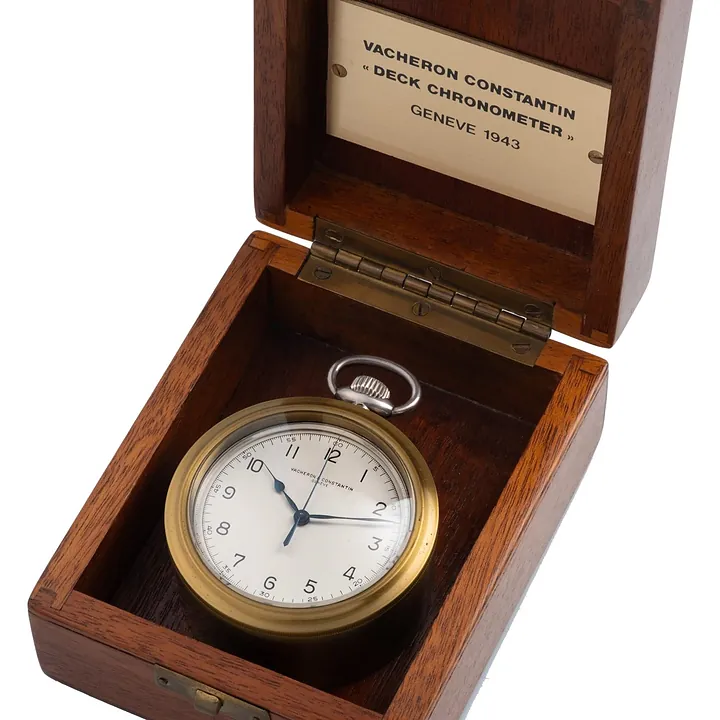
Pocket Watches · c. 1945
Vacheron Constantin pocket chronometer, c. 1945
Antiquorum auction archive, Geneva
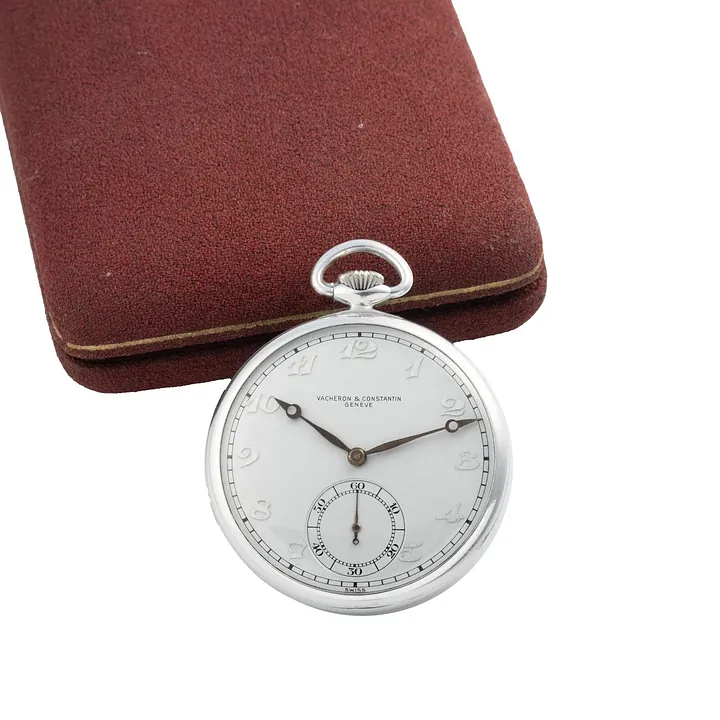
Pocket Watches · c. 1945
Vacheron Constantin watch, c. 1945
Antiquorum auction archive, Geneva
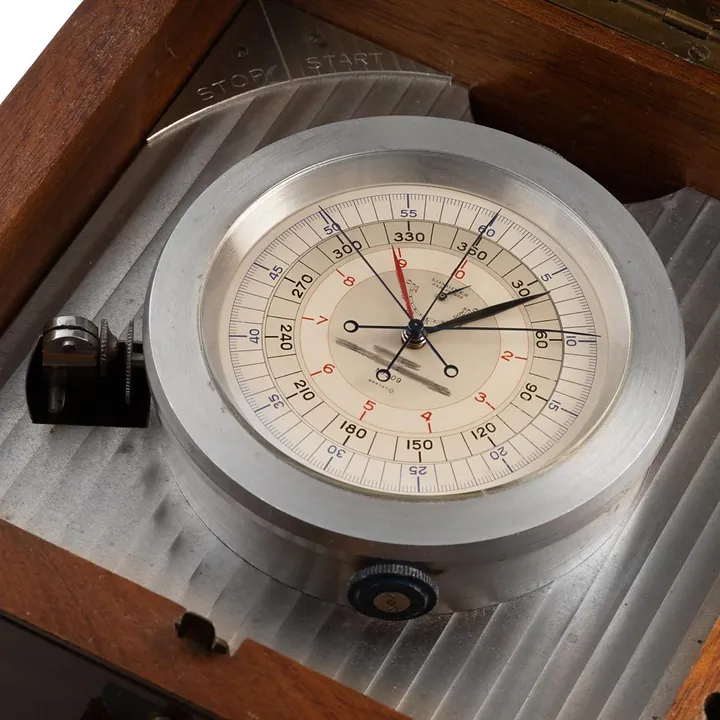
Pocket Watches · Sold to Longines France in January 1946
Longines Siderograph, ref. 5397, Sold to Longines France in January 1946
Antiquorum auction archive, Geneva
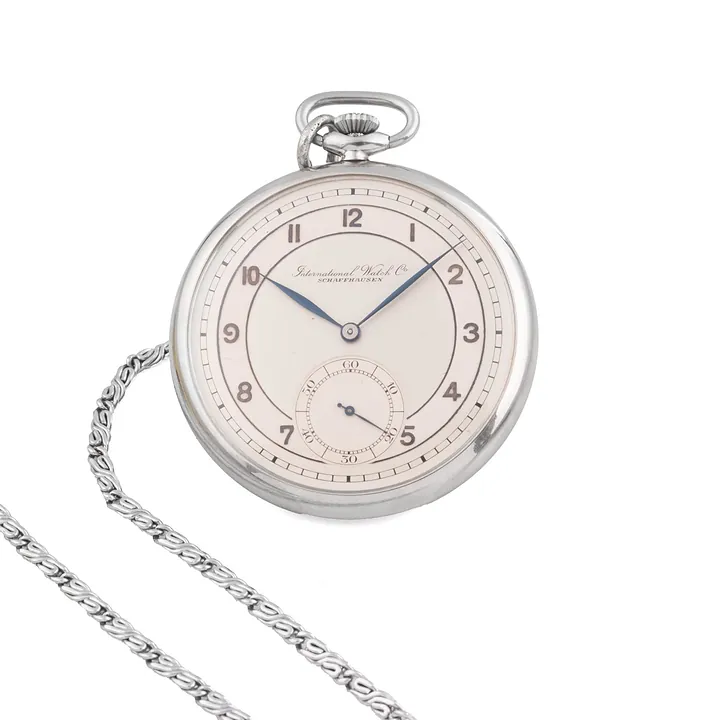
Pocket Watches · c. 1950
IWC Pocket Watch, c. 1950
Antiquorum auction archive, Geneva