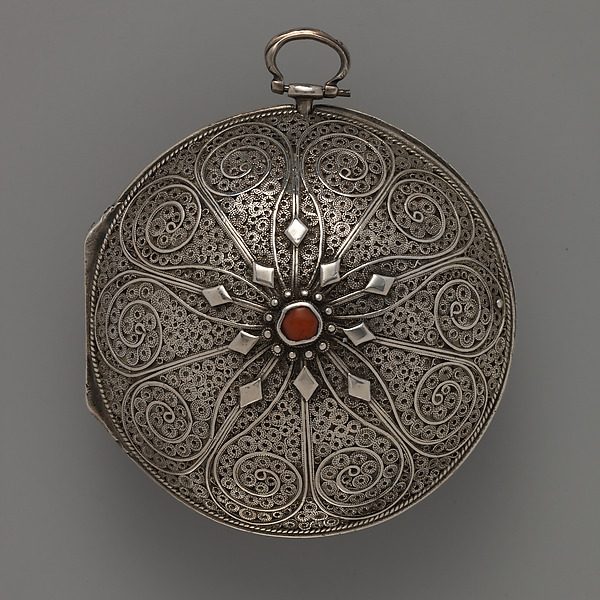
Pocket Watches · Watch
Watch by Edward Prior, United Kingdom, 19th century
- Maker / attribution
- Edward Prior (Maker)
- Date
- 19th century
- Historical period
- Precision & Scientific Horology (1750 – 1850)
- Country of origin
- United Kingdom
- Object type
- Watch
- Materials / technique
- Silver, tortoiseshell, coral, enamel
- Dimensions
- Diameter: 3 1/4 in. (8.3 cm)
- Holding institution
- The Metropolitan Museum of Art, New York
- Accession / object no.
- 07.253.1a–d
- Credit line
- Rogers Fund, 1907
- Catalogue title (original)
- Watch
Record summary
Held and catalogued by The Metropolitan Museum of Art, New York (object number 07.253.1a–d), this is a watch by Edward Prior, made in United Kingdom, dated 19th century. The Atlas places it in the Precision & Scientific Horology period (1750 – 1850) of its Pocket Watches collection. Materials and techniques recorded by the source: Silver, tortoiseshell, coral, enamel. Recorded dimensions: Diameter: 3 1/4 in. (8.3 cm). The record is illustrated with 4 photographs.
Assembled from the source record's structured fields. Dates and attributions are given as the source states them; where a field is missing the Atlas leaves it blank rather than estimating.
Catalogue description
The source record does not include a narrative description. The structured fields above are reproduced from it.
Historical context
Precision & Scientific Horology (1750 – 1850)
Harrison solves longitude; Mudge invents the lever; Breguet's Paris workshop defines the modern watch.
From 1750 to 1850 the watch became a precision instrument. Mudge's lever escapement, the cylinder escapement, Lépine's thin bar calibre, Breguet's innovations (overcoil, tourbillon, perpétuelle) and the pocket chronometer of Arnold and Earnshaw all date from this period, while verge watches remained common in cheaper production.
Read the period in the timelineMore pocket watches from this periodEarlier: Early Modern Horology
Atlas type guide
Watches for the Chinese and Ottoman markets
From the late eighteenth century English and Swiss makers produced watches specifically for export to China and the Ottoman Empire. For China, Fleurier houses such as Bovet, Juvet and Vrard made matching pairs of watches with richly engraved and decorated movements, often with the duplex escapement whose centre seconds hand jumps in full seconds. For Ottoman buyers, London makers such as George Prior and Markwick Markham supplied verge watches with Turkish numerals in triple or quadruple cases of tortoiseshell and silver.
These watches reflect global trade networks and the tastes of distant markets, and are important evidence for cross-cultural exchange in horology.
What to look for
- Engraved, fully decorated movements visible under a glass back.
- Duplex escapement with a jumping centre seconds hand.
- Chinese characters on the movement (e.g. the maker's name in transliteration).
- Turkish (Ottoman) numerals on the dial and multiple protective outer cases.
Dating clues
- Chinese-market Fleurier watches: c. 1820–1900.
- English Ottoman-market watches: c. 1770–1850.
General guidance written by the Atlas editors about this kind of object. It is not a statement about this particular piece; for that, rely on the source record above and on physical examination.
Read next:Verge escapement
Related records
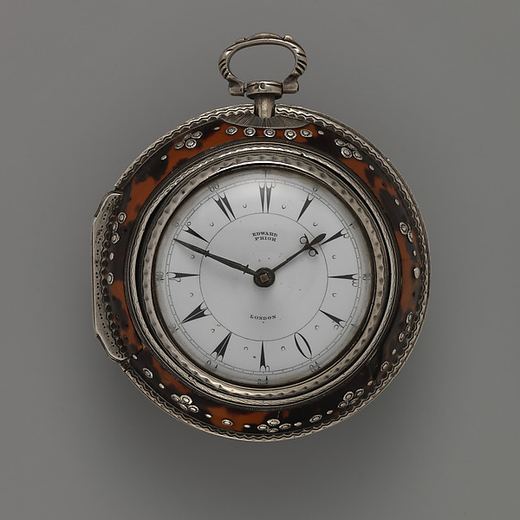
Pocket Watches · ca. 1849–50
Watch by Edward Prior, United Kingdom, ca. 1849–50
The Metropolitan Museum of Art, New York
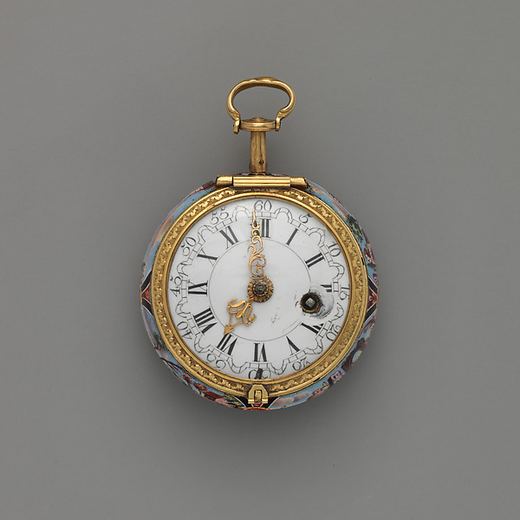
Pocket Watches · ca. 1740–60
Watch by Charles Cabrier II, United Kingdom, ca. 1740–60 (The Met 17.190.1458)
The Metropolitan Museum of Art, New York
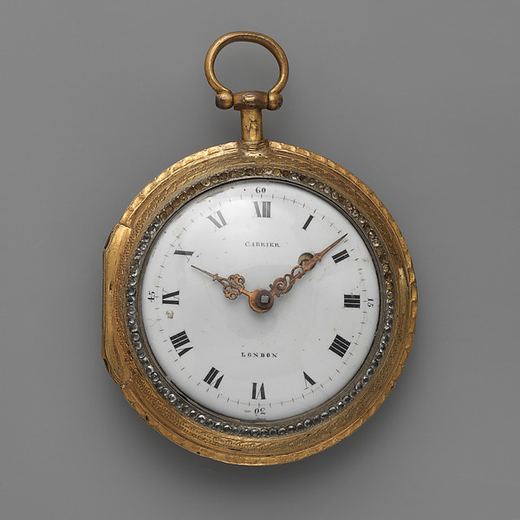
Pocket Watches · ca. 1740–60
Watch by Charles Cabrier II, United Kingdom, ca. 1740–60 (The Met 17.190.1461)
The Metropolitan Museum of Art, New York
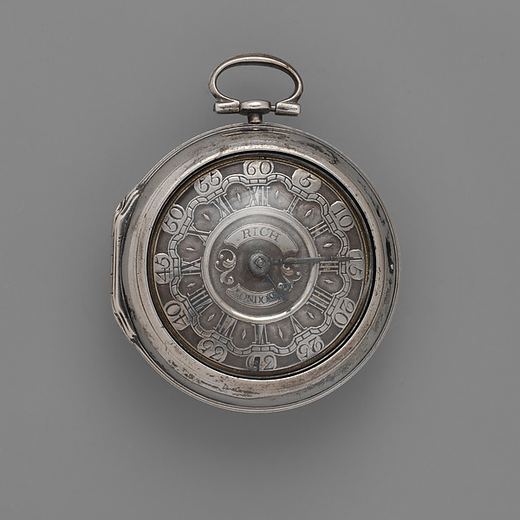
Pocket Watches · ca. 1751–52
Watch by John Rich, United Kingdom, ca. 1751–52
The Metropolitan Museum of Art, New York
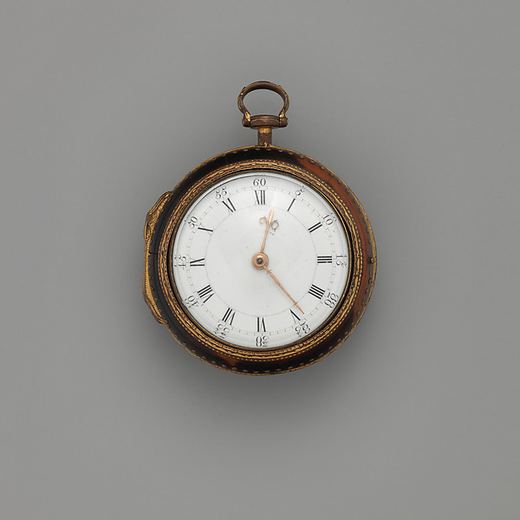
Pocket Watches · ca. 1760
Watch by John Ellicott, United Kingdom, ca. 1760
The Metropolitan Museum of Art, New York
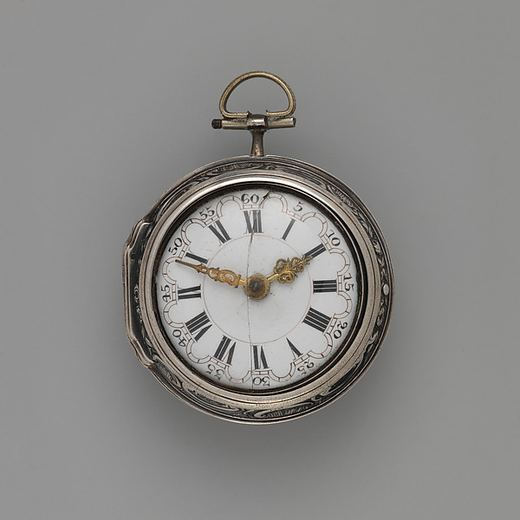
Pocket Watches · 1758
Watch by William Dunant, United Kingdom, 1758
The Metropolitan Museum of Art, New York
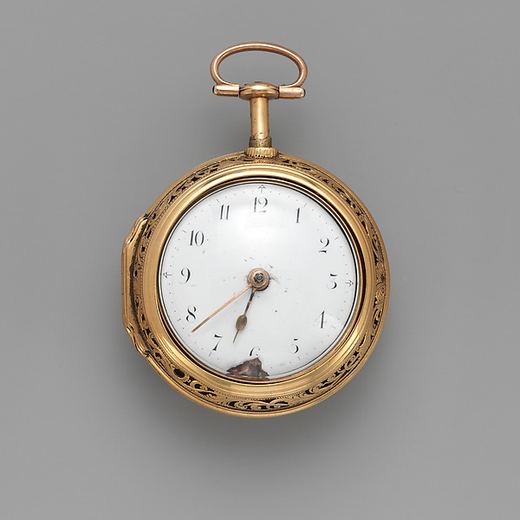
Pocket Watches · ca. 1770
Repeating watch by James Warne, United Kingdom, ca. 1770
The Metropolitan Museum of Art, New York
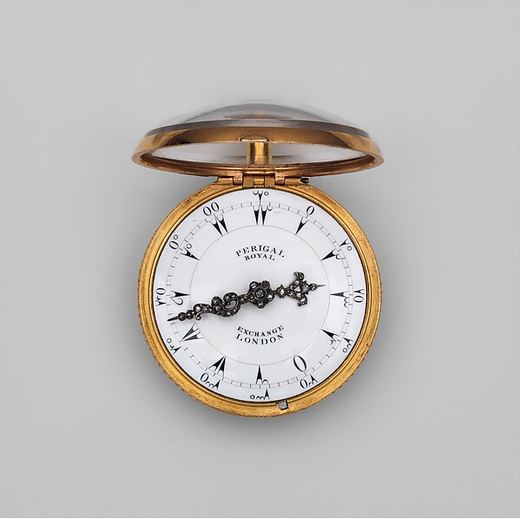
Pocket Watches · probably ca. 1770
Repeating watch by Movement by Francis Perigal, United Kingdom, probably ca. 1770
The Metropolitan Museum of Art, New York