Pocket Watches · Watch and pair case
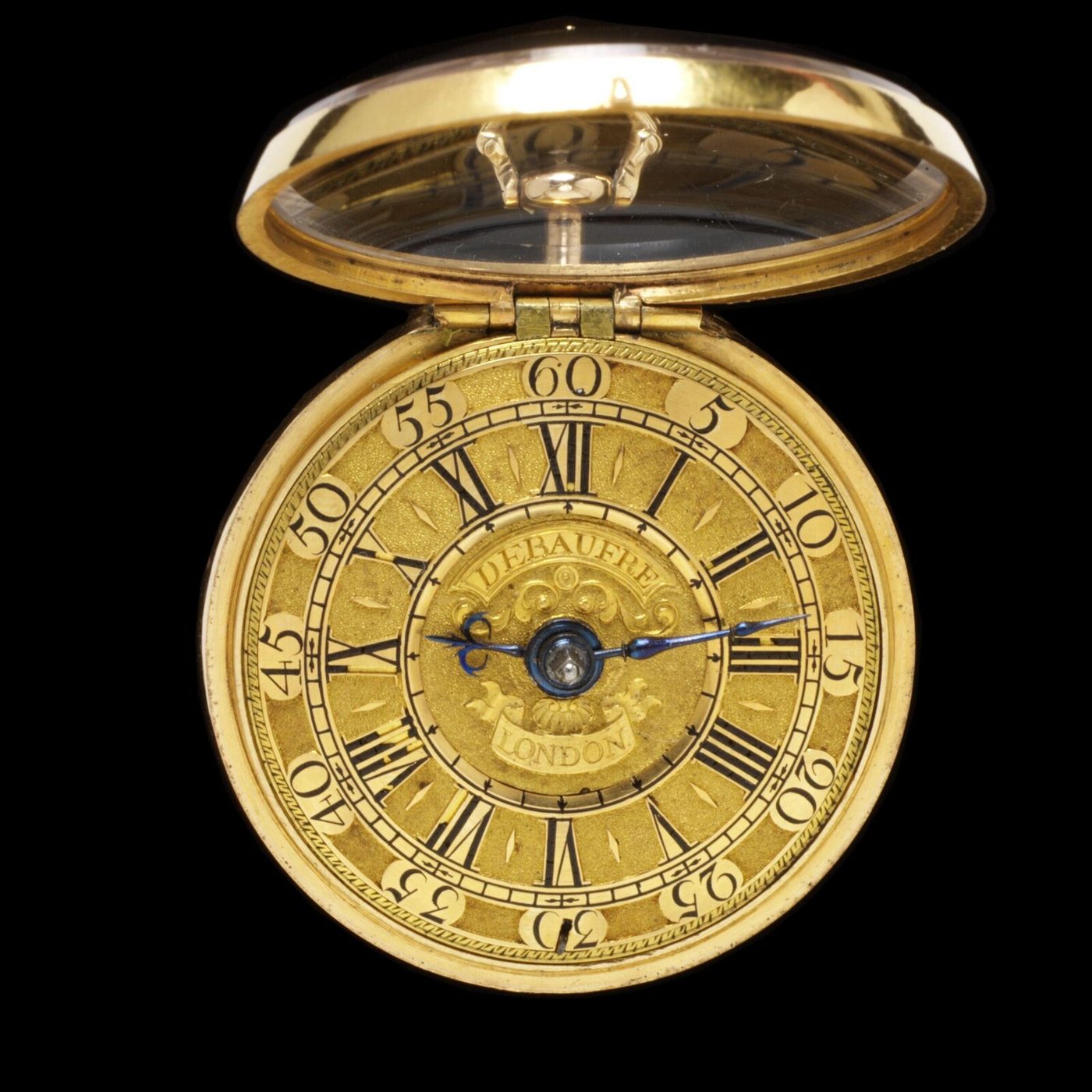
Watch and pair case by James Debaufre, England, 1723-1724
- Maker / attribution
- James Debaufre (maker)
- Date
- 1723-1724
- Historical period
- Early Modern Horology (1600 – 1750)
- Country of origin
- England
- Place
- London
- Object type
- Watch and pair case
- Materials / technique
- Gold, chased and set with coloured glass
- Holding institution
- Victoria and Albert Museum, London
- Accession / object no.
- 2372:1, 2-1855
Record summary
Held and catalogued by Victoria and Albert Museum, London (object number 2372:1, 2-1855), this is a watch and pair case by James Debaufre, made in London, England, dated 1723-1724. The Atlas places it in the Early Modern Horology period (1600 – 1750) of its Pocket Watches collection. Materials and techniques recorded by the source: Gold, chased and set with coloured glass. The record is illustrated with 4 photographs.
Assembled from the source record's structured fields. Dates and attributions are given as the source states them; where a field is missing the Atlas leaves it blank rather than estimating.
Catalogue description
V&A — Physical description
Gold watch and pair case, the watch signed 'Ja. Debaufre', the pair case with maker's mark 'H...' and chased and set with coloured glass, with London hallmarks for 1723-24
V&A — Object history
Purchased at the auction by Christie's of the collection of Ralph Bernal (1783-1854), politician and art collector, in 1855. He held a seat in the House of Commons from 1815-52. After his death the Society of Arts proposed without success that the Government should buy his entire collection for the Museum of Ornamental Art then at Marlborough House which became the future South Kensington Museum, now the Victoria and Albert Museum. 730 lots were acquired for Marlborough House (Anthony Burton, Vision & Accident, V&A Publications, 1999, p. 34). After his father's death in 1811, Bernal inherited three large sugar estates and over 500 enslaved people in Jamaica. 'In 1835 and 1836 he was awarded compensation for slave ownership amounting to over £11,450' (Helen Davies, Ralph Bernal, Oxford Dictionary of National Biography, version dated 11 March 2021). Provenance Ralph Bernal (1783-1854) was a renowned collector and objects from his collection are now in museums across the world, including the V&A. He was born into a Sephardic Jewish family of Spanish descent, but was baptised into the Christian religion at the age of 22. Bernal studied at Christ's College, Cambridge, and subsequently became a prominent Whig politician. He built a reputation for himself as a man of taste and culture through the collection he amassed and later in life he became the president of the British Archaeological Society. Yet the main source of income which enabled him to do this was the profits from enslaved labour. In 1811, Bernal inherited three sugar plantations in Jamaica, where over 500 people were eventually enslaved. Almost immediately, he began collecting works of art and antiquities. After the emancipation of those enslaved in the British Caribbean in the 1830s, made possible in part by acts of their own resistance, Bernal was awarded compensation of more than £11,450 (equivalent to over £1.5 million today). This was for the loss of 564 people enslaved on Bernal's estates who were classed by the British government as his 'property'. They included people like Antora, and her son Edward, who in August 1834 was around five years old (The National Archives, T 71/49). Receiving the money appears to have led to an escalation of Bernal's collecting. When Bernal died in 1855, he was celebrated for 'the perfection of his taste, as well as the extent of his knowledge' (Christie and Manson, 1855). His collection was dispersed in a major auction during which the Museum of Ornamental Art at Marlborough House, which later became the South Kensington Museum (now the V&A), was the biggest single buyer.
V&A — Production note
Movement by James Debaufre, no. 371.
Inscriptions & marks
'Ja. Debaufre 371 / LONDON'; 'H...'; London hallmarks for 1723-1724.
Historical context
Early Modern Horology (1600 – 1750)
Huygens' pendulum and balance spring transform accuracy; English makers develop the anchor and deadbeat escapements.
The balance spring (c. 1675) improved watches dramatically and introduced the minute hand. English pair-cased verge watches with pierced balance cocks and French oignons were typical; enamel painting at Blois and Geneva, and the repeating watch (1680s), made watches objects of great refinement.
Read the period in the timelineMore pocket watches from this periodEarlier: Renaissance Horology
Atlas type guide
Verge and pair-cased watches
After Christiaan Huygens and Robert Hooke applied the balance spring around 1675, the verge watch became a reasonably reliable timekeeper and the minute hand became standard. Through the eighteenth century the typical English watch was a pair-cased verge: a fusee movement with a pierced, engraved balance cock, housed in an inner case and a separate protective outer case, often of repoussé gold, shagreen, tortoiseshell or enamel.
French watches of the same period were thicker 'oignons', later replaced by elegant thinner watches following Jean-Antoine Lépine's bar-bridge calibre of c. 1770. Dutch, Swiss and German makers supplied international markets, and verge watches were made until the mid-nineteenth century as cheaper alternatives to the cylinder and lever.
What to look for
- The pierced balance cock on the backplate: winged (continental) or with a foot (English); its style dates the watch.
- Fusee and chain visible through the movement; key winding through the dial (early) or case back.
- Hallmarks inside English silver or gold cases, which give a date letter.
- Maker's name and serial number engraved on the backplate; watch papers inside outer cases.
- Enamel dials (after c. 1720) versus earlier champlevé metal dials.
Dating clues
- Champlevé dials: c. 1680–1730; white enamel dials thereafter.
- English case hallmarks give the year of assay to within a year.
- Verge watches persisted in cheap production until c. 1850.
General guidance written by the Atlas editors about this kind of object. It is not a statement about this particular piece; for that, rely on the source record above and on physical examination.
Read next:Verge escapementFuseeBalance spring (hairspring)Verge escapement
Related records
Pocket Watches · ca. 1610-1620
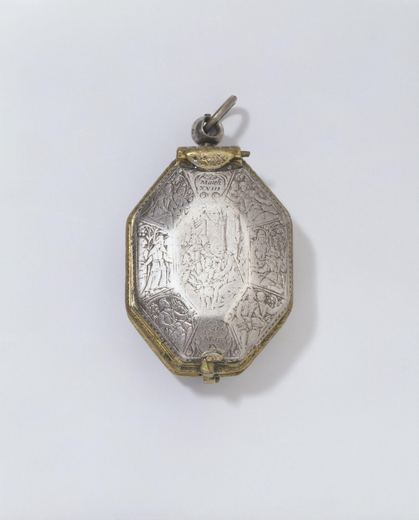
Case and dial of engraved silver and gilt brass. English, about 1640.
Victoria and Albert Museum, London
Pocket Watches · ca. 1610
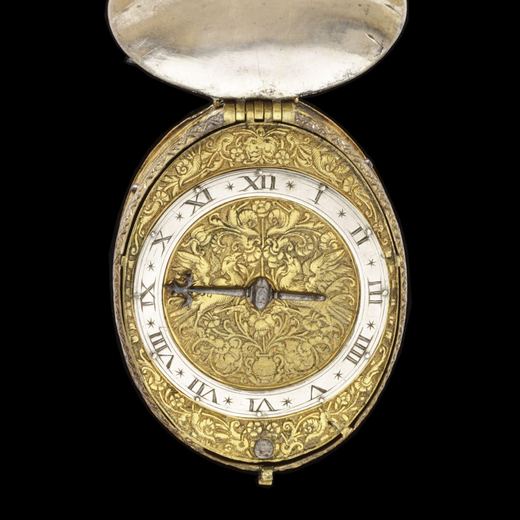
Watch by N. Ridgdale, England, ca. 1610
Victoria and Albert Museum, London
Pocket Watches · 1622-1628
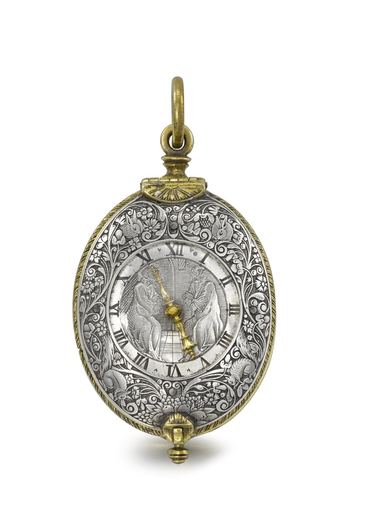
Pocket watch by Vautrollier, James, England, 1622-1628
Science Museum Group, London
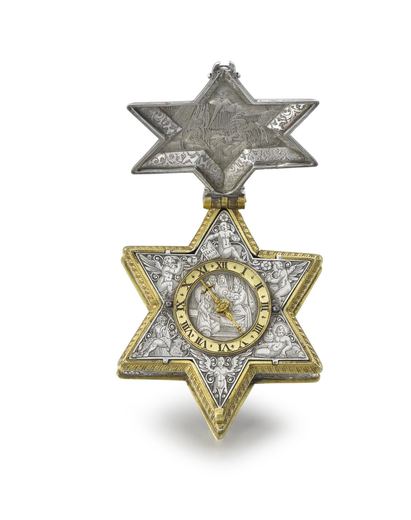
Pocket Watches · 1625
Pocket watch by Ramsay, David, England, 1625
Science Museum Group, London
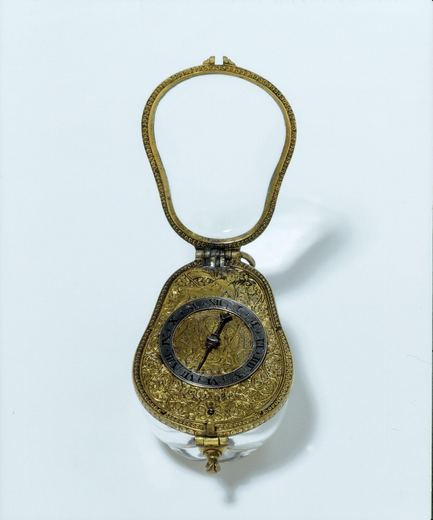
Pocket Watches · ca. 1635
Jewellery, England
Victoria and Albert Museum, London
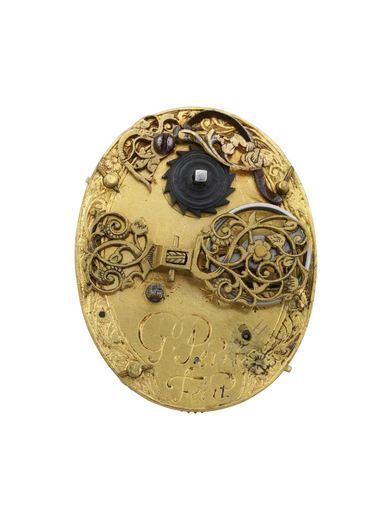
Pocket Watches · 1630
Pocket watch by Petit, G, England, 1630
Science Museum Group, London
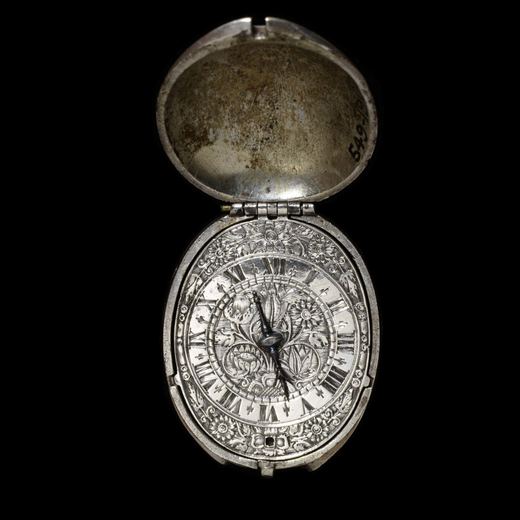
Pocket Watches · 1630-50
Watch by Henry Grendon, England, 1630-50
Victoria and Albert Museum, London
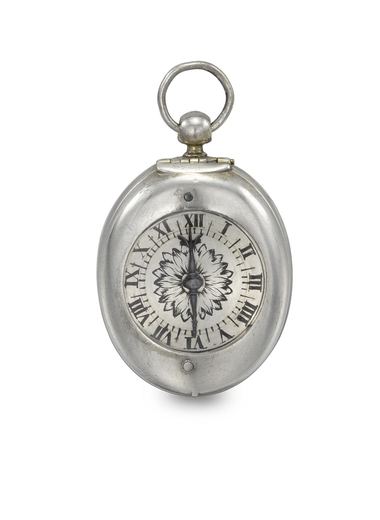
Pocket Watches · 1640
Pocket watch by Sampson Shelton, England, 1640
Science Museum Group, London