Clocks · Monstrance clock
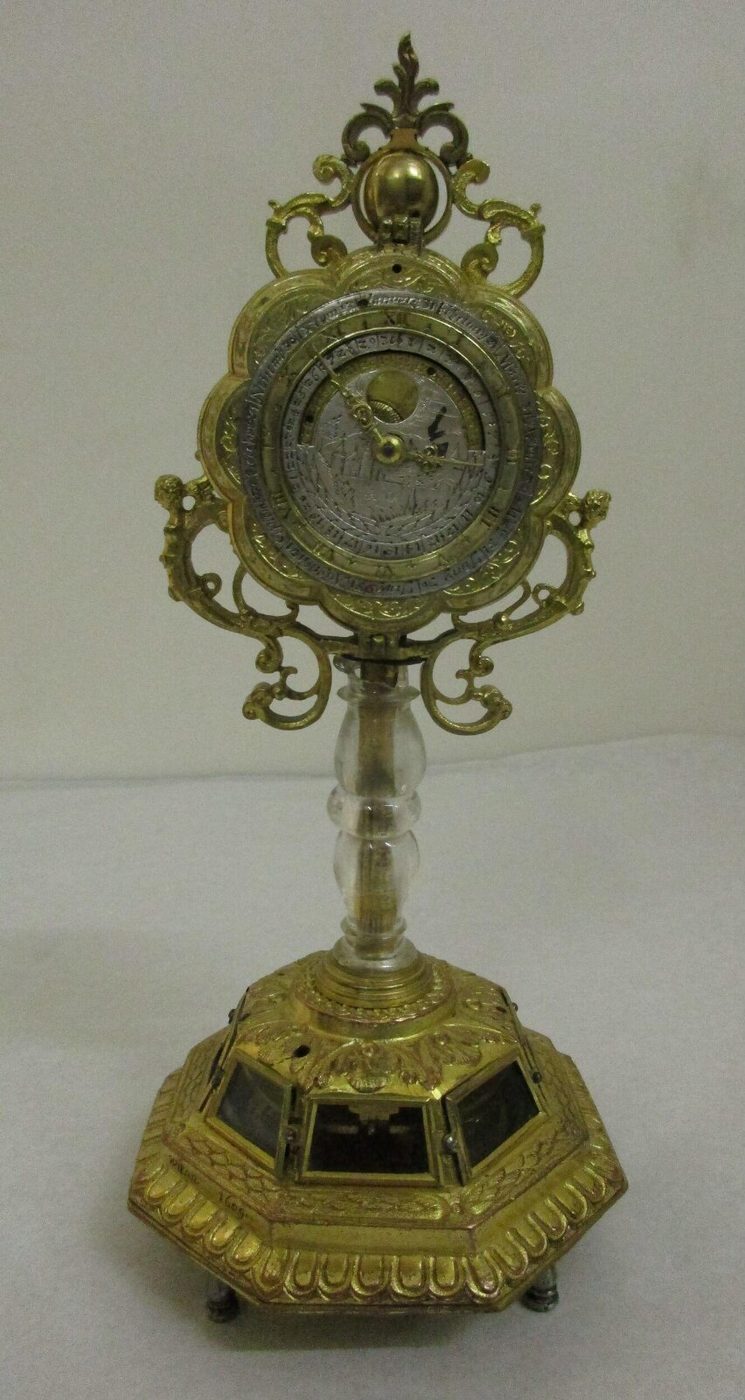
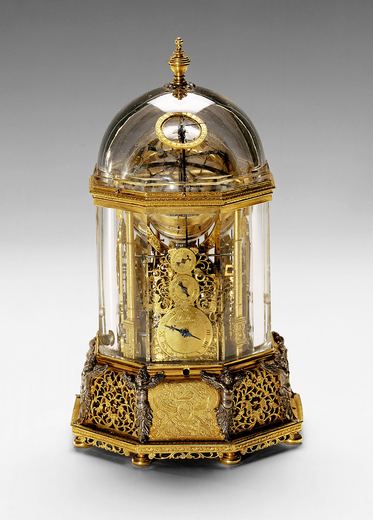
Small monstrance clock with rock crystal case South German or Austrian, early 17th Century.
- Maker / attribution
- J. Wolf (maker)
- Date
- 1600-1625
- Historical period
- Early Modern Horology (1600 – 1750)
- Country of origin
- Austria
- Place
- Austria,
- Object type
- Monstrance clock
- Materials / technique
- Gilt-brass, rock crystal and silver
- Dimensions
- Height: 19.4 cm; Width: 8.3 cm; Width: 8.3 cm
- Holding institution
- Victoria and Albert Museum, London
- Accession / object no.
- 2376-1855
- Credit line
- Purchased from the Ralph Bernal Collection
Record summary
Held and catalogued by Victoria and Albert Museum, London (object number 2376-1855), this is a monstrance clock by J. Wolf, made in Austria,, dated 1600-1625. The Atlas places it in the Early Modern Horology period (1600 – 1750) of its Clocks collection. Materials and techniques recorded by the source: Gilt-brass, rock crystal and silver. Recorded dimensions: Height: 19.4 cm; Width: 8.3 cm; Width: 8.3 cm. The record is illustrated with 4 photographs.
Assembled from the source record's structured fields. Dates and attributions are given as the source states them; where a field is missing the Atlas leaves it blank rather than estimating.
Catalogue description
V&A — Summary
Small monstrance clock with a movement enclosed in an octagonal drum-shaped case of rock-crystal with a scalloped rim imitating a flower, mounted in engraved gilt-metal, with gilt-brass dial with applied silver rings with indexes for months, hours, days and minutes. This is supported on a rock-crystal baluster stem, flanked by gilt arabesque brackets, with octagonal foot. The dial is punched 'ANNO 1609 WIENN' indicating that it was sold in Vienna in 1609. Bought from the sale of the collection of Ralph Bernal MP in 1855.
V&A — Physical description
Case: The base standing on four turned iron feet and molded and chased contains the striking movement, which is in a watch-type case, with the bell strapped below it. Eight sloping rock crystal panels allow a partial view of this movement. The turned-brass stem is encased in rock crystal of baluster shape and the going train of the clock is housed in an octagonal escalloped vertical drum-shaped case, of which the rear is a hinged door of rock-crystal with a brass bezel and the front including the dial, of gilt brass with applied silver rings. The sides of the drum are of rock crystal; they are flanked by pierced scrolls terminating in female busts surmounted by a pierced scroll surrounding a small globe. Dial: Dial with an outermost narrow silver ring Diameter 44cm. Engraved with the names of the months and the number of their days (but without indicating hand): within this a narrow brass hour ring with hours I to XII in Roman numerals and arrowheads at the half-hours. Within again, a silver disc numbered at its edge1 to 30 for the day of the month, and with an engraved landscape at its centre; in a semi-circular slot a ring of numbers can be seen corresponding to the moon’s age and through a circular aperture its phase can be seen visually. A pierced brass hand shows the hour on the hour-ring, and a similar shorter hand shows the date; this hand rotates, with the moon-ring, once in 30 days, so that the moon’s age is in error by ½ day per month. Movement: Going train of brass throughout, except for motion-work wheels, which are of iron. Fusee, verge escapement, brass balance-wheel with balance-spring and regulator of Tompion type. Pierced single-foot cock, foot and other decorations. The cock incorporates the letter A. The whole going movement is consistent with a date of about 1680 but thin brass sheet attached to the inside of the silver dial centre is punched “ANNO 1609 WIENN'. The striking train movement, mounted within plates, 4.4 cm diameter in the bases is of a conventional count-wheel type, with the wheel in the form of a sliding ring cut and marked for a sequence 1 to 12. Going barrel. The unlocking of the striking train is a vertical arbor within the stem.
V&A — Historical context
This table clock is inspired by contemporary watches in both scale and design. The movement is contained in a case which resembles a flower.
V&A — Object history
Clocks were luxury items designed to impress as well as educate. By the 1550s it was fashionable for wealthy gentlemen to have a sound understanding of all branches of learning, from art and literature to mathematics and the natural sciences. Clocks such as this were housed alongside automatons and scientific instruments such as astrolabes and sundials in Scientifica, collections celebrating human ability to control nature. Ralph Bernal's collection of decorative art objects was formed in the 1830s and 1840s and the V&A bought extensively from the sale of his collection in 1855 which lasted for thirty-two days and comprised 4,294 lots. Bernal trained as a lawyer and stood as Member of Parliament from 1818 to 1852. He spent twenty thousand pounds on his collection which was rich in ceramics, arms and armour and clocks. Provenance Ralph Bernal (1783-1854) was a renowned collector and objects from his collection are now in museums across the world, including the V&A. He was born into a Sephardic Jewish family of Spanish descent, but was baptised into the Christian religion at the age of 22. Bernal studied at Christ's College, Cambridge, and subsequently became a prominent Whig politician. He built a reputation for himself as a man of taste and culture through the collection he amassed and later in life he became the president of the British Archaeological Society. Yet the main source of income which enabled him to do this was the profits from enslaved labour. In 1811, Bernal inherited three sugar plantations in Jamaica, where over 500 people were eventually enslaved. Almost immediately, he began collecting works of art and antiquities. After the emancipation of those enslaved in the British Caribbean in the 1830s, made possible in part by acts of their own resistance, Bernal was awarded compensation of more than £11,450 (equivalent to over £1.5 million today). This was for the loss of 564 people enslaved on Bernal's estates who were classed by the British government as his 'property'. They included people like Antora, and her son Edward, who in August 1834 was around five years old (The National Archives, T 71/49). Receiving the money appears to have led to an escalation of Bernal's collecting. When Bernal died in 1855, he was celebrated for 'the perfection of his taste, as well as the extent of his knowledge' (Christie and Manson, 1855). His collection was dispersed in a major auction during which the Museum of Ornamental Art at Marlborough House, which later became the South Kensington Museum (now the V&A), was the biggest single buyer.
V&A gallery label
WATCH. The movement enclosed in an octagonal escalloped case of crystal, mounted in engraved gilt metal, with silver dial, and indexes for months, hours, days, and minutes; supported on a crystal baluster stem or pedestal, flanked by gilt arabesque brackets, the foot octagonal, with crystal plaques containing the striking movement: maker 'J.Wolf, Vienna'. German . Dated diam.3 3/ 8 in. 1609 H. 7 5/ 8 . Bought (Bernal coll.) 14l.
Inscriptions & marks
ANNO 1609 WIENN
Historical context
Early Modern Horology (1600 – 1750)
Huygens' pendulum and balance spring transform accuracy; English makers develop the anchor and deadbeat escapements.
Huygens's pendulum (1656–57) improved clock accuracy from about a quarter of an hour to under a minute a day. The anchor escapement (c. 1670) and the long seconds pendulum created the longcase clock; London makers such as Fromanteel, Knibb, Tompion and Quare led European clockmaking, and French makers created the Boulle pendule.
Read the period in the timelineMore clocks from this periodEarlier: Renaissance Horology
Atlas type guide
Astronomical, musical and automaton clocks
Astronomical clocks display more than the hour: the positions of the sun and moon in the zodiac, the phase of the moon, the calendar, sometimes the planets and eclipses. From Richard of Wallingford's and Giovanni de' Dondi's fourteenth-century clocks to the Prague Orloj and the Strasbourg cathedral clocks, they demonstrated the order of the cosmos. Renaissance makers in Augsburg and Nuremberg built celestial globe clocks and monstrance clocks as princely treasures.
Automaton and musical clocks entertained as well as informed: figures move, birds sing, organs and carillons play tunes from pinned cylinders. The eighteenth-century trade with China ('sing-songs') and Ottoman Turkey created a market for elaborate English, Swiss and French automata.
What to look for
- Subsidiary dials for moon phase, calendar, zodiac and planetary positions.
- Celestial globes or armillary spheres turned by the movement.
- Pinned cylinders, bellows and pipes or bells for music.
- Figures on cams and levers; separate trains for automaton work.
Dating clues
- Renaissance astronomical table and globe clocks: c. 1550–1650.
- English and Swiss automaton clocks for the Chinese market: c. 1760–1820.
- Picture clocks (clockwork pictures) are mostly nineteenth century.
General guidance written by the Atlas editors about this kind of object. It is not a statement about this particular piece; for that, rely on the source record above and on physical examination.
Related records
Clocks · case 1554, movement ca. 1680
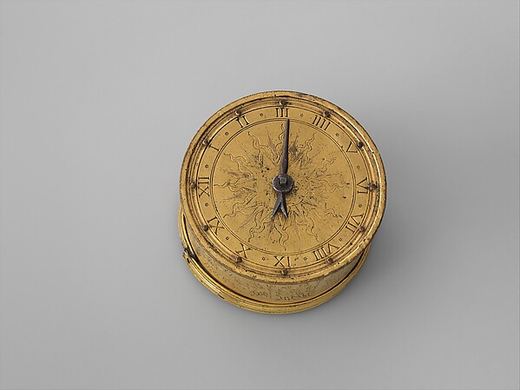
Table clock by Caspar Behaim (Chasparus Bohemus), Austria, case 1554, movement ca. 1680
The Metropolitan Museum of Art, New York
Clocks · 1720
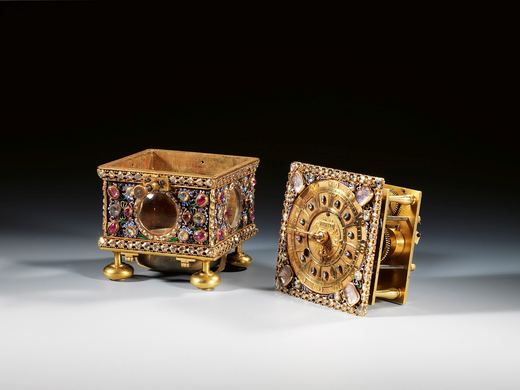
Table clock by Joseph Derchinger (Uhrmachermeister, gest. 1736), Austria, 1720
University of Graz
Clocks · 1550–1650
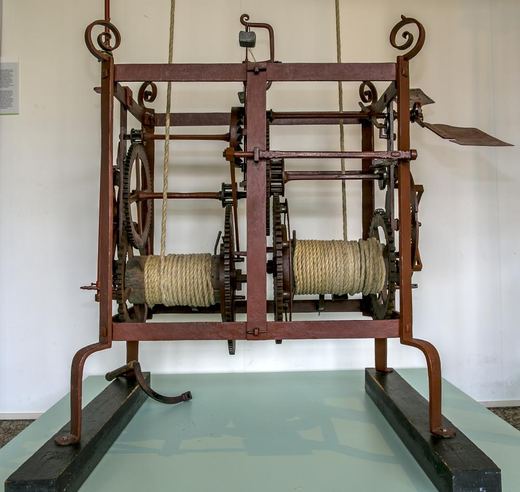
Turret clock, Netherlands, 1550–1650
Museum Klok & Peel
Clocks · 1590–1610
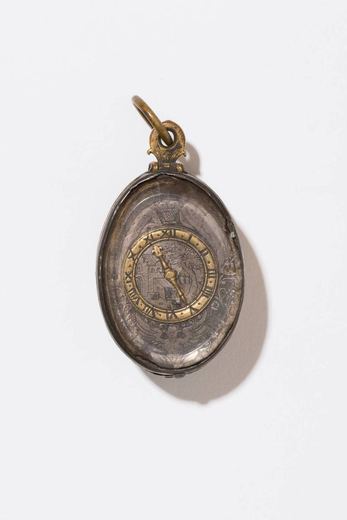
Clock, France, 1590–1610
MAK – Museum of Applied Arts
Clocks · 1598-1603
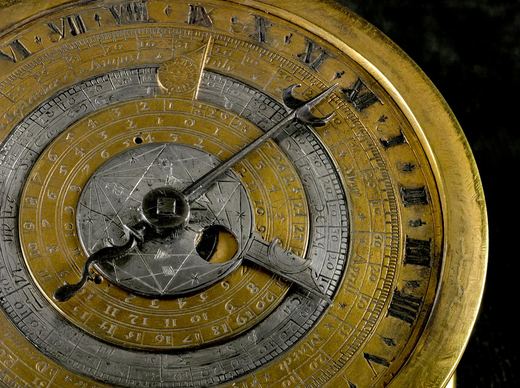
Circular table-clock with calendrical and lunar indications made by Nicholas Vallin in London between 1598 and 1603.
Science Museum Group, London
Clocks · 1600–1699
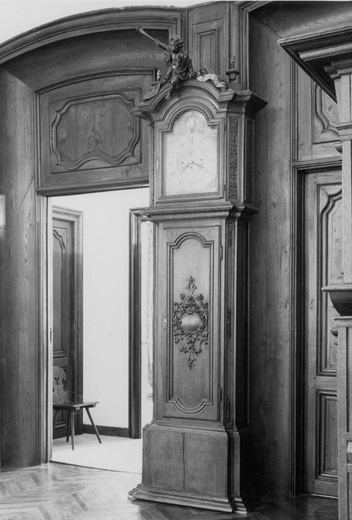
Clock by Joannes Volcker, Belgium, 1600–1699 (Royal Institute for Cultural Heritage AP_10156031)
Royal Institute for Cultural Heritage
Clocks · 1600–1699
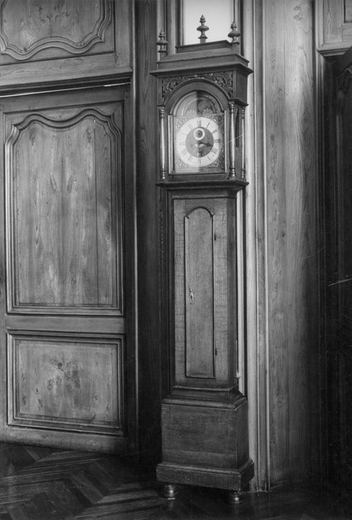
Clock by Joannes Volcker, Belgium, 1600–1699 (Royal Institute for Cultural Heritage AP_10156032)
Royal Institute for Cultural Heritage
Clocks · 1600–1699
Clock by Jobst Bürgi (ascribed to), Czech Republic, 1600–1699
Fine Arts Museum Vienna