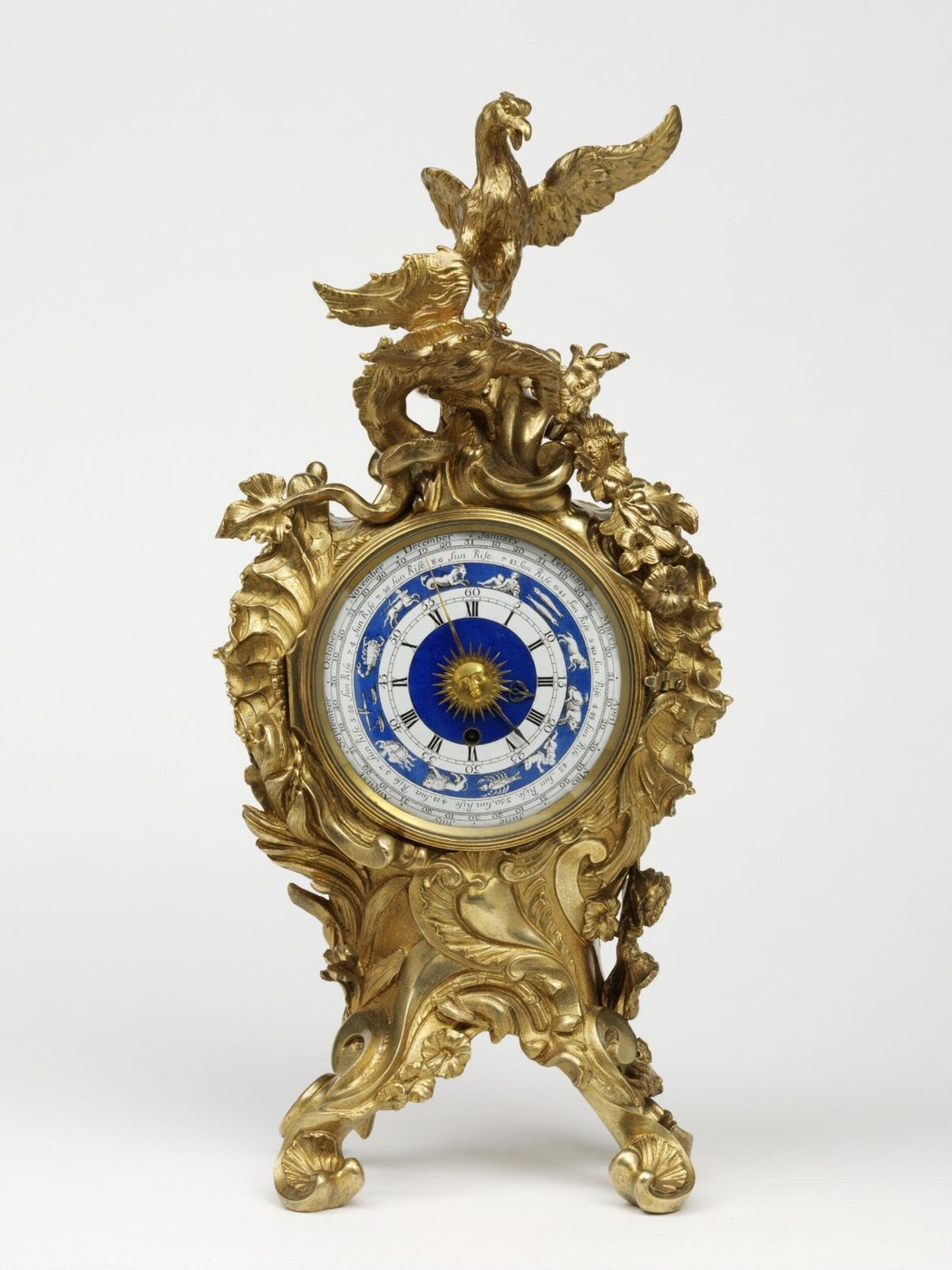
Clocks · Royal mantel clock
Royal mantel clock with gilt-brass case with enamel dial centred with sun in gold the movement signed on the back 'Clay'.
- Maker / attribution
- Charles Clay (maker); Peter Dutens (supplier)
- Date
- 1736
- Historical period
- Early Modern Horology (1600 – 1750)
- Country of origin
- England
- Place
- London
- Object type
- Royal mantel clock
- Materials / technique
- Gilt-brass, cast, chased, pierced, enamelled
- Dimensions
- Height: 40 cm; Width: 16 cm; Width: 19 cm; Depth: 11 cm; Depth: 17 cm
- Holding institution
- Victoria and Albert Museum, London
- Accession / object no.
- M.1:1,2-2016
- Credit line
- Acquired with support from Art Fund, the Gilbert Public Arts Foundation, the Gilbert Trust for the Arts, the Hugh Phillips Bequest and the Friends of the V&A.
Record summary
Held and catalogued by Victoria and Albert Museum, London (object number M.1:1,2-2016), this is a royal mantel clock by Charles Clay, made in London, England, dated 1736. The Atlas places it in the Early Modern Horology period (1600 – 1750) of its Clocks collection. Materials and techniques recorded by the source: Gilt-brass, cast, chased, pierced, enamelled. Recorded dimensions: Height: 40 cm; Width: 16 cm; Width: 19 cm; Depth: 11 cm; Depth: 17 cm. The record is illustrated with 4 photographs.
Assembled from the source record's structured fields. Dates and attributions are given as the source states them; where a field is missing the Atlas leaves it blank rather than estimating.
Catalogue description
V&A — Summary
This mantel clock was supplied by the London-based Huguenot jeweller Peter Dutens for Frederick Louis, Prince of Wales, eldest son of George II in 1736, at a cost of £61 2s. The elaborate case in the French rococo style was made in Paris. The eagle with one wing boldly outstretched which surmounts the case may symbolize Frederick’s close political associations with Prussia; Prince Frederick only came to London in 1728 and maintained contact with his cousin Frederick the Great throughout his life. The design of the case is influenced by contemporary French ornament prints including the work of de La Joue; a model for the case may have been carved in wood or rendered in terracotta in London and sent to Paris for casting. The complex dial with the signs of the zodiac was designed by Charles Clay, Clockmaker to His Majesty’s Board of Works. Clay was paid for the design of the enamelled dial and for its central gold mount chased with the face of the sun with a longer hand that points to the day of the month. The clock was ordered in February and delivered at the end of August, 1736. It is signed on the back of the movement ‘Clay’. Clay who had trained as a watchmaker and from 1730 specialized in assembling sophisticated organ clocks which played music by Handel with elaborate painted front plates and sculptural mounts using the best contemporary artists and sculptors celebrating the Italian opera staged in London. This clock may have been intended as a gift for Princess Augusta of Saxe-Gotha whom Prince Frederick Louis married in London in April 1736. It may have been intended for display on a mantelpiece in the Prince and Princess's private rooms at Carlton House, St.James’s, their new London residence.
V&A — Physical description
Gilt-brass case with pierced side panels; the movement signed Clay for Charles Clay (working in London 1720 to 1740) The clock case is mounted on top with an eagle with one open and one closed wing perched on the body of a draco (a dragon with the tail of a snake with a foliate terminal); its mouth open with teeth and tongue clearly visible. The sides of the case are decorated with flowers, shells and batwings; the apron on the front is decorated with a heart-shaped cartouche whilst that on the back has two superimposed shells. The clock is supported on four scroll feet also embellished with shells. The decoration on the back suggests that it was intended for display against an overmantel looking glass so that the detail on the back could be appreciated. The clock movement has an eight-day spring-driven going train.This has a circular five pillar single chain fusee movement with verge escapement and short-bob pendulum. The rotating circular disc on the backplate is connected via the centre-arbor to the concentric calendar hand and advanced day by day via pallet flag engaging with teeth cut to the circumference, held in place with a jumper (flexible spring). The fusee may have been regrooved to accept a fusee chain; it has an additional steel stop-piece and a first wheel of a redder colour which does not have the tiny marks on the teeth normal for the 1730s and may be a later replacement. The movement is held in place on a wooden platform by a screw on the underside of the case. The 4.25 inch circular enamelled dial has a cobalt blue centre within small diameter Roman numeral chapter ring with Arabic five minutes and concentric bands annotated with painted signs of the Zodiac. Sun Rise for each sign and date-of-the-month with months named to outer track, with fine sculpted steel hour and minute hands to centre and calendar hand issuing from a gold solar mask within narrow canted gilt bezel surround. The whole enamelled clock dial is a new introduction found in contemporary French clocks signed by Charles Voisin and developed by Antoine-Nicolas Martinière J-D Augarde, Les Ouvriers du Temps , p.99 who explains that ‘It was not until the 1730s that technical progress allowed the manufacture of entirely enamelled large dials, at the initiative of Antoine-Nicolas Martinière who in 1740 wrote as follows ‘You ask me, Sir, to find out from the Porcelain Manufacturers if they could make you a Clock Dial one foot in diameter, because you tell me that you know it is impossible to make any of this size all in enamel, like Watch Dials. It is true that until recently this was impossible in the City, and even at Court. Here is an example. The King ordered a Clock, and H.M. wished that the Dial be all of one piece, in enamel, and 14 inches in diameter. The one who received the order could only reply that he would attempt to carry it out, not that he would succeed. The Sr Martinière, Enameller, in the rue Dauphine, undertook this task, and succeeded so well in all respects, that he had the honour of presenting it himself to His Majesty, who was agreeably surprised, and gave him signs of satisfaction with so much kindness that he returned to Paris, enchanted with so happy a success, and resolved to carry out new studies in order to advance, as much in his Art as would be possible’. A.N.Martinière, ‘Lettre écrite de Paris à un horloger de Province sur les Cadran d’Email’ Mercure de France, Avril, 1740. The ‘gold sun chased’ is fitted to the dial by a gilt brass pipe. The key hole has been protected by inserting a brass sleeve which is a tight fit on the underlying dial plate. The border of zodiacal signs was reserved in white enamel; then overpainted in blue and finally drawn in black over both the white and blue enamelled grounds. Although the dial is English work the technique of stippling apparent in the outer blue ground border is associated with German artists, for example Christian Zinke who was working in London at this date. Zinke came to England in 1706 to assist Charles Boit and in 1732 was appointed Cabinet Painter to the Prince of Wales. He remained in England. The back of the dial plate has the scratched inscriptions ‘CRMX 326’ and September/99 Oct/06 indicating repairs undertaken in 1899 and 1906 suggesting a date for the re-enamelling of the centre. It is not now possible to access the back of the enamelled dial to ascertain whether these is a signature as is sometimes found. The dial is protected with a hinged convex glazed bezel and scroll, the rear with circular glazed aperture, probably a later replacement for the pierced brass back cover found on contemporary French mantel and table clocks. The pierced side frets are finely engraved and are held in place with returning bottom ledges.
V&A — Historical context
This ormolu-cased clock is amongst the earliest documented examples of Rococo confections in England, a subject area closely associated with the V&A’s ground-breaking 1984 exhibition 'Rococo: Art and Design in Hogarth’s England.' It may be inspired by designs by Jacques de la Joue (1686-1761) published as Livre Nouveau de Douze Morceaux de Fantaisie and advertised in Paris in May 1736 in the Mercure de France as ‘des sujets de fantaisies singulières et très élégantes’ ( see V&A 29678.3). Other possible sources include contemporary ornament prints by Jean Mondon, Quatrieme Livre De Formes Ornées de Rocailles Carels Figures Oyseaux et Dragons chinois , published in 1736 (E.364-1952) and designs engraved by Gabriel Huquier after Alexis Peyrotte. Frederick Prince of Wales was interested in science and his chaplain was the scientist J.T.Desaguiliers (1638-1744) who entertained members of the royal family with philosophical experiments at Hampton Court and at Kew, where Prince Frederick had a room containing Desaguliers's scientific instruments. Charles, 5 Lord Baltimore (1699-1751) who purchased another French clock on behalf of the prince was an important patron in his own right. His purchases of paintings and objets d’art in Paris for Prince Frederick Louis are documented in the Household Accounts at the Duchy of Cornwall and include a further payment for 11 guineas for a clock.
V&A — Object history
The clock remained in the British Royal Collection until 1843 when it was included in the sale of the collection of the Duke of Sussex at Christie’s 22 June 1843 (128); it was purchased by the dealer John Boykett of Jarman, 130 New Bond Street. It was later sold to Sir Richard Charles Henry Rycroft, Kempshott Park; acquired by the vendor Edward Hurst at Dreweatts, Newbury 28 August 2014.
V&A — Production note
It is possible the gold mount with the face of the sun might have been chased for Charles Clay by Ishmael Parbury a chaser with whom Clay is known to have worked. Parbury chased two watchcases for movements signed by Clay (see Richard Edgcumbe, The Art of the Gold Chaser in Eighteenth-Century London , Oxford, 2000, pp. 139-40). Watchmakers often continued with the chasers whose work they knew. The case may have been ordered in Paris through William Hubert of St Martin’s Lane who specialized in supplying metal lighting equipment and was paid for ‘four pair of Chandeliers and Branches and six pairs of Medal Branches’ for Prince Frederick’s use in September 1732. The model for the case may have been provided by the carver Paul Petit who was supplying carved picture frames for Prince Frederick from September 1733. The provision and setting of the two pierced side frets suggest that the original movement was intended to be a two-train with a striking mechanism. Perhaps there was a change of mind after delivery of the case and before the London movement was supplied; perhaps Frederick and Augusta did not want a striking clock in their private apartments or more probably the French clock case could not accommodate a larger English striking movement.
V&A gallery label
MANTEL CLOCK Gilded copper alloy case, enamelled dial and gold mount Signed 'Clay' on the movement for Charles Clay, the designer Paris and London, 1736 This Paris-made clock case is decorated with a lively combination of flowers and shells. The swirling ornament, inspired by the natural world, echoes goldsmiths' work from the 1720s to the 1760s. The dial, which ingeniously records the times of sunrise, day, date, and monthly zodiac sign, was designed by Yorkshire-born Charles Clay, clockmaker to George II by 1723. It is enamelled as a single piece, a technical achievement that had only recently been mastered. Supplied by the jeweller Peter Dutens to George's eldest son Frederick Louis, Prince of Wales, Frederick's household accounts show that the dial, unsurprisingly, was the most expensive element at £21. While the imported French case was comparatively cheaper at £11.55, these sums of money were still astronomical to most people at that time. Acquired with support from Art Fund, the Gilbert Public Arts Foundation, the Gilbert Trust for the Arts, the Hugh Phillips Bequest and the Friends of the V&A M.1-2016 Art Fund_
V&A gallery label
Mantel clock supplied by Peter Dutens, Jeweller, London, for Frederick Louis, Prince of Wales, 1736 Ormolu case, enamel dial with gold sun, movement signed by Charles Clay (d.1740) Commissioned in February 1736 for Frederick Louis, Prince of Wales, eldest son of George II, from Huguenot jeweller Peter Dutens, in London’s West End. Documented in the Prince’s household accounts, the clock was delivered seven months later on 31st August at a total cost of £61 2 shillings. A 'Drawing for a Clock Dial Plate' was submitted for approval in mid-March; enamelling the sophisticated dial in blue and white with the signs of the zodiac was the most expensive part; the drawing cost £1 5s (£1.25) but the dial cost 20 guineas (£21). The ormolu case was brought over from Paris. It cost 11 guineas (£11.55) with 2 guineas to cover the cost of commission, transport, custom duty and a further charge at the Custom House. The ‘Gold sun chased’ in the centre of the dial at 4 guineas (£4.20) was supplied by a London chaser, possibly Ishmael Parbury, who supplied gold cases for Charles Clay’s watches. There was a further charge of 2 guineas 'For making side Frizes to the Case and Glass' which suggests that the movement was originally intended to have a striking mechanism so that the bell could be heard through the pierced apertures. The eight day movement ‘that goes with a Chain to show the signs of the Zodiack with Rising of the Sun etc' cost 18 guineas (£18.90). Possibly intended as a wedding present from the Prince to his bride, Augusta of Saxe-Gotha; they married in April, 1736; and for display at their new London home Carlton House, St James’s.
Inscriptions & marks
The back of the movement (on the large toothed calendar wheel which conceals the back plate) is signed ‘Clay’; the front of the dial is inscribed with the months of the year; the average time of sunrise of each month and the hours in Roman numerals.
Historical context
Early Modern Horology (1600 – 1750)
Huygens' pendulum and balance spring transform accuracy; English makers develop the anchor and deadbeat escapements.
Huygens's pendulum (1656–57) improved clock accuracy from about a quarter of an hour to under a minute a day. The anchor escapement (c. 1670) and the long seconds pendulum created the longcase clock; London makers such as Fromanteel, Knibb, Tompion and Quare led European clockmaking, and French makers created the Boulle pendule.
Read the period in the timelineMore clocks from this periodEarlier: Renaissance Horology
Atlas type guide
Mantel and French pendule clocks
The mantel clock — the French pendule de cheminée — is as much decorative art as timekeeper. From the late seventeenth century Parisian clockmakers worked with cabinet-makers, bronze founders and gilders (ciseleurs-doreurs) to create cases in Boulle marquetry, gilt bronze and marble, while the movements were often supplied by specialist makers. Clocks of the Louis XIV, Louis XV and Louis XVI periods, and Empire clocks with allegorical figures, set fashions copied across Europe.
The nineteenth century industrialised the type. The 'Paris movement', a standardised round movement with silk-thread or Brocot suspension and count-wheel striking, was made in huge numbers by firms such as Japy and Vincenti, and fitted into cases of every style and material.
What to look for
- Round 'Paris' movements with makers' stamps (e.g. Japy Frères, Vincenti, S. Marti) and medal marks from exhibitions.
- Suspension type: silk thread (earlier) or Brocot adjustable suspension (after c. 1840).
- Visible Brocot escapement on the dial in later clocks.
- Fire-gilt (mercury) gilding on bronzes versus later electro-gilding.
- Signed dials naming a retailer rather than the movement maker.
Dating clues
- Silk-suspension Paris movements: c. 1800–1850.
- Brocot suspension and visible escapements: after c. 1840.
- Exhibition medal stamps on movements give dates after the medal year.
General guidance written by the Atlas editors about this kind of object. It is not a statement about this particular piece; for that, rely on the source record above and on physical examination.
Read next:Anchor (recoil) escapement
Related records
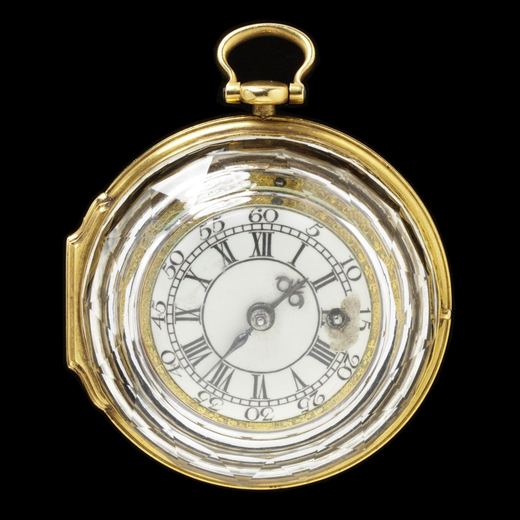
Pocket Watches · ca. 1730-1739
Gold and crystal watch, signed 'Cha: Clay, London, 1197', England, ca. 1730-9
Victoria and Albert Museum, London
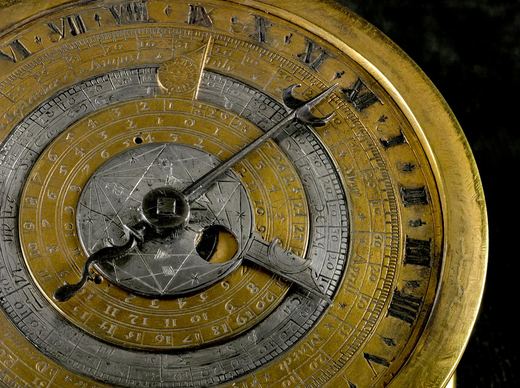
Clocks · 1598-1603
Circular table-clock with calendrical and lunar indications made by Nicholas Vallin in London between 1598 and 1603.
Science Museum Group, London
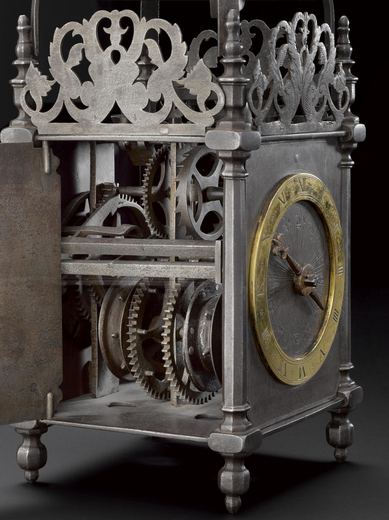
Clocks · 1611
English iron lantern clock, with wheel balance, by John Holloway, Market Lavington, Wiltshire, England, 1611.
Science Museum Group, London
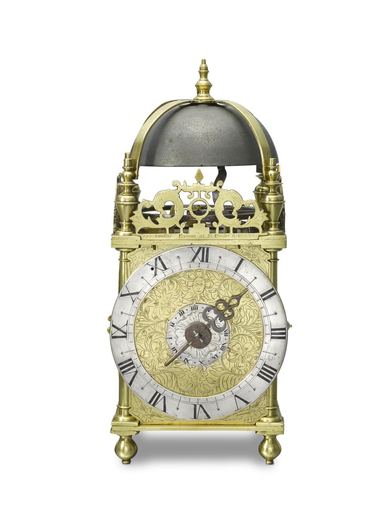
Clocks · 1630
Lantern clock by Forman, Francis, England, 1630
Science Museum Group, London
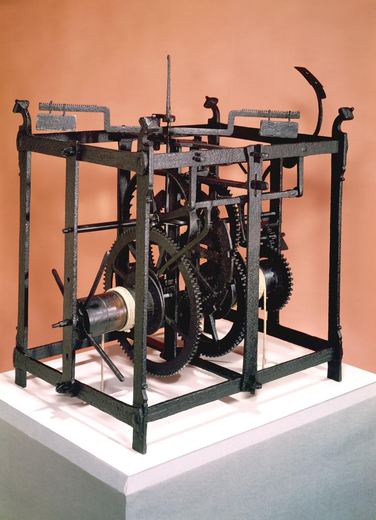
Clocks · 1632-1640
Turret clock, England, 1632-1640
Science Museum Group, London
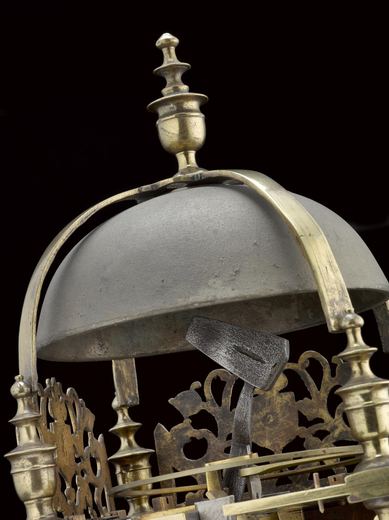
Clocks · 1645-1655
Balance-wheel brass lantern clock, with two driving weights and one counterweight, by Thomas Knifton, Cross Keys, Lothbury, London, England, 1645-1655.
Science Museum Group, London
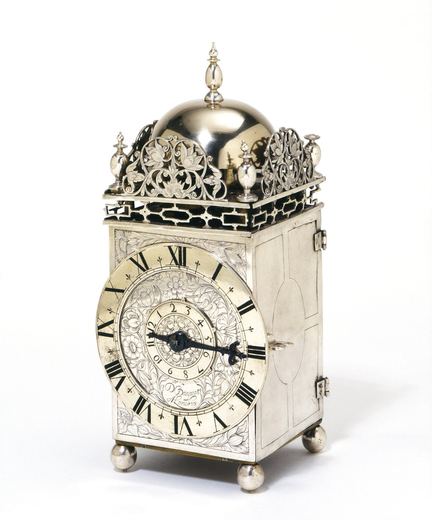
Clocks · ca. 1650
Lantern alarm clock, silver, by David Bouquet, circa 1650
Victoria and Albert Museum, London
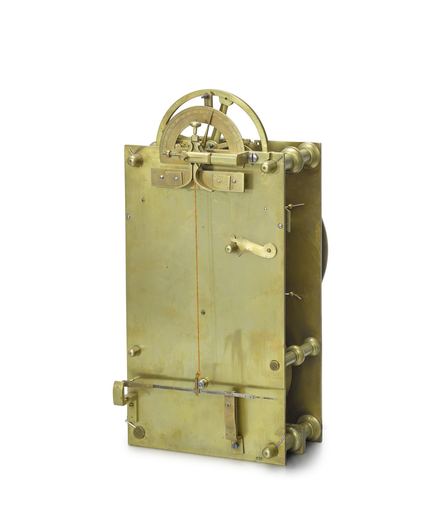
Clocks · 1650-1660
Lantern clock by Closon, Peter, England, 1650-1660
Science Museum Group, London