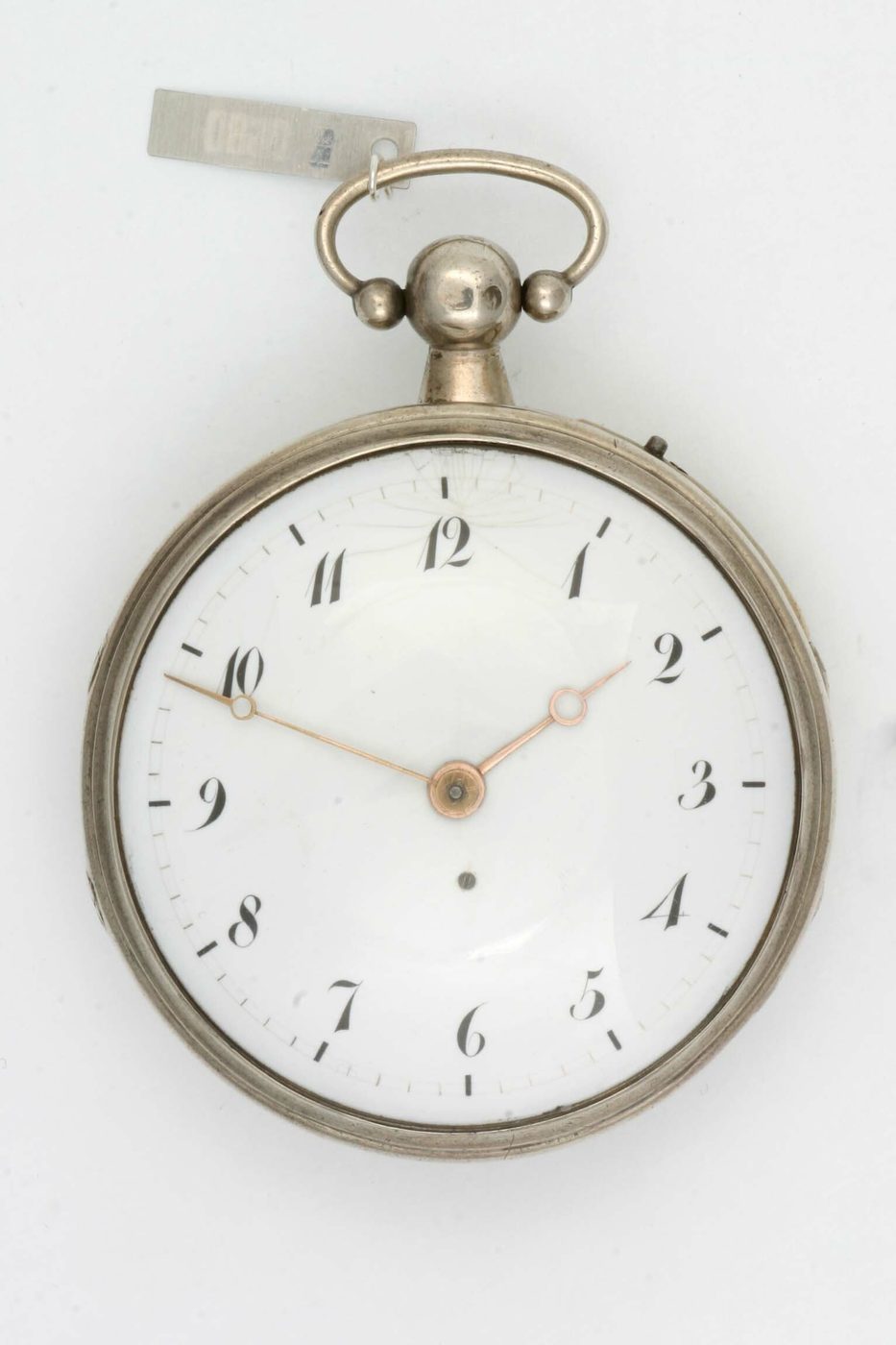
Pocket Watches · Repeating watch
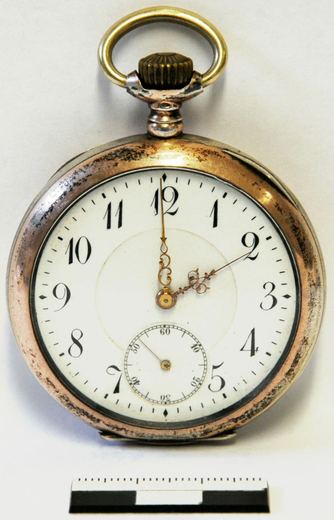
Repeating watch by Japy Frères et Cie., Germany, 1820
- Maker / attribution
- Japy Frères et Cie. (creator)
- Date
- 1820
- Historical period
- Precision & Scientific Horology (1750 – 1850)
- Country of origin
- Germany
- Place
- Beaucourt
- Object type
- Repeating watch
- Holding institution
- German Clock Museum
- Accession / object no.
- Museu_ProvidedCHO_museum_digital_56249__technical_number_
- Catalogue title (original)
- Taschenuhr mit Repetition, um 1820 (German)
Record summary
Held and catalogued by German Clock Museum (object number Museu_ProvidedCHO_museum_digital_56249__technical_number_), this is a repeating watch by Japy Frères et Cie., made in Beaucourt, Germany, dated 1820. The Atlas places it in the Precision & Scientific Horology period (1750 – 1850) of its Pocket Watches collection. The record is illustrated with 1 photograph.
Assembled from the source record's structured fields. Dates and attributions are given as the source states them; where a field is missing the Atlas leaves it blank rather than estimating.
Catalogue description
Catalogue description from German Clock Museum (German)
Taschenuhr mit Karrikatur "Aux Amateurs de Physique 1784", Repetition nach Japy/Vincenti, Hersteller unbekannt, um 1820 (Deutsches Uhrenmuseum Furtwangen)
Shown in the original language of the source catalogue. An editor-reviewed English translation has not yet been published; we do not publish machine translations as authoritative text.
Historical context
Precision & Scientific Horology (1750 – 1850)
Harrison solves longitude; Mudge invents the lever; Breguet's Paris workshop defines the modern watch.
From 1750 to 1850 the watch became a precision instrument. Mudge's lever escapement, the cylinder escapement, Lépine's thin bar calibre, Breguet's innovations (overcoil, tourbillon, perpétuelle) and the pocket chronometer of Arnold and Earnshaw all date from this period, while verge watches remained common in cheaper production.
Read the period in the timelineMore pocket watches from this periodEarlier: Early Modern Horology
Atlas type guide
Repeating watches
Before electric light, telling the time in the dark was a real problem. Repeating watches strike the time on demand when a slide or push-piece is operated: quarter repeaters sound hours and quarters, minute repeaters hours, quarters and minutes. Edward Barlow and Daniel Quare disputed the invention in London in the 1680s. Early repeaters struck on a bell inside the case; Abraham-Louis Breguet introduced the gong (a coiled steel wire) around 1780, allowing thinner watches.
Repeaters require a separate train with racks, snails and a governor to control the striking speed, and are among the most demanding complications to make and adjust. Swiss makers of the Vallée de Joux specialised in repeating ébauches in the nineteenth century.
What to look for
- A slide on the case band or a push-piece through the pendant.
- Gongs encircling the movement (after c. 1780) or a bell in the case (earlier); pierced case for sound.
- The racks, snails and governor visible under the dial or on the movement.
- Terms such as 'Minutes', 'Quarts' or 'Répétition' on the dial or cuvette.
Dating clues
- Bell-striking quarter repeaters: c. 1690–1800.
- Gong repeaters and dumb repeaters (striking on the case): after c. 1780.
- Minute repeaters became more common after c. 1830 with Vallée de Joux ébauches.
General guidance written by the Atlas editors about this kind of object. It is not a statement about this particular piece; for that, rely on the source record above and on physical examination.
Read next:Minute repeaterMinute repeater
Related records
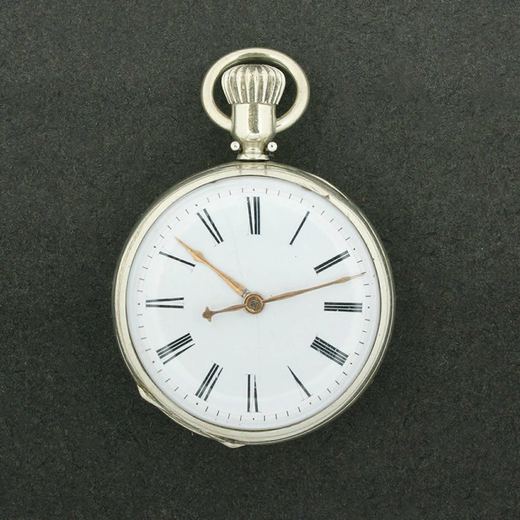
Pocket Watches · 1870
Pocket watch by Japy Frères et Cie., Germany, 1870
German Clock Museum
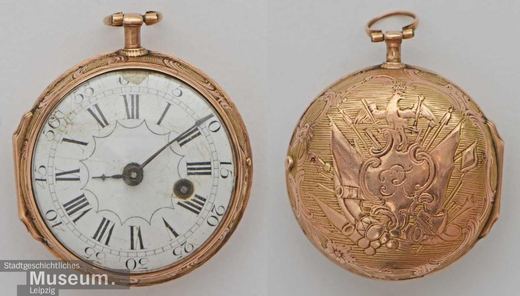
Pocket Watches · 1760
Pocket watch by Johann Michael Bendele, Germany, 1760
Museum of City History Leipzig
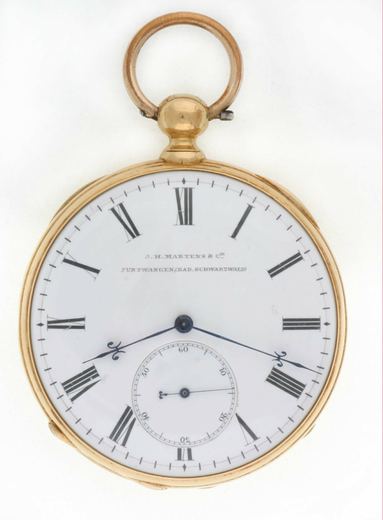
Pocket Watches · 1800–1899
Pocket watch by Martens und Cie., Germany, 1800–1899
German Clock Museum
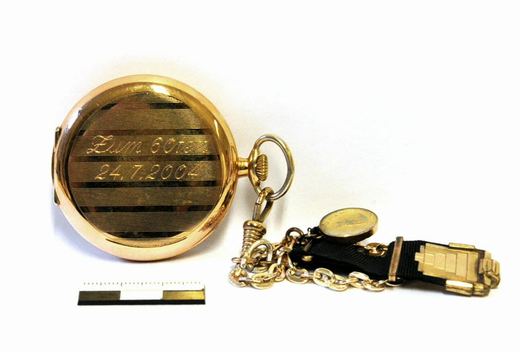
Pocket Watches · 1800–1899
Pocket watch, Germany, 1800–1899 (Montanhistorisches Dokumentationszentrum item_AHR2WWRUSXWB7JLUU5F27MD6R2QWTNL5)
Montanhistorisches Dokumentationszentrum
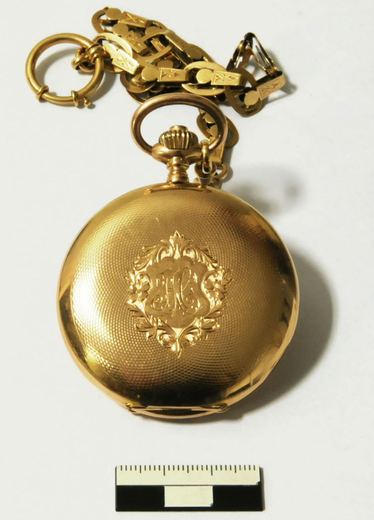
Pocket Watches · 1800–1899
Pocket watch, Germany, 1800–1899 (Montanhistorisches Dokumentationszentrum item_ANB57TW7X4AETN5YEIBPQZOCPZJNYTUG)
Montanhistorisches Dokumentationszentrum
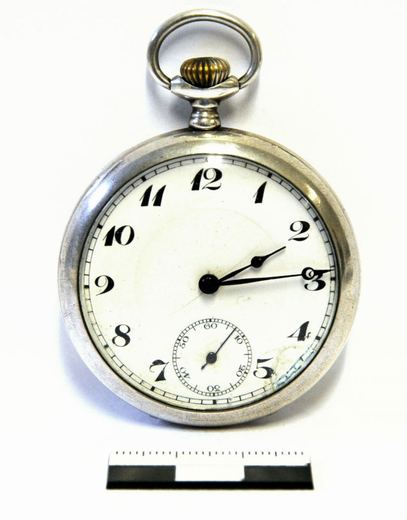
Pocket Watches · 1800–1899
Pocket watch, Germany, 1800–1899 (Montanhistorisches Dokumentationszentrum item_IMHEDCKJGACGO3F3DYT5PDA77S2OIJGY)
Montanhistorisches Dokumentationszentrum
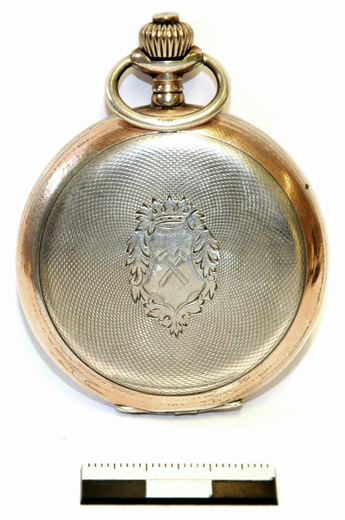
Pocket Watches · 1800–1899
Pocket watch, Germany, 1800–1899 (Montanhistorisches Dokumentationszentrum item_JSY5375J3KW4V3XW6BNN6ZXAZIC6QROL)
Montanhistorisches Dokumentationszentrum
Pocket Watches · 1800–1899
Pocket watch, Germany, 1800–1899 (Montanhistorisches Dokumentationszentrum item_KVL6R5LBGWNRKPW2IA3DJXMPO7C6Y7PC)
Montanhistorisches Dokumentationszentrum