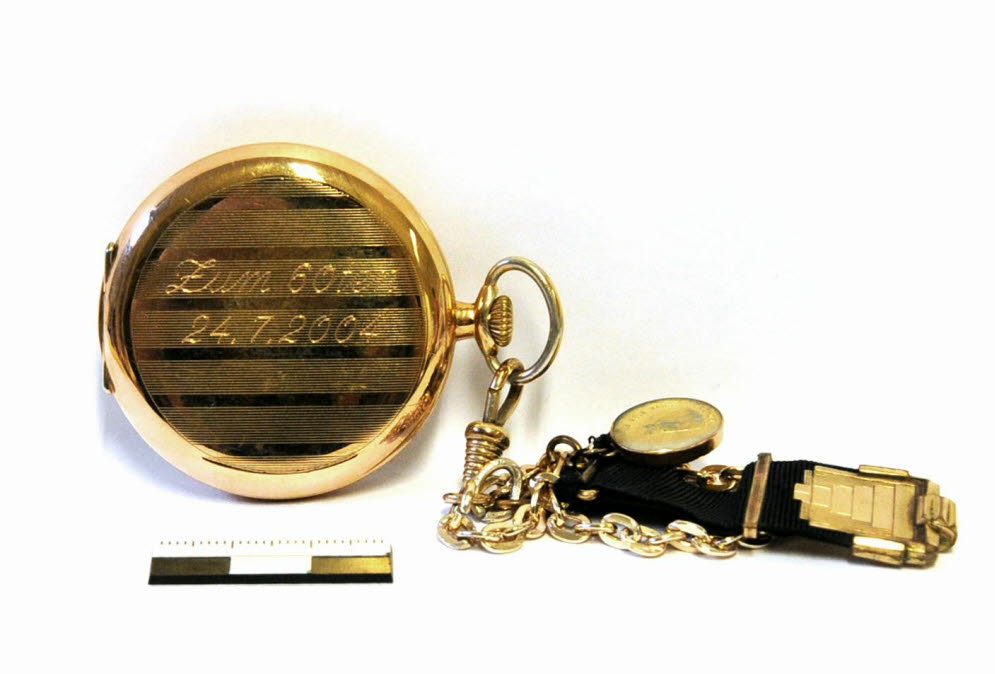
Pocket Watches · Pocket watch
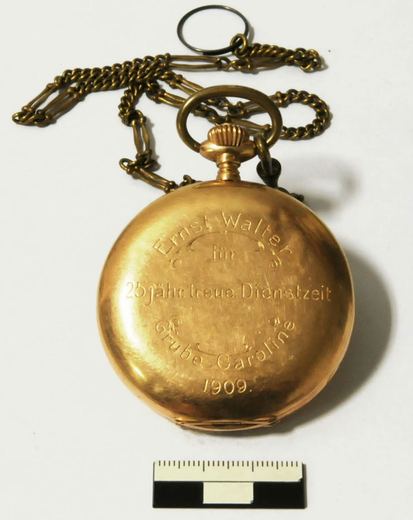
Pocket watch, Germany, 1800–1899 (Montanhistorisches Dokumentationszentrum item_AHR2WWRUSXWB7JLUU5F27MD6R2QWTNL5)
- Maker / attribution
- Unrecorded in source
- Date
- 1800–1899
- Historical period
- Precision & Scientific Horology (1750 – 1850)
- Country of origin
- Germany
- Place
- Germany
- Object type
- Pocket watch
- Holding institution
- Montanhistorisches Dokumentationszentrum
- Accession / object no.
- item_AHR2WWRUSXWB7JLUU5F27MD6R2QWTNL5
- Catalogue title (original)
- Taschenuhr von Johann Koch für das 50-jährige Arbeitsjubliäum von der Burbacher Hütte (German)
Record summary
Held and catalogued by Montanhistorisches Dokumentationszentrum (object number item_AHR2WWRUSXWB7JLUU5F27MD6R2QWTNL5), this is a pocket watch, made in Germany, dated 1800–1899. The Atlas places it in the Precision & Scientific Horology period (1750 – 1850) of its Pocket Watches collection. The record is illustrated with 1 photograph.
Assembled from the source record's structured fields. Dates and attributions are given as the source states them; where a field is missing the Atlas leaves it blank rather than estimating.
Catalogue description
Catalogue description from Montanhistorisches Dokumentationszentrum (def)
Halboffene Taschenuhr mit vergoldetem Gehäuse, geriffelter und herausziehbarer Krone (Kronenaufzug) und Pendant mit Bügel zur Befestigung einer Uhrkette auf Position 12. Das Uhrenglas ist in einem Deckel mit Lünette eingelassen. Unter dem Uhrenglas liegt ein silberfarbenes Zifferblatt mit arabischen Ziffern, Hilfsblatt für Sekunden ("Kleine Sekunde") auf Position 6 und goldfarbenen Stunden- und Minutenzeiger. Zusätzlich zeigt es das Herstellerlogo "LIP" auf Position 12 und die Angaben "16 RUBIS" und "MADE IN FRANCE" auf Position 6. Der Rückdeckel mit Scharnier ist auf der Außenseite schraffiert und mit einer Widmung verziert. Die Innenseite zeigt verschiedene Stempelmarken "LIP 403 841" und "225397". Das Uhrwerk wird durch einen Staubdeckel (Cuvette) mit Widmung und Schlägel und Eisen geschützt. Das Uhrwerk selbst trägt u.a. das Herstellerlogo. Zur Uhr gehört eine goldfarbene Uhrkette, an der ein schwarzer Zipfel aus schwarzem Textil mit goldfarbenen Schieber und Abschluss genäht wurde. Zusätzlich ist an diesem ein kleines Medaillon mit beidseitigem Motiv und Umschrift angebracht. Zubehör: rotes mit Samt ausgeschlagenes Kästchen mit Zertifikat für Ganggenauigkeit Das Stellen der Zeiger erfolgt über die gezogene Krone. Die Taschenuhr ist ursprünglich eine Ehrengabe der Burbacher Hütte für Johann Koch als Dank für 50-jährige treue Dienste. 2004 (siehe Gravur) wurde sie anscheinend erneut als Geschenk oder Ehrengabe anlässlich eines 60-jährigen Geburtstages oder Jubiläums (o.ä.) überreicht. Der an der Uhrkette angebrachte Zipfel erinnert an bzw. steht in Tradition der sogenannten "Bierzipfel" von (Studenten-)Verbindungen. Die Medaille erinnert an eine Wallfahrt zur Kapelle Notre-Dame des Anges in Clichy-sous-Bois und zeigt auf der Vorderseite zwei weibliche Figuren und auf der Rückseite die Ansicht der Kapelle. Die Kapelle Notre-Dame der Engel in Clichy-Sous-Bois ist neben dem Wald von Bondy im 19. und 20. Jahrhundert ein berühmter Wallfahrtort. Der Legende nach sollen im Mittelalter drei Händler von Räubern angegriffen und von einem Engel gerettet worden sein. Der Uhr liegt ein Zertifikat vom 15.06.1951 über die Ganggenauigkeit der Uhr bei.
Historical context
Precision & Scientific Horology (1750 – 1850)
Harrison solves longitude; Mudge invents the lever; Breguet's Paris workshop defines the modern watch.
From 1750 to 1850 the watch became a precision instrument. Mudge's lever escapement, the cylinder escapement, Lépine's thin bar calibre, Breguet's innovations (overcoil, tourbillon, perpétuelle) and the pocket chronometer of Arnold and Earnshaw all date from this period, while verge watches remained common in cheaper production.
Read the period in the timelineMore pocket watches from this periodEarlier: Early Modern Horology
Atlas type guide
Pocket watches
The pocket watch was the dominant personal timekeeper from the late seventeenth century until the First World War. Its development tracks the history of the escapement: verge watches with fusees until the late eighteenth century; Thomas Mudge's lever escapement (c. 1755) and the cylinder escapement popularised by George Graham and later by Swiss makers; and the Swiss and English lever watches of the nineteenth century. Lépine's bar-bridge calibre and keyless winding made watches thinner and easier to use.
Industrialisation transformed the trade: American factories such as Waltham (from 1850) and Elgin produced interchangeable parts by machine, and Swiss makers responded with their own mechanisation after the 1876 Philadelphia Exhibition. By 1900 a reliable watch was affordable to millions; the finest makers continued to produce complications and precision watches.
What to look for
- The escapement: verge (crown wheel), cylinder, duplex, English or Swiss lever.
- Key winding (a square arbor in dial or back) or keyless crown winding.
- Signatures and serial numbers on the movement, dial and inside case back.
- Hallmarks, case maker's marks and gold or silver standards stamped in the case.
- Dial material: enamel, silver, gold, later printed metal.
Dating clues
- Verge watches dominate before c. 1800; cylinder watches c. 1770–1900; lever watches after c. 1820.
- Keyless winding: increasingly common after c. 1860.
- Manufacturer serial number lists exist for Waltham, Elgin, Longines, Omega, Patek Philippe and others.
General guidance written by the Atlas editors about this kind of object. It is not a statement about this particular piece; for that, rely on the source record above and on physical examination.
Read next:Verge escapementDetached lever escapementFuseeIdentification Centre
Related records
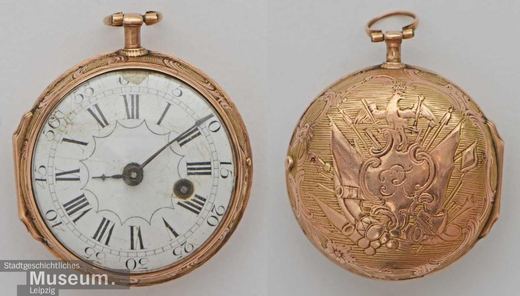
Pocket Watches · 1760
Pocket watch by Johann Michael Bendele, Germany, 1760
Museum of City History Leipzig
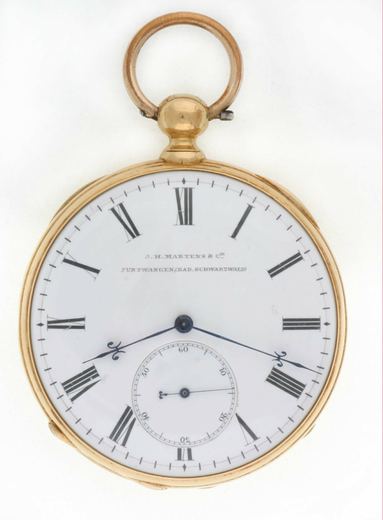
Pocket Watches · 1800–1899
Pocket watch by Martens und Cie., Germany, 1800–1899
German Clock Museum
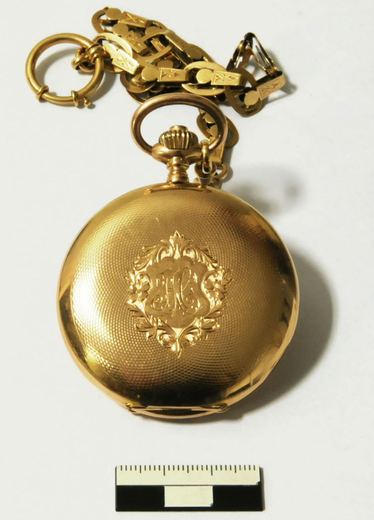
Pocket Watches · 1800–1899
Pocket watch, Germany, 1800–1899 (Montanhistorisches Dokumentationszentrum item_ANB57TW7X4AETN5YEIBPQZOCPZJNYTUG)
Montanhistorisches Dokumentationszentrum
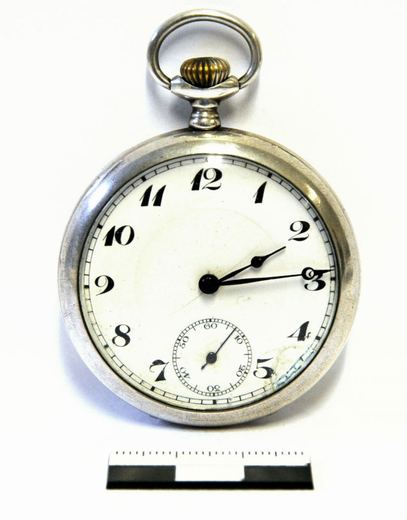
Pocket Watches · 1800–1899
Pocket watch, Germany, 1800–1899 (Montanhistorisches Dokumentationszentrum item_IMHEDCKJGACGO3F3DYT5PDA77S2OIJGY)
Montanhistorisches Dokumentationszentrum
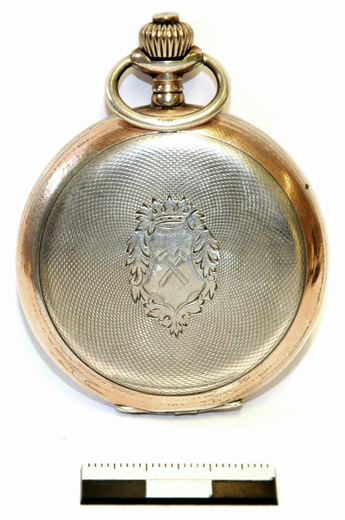
Pocket Watches · 1800–1899
Pocket watch, Germany, 1800–1899 (Montanhistorisches Dokumentationszentrum item_JSY5375J3KW4V3XW6BNN6ZXAZIC6QROL)
Montanhistorisches Dokumentationszentrum
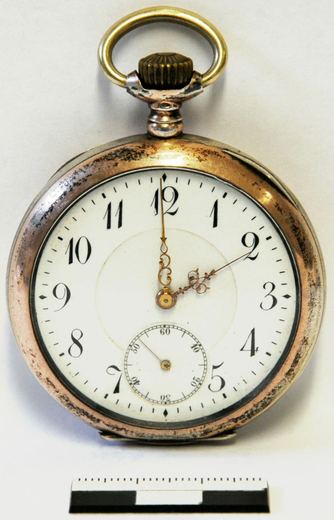
Pocket Watches · 1800–1899
Pocket watch, Germany, 1800–1899 (Montanhistorisches Dokumentationszentrum item_KVL6R5LBGWNRKPW2IA3DJXMPO7C6Y7PC)
Montanhistorisches Dokumentationszentrum
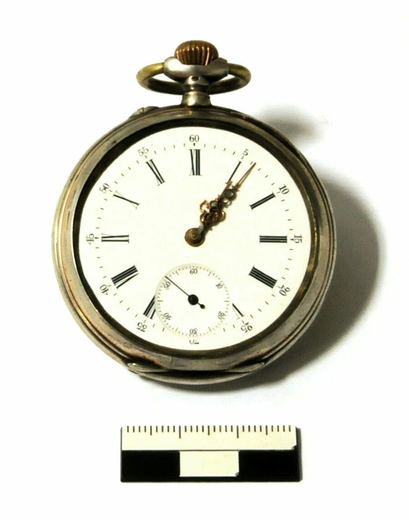
Pocket Watches · 1800–1899
Pocket watch, Germany, 1800–1899 (Montanhistorisches Dokumentationszentrum item_OX6Y3ED72B75OYGLQ5IIBFYTN2WQL74O)
Montanhistorisches Dokumentationszentrum
Pocket Watches · 1800–1899
Pocket watch, Germany, 1800–1899 (Montanhistorisches Dokumentationszentrum item_QGN2QFMRUX6EFKLR3HI7IALZSP2MUAR5)
Montanhistorisches Dokumentationszentrum