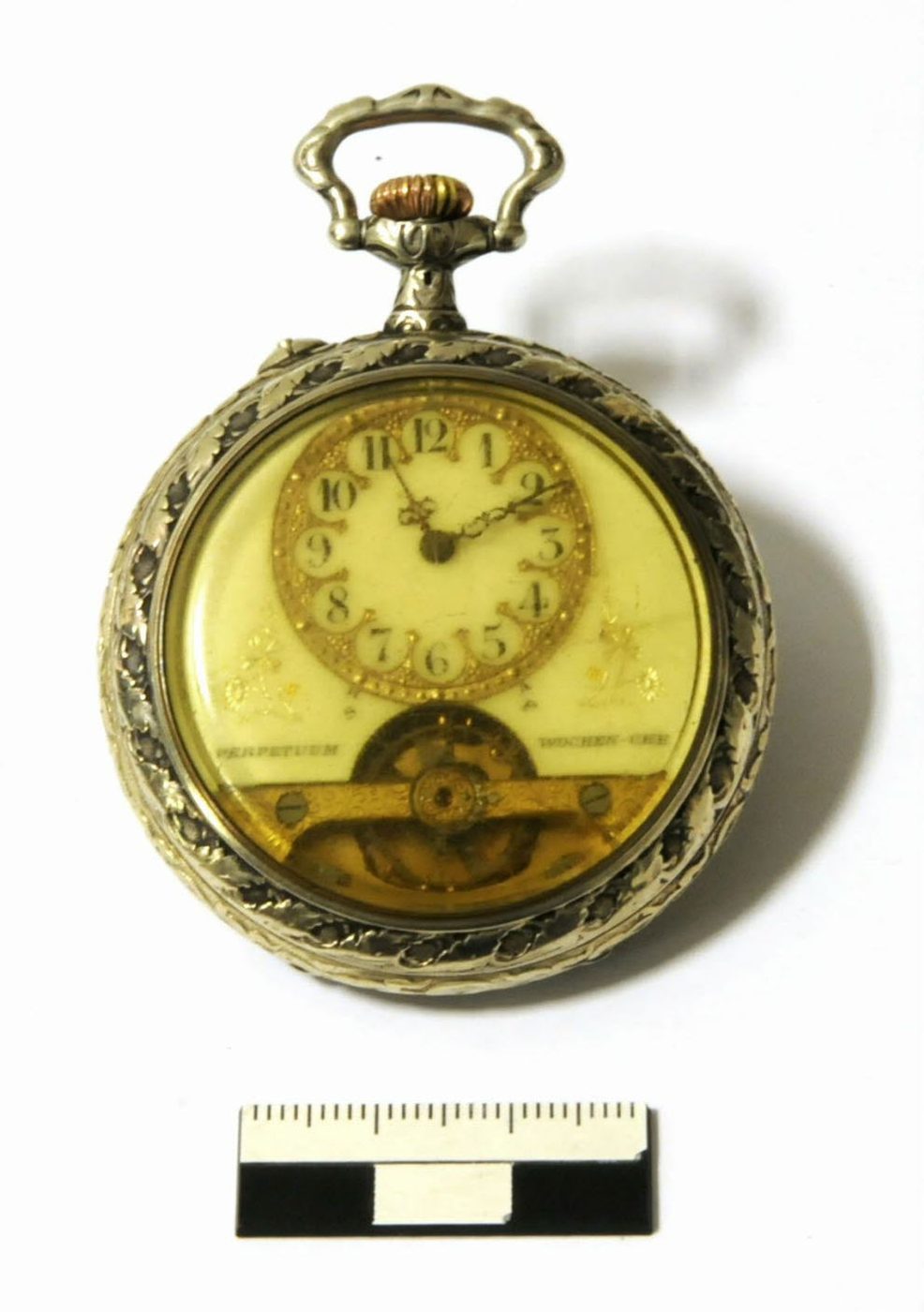
Pocket Watches · Pocket watch
Pocket watch, France, 1800–1899
- Maker / attribution
- Unrecorded in source
- Date
- 1800–1899
- Historical period
- Precision & Scientific Horology (1750 – 1850)
- Country of origin
- France
- Place
- Île-de-France Region
- Object type
- Pocket watch
- Holding institution
- Montanhistorisches Dokumentationszentrum
- Accession / object no.
- item_MUTIQEXUWQKPCNBVA6GGU4QTC3LY6ZUB
- Catalogue title (original)
- Taschenuhr (Wochenuhr) mit Bergbaumotiv (German)
Record summary
Held and catalogued by Montanhistorisches Dokumentationszentrum (object number item_MUTIQEXUWQKPCNBVA6GGU4QTC3LY6ZUB), this is a pocket watch, made in Île-de-France Region, dated 1800–1899. The Atlas places it in the Precision & Scientific Horology period (1750 – 1850) of its Pocket Watches collection. The record is illustrated with 1 photograph.
Assembled from the source record's structured fields. Dates and attributions are given as the source states them; where a field is missing the Atlas leaves it blank rather than estimating.
Catalogue description
Catalogue description from Montanhistorisches Dokumentationszentrum (def)
Halboffene Taschenuhr mit versilbertem Gehäuse, geriffelter kupferfarbener Krone (Kronenaufzug) und Pendant mit Bügel zur Befestigung einer Uhrkette auf Position 12. Seitlich am Gehäuse befindet sich zusätzlich auf Position 11 der Zeigerstelldrücker und das Drückerschiffchen. Das Uhrenglas ist in einem Deckel mit floral verzierter Lünette eingelassen. Unter dem Uhrenglas liegt ein weißes Zifferblatt aus Emaille mit Aussparung in der unteren Hälfte, so dass Teile des Uhrwerks frei liegen. Die Indikation der Uhrzeit mit goldener Umrahmung, arabischen Ziffern und Stunden- und Minutenzeiger ist auf Position 12 ausgerichtet. Zusätzlich ist das Zifferblatt mit Silber unterlegten Blumen verziert und mit den Schriftzügen versehen. Auf dem Rückdeckel mit Scharnier und Lippe zur Öffnung befindet sich eine plastische Darstellung. Die Innenseite zeigt eine Stempelmarke. Der Deckel des Uhrwerks (8-Tage-Werk mit Breguet-Spirale und Ankerhemmung) ist aufwendig verziert. Neben den Angaben zum Uhrwerk sind zusätzlich sind Medaillen und Orte mit Jahreszahlen abgebildet. Das Stellen der Zeiger erfolgt über die Krone, während mit dem Fingernagel ein kleiner Pin an der Seite (Zeigerstelldrücker) eingedrückt wird. Dieser ist in eine geschlitzte Erhöhung am Gehäuse (Drückerschiffchen) eingelassen und so vor unbeabsichtigtes Eindrücken geschützt. Bei der Taschenuhr handelt es sich um eine Uhr mit 8-Tage-Uhrwerk, dieses hat eine Gangdauer von mindestens 168 Stunden oder einer Woche. Die Taschenuhr ist auf dem Rückdeckel mit einer Darstellung von zwei Bergmännern mit Lederhelmen vor Ort bei der Arbeit mit Keilhaue und Schaufel. Das Uhrwerk selbst ist mit den Veranstaltungsorten und Medaillen verschiedener (Welt-)Ausstellungen verziert.
Historical context
Precision & Scientific Horology (1750 – 1850)
Harrison solves longitude; Mudge invents the lever; Breguet's Paris workshop defines the modern watch.
From 1750 to 1850 the watch became a precision instrument. Mudge's lever escapement, the cylinder escapement, Lépine's thin bar calibre, Breguet's innovations (overcoil, tourbillon, perpétuelle) and the pocket chronometer of Arnold and Earnshaw all date from this period, while verge watches remained common in cheaper production.
Read the period in the timelineMore pocket watches from this periodEarlier: Early Modern Horology
Atlas type guide
Pocket watches
The pocket watch was the dominant personal timekeeper from the late seventeenth century until the First World War. Its development tracks the history of the escapement: verge watches with fusees until the late eighteenth century; Thomas Mudge's lever escapement (c. 1755) and the cylinder escapement popularised by George Graham and later by Swiss makers; and the Swiss and English lever watches of the nineteenth century. Lépine's bar-bridge calibre and keyless winding made watches thinner and easier to use.
Industrialisation transformed the trade: American factories such as Waltham (from 1850) and Elgin produced interchangeable parts by machine, and Swiss makers responded with their own mechanisation after the 1876 Philadelphia Exhibition. By 1900 a reliable watch was affordable to millions; the finest makers continued to produce complications and precision watches.
What to look for
- The escapement: verge (crown wheel), cylinder, duplex, English or Swiss lever.
- Key winding (a square arbor in dial or back) or keyless crown winding.
- Signatures and serial numbers on the movement, dial and inside case back.
- Hallmarks, case maker's marks and gold or silver standards stamped in the case.
- Dial material: enamel, silver, gold, later printed metal.
Dating clues
- Verge watches dominate before c. 1800; cylinder watches c. 1770–1900; lever watches after c. 1820.
- Keyless winding: increasingly common after c. 1860.
- Manufacturer serial number lists exist for Waltham, Elgin, Longines, Omega, Patek Philippe and others.
General guidance written by the Atlas editors about this kind of object. It is not a statement about this particular piece; for that, rely on the source record above and on physical examination.
Related records
Pocket Watches · 1745–1755
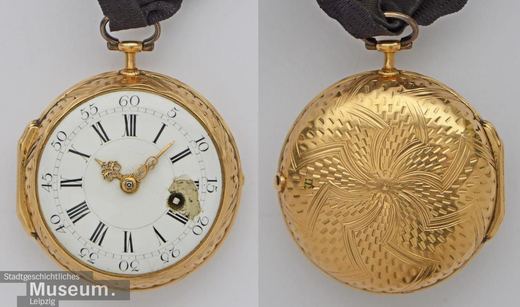
Pocket watch by Jean Baptiste Baillon, France, 1745–1755
Museum of City History Leipzig
Pocket Watches · circa 1750
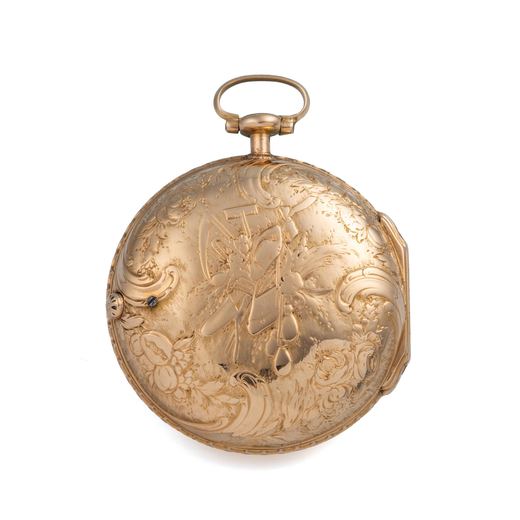
Baillon À Paris pocket watch, circa 1750
Antiquorum auction archive, Geneva
Pocket Watches · 1750-65
Enamelled gold watch, signed 'Baillon A Paris', with a casemaker's mark, 'RC crowned', probably Switzerland, mid 18th century
Victoria and Albert Museum, London
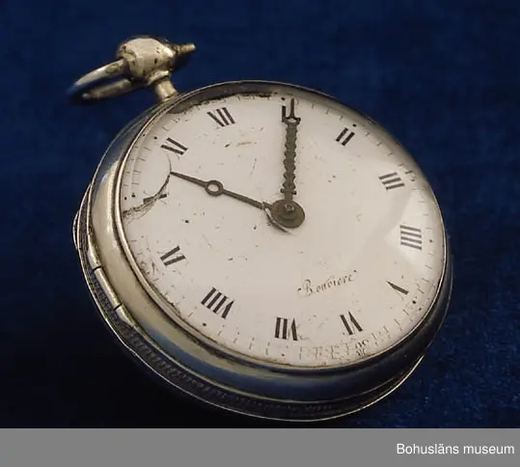
Pocket Watches · 1750–1780
Pocket watch by BONBIERE, France, 1750–1780
Bohuslän Museum
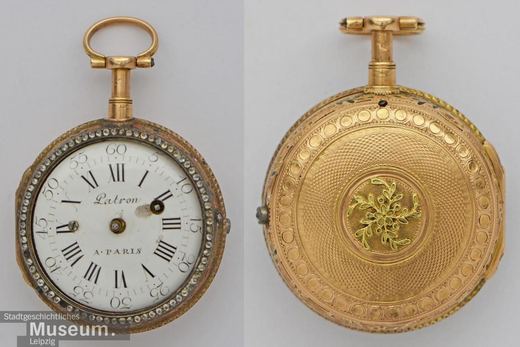
Pocket Watches · 1750
Pocket watch by Patron, France, 1750
Museum of City History Leipzig
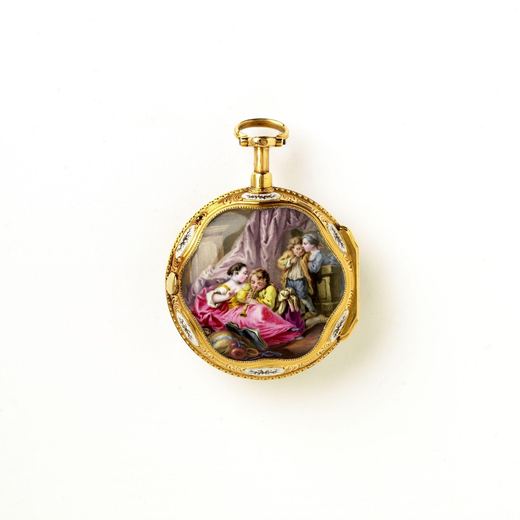
Pocket Watches · 1760-1761
Enamelled gold, quarter repeating watch, Paris, 1760-62, Romilly
Victoria and Albert Museum, London
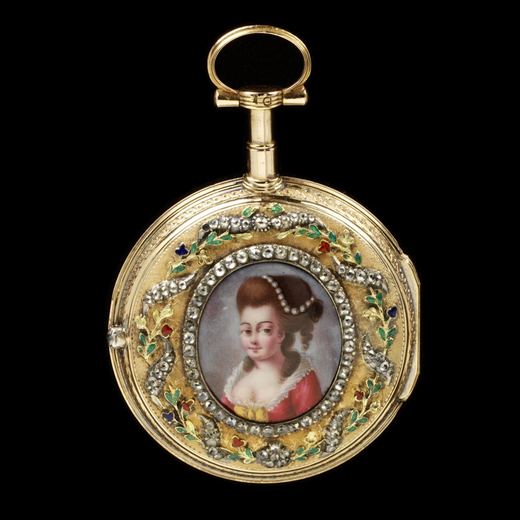
Pocket Watches · 1770-5
Enamelled copper gilt watch set with pastes, signed 'Vauchez A Paris'; made in France or Switzerland, 1770-5
Victoria and Albert Museum, London
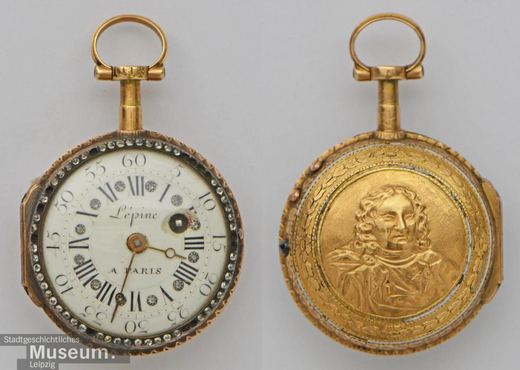
Pocket Watches · 1770–1780
Pocket watch by Lepine, France, 1770–1780
Museum of City History Leipzig