Clocks · Longcase clock
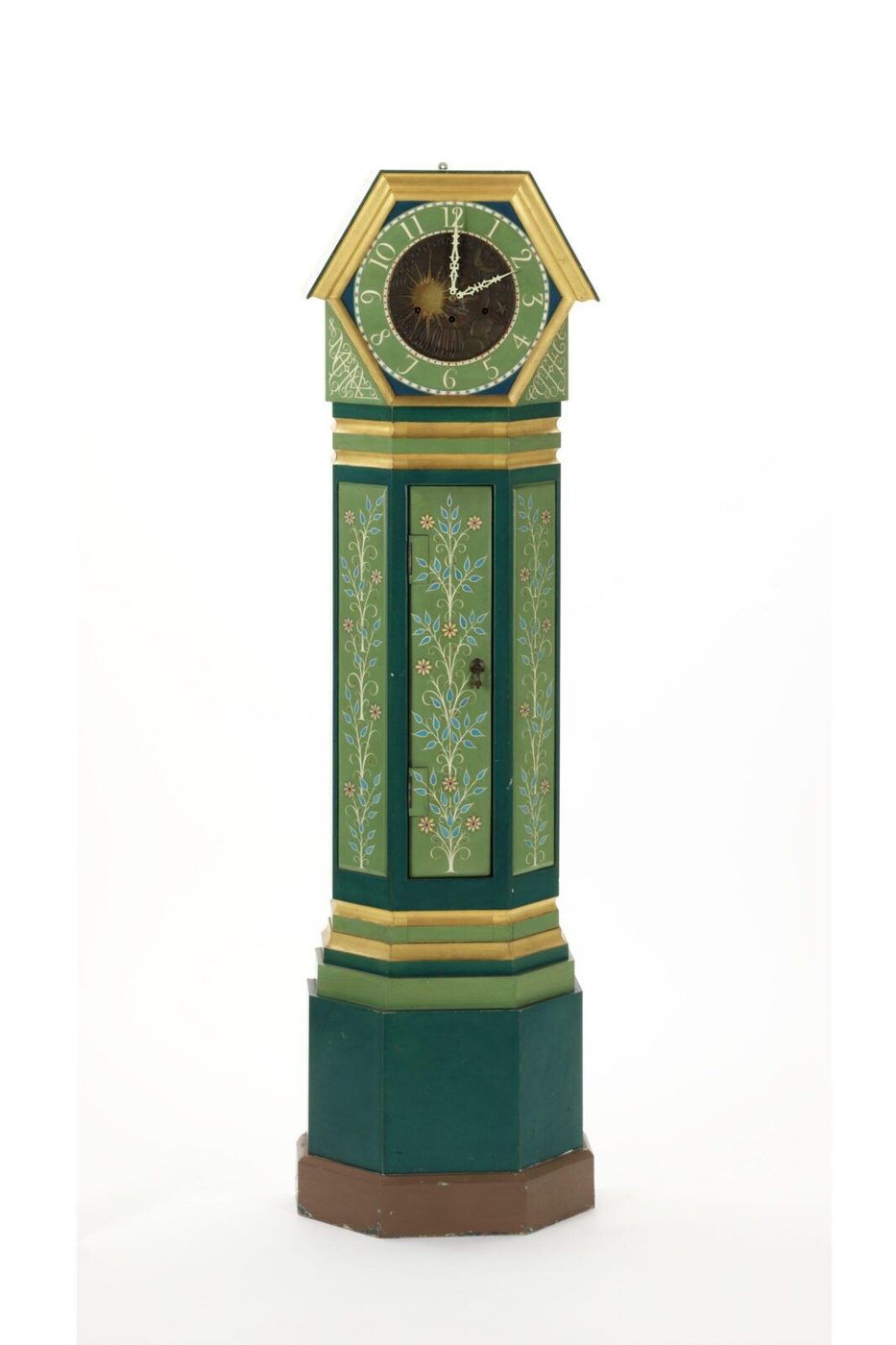
Longcase clock with painted and gilded decoration. English, ca 1930. Designed and painted by MacDonald Gill.
- Maker / attribution
- MacDonald FRIBA Gill (designer); George Taylor OBE Friend (engraver)
- Date
- 1930
- Historical period
- Golden Age of Mechanical Watchmaking (1900 – 1945)
- Country of origin
- England
- Place
- England
- Object type
- Longcase clock
- Materials / technique
- Mahogany clockcase with painted and gilded decoration
- Dimensions
- Height: 168.4 cm; Width: 48 cm (maximum at base); Depth: 25 cm
- Holding institution
- Victoria and Albert Museum, London
- Accession / object no.
- W.10:1 to 13-2000
- Credit line
- Given by Eileen Hunter, daughter of Edward Hunter, Chairman of Sun Engraving Co.
Record summary
Held and catalogued by Victoria and Albert Museum, London (object number W.10:1 to 13-2000), this is a longcase clock by MacDonald FRIBA Gill, made in England, dated 1930. The Atlas places it in the Golden Age of Mechanical Watchmaking period (1900 – 1945) of its Clocks collection. Materials and techniques recorded by the source: Mahogany clockcase with painted and gilded decoration. Recorded dimensions: Height: 168.4 cm; Width: 48 cm (maximum at base); Depth: 25 cm. The record is illustrated with 1 photograph.
Assembled from the source record's structured fields. Dates and attributions are given as the source states them; where a field is missing the Atlas leaves it blank rather than estimating.
Catalogue description
V&A — Summary
MacDonald Gill, known as Max, designed and painted this clock for Edward W. Hunter, the founder of the Sun Engraving Co. Gill may have had some of his work printed by Hunter's firm, but little is known about the circumstances of the commission or making of the clock. It stood in the hallway of Hunter's country home in Frensham, Surrey. Gill incorporated the stylised initials of the Hunter family members into the decorative scheme to the left and right of the clock face, with the parents on one side and the children on the other. The floral motif on the case, the colours and the hexagonal shape of the clock face are all typical of arts-and-crafts design in the early twentieth century.
V&A — Physical description
Casework constructed from mahogony with applied mouldings and plywood backboard, clock shelf and chime board. Exterior painted in a scheme of greens and gold, and includes three panels of floral decoration. The central panel is a hinged door which opens by means of a small brass handle. Skirting at base is beige/brown (further examination of the stratigraphy of the paint is required to confirm whether applied at some later date). The brass clock dial incorporates sun, moon and star motifs and face of a woman wearing spectacles [an illusion to this as a grandmother clock]. Gilded mouldings form an hexagonal shape around the dial and painted numerals.
V&A — Object history
The clock was designed by MacDonald Gill for Edward W Hunter, Chairman and founder of the Sun Engraving Co. It seems that the men met professionally, perhaps Gill had some of his work engraved or printed by Hunter's company, but little is known about the circumstances of the commission for the clock. It is not known who made the clock or the horological parts [nb Francis Brody, external clock specialist to examine movement etc]. According to Mrs Janie Bright, Edward Hunter's second daughter, the clock stood in the hallway of the family's small country house, Easeway, in Frensham, Surrey. Mrs Bright recalls that there was also a framed map hanging over a cosy stove in the hallway, and this was also designed and painted by Gill - the frame was painted in greens and blues to match the clock. [see curator's comment] The initials of the Hunter family are incorporated into the decorative scheme on either side of the clock face. On the proper right side - 'MEHEW' - ME stands for Mabel Elisabeth, H for Hunter, and EW for Edward William ie husband and wife. On the proper left side - 'ECJHECE' - which are the initials of the four daughters: Elisabeth Curling (3rd child), Janie (2nd child), Hunter, Eileen (1st child), and Ellen Claire (4th child). The initials of Ellen Claire appear to have been reversed in the monogram. The clock was bequeathed to the V&A by Eileen Hunter, Edward Hunter's eldest daughter, who took over the Surrey house after her father died. Eileen Hunter launched her eponymous textile company in 1932 and enjoyed success until the outbreak of the Second World War. Her boldly patterned, luxurious textiles went against pure modernist ideals and increasingly unadorned décors, but worked well in a variety of settings. In 1979 she lent the clock to the Hayward Gallery for the exhibition 'Thirties: British art and design before the war' and subsequently offered it to the V&A as a bequest. Historical significance : Leslie MacDonald Gill, FRIBA is well-known for his work as a graphic designer and cartographer. There are no direct precedents for the design although Gill may have been familiar with a painted clock by Charles Voysey, dated 1895 and published in The Studio in 1896 (which is now in the V&A's collection, W.5-1998).
V&A — Production note
Previously attributed to Eric Gill Reason For Production: Commission
V&A gallery label
Twentieth Century Study Gallery Label [Rooms 103-6], October 2000: LONGCASE CLOCK Designed by Eric Gill (British, 1882-1940) Painted wooden case, brass dial About 1930 This clock was designed by Eric Gill for Edward W Hunter, Chairman of the Sun Engraving Company. Hunter's monogram forms part of the decorative scheme and is also visible on the clock hands. Eric Gill is widely known for his work as a typographer and this is an unusual application of his skills. Given by Eileen Hunter W.10-2000
Inscriptions & marks
'E'; 'H'; 'MEHEW'; 'ECJHECE'
Historical context
Golden Age of Mechanical Watchmaking (1900 – 1945)
The wristwatch displaces the pocket watch; waterproof cases, self-winding and grand complications.
Between 1900 and 1945 clocks were electrified: master-clock systems ran factories and offices, synchronous mains clocks entered homes, and the Shortt free-pendulum clock set new standards of accuracy before the first quartz clocks (1927). Art Deco design reshaped mantel and table clocks.
Read the period in the timelineMore clocks from this periodEarlier: Industrial Revolution
Atlas type guide
Longcase (tall-case or grandfather) clocks
The longcase clock was born from two seventeenth-century innovations: Christiaan Huygens's pendulum (1656–57) and the anchor escapement (c. 1670). A long seconds pendulum, nearly a metre long, swings with a small arc, and enclosing it together with the driving weights in a tall wooden case protected the mechanism and created a new piece of furniture. London makers such as Ahasuerus Fromanteel, Thomas Tompion and Joseph Knibb set the pattern.
By the eighteenth century longcase clocks were made throughout Britain, the Netherlands, Scandinavia (the Swedish Mora clock), France (the Comtoise from the Franche-Comté), Germany and colonial America. Eight-day movements with two weights became standard in better clocks; thirty-hour clocks with one weight and a rope or chain were cheaper alternatives.
What to look for
- Winding holes in the dial: two (eight-day, going and striking) or none (thirty-hour, pulled up by a chain).
- Brass dials with applied chapter rings (earlier) versus painted iron 'white' dials (after c. 1770 in Britain).
- Moon-phase arches, date apertures, seconds dials and maker's name on the dial.
- Case woods and style: ebonised, walnut marquetry, lacquer, oak or mahogany; regional styles from London, Lancashire, Scotland or America.
- Whether the movement and dial match the case — 'marriages' are common.
Dating clues
- Square brass dials suggest c. 1670–1720; arched brass dials c. 1715–1790.
- Painted (white) dials were made by Birmingham dial-makers from about 1772.
- Comtoise clocks with repoussé pendulums are mostly nineteenth century.
General guidance written by the Atlas editors about this kind of object. It is not a statement about this particular piece; for that, rely on the source record above and on physical examination.
Related records
Clocks · 1890-1930
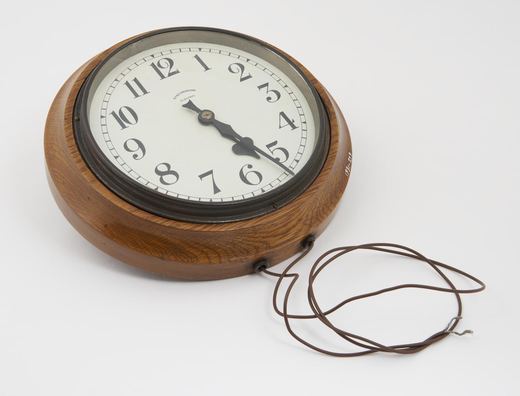
Clock with 8-inch impulse dial, by the Synchronome Company Limited, England, 1890-1930.
Science Museum Group, London
Clocks · c.1903-1904
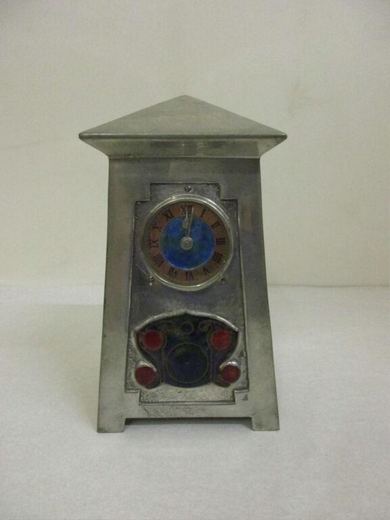
Clock, pewter, made for Liberty& Co., England. 1903-4.
Victoria and Albert Museum, London
Clocks · 1900-1939
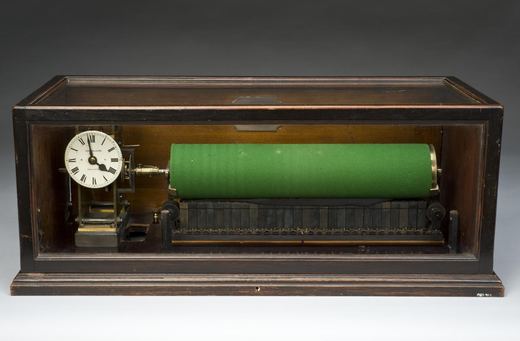
Clock by Cox-Walkers of Darlington, England, 1900-1939
Science Museum Group, London
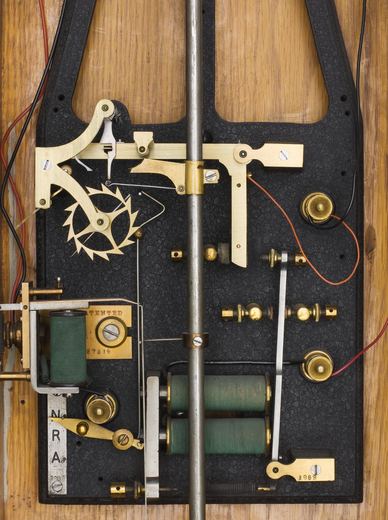
Clocks · 1900-1935
Clock by The Synchronome Company Limited, England, 1900-1935
Science Museum Group, London
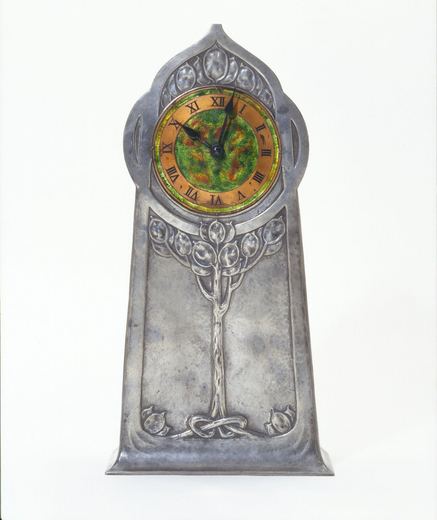
Clocks · ca. 1905
Pewter and enamel, "Tudric range, Honesty design" Birmingham ca.1905, made by W.H. Haseler, designed by Archibald Knox.
Victoria and Albert Museum, London
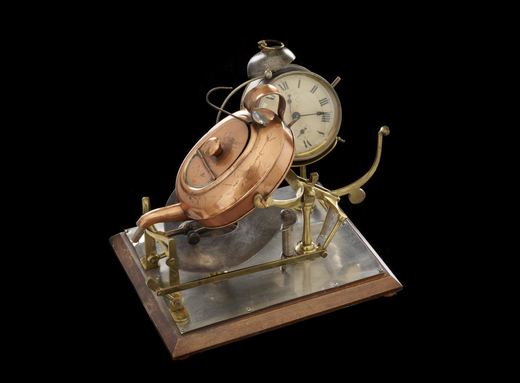
Clocks · 1902-1910
Clock by Automatic Water Boiler Company; Clarke, Frank, England, 1902-1910
Science Museum Group, London
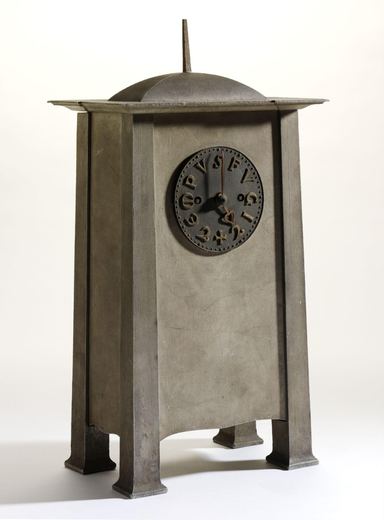
Clocks · 1903
Clock by C. F. A. Voysey, England, 1903
Victoria and Albert Museum, London
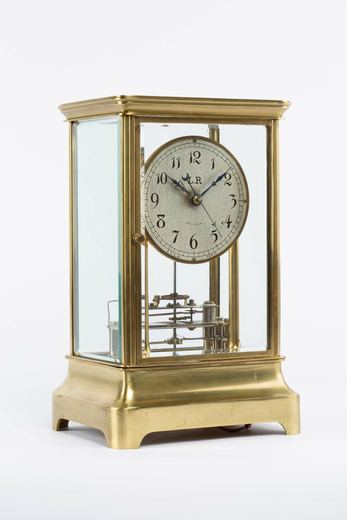
Clocks · 1920
Table clock by L. R, England, 1920
German Clock Museum