Clocks · Clock
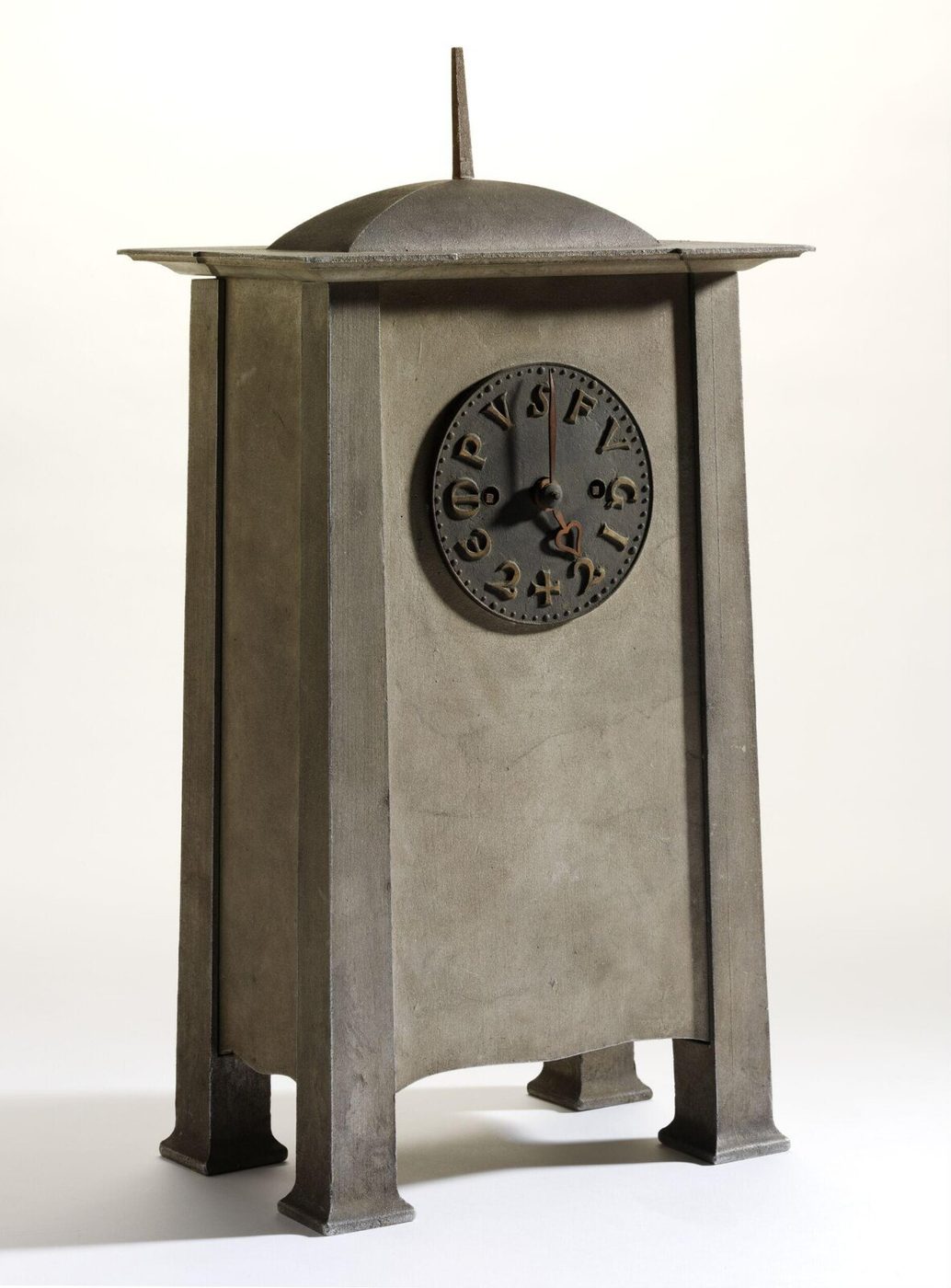
Clock by C. F. A. Voysey, England, 1903
- Maker / attribution
- C. F. A. Voysey (designer); W. H. Tingey (maker); W. C. Barker (founders (metalworkers)); Camerer, Kuss & Co. (clock-makers)
- Date
- 1903
- Historical period
- Golden Age of Mechanical Watchmaking (1900 – 1945)
- Country of origin
- England
- Place
- London
- Object type
- Clock
- Materials / technique
- Aluminium, copper, partially gilded, iron strap work, the movement of brass and steel.
- Dimensions
- Height: 19.5 in; Width: 10.5 in; Depth: 7 in
- Holding institution
- Victoria and Albert Museum, London
- Accession / object no.
- CIRC.519:1, 2-1962
Record summary
Held and catalogued by Victoria and Albert Museum, London (object number CIRC.519:1, 2-1962), this is a clock by C. F. A. Voysey, made in London, England, dated 1903. The Atlas places it in the Golden Age of Mechanical Watchmaking period (1900 – 1945) of its Clocks collection. Materials and techniques recorded by the source: Aluminium, copper, partially gilded, iron strap work, the movement of brass and steel. Recorded dimensions: Height: 19.5 in; Width: 10.5 in; Depth: 7 in. The record is illustrated with 4 photographs.
Assembled from the source record's structured fields. Dates and attributions are given as the source states them; where a field is missing the Atlas leaves it blank rather than estimating.
Catalogue description
V&A — Summary
Charles Francis Annesley Voysey (1857-1941) was a major architect, designer and typographer of the British Arts & Crafts movement. From 1874 to 1880, Voysey worked as a pupil in the office of J.P. Seddon, then briefly as an assistant to George Devey. In 1882 he set up his own office, but concentrated at first on decorative work rather than architecture, selling his first designs for fabrics and wallpaper in 1883. In 1884, he joined the Art Workers’ Guild and his first house was not built until 1888. In 1891 Voysey designed a house in Bedford Park. Known as the ‘Grey House’ it stands out from its neighbours, by this time 15 years old and in a style which was rapidly being superseded, as a foretaste of Voysey’s more uncompromising style, soon to supplant the ‘Shavian’ Queen Anne as the most potent influence on urban and suburban development. In 1900, he completed his own house, ‘The Orchard’ at Chorley Wood in Hertfordshire, for which he designed much of the furniture, the decoration and the fittings. His characteristic style, simple linear and with almost no surface decoration, was to be widely copied in ‘artistic’ interiors of the period. In 1924, he was made Master of the Art Workers; Guild. His work was known in Europe through his participation in a number of exhibitions; he showed architectural work in the Salons de la Libre Esthetique in 1894 and 1897 and he also exhibited alongside the Glasgow School ‘Four’ at Liege in 1895 and in Turin in 1902.
V&A — Physical description
The design of this clock case has an architectural form, reminiscent of a clock tower as the one on the stable entrance at the house for Julian Sturgis near Puttneham, Surrey, designed by Voysey, 1896-7. The top of ogee form, surmounted by a plain, spike finial and with a steeped edge, the four side panels plain with an undulating lower edge, each corner supported by a plain pillar with a flared foot. The circular dial of copper, the numerals substituted with the letters TEMPUS FUGIT + (Time Flies), originally gilded, the hands of copper, the minute hand terminates with a pierced, heart shaped motif, the minutes marked by a row of raised dots around the circumference. The back plate has a rectangular door with three, pierced holes in a triangular formation, the door supported on strap work hinges of iron, the latch a stylised scroll with the door pull a plain, copper wire loop. The pendulum movement has a rectangular back plate of brass inscribed with the legend; CAMERER KUSS & C O / 56 NEW OXFORD STREET / LONDON.
V&A — Object history
This clock was owned by Mrs Ella Annesley Donat, the first wife of the actor Robert Donat and the daughter of C.F.A. Voysey, prior to it being purchased by the Victoria and Albert Museum. There is a reference in Voysey's address book under Tingey: 'Founder for casting of / clock W.C. Barker / Stood Kent.' which suggests that the aluminium clock cases were probably cast by Barker's foundry.
Inscriptions & marks
TEMPUS FUGIT +; CAMERER KUSS & C O / 56 NEW OXFORD STREET / LONDON
Historical context
Golden Age of Mechanical Watchmaking (1900 – 1945)
The wristwatch displaces the pocket watch; waterproof cases, self-winding and grand complications.
Between 1900 and 1945 clocks were electrified: master-clock systems ran factories and offices, synchronous mains clocks entered homes, and the Shortt free-pendulum clock set new standards of accuracy before the first quartz clocks (1927). Art Deco design reshaped mantel and table clocks.
Read the period in the timelineMore clocks from this periodEarlier: Industrial Revolution
Atlas type guide
Domestic clocks
A clock combines four systems: a source of power (falling weight, coiled spring, or later electricity), a gear train that divides time, an escapement and oscillator that regulate it (foliot, pendulum or balance), and an indicating system of dial and hands or a bell. Its history runs from the large iron weight-driven clocks of the late thirteenth century to Renaissance spring-driven table clocks, the pendulum revolution of 1656, the factory clocks of the nineteenth century and electric and quartz clocks of the twentieth.
Domestic clocks also reflect regional furniture and decorative traditions — English longcase and bracket clocks, French pendules, Viennese regulators, Black Forest and American shelf clocks — and therefore record changing tastes as much as technical progress.
What to look for
- How the clock is powered: weights, spring barrel, fusee, electric coil.
- The oscillator: foliot, short pendulum, long seconds pendulum or balance.
- Whether it strikes: hour only (count wheel) or hours and quarters (rack striking).
- The maker or retailer's name on dial and movement, and any factory trademarks.
- Signs of alteration — replaced dials, converted escapements, 'married' cases.
Dating clues
- Before 1656 clocks used foliots or balances; after, most domestic clocks have pendulums.
- Anchor escapements spread after c. 1670; minute hands became common at the same time.
- Factory production in America and Germany transformed prices after c. 1840.
General guidance written by the Atlas editors about this kind of object. It is not a statement about this particular piece; for that, rely on the source record above and on physical examination.
Related records
Clocks · 1895
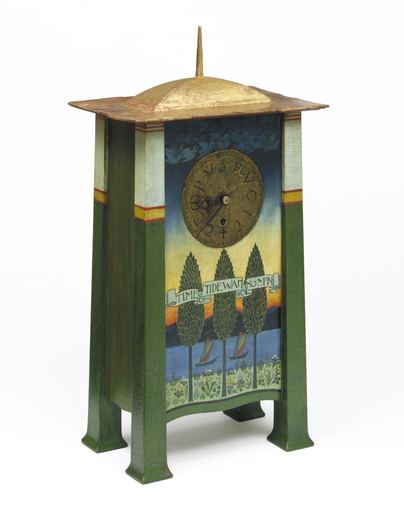
Mahogany clock case with painted and gilded decoration, English, 1896. Designed and painted by Charles Annesley Voysey.
Victoria and Albert Museum, London
Clocks · 1890-1930
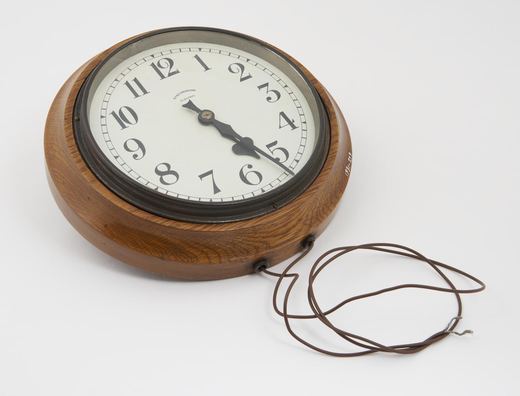
Clock with 8-inch impulse dial, by the Synchronome Company Limited, England, 1890-1930.
Science Museum Group, London
Clocks · c.1903-1904
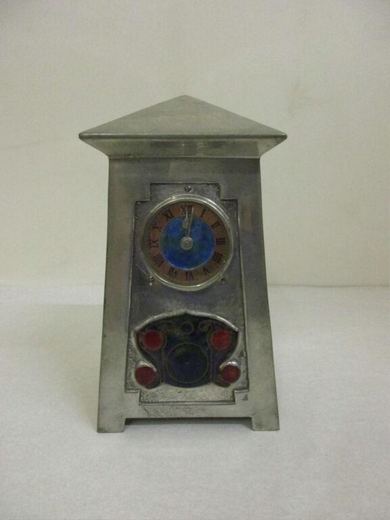
Clock, pewter, made for Liberty& Co., England. 1903-4.
Victoria and Albert Museum, London
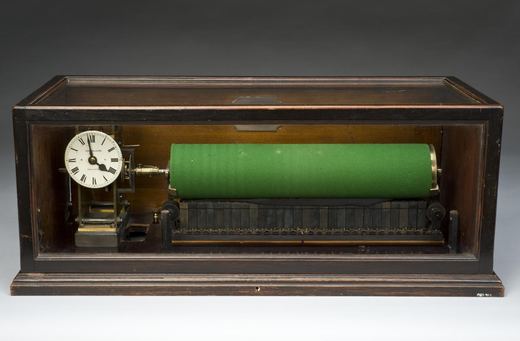
Clocks · 1900-1939
Clock by Cox-Walkers of Darlington, England, 1900-1939
Science Museum Group, London
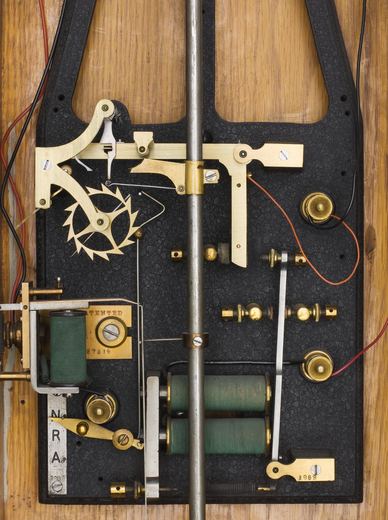
Clocks · 1900-1935
Clock by The Synchronome Company Limited, England, 1900-1935
Science Museum Group, London
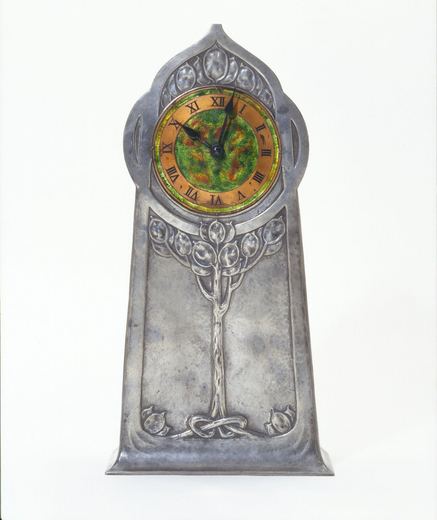
Clocks · ca. 1905
Pewter and enamel, "Tudric range, Honesty design" Birmingham ca.1905, made by W.H. Haseler, designed by Archibald Knox.
Victoria and Albert Museum, London
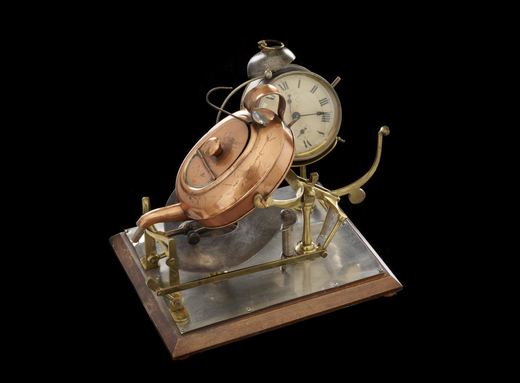
Clocks · 1902-1910
Clock by Automatic Water Boiler Company; Clarke, Frank, England, 1902-1910
Science Museum Group, London
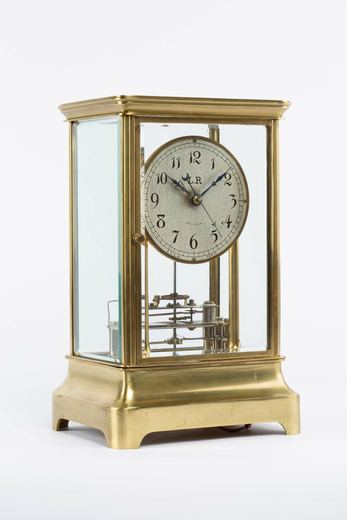
Clocks · 1920
Table clock by L. R, England, 1920
German Clock Museum