Clocks · Automaton
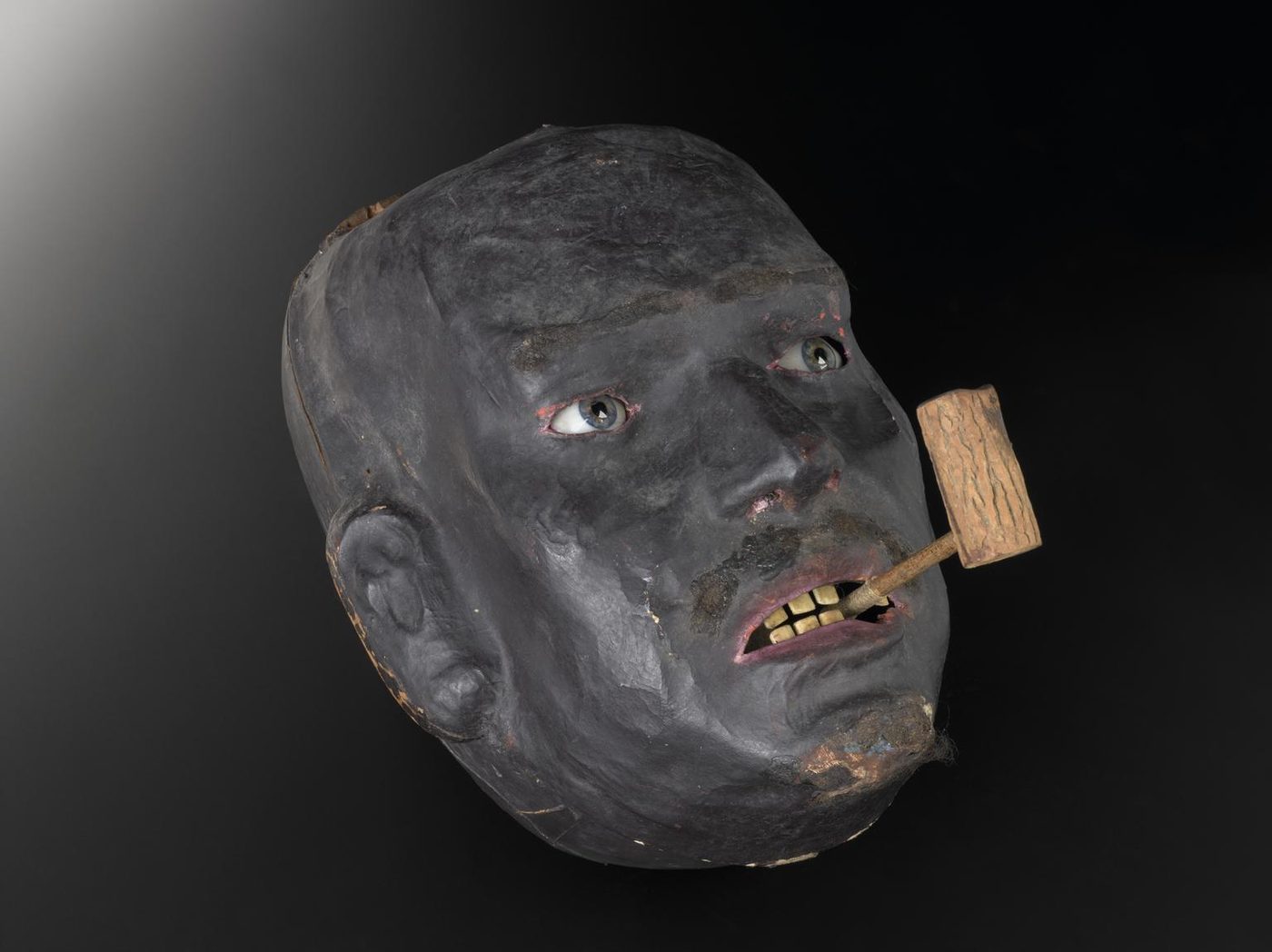
Jack the Smoking Head, sales automaton, maker unknown, London, 1850-1865.
- Maker / attribution
- Unrecorded in source
- Date
- 1850-1865
- Historical period
- Industrial Revolution (1850 – 1900)
- Country of origin
- England
- Place
- London, Greater London, England, United Kingdom, London
- Object type
- Automaton
- Holding institution
- Science Museum Group, London
- Accession / object no.
- 2017-175
- Credit line
- House of Automata
- Catalogue title (original)
- Jack the Smoking Head, Sales Automaton
Record summary
Held and catalogued by Science Museum Group, London (object number 2017-175), this is an automaton, made in London, Greater London, England, United Kingdom, London, dated 1850-1865. The Atlas places it in the Industrial Revolution period (1850 – 1900) of its Clocks collection. The record is illustrated with 4 photographs.
Assembled from the source record's structured fields. Dates and attributions are given as the source states them; where a field is missing the Atlas leaves it blank rather than estimating.
Catalogue description
Science Museum Group description
This automaton appears to be unique. It was intended for use as an advertisement, sitting in the shop windows of cafes or tobacconists smoking either a cigar or a pipe, while the eyes moved back and forth above. It demonstrates the extent to which mechanical figures subtly pervaded many aspects of nineteenth century life, with this and other examples being used for public advertising – something which happened on both sides of the English Channel. Mechanical evocations of life subtly insinuated their way into many aspects of nineteenth century living. Advertising automatons were a particular speciality in France (and the automata museums in Lyon and La Rochelle are in large part devoted to them) – but as far as can be established, this is the only example surviving from the UK. And, while many 19th century automatons involve creatures, monkeys or humans smoking (sometimes in a rather grotesque way) the smoking is always part of a range of different features, whereas here it is the main activity happening. A lit cigar or pipe could be places in the automaton’s mouth, and a saltpetre slow-fuse could be used to help keep it alight as the eyes above moved back and forth. The mechanism and hole in the top of the head suggests that the driving force came from above – perhaps from a clock with a pendulum appropriately positioned above. The automaton has with it a letter dated 1882, outlining its sale to a coffee shop in London, and explaining how it works.
Historical context
Industrial Revolution (1850 – 1900)
American interchangeable-parts manufacture; railroad time standards; Swiss and German factory systems.
Factory production transformed the clock into an everyday object. American makers (Seth Thomas, Ansonia, Waterbury) and German factories (Junghans, Gustav Becker, Lenzkirch) sold millions of shelf, wall and alarm clocks worldwide; France produced standardised Paris movements and carriage clocks; electric time distribution began.
Read the period in the timelineMore clocks from this periodEarlier: Precision & Scientific Horology
Atlas type guide
Astronomical, musical and automaton clocks
Astronomical clocks display more than the hour: the positions of the sun and moon in the zodiac, the phase of the moon, the calendar, sometimes the planets and eclipses. From Richard of Wallingford's and Giovanni de' Dondi's fourteenth-century clocks to the Prague Orloj and the Strasbourg cathedral clocks, they demonstrated the order of the cosmos. Renaissance makers in Augsburg and Nuremberg built celestial globe clocks and monstrance clocks as princely treasures.
Automaton and musical clocks entertained as well as informed: figures move, birds sing, organs and carillons play tunes from pinned cylinders. The eighteenth-century trade with China ('sing-songs') and Ottoman Turkey created a market for elaborate English, Swiss and French automata.
What to look for
- Subsidiary dials for moon phase, calendar, zodiac and planetary positions.
- Celestial globes or armillary spheres turned by the movement.
- Pinned cylinders, bellows and pipes or bells for music.
- Figures on cams and levers; separate trains for automaton work.
Dating clues
- Renaissance astronomical table and globe clocks: c. 1550–1650.
- English and Swiss automaton clocks for the Chinese market: c. 1760–1820.
- Picture clocks (clockwork pictures) are mostly nineteenth century.
General guidance written by the Atlas editors about this kind of object. It is not a statement about this particular piece; for that, rely on the source record above and on physical examination.
Read next:Verge escapementFusee
Related records
Clocks · 1830-1870
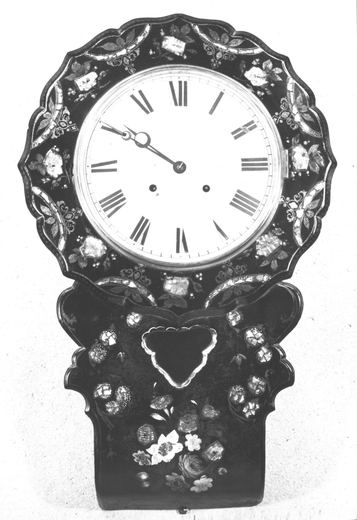
Wall clock in a papier mâché case with painted decoration. English, mid 19th century.
Victoria and Albert Museum, London
Clocks · 1840-1900
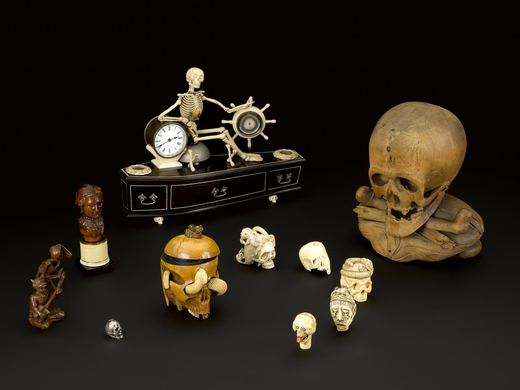
Alarm clock, mounted on model of coffin with skeleton, probably English, 1840-1900
Science Museum Group, London
Clocks · 1840-1880
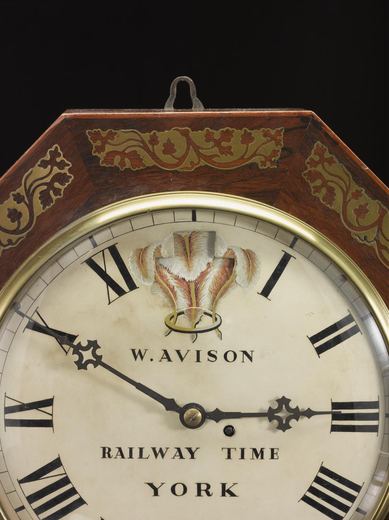
Wall Clock in octagonal case with Prince of Wales Feathers above makers name "W. Avison, Railway Time, York", made by William Avison, England, 1840-1880.
Science Museum Group, London
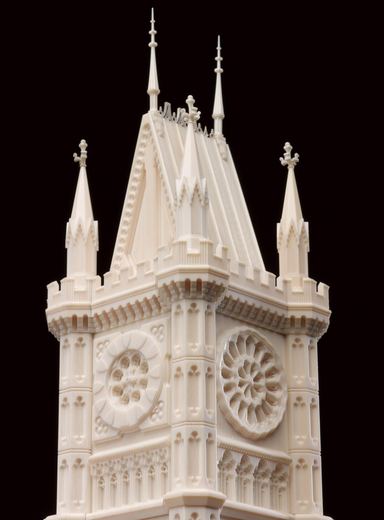
Clocks · 1843-1884
One ivory gothic clock tower & travelling case, by Holtzapffel and Company, London, England, 1843-1884
Science Museum Group, London
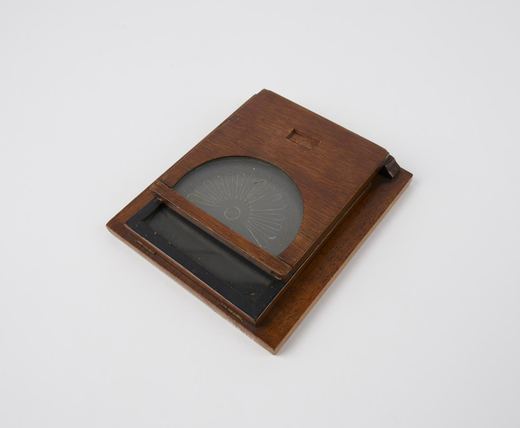
Clocks · 1845-1855
Clock by Darker, W. H., England, 1845-1855
Science Museum Group, London
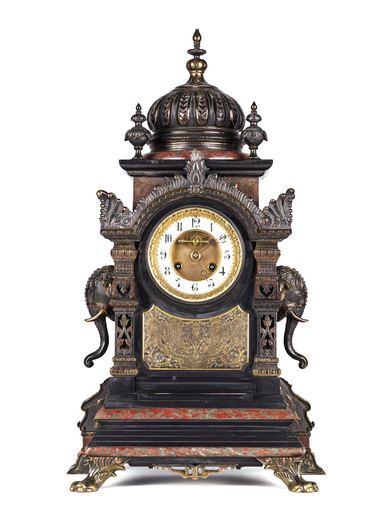
Clocks · 1845-1855
Clock, England, 1845-1855
Science Museum Group, London
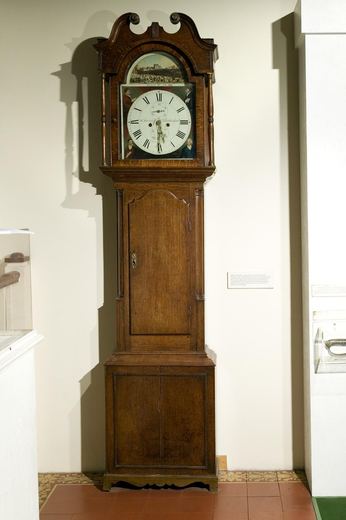
Clocks · 1845-1855
Longcase clock commemorating the Peterloo Massacre of 1819, made by W. Stancliffe, Barkisland.
Science Museum Group, London
Clocks · 1850-1900
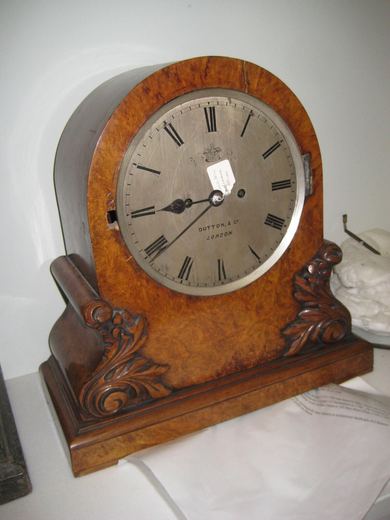
Case veneered in burr walnut, with arched top; from the early furnishings of the V&A
Victoria and Albert Museum, London