Instruments · Sundial
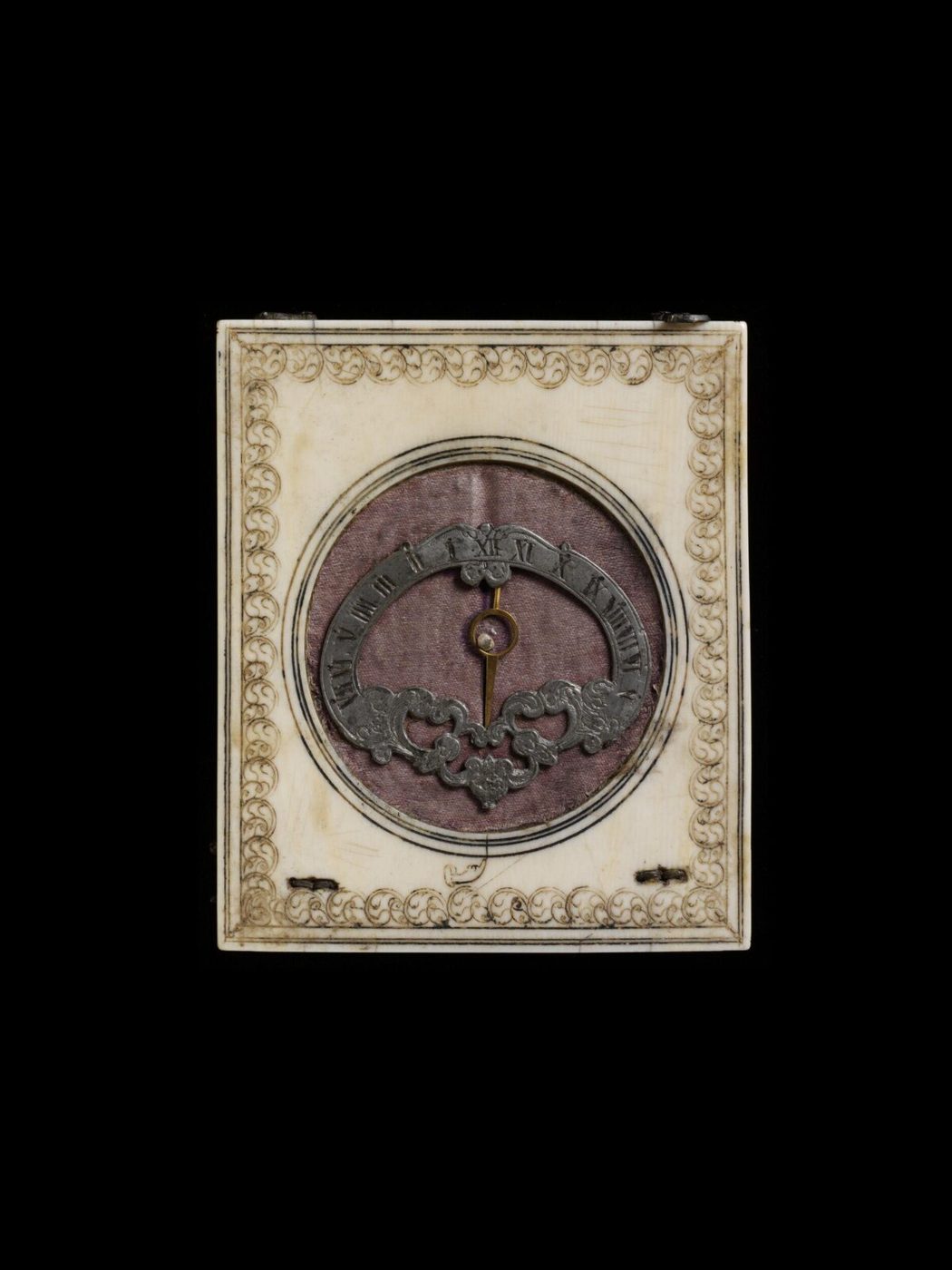
Folding compass and sundial, ivory, engraved in black with brass fittings, France (Dieppe), ca. 1650-1700
- Maker / attribution
- Unrecorded in source
- Date
- ca. 1650 - ca. 1700
- Historical period
- Early Modern Horology (1600 – 1750)
- Country of origin
- Unrecorded in source
- Place
- Dieppe
- Object type
- Sundial
- Materials / technique
- Ivory panels, hinged and engraved, partly painted, with brass and pewter fittings, string and inked paper
- Dimensions
- Height: 1 cm (when closed); Width: 7 cm; Depth: 8.5 cm
- Holding institution
- Victoria and Albert Museum, London
- Accession / object no.
- A.52-1923
- Credit line
- Given by Mrs Ellen Hearn, Villa St Louis, Menton in 1923; this and other objects presented at the same time were labelled as the Alfred Williams Hearn gift.
Record summary
Held and catalogued by Victoria and Albert Museum, London (object number A.52-1923), this is a sundial, made in Dieppe, dated ca. 1650 - ca. 1700. The Atlas places it in the Early Modern Horology period (1600 – 1750) of its Instruments collection. Materials and techniques recorded by the source: Ivory panels, hinged and engraved, partly painted, with brass and pewter fittings, string and inked paper. Recorded dimensions: Height: 1 cm (when closed); Width: 7 cm; Depth: 8.5 cm. The record is illustrated with 4 photographs.
Assembled from the source record's structured fields. Dates and attributions are given as the source states them; where a field is missing the Atlas leaves it blank rather than estimating.
Catalogue description
V&A — Summary
This folding compass and dial was likely made in the seventeenth century, probably in Dieppe. This compass is made in ivory, engraved in black, with brass fittings. The outside of this compass is fitted with a dial of rococo form in pewter, mounted on purple silk. At the back is a dial engraved. The interior is fitted with a dial in pewter with circular pointer, and a compass, the glass and needle of which are missing; at the back is a table of latitudes in paper, printed in black. These sundials were portable and essential for accurate time-keeping, and would have beed used by merchants, sea captains, travellers, and indeed anyone who wished to know the time, in the days before accurate pocket watches or of course wrist watches. They relied on measuring the sun’s changing direction in the sky, indicating the hour of the day through the angle of the shadow cast by the gnomon, which was the string in the hinged portable sundials. In order to work correctly the direction dials das to be properly aligned, and for this reason such portaqble sundials needed to incorporate magnetic compasses. Ivory was a suitable material for a number of reasons: it was not heavy, did not warp as easily as wood, and its light colour and realtive softness meant that it was easy to inscribe. Such objects were produced from the fifteenth century up to the early twentieth.
V&A — Physical description
Folding compass and dial. The outside is fitted with a dial of rococo form in pewter, mounted on purple silk; at the back is engraved a dial. The interior is fitted with a dial in pewter with circular pointer, and a compass, the glass and needle of which are missing; at the back is a table of latitudes in paper, printed in black.
V&A — Object history
Given by Mrs Ellen Hearn, in 1923; This and other objects presented at the same time were labelled as the Alfred Williams Hearn gift.
Historical context
Early Modern Horology (1600 – 1750)
Huygens' pendulum and balance spring transform accuracy; English makers develop the anchor and deadbeat escapements.
Pocket sundials, Butterfield dials and sandglasses remained essential companions to imperfect clocks; navigators used sandglasses and the log line; observatories began to combine telescopes with pendulum clocks.
Read the period in the timelineMore instruments from this periodEarlier: Renaissance Horology
Atlas type guide
Sundials and solar time-finders
A sundial tells time from the position of a shadow cast by a gnomon or style. Because the sun's apparent motion depends on latitude, every fixed dial is laid out for a particular latitude, and portable dials either carry a latitude scale or are made for one region. Sundials show local apparent solar time, which drifts against mean (clock) time by up to about sixteen minutes over the year — the equation of time.
Portable dials were the pocket instruments of the sixteenth to eighteenth centuries. Nuremberg and Augsburg workshops produced folding ivory diptych dials with inset compasses; English and French makers sold brass horizontal dials, ring dials and the Butterfield type; Japanese and Chinese makers had their own traditions of compass dials. After mechanical watches became reliable, dials remained in use for setting them, and nineteenth-century heliochronometers were built to correct directly for the equation of time.
What to look for
- The latitude engraved on the dial plate or a latitude arc on the gnomon — it shows where the dial was meant to be used.
- The type of hour lines: equal (equinoctial) hours, Italian or Babylonian hours counted from sunset or sunrise, or unequal temporal hours on early and Islamic instruments.
- An inset magnetic compass and whether a magnetic-declination mark is drawn on its card — a useful dating clue because declination changes over time.
- Maker's signatures and town marks: Nuremberg compass-makers (Kompassmacher) often struck a personal mark and the town's punch.
- Additional scales such as lunar volvelles, wind roses, perpetual calendars or lists of cities with their latitudes.
Dating clues
- Ivory diptych dials are characteristic of Nuremberg between about 1500 and 1700.
- Butterfield-type dials with a bird-shaped adjustable gnomon point to Paris workshops from the late seventeenth century onward.
- Equation-of-time tables engraved on the plate became common after the mid-seventeenth century, once pendulum clocks made the difference between solar and mean time obvious.
General guidance written by the Atlas editors about this kind of object. It is not a statement about this particular piece; for that, rely on the source record above and on physical examination.
Read next:The history timeline
Related records
Instruments · 1575-1625
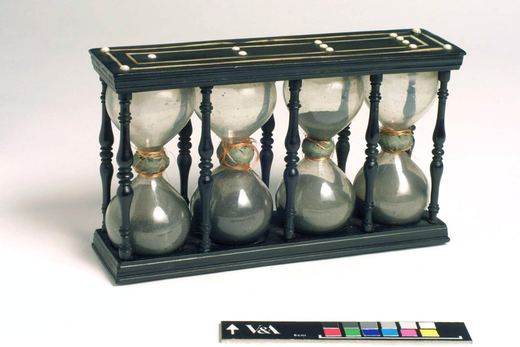
Sand-glass set (x4) fitted into an ebony case, inlaid with ivory. Italian, c1600
Victoria and Albert Museum, London
Instruments · 1578-1631
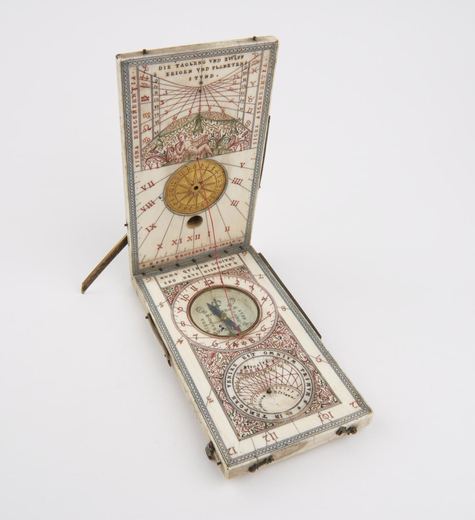
Tablet sun-dial 532-68, V & A M. reg, ivory inscribed "Hans Troschel faciebat", German, 6in by 3 1/4 in, 1578-1631
Science Museum Group, London
Instruments · 1593–1613
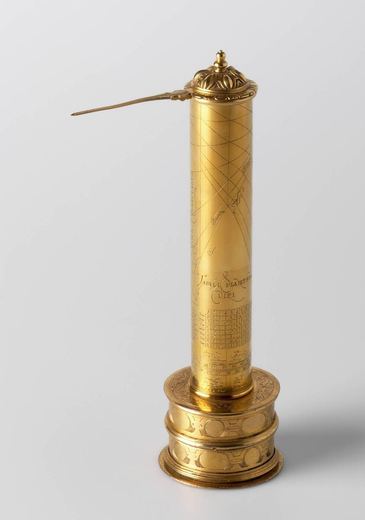
Sundial, Czech Republic, 1593–1613
MAK – Museum of Applied Arts
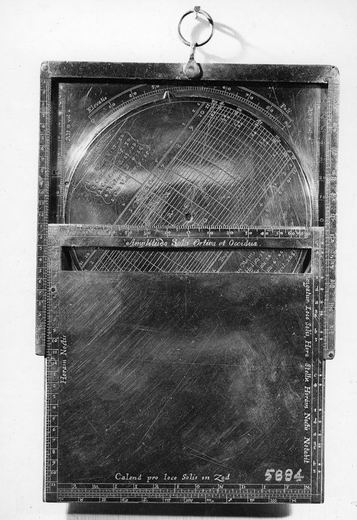
Instruments · 1600–1699
Astrolabe by Henry Sutton, Belgium, 1600–1699
Royal Institute for Cultural Heritage
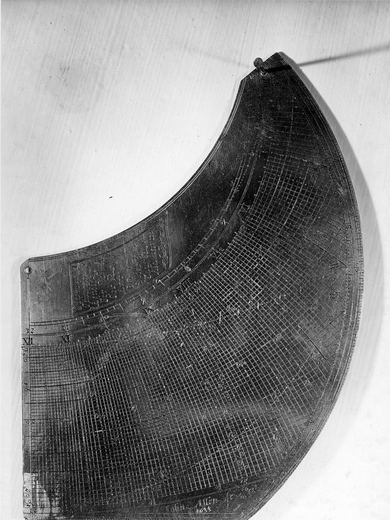
Instruments · 1600–1699
Astrolabe by John Allen, Belgium, 1600–1699
Royal Institute for Cultural Heritage
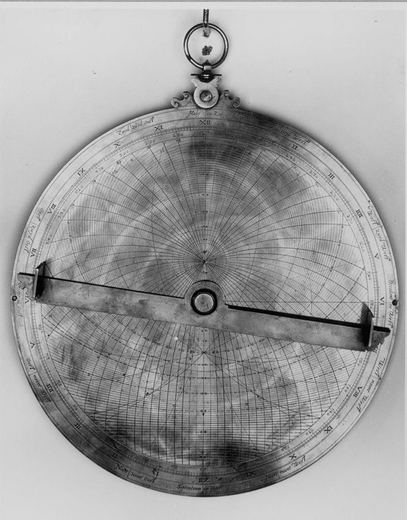
Instruments · 1600–1699
Astrolabe by Lambert Damery, Belgium, 1600–1699 (Royal Institute for Cultural Heritage AP_10277393)
Royal Institute for Cultural Heritage
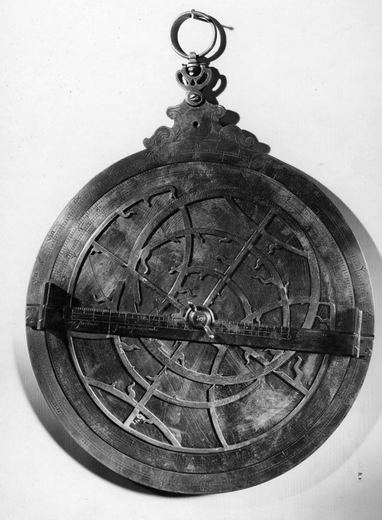
Instruments · 1600–1699
Astrolabe by Lambert Damery, Belgium, 1600–1699 (Royal Institute for Cultural Heritage AP_10368156)
Royal Institute for Cultural Heritage
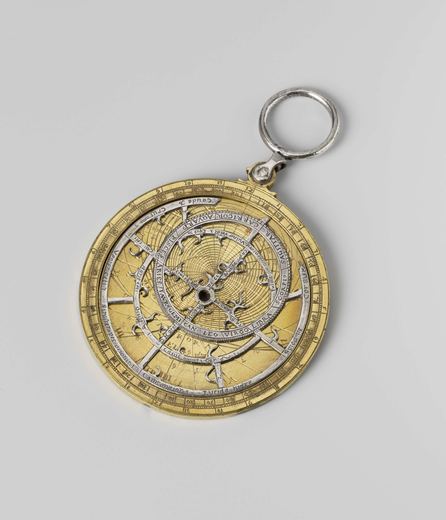
Instruments · 1600–1636
Astrolabe, Germany, 1600–1636
Rijksmuseum