Instruments · Astrolabe
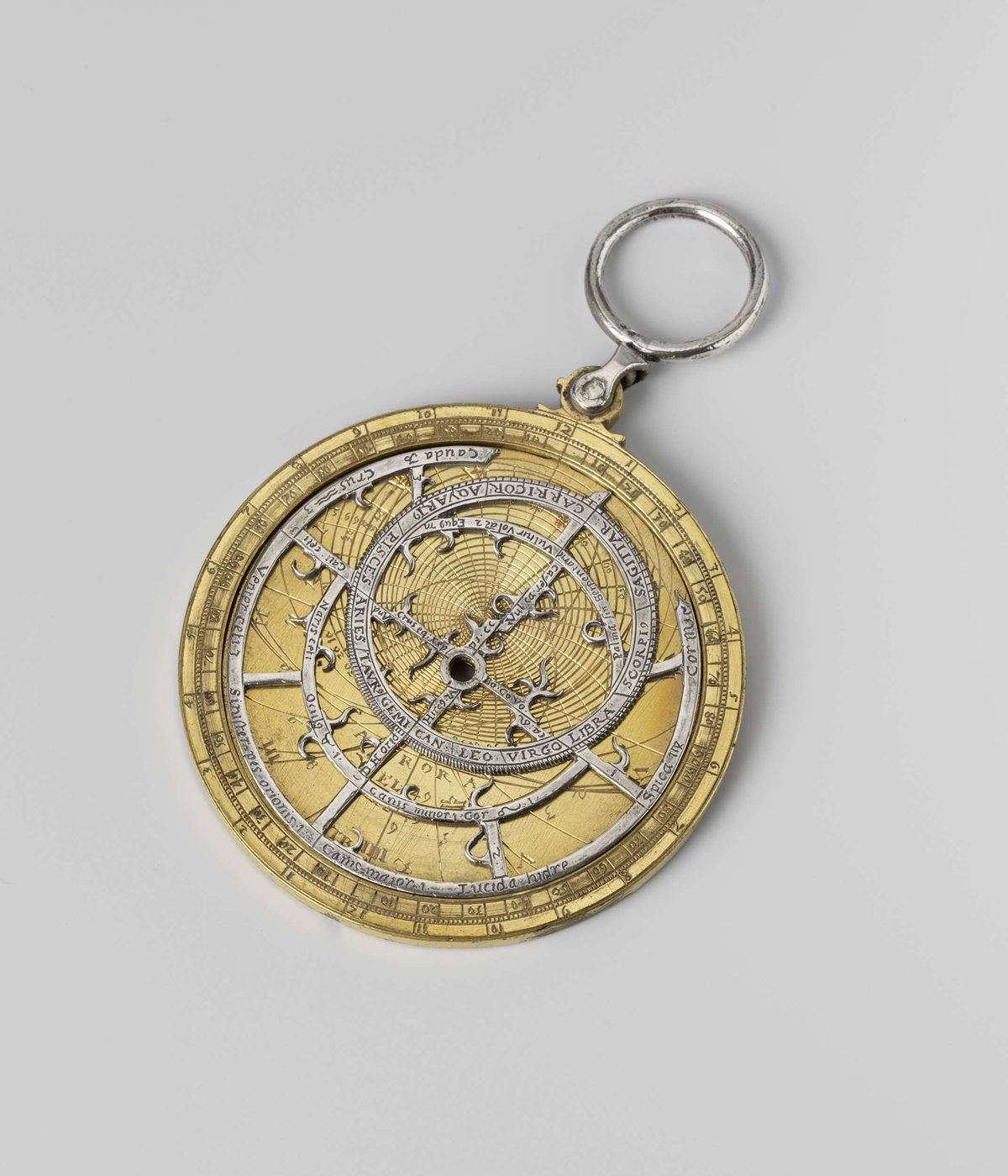
Astrolabe, Germany, 1600–1636
- Maker / attribution
- Unrecorded in source
- Date
- 1600–1636
- Historical period
- Early Modern Horology (1600 – 1750)
- Country of origin
- Germany
- Place
- Germany
- Object type
- Astrolabe
- Holding institution
- Rijksmuseum
- Accession / object no.
- NG_KOG_1691
- Catalogue title (original)
- Astrolabium gemaakt door of toebehoord hebbende aan Zacharias Jansen (Dutch)
Record summary
Held and catalogued by Rijksmuseum (object number NG_KOG_1691), this is an astrolabe, made in Germany, dated 1600–1636. The Atlas places it in the Early Modern Horology period (1600 – 1750) of its Instruments collection. The record is illustrated with 1 photograph.
Assembled from the source record's structured fields. Dates and attributions are given as the source states them; where a field is missing the Atlas leaves it blank rather than estimating.
Catalogue description
Catalogue description from Rijksmuseum (Dutch)
Instrument van verschillende metalen voor graadmeting gevormd zoals een groot plat rond horloge. Met inscriptie 'ZACHARIAS JANSEN MIDELBURG ANNO 1636'. Limbus: indeling in 2 x 1-12 uren en 0-90-0-90 graden. Index zonder gradenindeling. Rete: Ecliptica met de namen en tekens van de dierenriem. Daarbinnen, met naame en teken, 15 vaste sterren en daarbuiten 20 vaste strren. Timpaan: twee schijven voor poolhoogten 49 en 52 graden, 46 en 55 graden. Noord-zuidmeridiaan, horizon rectus, kreeftskeerkring, evenaar, steenbokskeerkring, horizon obliquus, hoogteparallellen, azimutlijnen, dageraadslijn, schemeringslijn, lijnen van de twaalf huizen (I-XII), lijnen van de 1-12 uren. Mater: inscriptie. Dorsum: Rand waarop de namen van de dierenriem, maanden en dagen en schaalverdeling 90-0-90-0 graden. Bovenste helft: 1-12 uren. Onderste helft: schaduwkwadrant. Alhidade zonder gradenindeling.
Shown in the original language of the source catalogue. An editor-reviewed English translation has not yet been published; we do not publish machine translations as authoritative text.
Historical context
Early Modern Horology (1600 – 1750)
Huygens' pendulum and balance spring transform accuracy; English makers develop the anchor and deadbeat escapements.
Pocket sundials, Butterfield dials and sandglasses remained essential companions to imperfect clocks; navigators used sandglasses and the log line; observatories began to combine telescopes with pendulum clocks.
Read the period in the timelineMore instruments from this periodEarlier: Renaissance Horology
Atlas type guide
Astrolabes, quadrants and astronomical compendia
The planispheric astrolabe is a two-dimensional model of the sky. A pierced rotating star map (the rete) turns over a plate engraved for a particular latitude; by aligning a star or the sun with its observed altitude, the user can read the time of day or night, the time of sunrise and sunset, and solve many other astronomical problems. Developed in the Hellenistic world and refined by astronomers in the Islamic world from the eighth century, it reached Latin Europe through al-Andalus.
Quadrants, compendia, armillary spheres and later orreries belong to the same family of instruments that model the heavens. They were teaching tools, status objects and practical time-finders. Many surviving examples are signed and dated, which makes them important evidence for the history of instrument-making workshops in Baghdad, Isfahan, Lahore, Toledo, Louvain, Nuremberg, London and elsewhere.
What to look for
- The latitudes engraved on the plates — they show which cities the instrument was made for.
- The script and calendar used: Arabic or Persian inscriptions, abjad numerals, Hebrew or Latin text indicate tradition and region.
- The design of the rete: the number of named stars and the style of the star pointers changes by region and period.
- Shadow squares, unequal-hour lines and zodiac scales on the back (dorsum).
- Signatures, dedications and dates, often hidden on the throne (kursi) or the back.
Dating clues
- Signed and dated astrolabes allow precise dating; undated ones are attributed by star positions on the rete, which shift slowly through precession.
- Gothic-style retes with tracery are typical of European instruments of the fourteenth and fifteenth centuries.
- Printed paper astrolabes and planispheres became common from the sixteenth century onward.
General guidance written by the Atlas editors about this kind of object. It is not a statement about this particular piece; for that, rely on the source record above and on physical examination.
Related records
Instruments · 1578-1631
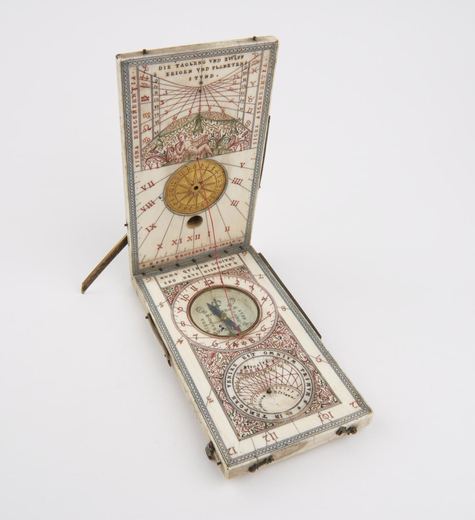
Tablet sun-dial 532-68, V & A M. reg, ivory inscribed "Hans Troschel faciebat", German, 6in by 3 1/4 in, 1578-1631
Science Museum Group, London
Instruments · 17th century
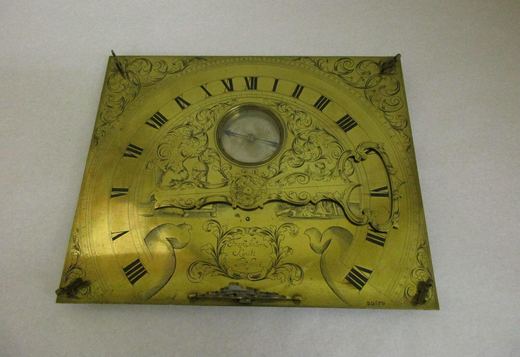
Sundial and compass. Gilt metal, engraved. Inscribed 'Franz Antoni Knitt Linz Fecit', German, 17th century.
Victoria and Albert Museum, London
Instruments · 1600–1699
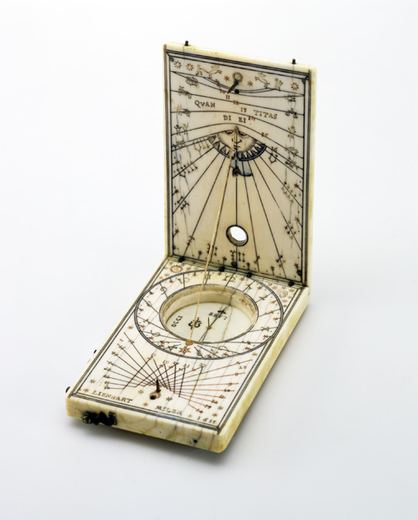
Sundial by Leonhart Miller, Germany, 1600–1699
Badisches Landesmuseum Karlsruhe
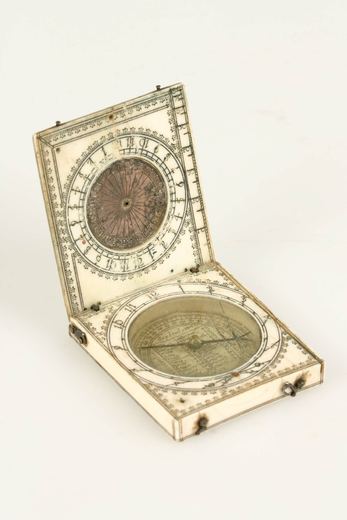
Instruments · 1600–1699
Sundial, Germany, 1600–1699 (German Clock Museum Museu_ProvidedCHO_museum_digital_57146__technical_number_)
German Clock Museum
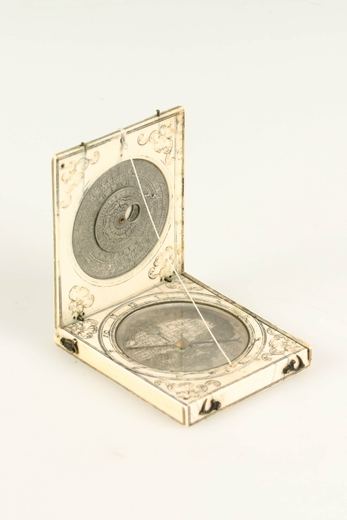
Instruments · 1600–1699
Sundial, Germany, 1600–1699 (German Clock Museum Museu_ProvidedCHO_museum_digital_57147__technical_number_)
German Clock Museum
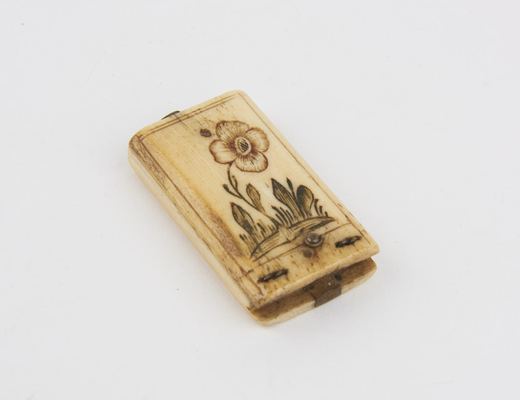
Instruments · 1601-1700
Horizontal sundial for latitude 47 degrees, in ivory with string style. German, 17th century.
Science Museum Group, London
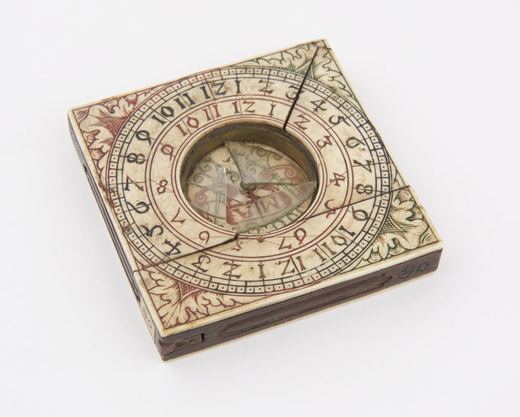
Instruments · 1601-1700
Quadrangular horizontal sundial, ivory, engraved and coloured, inlaid on wood (cracked)
Science Museum Group, London
Instruments · 1601-1650
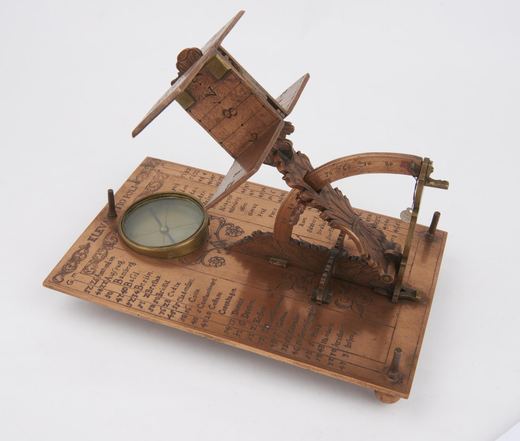
Sundial with compass, copper, base plate 8 x 5 3/8-inches, unsigned, Germany, 1601-1650. Compass glass slightly chipped.
Science Museum Group, London