Instruments · Clock
Clocks by International Time Recording Company, American, 1900 - 1933, United States, ca. 1912
- Maker / attribution
- International Time Recording Company, American, 1900 - 1933 (Manufactured by); R.H. Boyd Publishing Corporation, American, founded 1896 (Used by); Rev. Dr. Richard Henry Boyd, American, 1843 - 1922 (Subject of)
- Date
- ca. 1912
- Historical period
- Golden Age of Mechanical Watchmaking (1900 – 1945)
- Country of origin
- United States
- Place
- Endicott, Broome County, New York, United States, North and Central America; Nashville, Davidson County, Tennessee, United States, North…
- Object type
- Clock
- Materials / technique
- wood, metal, glass, paper
- Dimensions
- wood, metal, glass, paper; H x W x D (time clock): 35 1/4 × 30 × 41 1/4 in., 260 lb. (89.5 × 76.2 × 104.8 cm, 117.9 kg); H x W x D (large winding key): 8 11/16 × 5 1/16 × 1/2 in. (22 × 12.8 × 1.2 cm); H x W x D (small winding key): 5 3/4 × 5 × 1/2 in. (14.6 × 12.7 × 1.2 cm)
- Holding institution
- National Museum of African American History and Culture, Smithsonian Institution, Washington DC
- Accession / object no.
- 2013.208.1a-f
- Credit line
- Collection of the Smithsonian National Museum of African American History and Culture; Gift of Dr. and Mrs. T.B. Boyd, III and R.H. Boyd Publishing Corporation
- Catalogue title (original)
- Time clock from the R. H. Boyd Publishing Corporation
Record summary
Held and catalogued by National Museum of African American History and Culture, Smithsonian Institution, Washington DC (object number 2013.208.1a-f), this is a clock by International Time Recording Company, American, 1900 - 1933, made in Endicott, Broome County, New York, United States, North and Central America; Nashville, Davidson County, Tennessee, United States, North…, dated ca. 1912. The Atlas places it in the Golden Age of Mechanical Watchmaking period (1900 – 1945) of its Instruments collection. Materials and techniques recorded by the source: wood, metal, glass, paper. Recorded dimensions: wood, metal, glass, paper; H x W x D (time clock): 35 1/4 × 30 × 41 1/4 in., 260 lb. (89.5 × 76.2 × 104.8 cm, 117.9 kg); H x W x D (large winding key): 8 11/16 × 5 1/16 × 1/2 in. (22 × 12.8 × 1.2 cm); H x W x D (small winding key): 5 3/4 × 5 × 1/2 in. (14.6 × 12.7 × 1.2 cm). The record is illustrated with 4 photographs.
Assembled from the source record's structured fields. Dates and attributions are given as the source states them; where a field is missing the Atlas leaves it blank rather than estimating.
Catalogue description
Description
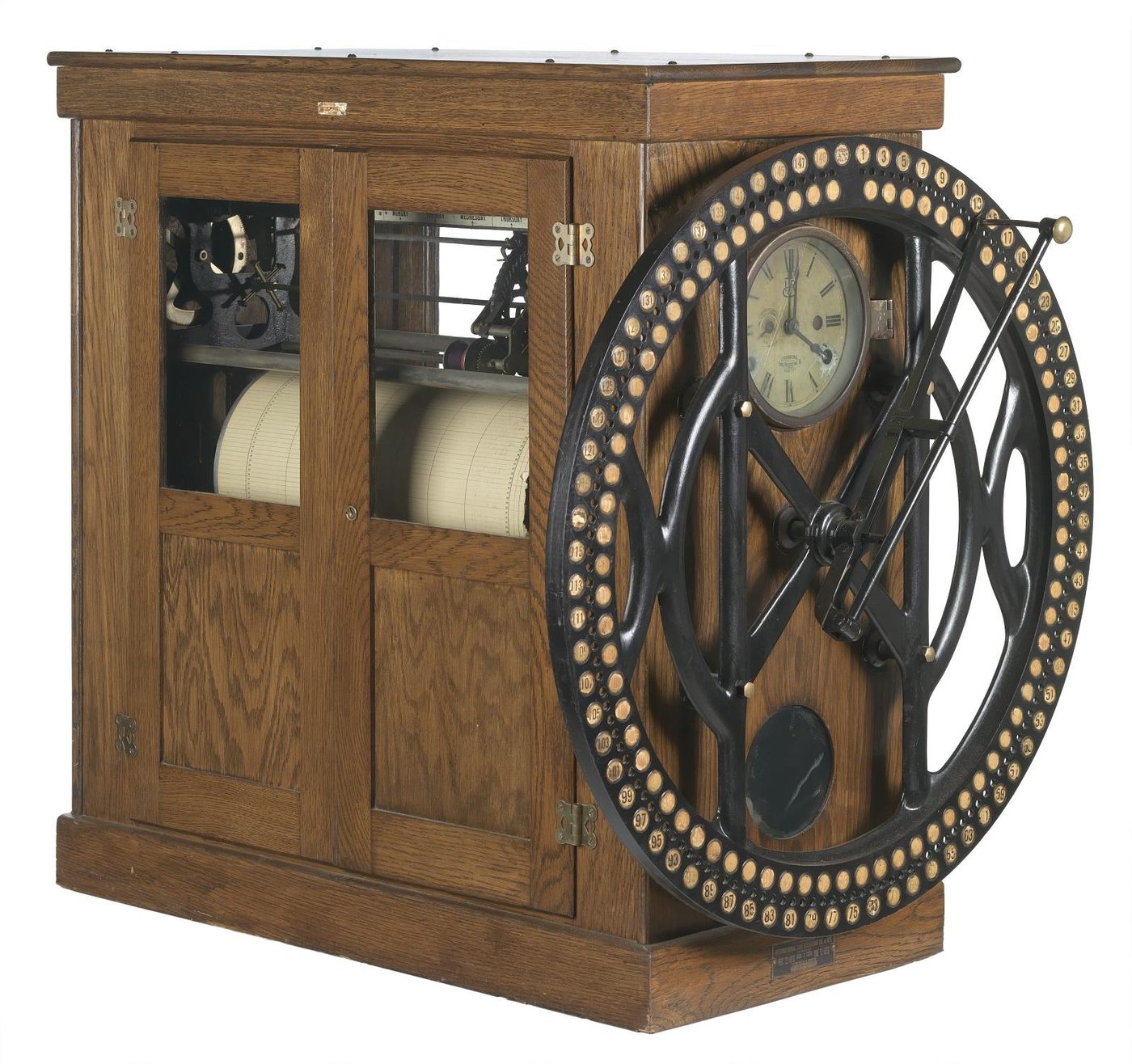
A large rectangular worker's time clock used by the R. H. Boyd Publishing Company. The front of clock has a large metal wheel with small black encircled numbers. Behind the large metal wheel is a clock featuring roman numerals and an AM/PM dial. Black type on the clock reads, “INTERNATIONAL / TIME RECORDING CO. / OF NEW YORK / ENDICOTT, N.Y.” The time clock has two doors with glass windows on both sides that show the inner workings of the clock. The inside of the clock has a large paper roll that works as a time sheet. Above the roll of paper in the front of the clock the days of the week are listed. Two “T” shaped metal winding keys (2013.208b and c) are also inside the clock. A faded label on the bottom of the interior of the clock has shipping information, model number, serial number and a statement of guaranty as well as other information printed on it.
Historical context
Golden Age of Mechanical Watchmaking (1900 – 1945)
The wristwatch displaces the pocket watch; waterproof cases, self-winding and grand complications.
Timing instruments became electrical and specialised: industrial time recorders, sports timers and aviation instruments.
Read the period in the timelineMore instruments from this periodEarlier: Industrial Revolution
Atlas type guide
Timers, stopwatches, chronoscopes and time recorders
Instruments for measuring short intervals or recording when something happened form a large and practical branch of horology. Sports stopwatches and split-seconds timers, laboratory chronoscopes (such as Hipp's, which measured thousandths of a second for psychology and ballistics experiments), metronomes for music, watchmen's clocks that recorded patrol rounds, and the time recorders that clocked factory workers in and out all derive from clock and watch technology.
These objects matter historically because they show timekeeping leaving the observatory and the drawing room and entering industry, science and sport. Many were mass-produced, and their dials, scales and patents chart the rise of electrification and industrial management.
What to look for
- Scales graduated in fifths, tenths or hundredths of a second, or decimal minutes for industrial use.
- Start, stop and reset push-pieces; a second hand that can be stopped independently (split seconds).
- Recording devices: paper discs or tapes, printing mechanisms, keys or punches.
- Patent numbers and dates on the dial or case, which give a terminus post quem.
Dating clues
- Hipp chronoscopes were made from the 1840s into the twentieth century.
- Employee time recorders spread from the 1890s (Bundy, IBM, International Time Recording Co.).
- Quartz and electronic timers replaced mechanical stopwatches in sport from the 1970s.
General guidance written by the Atlas editors about this kind of object. It is not a statement about this particular piece; for that, rely on the source record above and on physical examination.
Read next:ChronographFlyback chronograph
Related records
Instruments · 1922-1939
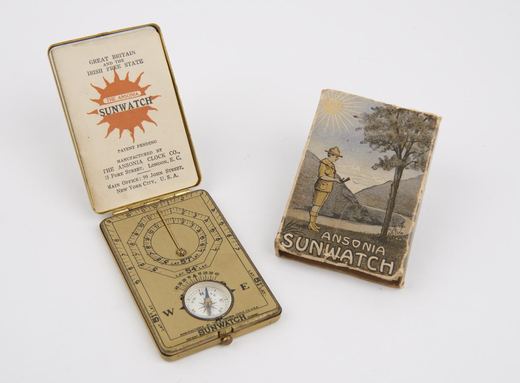
Ansonia Sun-watch in original card case, with instruction leaflet, c.1922
Science Museum Group, London
Instruments · 1922-1939
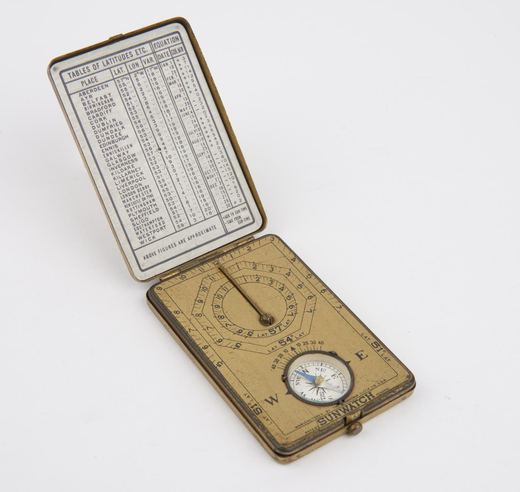
Ansonia Sunwatch (pocket compass dial)
Science Museum Group, London
Instruments · 1880-1920
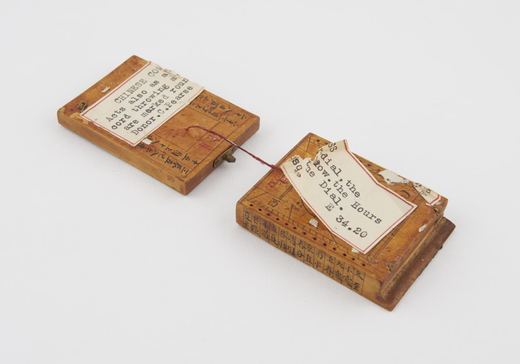
Compass and sundial, two hinged wooden blocks, compass needle set into one, covered with glass windows, painted with Chinese characters, Chinese, 1880-1920
Science Museum Group, London
Instruments · 1890-1930
Decorative fake Islamic astrolabe with four plates and sightless alidade, pin missing.
Science Museum Group, London
Instruments · 1890-1930
Decorative fake Islamic astrolabe, Arabic origin, brass, with four plates and foliate cover.
Science Museum Group, London
Instruments · 1890-1930
Decorative fake Islamic astrolabe, brass, with four plates, cursive kursi, and sightless alidade, pin missing.
Science Museum Group, London
Instruments · 1890-1945
Optometer(?), stop-watch form, scaled circular face to measure concanity,[.........] of lenses, English, 1890-1945
Science Museum Group, London
Instruments · 1890-1950
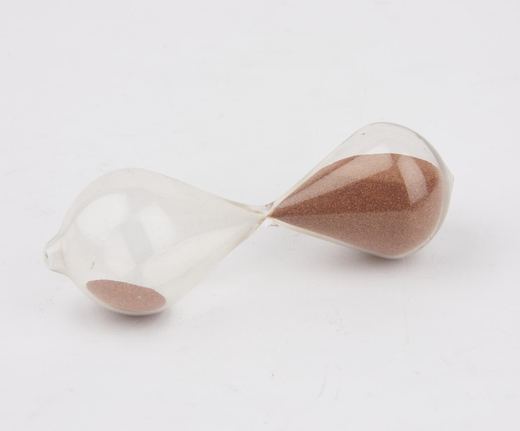
Single sand-glass unmounted, showing complete seal. 15 mins. Abbot Horne. No. Type C., 1890-1950
Science Museum Group, London