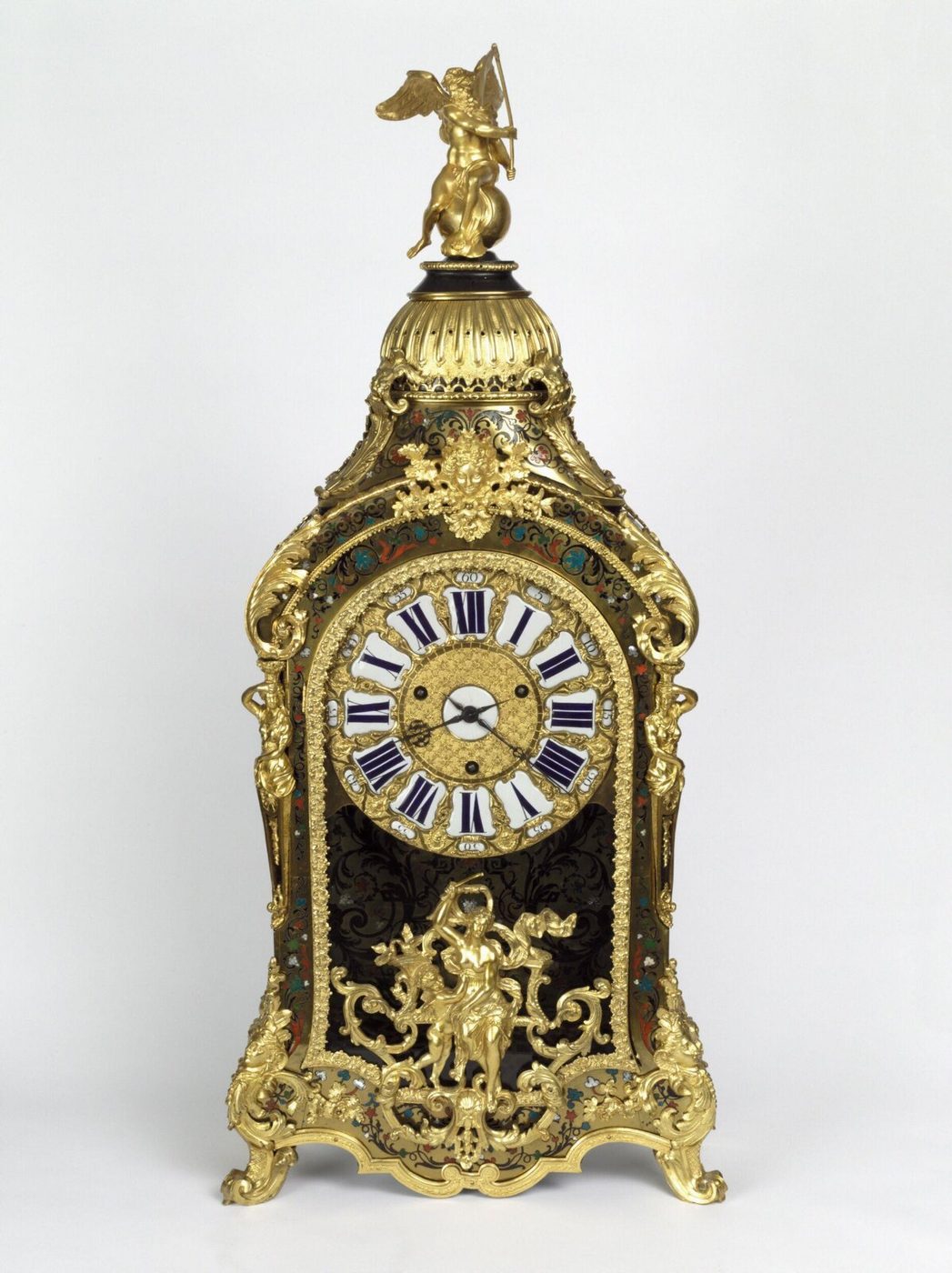
Clocks · Clock
Clock by Salles, France, 1710 - 1750
- Maker / attribution
- Salles (made)
- Date
- 1710 - 1750
- Historical period
- Early Modern Horology (1600 – 1750)
- Country of origin
- France
- Place
- Paris, Caen
- Object type
- Clock
- Materials / technique
- Oak case veneered with sheet brass inlaid with tortoiseshell, mother-of-pearl and coloured, horn, with gilt brass mounts, a brass dial plate inset with enamel plaques and blue steel hands
- Dimensions
- Height: 117 cm; Width: 50 cm; Depth: 25 cm
- Holding institution
- Victoria and Albert Museum, London
- Accession / object no.
- M.265:1 to 3-1923
- Credit line
- Bequeathed by Mrs R.S. Warburton
Record summary
Held and catalogued by Victoria and Albert Museum, London (object number M.265:1 to 3-1923), this is a clock by Salles, made in Paris, Caen, France, dated 1710 - 1750. The Atlas places it in the Early Modern Horology period (1600 – 1750) of its Clocks collection. Materials and techniques recorded by the source: Oak case veneered with sheet brass inlaid with tortoiseshell, mother-of-pearl and coloured, horn, with gilt brass mounts, a brass dial plate inset with enamel plaques and blue steel hands. Recorded dimensions: Height: 117 cm; Width: 50 cm; Depth: 25 cm. The record is illustrated with 4 photographs.
Assembled from the source record's structured fields. Dates and attributions are given as the source states them; where a field is missing the Atlas leaves it blank rather than estimating.
Catalogue description
V&A — Summary
The fashion for boulle marquetry on clock cases extended well into the eighteenth century and the clock movement in this clock is consistent with an eighteenth century date. The ornate case would have been ordered from Paris by Salles, the Caen clockmaker who signed the movement. Two clockmakers named Salles were recorded as working in Caen in the 1750s, although by then the clock would have been rather old-fashioned in form.
V&A — Physical description
A spring-driven clock, in a case of oak, veneered with sheet brass inlaid with brightly-coloured flowers and foliage in tortoiseshell, mother-of-pearl and coloured horn. The case is ornamented with gilt brass mounts representing the themes of Time and Love. Below the dial is a figural group with Venus clasping Cupid's bow, and at the four corner edges, draped female figures. Inward-scrolling leaves rise towards a female mask at the centre of the cresting. Behind this rises a removable pediment, in part formed by a pierced, ribbed dome of brass surmounted by a finial mount in the form of a winged figure of Time seated on a globe. The case is set at its lower corners with four further female masks and stands on four scrolling brass feet. The inside surface of the door at the back of the case is decorated with a panel of inlaid brass in the same materials as the clock case, depicting Bacchus astride a barrel holidng a glass of wine and a pouch, surrounded by leafy scrollwork, grape vines and masks. The movement has a verge escapement. The pendulum and silk suspension are missing. The brass dial plate is set with enamelled plaques with a white ground, showing the hours in blue Roman numerals with the minutes in black Arabic numerals in smaller plaques around the edge, and has hour and minute hands of pierced blue steel.
V&A — Object history
The clock movement is marked by Salles of Caen, north-west France, and is consistent with an eighteenth-century date. Two clockmakers of this name, Jacques Salles and Michel Salles, are recorded as working in Caen in the 1750s. The clock case was almost certainly made in Paris. The maker of the is unknown but the boulle decoration is similar to clocks made in about 1710. The clock was bought from a resident in Caen by Sir William Leeson for 300 francs
V&A gallery label
Clock Probably 1710-50 France Case: Paris Movement: Caen, possibly by Jacques or Michel Salles Oak veneered with brass; marquetry in turtle shell, mother-of-pearl and coloured horn; gilded copper alloy mounts The mounts with figures of Time, Venus and Cupid Bequeathed by Mrs R.S. Warburton
Inscriptions & marks
Bimol [or Binol, or Burol, or Jurot] aout 1743 [or 1745]
Historical context
Early Modern Horology (1600 – 1750)
Huygens' pendulum and balance spring transform accuracy; English makers develop the anchor and deadbeat escapements.
Huygens's pendulum (1656–57) improved clock accuracy from about a quarter of an hour to under a minute a day. The anchor escapement (c. 1670) and the long seconds pendulum created the longcase clock; London makers such as Fromanteel, Knibb, Tompion and Quare led European clockmaking, and French makers created the Boulle pendule.
Read the period in the timelineMore clocks from this periodEarlier: Renaissance Horology
Atlas type guide
Domestic clocks
A clock combines four systems: a source of power (falling weight, coiled spring, or later electricity), a gear train that divides time, an escapement and oscillator that regulate it (foliot, pendulum or balance), and an indicating system of dial and hands or a bell. Its history runs from the large iron weight-driven clocks of the late thirteenth century to Renaissance spring-driven table clocks, the pendulum revolution of 1656, the factory clocks of the nineteenth century and electric and quartz clocks of the twentieth.
Domestic clocks also reflect regional furniture and decorative traditions — English longcase and bracket clocks, French pendules, Viennese regulators, Black Forest and American shelf clocks — and therefore record changing tastes as much as technical progress.
What to look for
- How the clock is powered: weights, spring barrel, fusee, electric coil.
- The oscillator: foliot, short pendulum, long seconds pendulum or balance.
- Whether it strikes: hour only (count wheel) or hours and quarters (rack striking).
- The maker or retailer's name on dial and movement, and any factory trademarks.
- Signs of alteration — replaced dials, converted escapements, 'married' cases.
Dating clues
- Before 1656 clocks used foliots or balances; after, most domestic clocks have pendulums.
- Anchor escapements spread after c. 1670; minute hands became common at the same time.
- Factory production in America and Germany transformed prices after c. 1840.
General guidance written by the Atlas editors about this kind of object. It is not a statement about this particular piece; for that, rely on the source record above and on physical examination.
Read next:Anchor (recoil) escapementFoliot
Related records
Clocks · 1590–1610
Clock, France, 1590–1610
MAK – Museum of Applied Arts
Clocks · 1600–1699
Table clock by Charles Goret, France, 1600–1699
German Clock Museum
Clocks · 1640
Table clock, France, 1640
Rijksmuseum
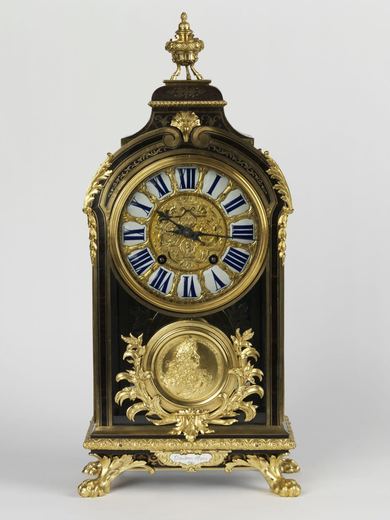
Clocks · late 17th century
Clock with case of tortoiseshell inlaid with brass, Paris, late 17th century
Victoria and Albert Museum, London
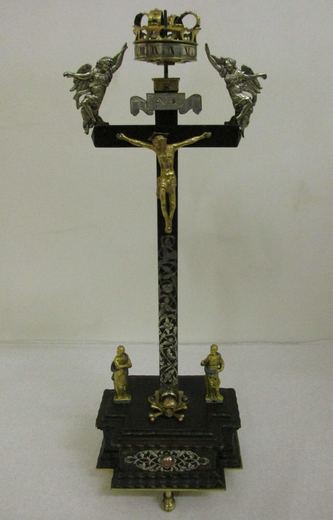
Clocks · 1650
Crucifix Clock, signed W. H. Arnstad, mid- 17th century.
Victoria and Albert Museum, London
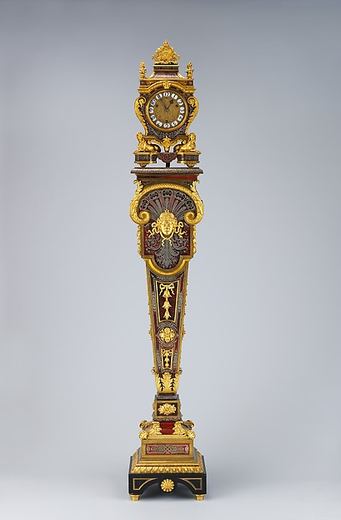
Clocks · ca. 1690
Clock with pedestal by Case attributed to André Charles Boulle, France, ca. 1690
The Metropolitan Museum of Art, New York
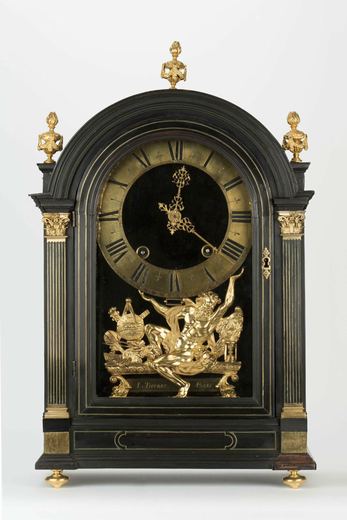
Clocks · 1690
Table clock by Marc Boucher, France, 1690
German Clock Museum
Clocks · ca. 1700–1710
Traveling clock with alarm and calendar by Probably by Joseph Paulet, France, ca. 1700–1710
The Metropolitan Museum of Art, New York