Clocks · Clock
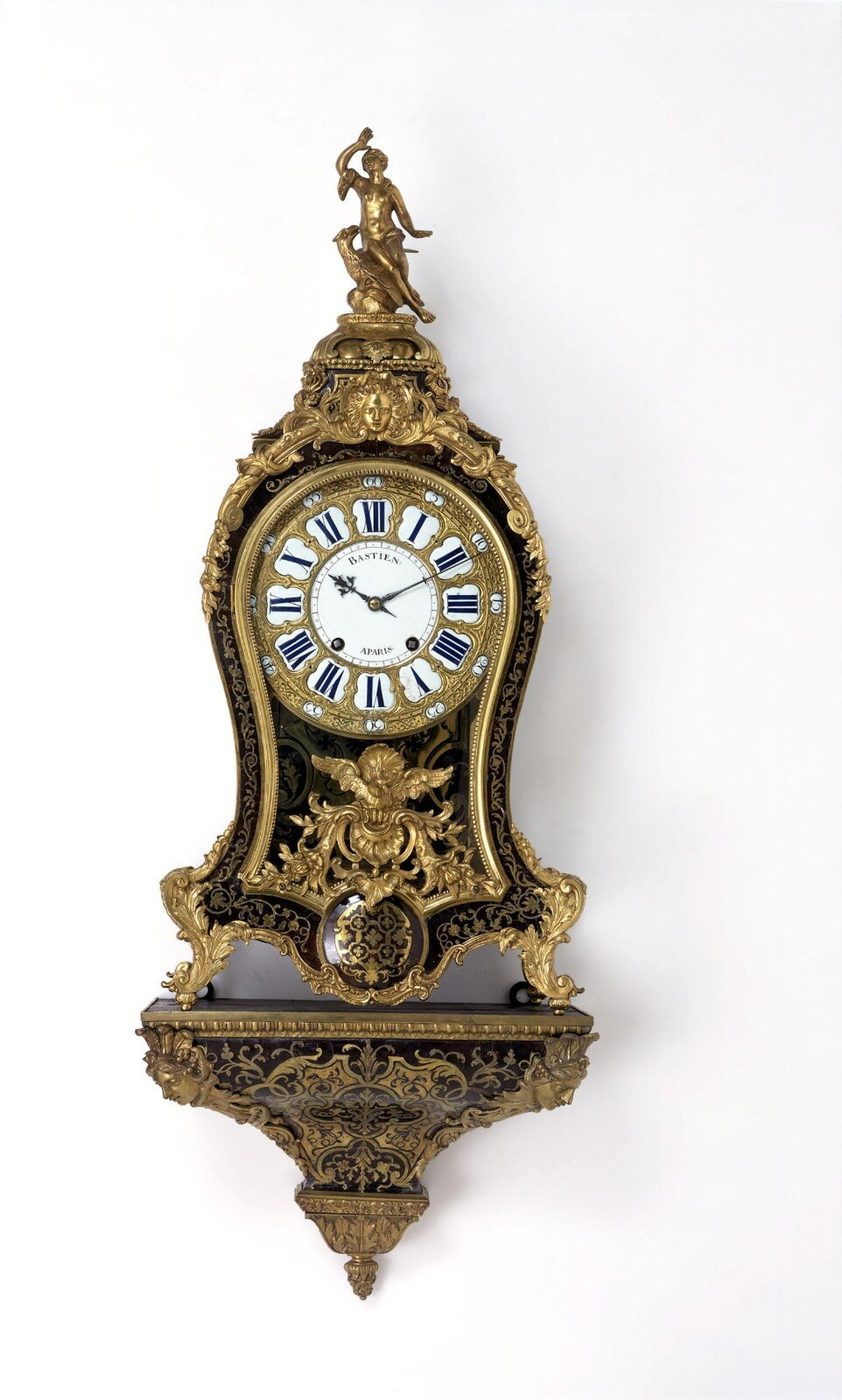
Clock by Joseph-Joachim Bastien, France, ca. 1740
- Maker / attribution
- Joseph-Joachim Bastien (maker)
- Date
- ca. 1740
- Historical period
- Early Modern Horology (1600 – 1750)
- Country of origin
- France
- Place
- Paris
- Object type
- Clock
- Materials / technique
- The carcase probably of oak, the bracket of pine, both veneered with boulle marquetry of turtleshell inlaid with engraved brass; with gilt-brass mounts; movement of brass and steel; dial plate of tin? enamelled in white, blue and black; glass; hands of blued steel; iron hooks to the bracket
- Dimensions
- Height: 1190 mm (fully assembled); Height: 30.5 cm (of bracket); Width: 435 mm (fully assembled); Depth: 210 mm (fully assembled)
- Holding institution
- Victoria and Albert Museum, London
- Accession / object no.
- M.354&A-1940
- Credit line
- Given by Christina H. M. and Frances E. Holly
Record summary
Held and catalogued by Victoria and Albert Museum, London (object number M.354&A-1940), this is a clock by Joseph-Joachim Bastien, made in Paris, France, dated ca. 1740. The Atlas places it in the Early Modern Horology period (1600 – 1750) of its Clocks collection. Materials and techniques recorded by the source: The carcase probably of oak, the bracket of pine, both veneered with boulle marquetry of turtleshell inlaid with engraved brass; with gilt-brass mounts; movement of brass and steel; dial plate of tin? enamelled in white, blue and black; glass; hands of blued steel; iron hooks to the bracket. Recorded dimensions: Height: 1190 mm (fully assembled); Height: 30.5 cm (of bracket); Width: 435 mm (fully assembled); Depth: 210 mm (fully assembled). The record is illustrated with 4 photographs.
Assembled from the source record's structured fields. Dates and attributions are given as the source states them; where a field is missing the Atlas leaves it blank rather than estimating.
Catalogue description
V&A — Summary
This was the standard form for a fashionable wall clock in France from about 1735 to 1760. The sweeping lines of the case follow the fashionable curves of the Rococo style. However, the decoration of clocks was often rather old-fashioned in comparison with that of other furnishings. In this example the tight, symmetrical scrolling pattern of the boulle marquetry – which combined brass and dark tortoiseshell and was named after André-Charles Boulle, cabinetmaker to Louis XIV – is closer to designs of the period before 1720 than to those of 1740. The dial is more up-to-date in style, with 13 separate plaques of enamel set into a gilt-brass framework.
V&A — Physical description
A clock on a separate bracket, of waisted, serpentine form. The clock case is probably of oak and the bracket is of pine. Both clock and bracket are veneered with boulle marquetry of turtleshell inlaid with engraved brass, with gilt-brass mounts, the dial set with a centre and 12 hour plaques of white enamel with black Roman numerals. The cresting of the clock is a separate section and is surmounted by a sculptural group of young woman carried aloft on an eagle.
V&A gallery label
Clock About 1740 France (Paris) Movement by Joseph-Joachim Bastien Probably oak and pine; marquetry in turtle shell and brass; gilded copper alloy mounts Given by Christina H.M. and Frances E. Holly
V&A gallery label
BRACKET CLOCK FRENCH (Paris); first third of the 18th century Decorated with boulle-work marquetry Inscribed BASTIEN A PARIS The boulle technique of marquetry using tortoiseshell and brass with other materials remained fashionable for clocks, even when it use on contemporary furniture had fallen out of fashion. M.354-1940
V&A gallery label
BRACKET CLOCK FRENCH (Paris); 1730-50 Dial inscribed; BASTIEN A PARIS Veneered with boulle marquetry of tortoiseshell and brass; on a carcase of oak; gilt-bronze mounts The boulle technique of marquetry, using tortoiseshell and brass, with other materials, had been highly fashionable in Paris in the first decade of the 18th century. By 1730 it was becoming old-fashioned, though it never entirely fell out of fashion. Its complex technique and luxurious materials continued to be valued by some clients, and boulle marquetry panels were often re-used or adapted for new furniture, as is clear on the adjacent table (1021-1882). Clockmakers in France, as in England, tended to be conservative in the styles they chose for their clock cases and so boulle marquetry continued to be used for clocks even after it had fallen out of favour for furniture. M.354-1940
Inscriptions & marks
BASTIEN À PARIS; Bastien Aparis; Ladoüé Janvier 1740
Historical context
Early Modern Horology (1600 – 1750)
Huygens' pendulum and balance spring transform accuracy; English makers develop the anchor and deadbeat escapements.
Huygens's pendulum (1656–57) improved clock accuracy from about a quarter of an hour to under a minute a day. The anchor escapement (c. 1670) and the long seconds pendulum created the longcase clock; London makers such as Fromanteel, Knibb, Tompion and Quare led European clockmaking, and French makers created the Boulle pendule.
Read the period in the timelineMore clocks from this periodEarlier: Renaissance Horology
Atlas type guide
Domestic clocks
A clock combines four systems: a source of power (falling weight, coiled spring, or later electricity), a gear train that divides time, an escapement and oscillator that regulate it (foliot, pendulum or balance), and an indicating system of dial and hands or a bell. Its history runs from the large iron weight-driven clocks of the late thirteenth century to Renaissance spring-driven table clocks, the pendulum revolution of 1656, the factory clocks of the nineteenth century and electric and quartz clocks of the twentieth.
Domestic clocks also reflect regional furniture and decorative traditions — English longcase and bracket clocks, French pendules, Viennese regulators, Black Forest and American shelf clocks — and therefore record changing tastes as much as technical progress.
What to look for
- How the clock is powered: weights, spring barrel, fusee, electric coil.
- The oscillator: foliot, short pendulum, long seconds pendulum or balance.
- Whether it strikes: hour only (count wheel) or hours and quarters (rack striking).
- The maker or retailer's name on dial and movement, and any factory trademarks.
- Signs of alteration — replaced dials, converted escapements, 'married' cases.
Dating clues
- Before 1656 clocks used foliots or balances; after, most domestic clocks have pendulums.
- Anchor escapements spread after c. 1670; minute hands became common at the same time.
- Factory production in America and Germany transformed prices after c. 1840.
General guidance written by the Atlas editors about this kind of object. It is not a statement about this particular piece; for that, rely on the source record above and on physical examination.
Related records
Clocks · 1590–1610
Clock, France, 1590–1610
MAK – Museum of Applied Arts
Clocks · 1600–1699
Table clock by Charles Goret, France, 1600–1699
German Clock Museum
Clocks · 1640
Table clock, France, 1640
Rijksmuseum
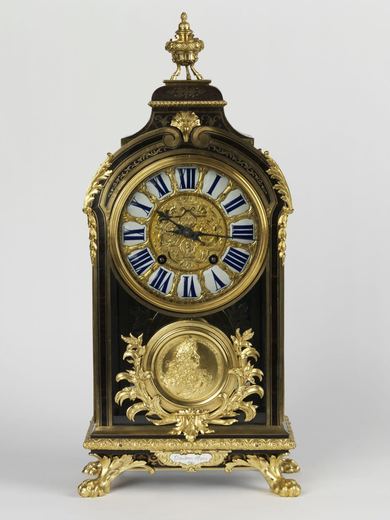
Clocks · late 17th century
Clock with case of tortoiseshell inlaid with brass, Paris, late 17th century
Victoria and Albert Museum, London
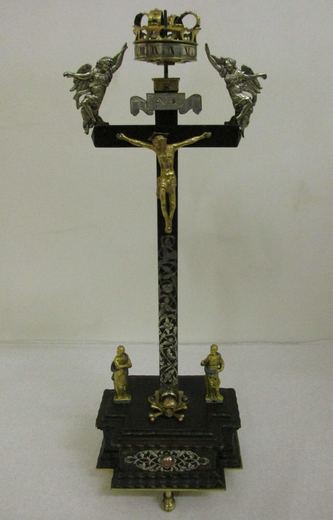
Clocks · 1650
Crucifix Clock, signed W. H. Arnstad, mid- 17th century.
Victoria and Albert Museum, London
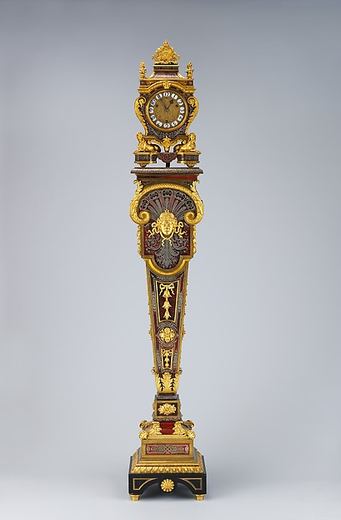
Clocks · ca. 1690
Clock with pedestal by Case attributed to André Charles Boulle, France, ca. 1690
The Metropolitan Museum of Art, New York
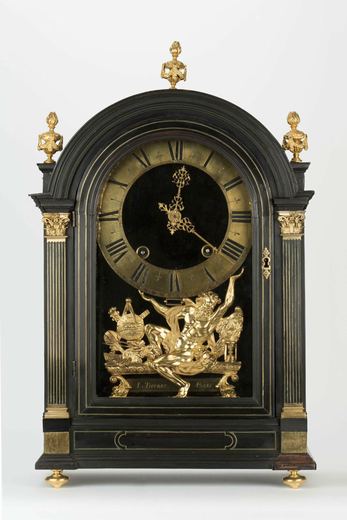
Clocks · 1690
Table clock by Marc Boucher, France, 1690
German Clock Museum
Clocks · ca. 1700–1710
Traveling clock with alarm and calendar by Probably by Joseph Paulet, France, ca. 1700–1710
The Metropolitan Museum of Art, New York