Clocks · Clock
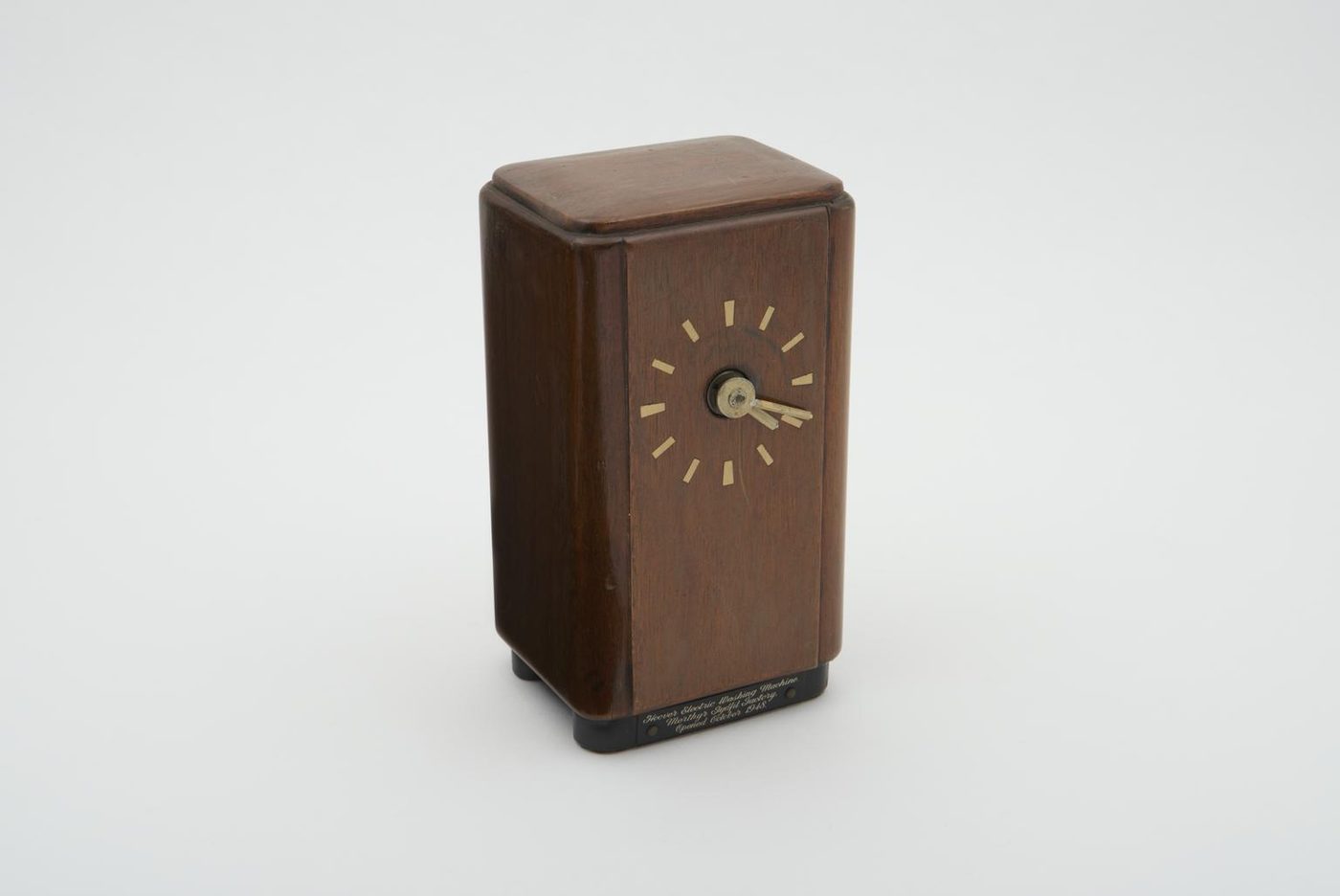
Wooden clock in the shape of a Hoover MK 1 washing machine, made to commemorate the opening of the Hoover washing machine factory in Merthyr Tydfil.
- Maker / attribution
- Smiths English Clocks Limited (maker)
- Date
- 1948
- Historical period
- Modern Mechanical Horology (1945 – 1969)
- Country of origin
- England
- Place
- Cricklewood, Barnet, Greater London, England, United Kingdom, Cricklewood
- Object type
- Clock
- Holding institution
- Science Museum Group, London
- Accession / object no.
- 2019-301
- Catalogue title (original)
- Wooden clock, to commemorate opening of Hoover washing machine factory in Merthyr Tydfil, October 1948
Record summary
Held and catalogued by Science Museum Group, London (object number 2019-301), this is a clock by Smiths English Clocks Limited, made in Cricklewood, Barnet, Greater London, England, United Kingdom, Cricklewood, dated 1948. The Atlas places it in the Modern Mechanical Horology period (1945 – 1969) of its Clocks collection. The record is illustrated with 1 photograph.
Assembled from the source record's structured fields. Dates and attributions are given as the source states them; where a field is missing the Atlas leaves it blank rather than estimating.
Catalogue description
Science Museum Group description
This wooden mantel clock was made to commemorate the opening of the Hoover washing machine factory in Pentrebach, Merthyr Tydfil on 12th October 1948. The clocks were gifts to those who were involved in the opening of the factory - a seminal moment in British production of washing machines by Hoover. The late 1940s and early 1950s saw a programme designed to reinvigorate industry after the end of the Second World War. The opening of this extremely modern factory (in terms of architectural design, operation and market aspiration) was just one of the developments that brought new economic opportunities to the region. The factory also sought to give employment to disabled coal miners. The clock itself is probably manufactured by well-known maker Smiths who made clock mechanisms and timers for many British appliance manufacturers at the time. It is designed in the shape of the brand-new Hoover Mk1 washing machine being specially built at the plant for the British market. Other examples of the clock have white batten numerals and a red 'seconds' hand. It is unknown as to whether this model is missing the 'seconds' hand. The inscription on the front reads ‘Hoover Electric Washing Machine Merthyr Tydfil Factory Opened October 1948’. The Mk1 washing machine was designed to be a good quality, smaller, cheaper machine, capable of fitting into even the smallest (British) house or flat and take all but the largest items of washing. It also touted a fast wash, a high degree of cleanliness and simplicity of maintenance - with easy-clean lines and few moving parts. The factory opening event was attended by a long list of high-profile guests from public and industrial spheres of life and the programme of events included an evening cabaret event for the factory staff broadcast on the BBC Light Programme. An estimated 20,000 people from Merthyr and the surrounding villages lined the streets to watch VIP guests arrive by train from London for the opening.
Historical context
Modern Mechanical Horology (1945 – 1969)
Tool watches for divers, pilots and astronauts; electric watches anticipate the electronic age.
Post-war clocks combined new materials and industrial design: plastic and metal cases, battery-powered transistor movements from the late 1950s, and design classics by George Nelson, Max Bill and others. The first caesium atomic clock (1955) moved the definition of time from astronomy to physics.
Read the period in the timelineMore clocks from this periodEarlier: Golden Age of Mechanical Watchmaking
Atlas type guide
Longcase (tall-case or grandfather) clocks
The longcase clock was born from two seventeenth-century innovations: Christiaan Huygens's pendulum (1656–57) and the anchor escapement (c. 1670). A long seconds pendulum, nearly a metre long, swings with a small arc, and enclosing it together with the driving weights in a tall wooden case protected the mechanism and created a new piece of furniture. London makers such as Ahasuerus Fromanteel, Thomas Tompion and Joseph Knibb set the pattern.
By the eighteenth century longcase clocks were made throughout Britain, the Netherlands, Scandinavia (the Swedish Mora clock), France (the Comtoise from the Franche-Comté), Germany and colonial America. Eight-day movements with two weights became standard in better clocks; thirty-hour clocks with one weight and a rope or chain were cheaper alternatives.
What to look for
- Winding holes in the dial: two (eight-day, going and striking) or none (thirty-hour, pulled up by a chain).
- Brass dials with applied chapter rings (earlier) versus painted iron 'white' dials (after c. 1770 in Britain).
- Moon-phase arches, date apertures, seconds dials and maker's name on the dial.
- Case woods and style: ebonised, walnut marquetry, lacquer, oak or mahogany; regional styles from London, Lancashire, Scotland or America.
- Whether the movement and dial match the case — 'marriages' are common.
Dating clues
- Square brass dials suggest c. 1670–1720; arched brass dials c. 1715–1790.
- Painted (white) dials were made by Birmingham dial-makers from about 1772.
- Comtoise clocks with repoussé pendulums are mostly nineteenth century.
General guidance written by the Atlas editors about this kind of object. It is not a statement about this particular piece; for that, rely on the source record above and on physical examination.
Related records
Clocks · 1930-1940
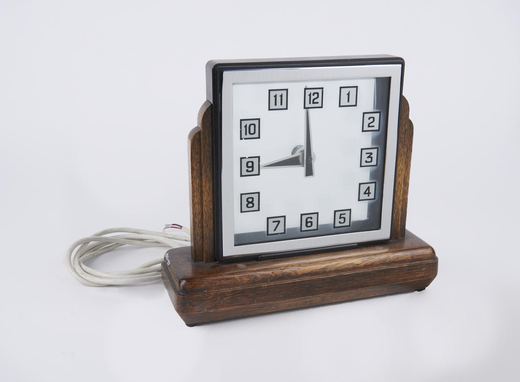
Mystery clock with synchronous electric movement, by Smiths English Clocks Ltd., London, England, 1930-1940.
Science Museum Group, London
Clocks · 1940
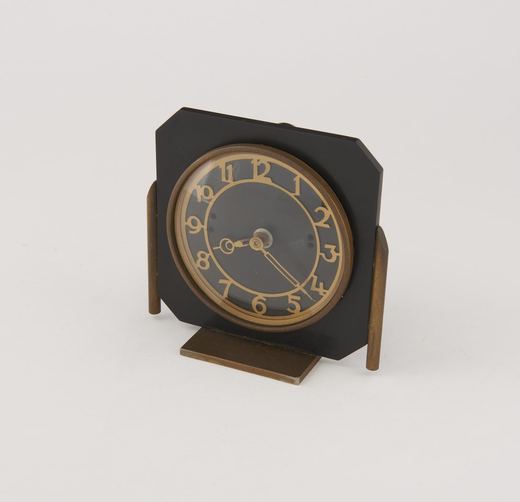
Ferranti electric mantel clock, 1940.
Science Museum Group, London
Clocks · circa 1946
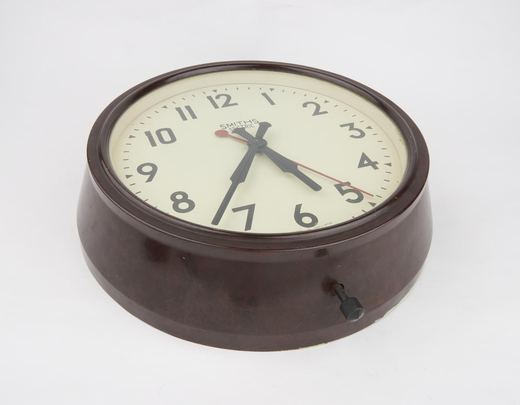
Smiths Sectric synchronous motor electric wall clock with centre seconds hand, by Smiths English Clocks Ltd, England c. 1946
Science Museum Group, London
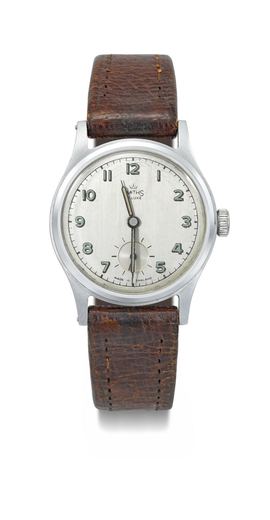
Wristwatches · 1953
Wristwatch by Smiths English Clocks Limited, England, 1953
Science Museum Group, London
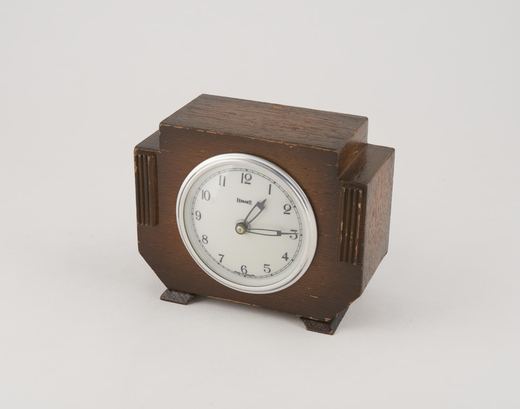
Clocks · 1930-1960
Ferranti electric mantel clock. (Science Museum Group Y1996.10.820)
Science Museum Group, London
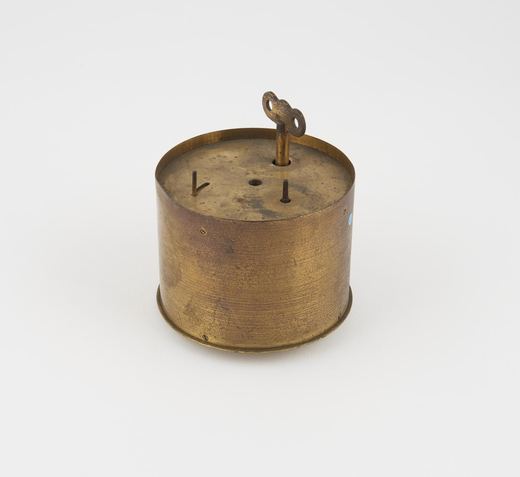
Clocks · 1931-1970
Clock and drum for recorder, 24 hours, English, 1931-1970.
Science Museum Group, London
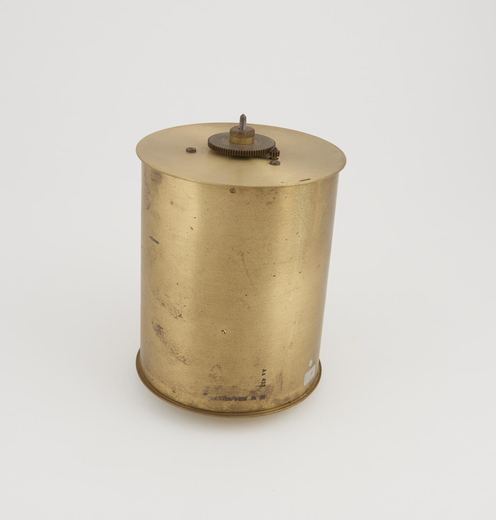
Clocks · 1940-1967
Drum and clock, English, 1940-1947, MO W 5124/ 47/ 57.
Science Museum Group, London
Clocks · 1940-1950
Drum and clock. by Smith's English Clocks Ltd., London, for Air Ministry.
Science Museum Group, London