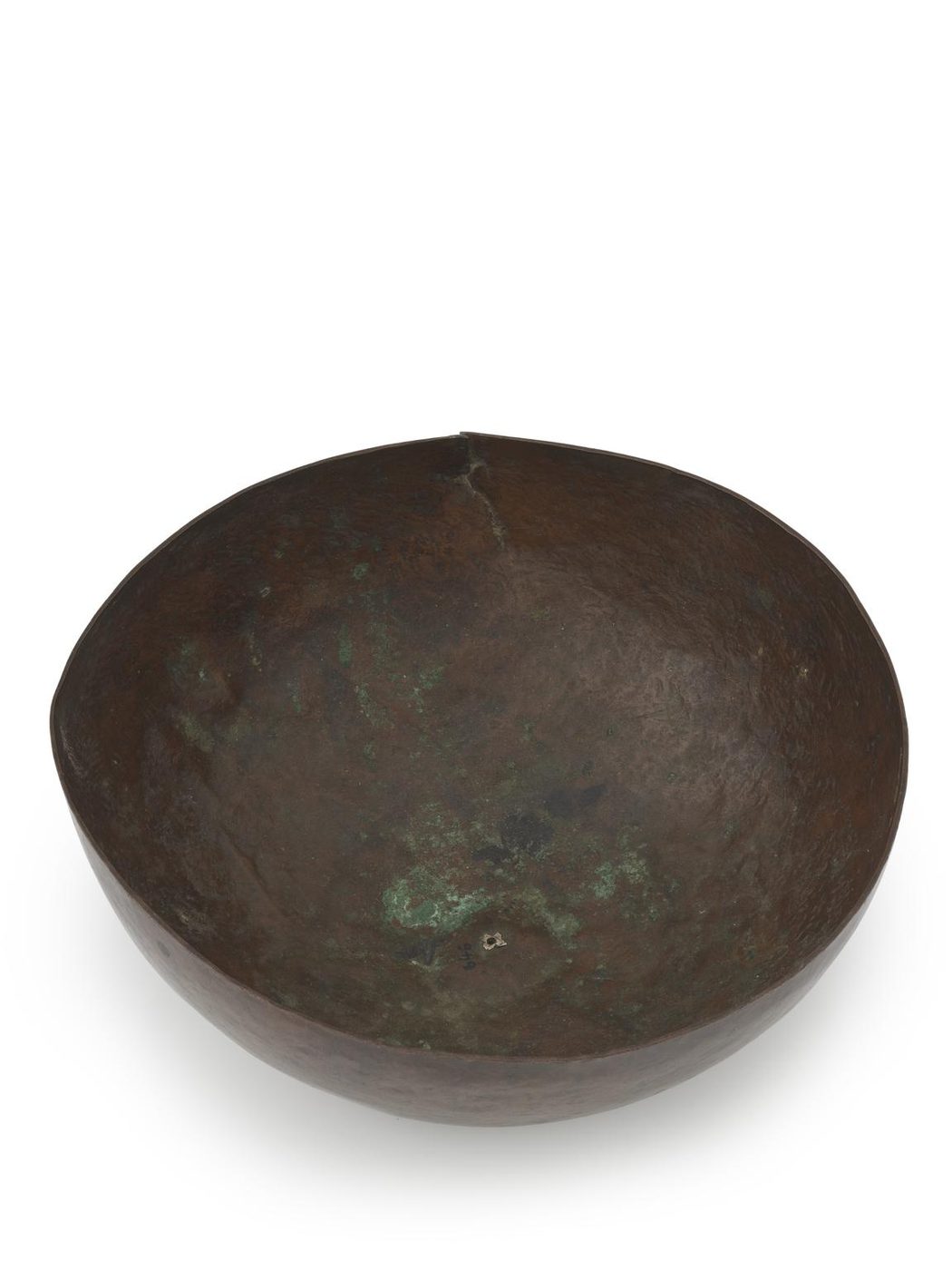
Instruments · Water clock
Water clock, Sri Lanka, 646
- Maker / attribution
- Unrecorded in source
- Date
- 646
- Historical period
- Medieval Period (500 – 1400)
- Country of origin
- Unrecorded in source
- Place
- Sri Lanka, Sri Lanka
- Object type
- Water clock
- Holding institution
- Science Museum Group, London
- Accession / object no.
- L2015-3520
- Credit line
- Lent by the Worshipful Company of Clockmakers
- Catalogue title (original)
- Sinking bowl water clock
Record summary
Held and catalogued by Science Museum Group, London (object number L2015-3520), this is a water clock, made in Sri Lanka, Sri Lanka, dated 646. The Atlas places it in the Medieval Period period (500 – 1400) of its Instruments collection. The record is illustrated with 1 photograph.
Assembled from the source record's structured fields. Dates and attributions are given as the source states them; where a field is missing the Atlas leaves it blank rather than estimating.
Catalogue description
Science Museum Group description
The water clock, or clepsydra, is one of the earliest forms of timekeepers and allows the passage of time to be measured by regulating and measuring the flow of water into or out of a vessel. In use this 'sinking' bowl is placed on the surface of water. Through the hole in the bottom which slowly allows water into it, the bowl gradually sinks until it is fully submerged after a period of approximately 24 minutes.
Historical context
Medieval Period (500 – 1400)
Su Song's astronomical tower in Song China, al-Jazari's automata, and the first European weight-driven verge clocks.
Astronomers in the Islamic world refined the astrolabe, quadrants and sundials for prayer times and astronomy; through al-Andalus these instruments reached Latin Europe, where they were taught at universities.
Read the period in the timelineMore instruments from this periodEarlier: Classical Antiquity
Atlas type guide
Water, fire and incense clocks
Before the mechanical clock, intervals and hours were measured by flow and combustion. Outflow and inflow water clocks were used in Egypt, Mesopotamia, Greece, China and the Islamic world; Chinese and Japanese incense clocks burned powdered incense along a maze-like path; oil-lamp clocks with graduated glass reservoirs were popular in German-speaking Europe in the seventeenth and eighteenth centuries.
These timekeepers needed constant correction and could not keep the hour automatically for long periods, but they underpinned temple ritual, legal procedure, astronomy and the earliest monumental astronomical clocks such as Su Song's clock tower (1090s) and al-Jazari's designs (1206).
What to look for
- Graduated vessels or glass reservoirs with hour scales.
- Incense trays with stencils for laying the powder trail.
- Pewter oil-lamp clocks with a glass reservoir marked in Roman numerals.
Dating clues
- Oil-lamp clocks are mostly eighteenth century and often reproduced later.
- Incense clocks were made in China and Japan into the twentieth century.
General guidance written by the Atlas editors about this kind of object. It is not a statement about this particular piece; for that, rely on the source record above and on physical examination.
Read next:Su Song's astronomical clock tower
Related records
Instruments · 569
Metronome, France, 569
Science Museum Group, London
Instruments · 600 BCE
Sundial, Egypt, 600 BCE
Science Museum Group, London
Instruments · 10th century
Quadrant by Muhammad ibn Mahmud, Iran (Persia), 10th century
The Metropolitan Museum of Art, New York
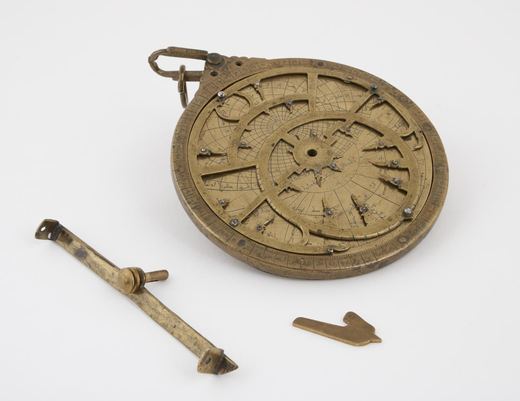
Instruments · 1145-1155
Brass Moorish planispheric astrolabe with five plates, a shadow dial on the reverse and silver studs on the rete, c. 1150, IC 1058 [international checklist].
Science Museum Group, London
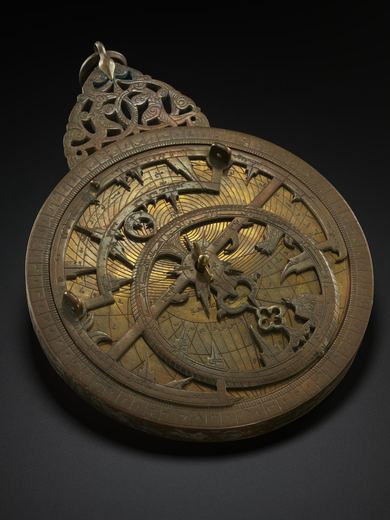
Instruments · 1221
Astrolabe by Mohammad ibn Bekr ibn Mohammad Al Rashidi Al-Abari, Iran (Persia), 1221
Science Museum Group, London
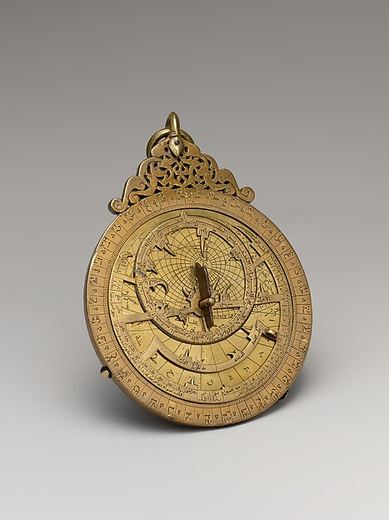
Instruments · 1290–1292
Astrolabe by ‘Umar ibn Yusuf ibn ‘Umar ibn ‘Ali ibn Rasul al-Muzaffari, Yemen, 1290–1292
The Metropolitan Museum of Art, New York
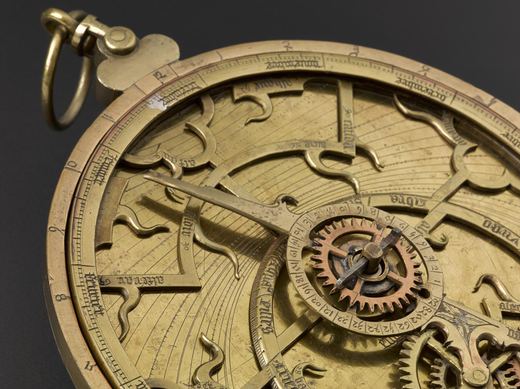
Instruments · 1295-1305
Astrolabe, France, 1295-1305
Science Museum Group, London
Instruments · 1300-1400
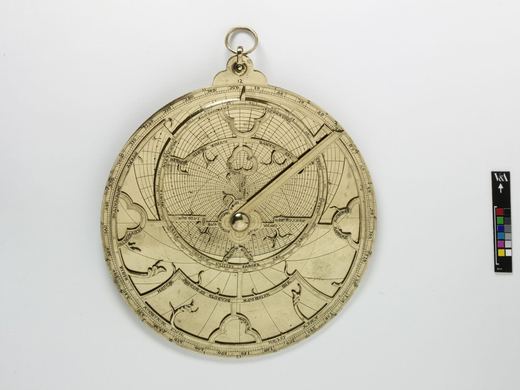
Astrolabe of cast sheet brass, with additional cast elements, engraved, France; 1300-1400
Victoria and Albert Museum, London