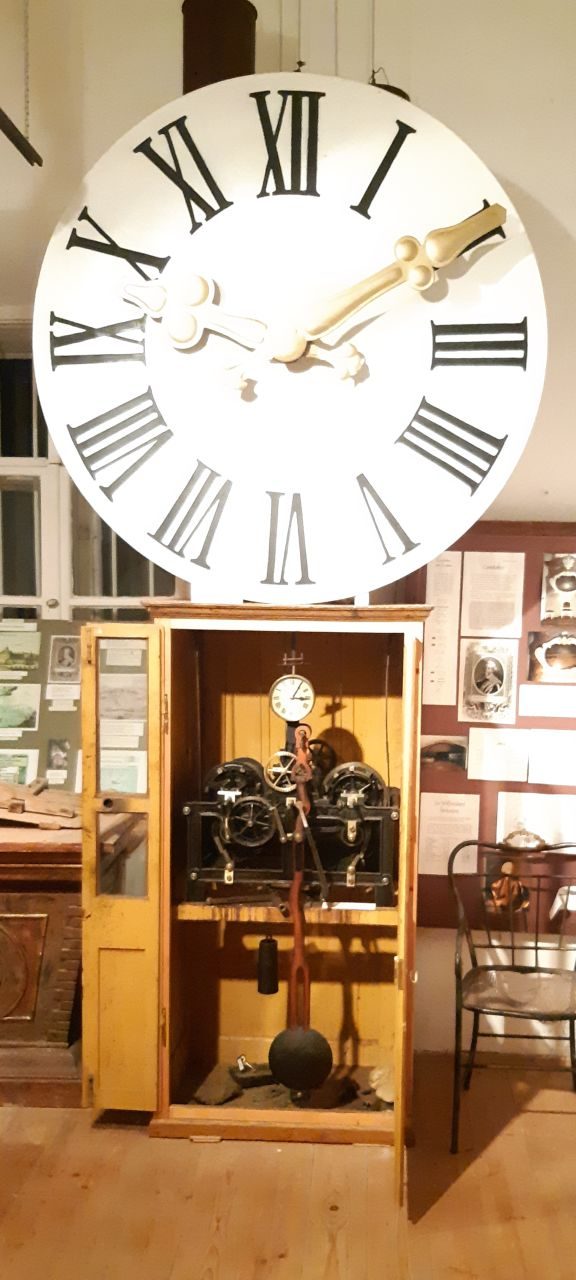
Clocks · Turret clock
Turret clock, 1914
- Maker / attribution
- Unrecorded in source
- Date
- 1914
- Historical period
- Golden Age of Mechanical Watchmaking (1900 – 1945)
- Country of origin
- Unrecorded in source
- Object type
- Turret clock
- Holding institution
- Local History Museum of Wilfersdorf
- Accession / object no.
- 01901
- Catalogue title (original)
- Turmuhr aus der Kirche Wilfersdorf 1914 (German)
Record summary
Held and catalogued by Local History Museum of Wilfersdorf (object number 01901), this is a turret clock, dated 1914. The Atlas places it in the Golden Age of Mechanical Watchmaking period (1900 – 1945) of its Clocks collection. The record is illustrated with 1 photograph.
Assembled from the source record's structured fields. Dates and attributions are given as the source states them; where a field is missing the Atlas leaves it blank rather than estimating.
Catalogue description
Catalogue description from Local History Museum of Wilfersdorf (German)
Die Uhr wurde vom Pfarramt Wilfersdorf im Jahr 1914 in Auftrag gegeben, da laut Aufzeichnungen (Gedenkbuch der Pfarre Wilfersdorf) die alte Uhr ihren Dienst versagte. Die damaligen Kosten in Kronen und Hellern wurden von der Kirche zu 500Kr., der Gemeinde zu 600Kr., und dem Patron (Fürst Johann von u. zu Liechtenstein) zu 961Kr. 59 H übernommen. Hersteller der Turmuhr war: Ingenieur Emil Schauer-Erste Wiener Turmuhren- u. elektrische Uhren-Fabrik , geliefert wurde die Uhr jedoch vom Uhrmacher H. Nawrata aus 2130 Mistelbach . Aus der Original- Rechnung (im Pfarrarchiv Wilfersdorf) geht hervor, dass es sich bei der Turmuhr um eine nach der neuesten best-bewährtesten Konstruktion mit Viertel u. Stundenschlagwerk Größe Nr. 3 gehandelt hat.
Shown in the original language of the source catalogue. An editor-reviewed English translation has not yet been published; we do not publish machine translations as authoritative text.
Historical context
Golden Age of Mechanical Watchmaking (1900 – 1945)
The wristwatch displaces the pocket watch; waterproof cases, self-winding and grand complications.
Between 1900 and 1945 clocks were electrified: master-clock systems ran factories and offices, synchronous mains clocks entered homes, and the Shortt free-pendulum clock set new standards of accuracy before the first quartz clocks (1927). Art Deco design reshaped mantel and table clocks.
Read the period in the timelineMore clocks from this periodEarlier: Industrial Revolution
Atlas type guide
Turret, tower and public clocks
The first mechanical clocks of the late thirteenth and fourteenth centuries were large iron striking clocks in towers, monasteries and cathedrals, driven by falling weights and controlled by a verge escapement with a foliot or wheel balance. They struck a bell rather than displaying the time, and only gradually acquired dials. Public clocks ordered civic life, regulating markets, work and worship.
From the seventeenth century the pendulum and then the anchor and pinwheel escapements made turret clocks far more accurate. In the nineteenth century firms such as Dent, Smith of Derby, Gillett & Johnston, J. F. Weule and Collin made cast-iron flatbed movements, and Edmund Beckett Denison's gravity escapement for the Great Clock of Westminster (1859) became the standard for accurate tower clocks.
What to look for
- Frame construction: early wrought-iron 'birdcage' or posted frames versus later cast-iron flatbed or plate-and-spacer frames.
- The escapement: verge and foliot, anchor, pinwheel or double three-legged gravity escapement.
- Striking and chiming trains with count wheels or rack striking.
- Maker's plates and dates cast or engraved on the frame.
Dating clues
- Wedged and riveted wrought-iron frames generally predate 1700.
- Flatbed cast-iron movements date from about 1840 onward.
- Electrical synchronisation and electric winding appear from about 1900.
General guidance written by the Atlas editors about this kind of object. It is not a statement about this particular piece; for that, rely on the source record above and on physical examination.
Related records
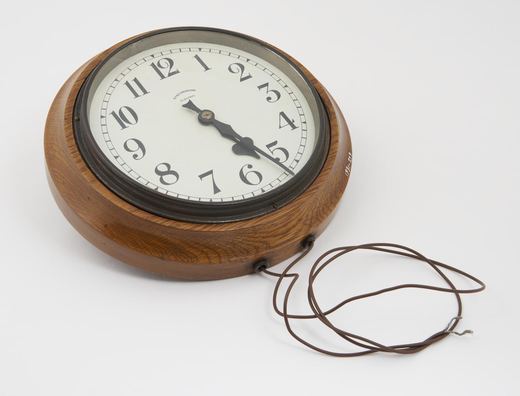
Clocks · 1890-1930
Clock with 8-inch impulse dial, by the Synchronome Company Limited, England, 1890-1930.
Science Museum Group, London
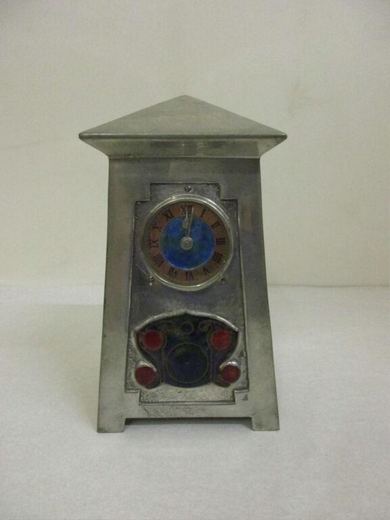
Clocks · c.1903-1904
Clock, pewter, made for Liberty& Co., England. 1903-4.
Victoria and Albert Museum, London
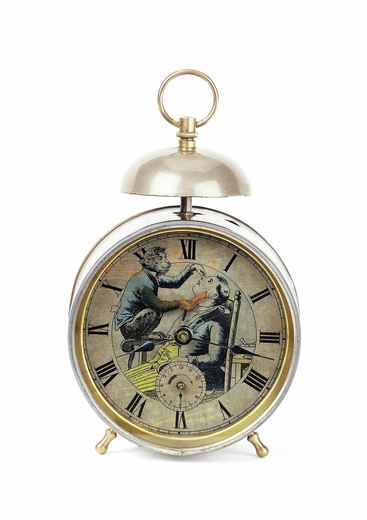
Clocks · 1900
Alarm clock by Union Clock Company, Germany, 1900
German Clock Museum
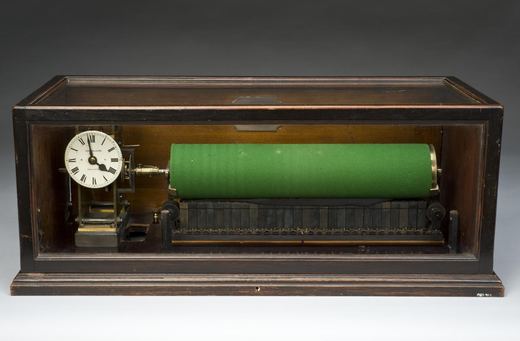
Clocks · 1900-1939
Clock by Cox-Walkers of Darlington, England, 1900-1939
Science Museum Group, London
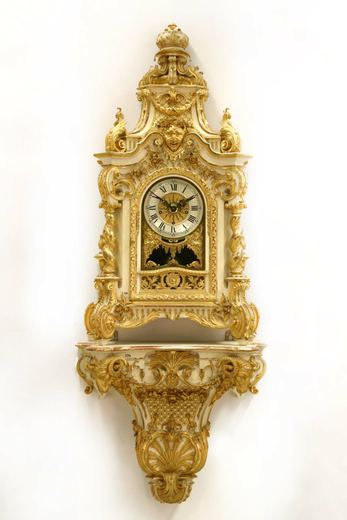
Clocks · 1900
Clock by Josef Münzer, Germany, 1900
German Clock Museum
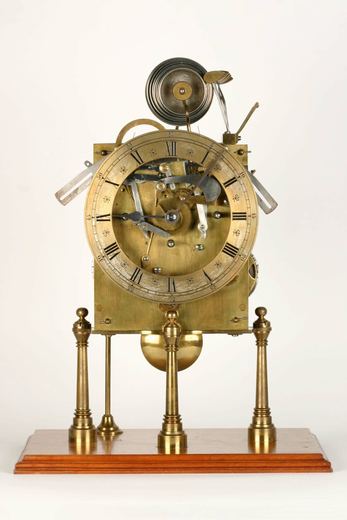
Clocks · 1900
Clock by Mathias Bäuerle, Germany, 1900
German Clock Museum
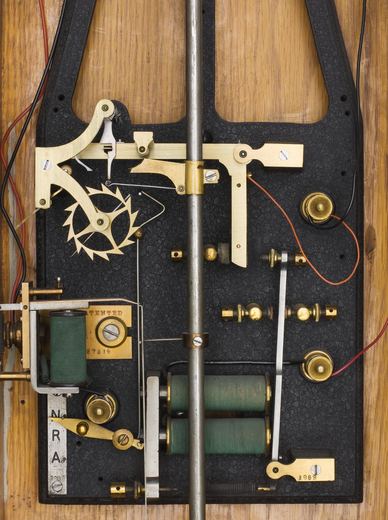
Clocks · 1900-1935
Clock by The Synchronome Company Limited, England, 1900-1935
Science Museum Group, London
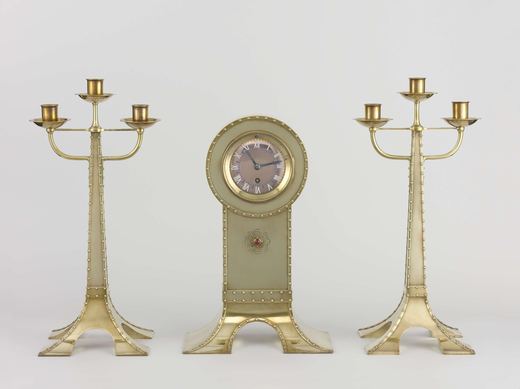
Clocks · 1900
Clock, Netherlands, 1900 (Rijksmuseum BK_1977_136)
Rijksmuseum