Instruments · Sundial
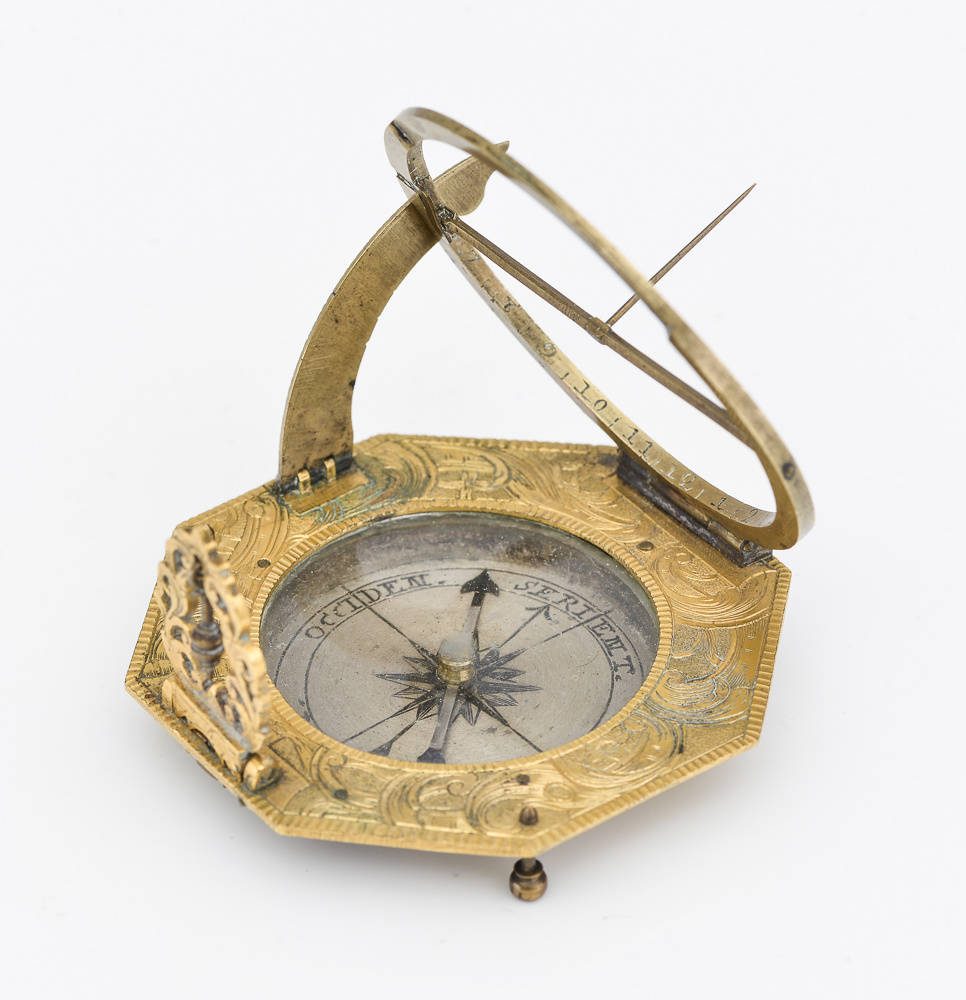
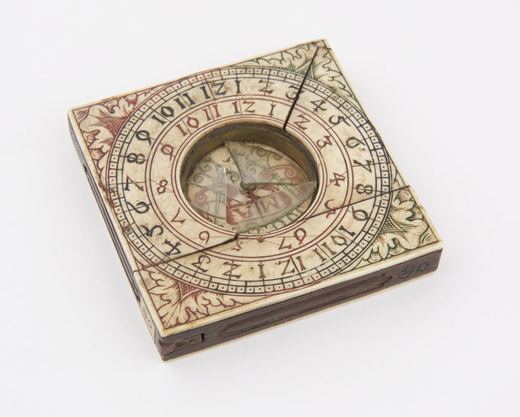
Sundial by Vogler, Johann Georg (1720-1765) (Uhrmacher), Germany, 1700–1799
- Maker / attribution
- Vogler, Johann Georg (1720-1765) (Uhrmacher) (creator)
- Date
- 1700–1799
- Historical period
- Early Modern Horology (1600 – 1750)
- Country of origin
- Germany
- Place
- Berlin
- Object type
- Sundial
- Holding institution
- City Museum Berlin
- Accession / object no.
- item_TBX6R532CWYKZL2O53YLREGFTVAK6VGR
- Catalogue title (original)
- Taschensonnenuhr signiert JVG (German)
Record summary
Held and catalogued by City Museum Berlin (object number item_TBX6R532CWYKZL2O53YLREGFTVAK6VGR), this is a sundial by Vogler, Johann Georg (1720-1765) (Uhrmacher), made in Berlin, Germany, dated 1700–1799. The Atlas places it in the Early Modern Horology period (1600 – 1750) of its Instruments collection. The record is illustrated with 1 photograph.
Assembled from the source record's structured fields. Dates and attributions are given as the source states them; where a field is missing the Atlas leaves it blank rather than estimating.
Catalogue description
Catalogue description from City Museum Berlin (German)
Achteckige Äquatorialsonnenuhr von Johann Georg Vogler, der 1720 in Augsburg geboren wurde und am 27.03.1765 dort starb. Heirat 09.05.1745. Bruder von Andreas Vogler, der 1766 seine Werkstatt übernimmt und äußerst produktiv war. Mehr als 130 Geräte konnten in Sammlungen und Museen nachgewiesen werden. Die Uhr ist mit einem Kompass und einem kleinen Lot ausgestattet. Floral graviert, feuervergoldet. Der Kompass auf versilberten Grund mit Windrose. Polnadel Eisen mit gebläuter Pfeilspitze und Kiel. Drei kleine Stellfüße ermöglichen ein genau waagrechtes Aufstellen, wozu das Lot als Hilfe dient. Hinten eingraviert die Elevationen (Polhöhen) für Gorsü, Lion, Bozen, Osen, Ingolstadt, Landau, Prag, Dresden, Warschau, Riga. Und die Signatur J.G.V. Umrandet von einem Gravurband, alles mit Gravurkitt ausgelegt. Die Gebrauchsanweisung gedruckt auf Papier, unten nennt sich Johann Georg Vogler als Compass-Macher in Augsburg. Auf der Rückseite die Angaben von 160 Städten und ihren Polhöhen.
Shown in the original language of the source catalogue. An editor-reviewed English translation has not yet been published; we do not publish machine translations as authoritative text.
Historical context
Early Modern Horology (1600 – 1750)
Huygens' pendulum and balance spring transform accuracy; English makers develop the anchor and deadbeat escapements.
Pocket sundials, Butterfield dials and sandglasses remained essential companions to imperfect clocks; navigators used sandglasses and the log line; observatories began to combine telescopes with pendulum clocks.
Read the period in the timelineMore instruments from this periodEarlier: Renaissance Horology
Atlas type guide
Sundials and solar time-finders
A sundial tells time from the position of a shadow cast by a gnomon or style. Because the sun's apparent motion depends on latitude, every fixed dial is laid out for a particular latitude, and portable dials either carry a latitude scale or are made for one region. Sundials show local apparent solar time, which drifts against mean (clock) time by up to about sixteen minutes over the year — the equation of time.
Portable dials were the pocket instruments of the sixteenth to eighteenth centuries. Nuremberg and Augsburg workshops produced folding ivory diptych dials with inset compasses; English and French makers sold brass horizontal dials, ring dials and the Butterfield type; Japanese and Chinese makers had their own traditions of compass dials. After mechanical watches became reliable, dials remained in use for setting them, and nineteenth-century heliochronometers were built to correct directly for the equation of time.
What to look for
- The latitude engraved on the dial plate or a latitude arc on the gnomon — it shows where the dial was meant to be used.
- The type of hour lines: equal (equinoctial) hours, Italian or Babylonian hours counted from sunset or sunrise, or unequal temporal hours on early and Islamic instruments.
- An inset magnetic compass and whether a magnetic-declination mark is drawn on its card — a useful dating clue because declination changes over time.
- Maker's signatures and town marks: Nuremberg compass-makers (Kompassmacher) often struck a personal mark and the town's punch.
- Additional scales such as lunar volvelles, wind roses, perpetual calendars or lists of cities with their latitudes.
Dating clues
- Ivory diptych dials are characteristic of Nuremberg between about 1500 and 1700.
- Butterfield-type dials with a bird-shaped adjustable gnomon point to Paris workshops from the late seventeenth century onward.
- Equation-of-time tables engraved on the plate became common after the mid-seventeenth century, once pendulum clocks made the difference between solar and mean time obvious.
General guidance written by the Atlas editors about this kind of object. It is not a statement about this particular piece; for that, rely on the source record above and on physical examination.
Read next:The history timeline
Related records
Instruments · 1578-1631
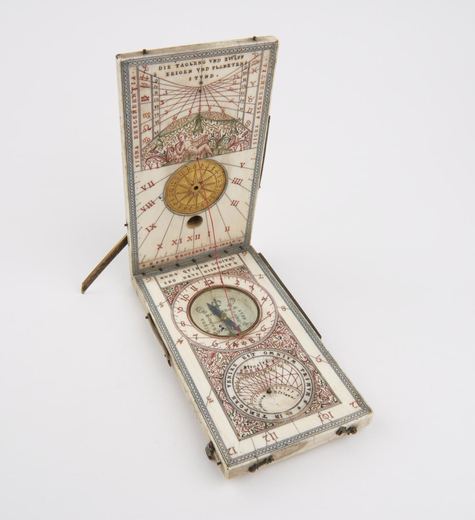
Tablet sun-dial 532-68, V & A M. reg, ivory inscribed "Hans Troschel faciebat", German, 6in by 3 1/4 in, 1578-1631
Science Museum Group, London
Instruments · 1600–1636
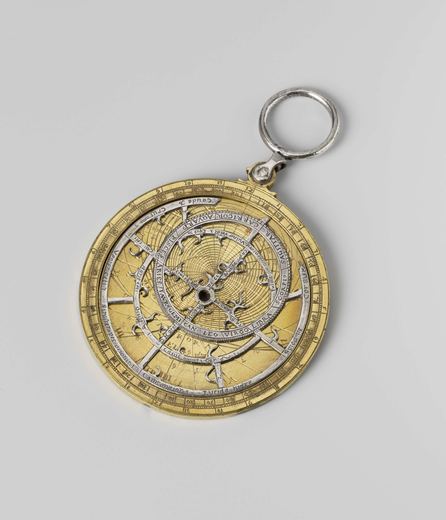
Astrolabe, Germany, 1600–1636
Rijksmuseum
Instruments · 17th century
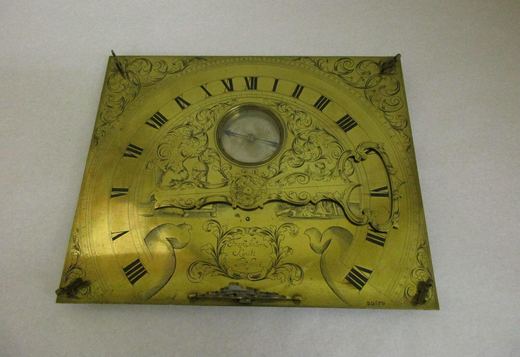
Sundial and compass. Gilt metal, engraved. Inscribed 'Franz Antoni Knitt Linz Fecit', German, 17th century.
Victoria and Albert Museum, London
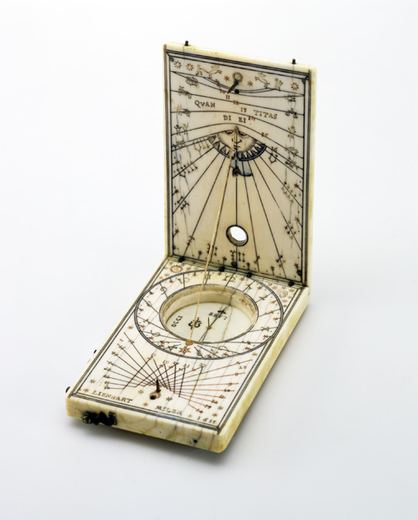
Instruments · 1600–1699
Sundial by Leonhart Miller, Germany, 1600–1699
Badisches Landesmuseum Karlsruhe
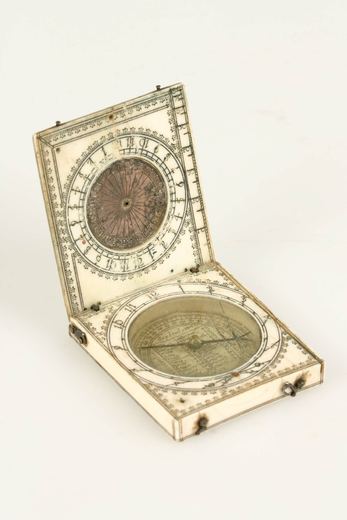
Instruments · 1600–1699
Sundial, Germany, 1600–1699 (German Clock Museum Museu_ProvidedCHO_museum_digital_57146__technical_number_)
German Clock Museum
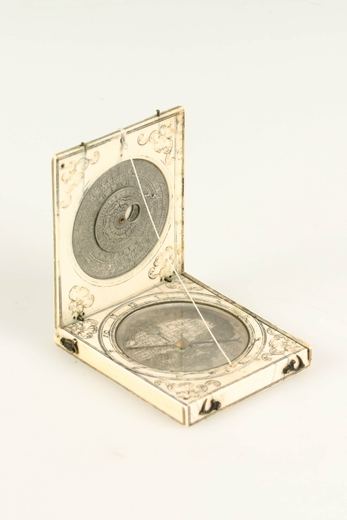
Instruments · 1600–1699
Sundial, Germany, 1600–1699 (German Clock Museum Museu_ProvidedCHO_museum_digital_57147__technical_number_)
German Clock Museum
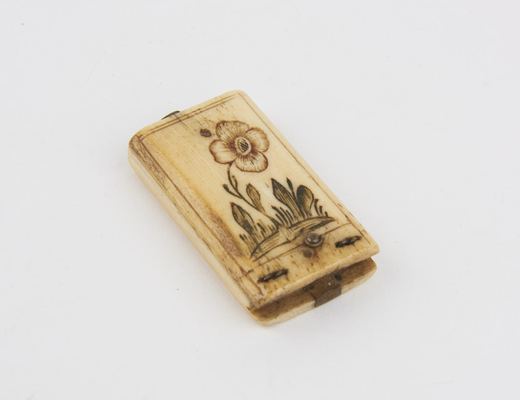
Instruments · 1601-1700
Horizontal sundial for latitude 47 degrees, in ivory with string style. German, 17th century.
Science Museum Group, London
Instruments · 1601-1700
Quadrangular horizontal sundial, ivory, engraved and coloured, inlaid on wood (cracked)
Science Museum Group, London