Wristwatches · Smartwatch
Smartwatch, 1803
- Maker / attribution
- Unrecorded in source
- Date
- 1803
- Historical period
- Precision & Scientific Horology (1750 – 1850)
- Country of origin
- Unrecorded in source
- Object type
- Smartwatch
- Holding institution
- Vienna Museum of Science and Technology
- Accession / object no.
- https___id_kulturpool_at_9a0a2ded_d2a3_470c_938b_defede8c58bb_cho
- Catalogue title (original)
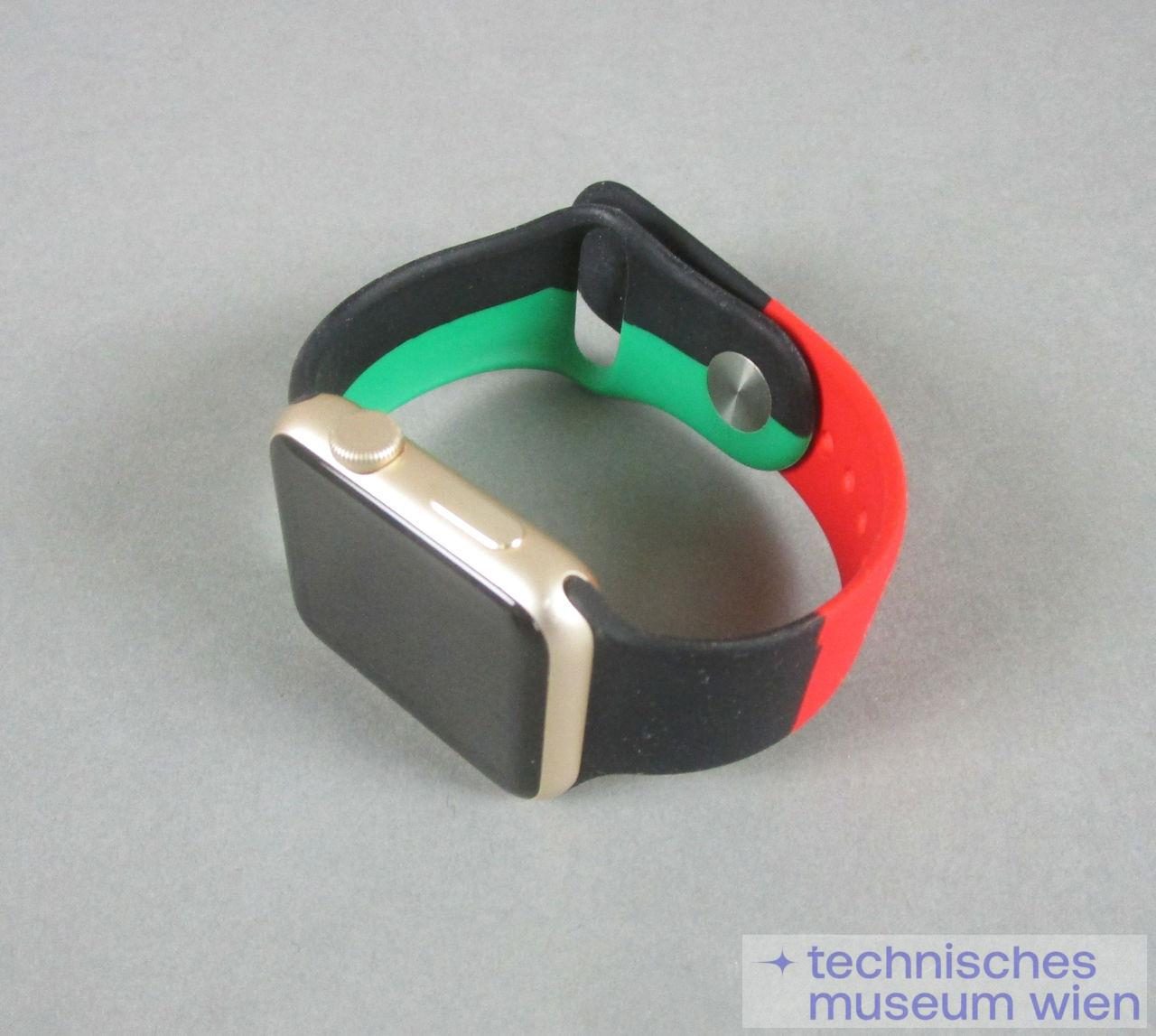
- Smartwatch Apple Watch Series 1 42 mm case (A1803) Gold Aluminium (German)
Record summary
Held and catalogued by Vienna Museum of Science and Technology (object number https___id_kulturpool_at_9a0a2ded_d2a3_470c_938b_defede8c58bb_cho), this is a smartwatch, dated 1803. The Atlas places it in the Precision & Scientific Horology period (1750 – 1850) of its Wristwatches collection. The record is illustrated with 1 photograph.
Assembled from the source record's structured fields. Dates and attributions are given as the source states them; where a field is missing the Atlas leaves it blank rather than estimating.
Catalogue description
Catalogue description from Vienna Museum of Science and Technology (German)
Mit der Smartwatch entsteht ein neuer Typ von Armbanduhr, der verschiedene digitale Funktionen vereint und via Apps kommuniziert. Im März 2015 erscheint [...]
Shown in the original language of the source catalogue. An editor-reviewed English translation has not yet been published; we do not publish machine translations as authoritative text.
Historical context
Precision & Scientific Horology (1750 – 1850)
Harrison solves longitude; Mudge invents the lever; Breguet's Paris workshop defines the modern watch.
Bracelet watches existed as jewellery for women in the early nineteenth century, but they were rare and individually made.
Read the period in the timelineMore wristwatches from this periodEarlier: Early Modern Horology
Atlas type guide
Quartz, digital and electronic watches
Electronic watches arrived in three steps. The Hamilton Electric 500 (1957) was the first battery-powered wristwatch, still with a balance; Bulova's Accutron (1960) used a tuning fork. On 25 December 1969 Seiko released the Astron 35SQ, the first quartz wristwatch, closely followed by the Swiss Beta 21 group. In 1972 Hamilton's Pulsar introduced the LED digital watch, and LCD displays soon made digital watches cheap.
The 'Quartz Crisis' that followed devastated the Swiss mechanical industry, which lost two-thirds of its workforce between 1970 and 1984 before recovering with the Swatch (1983) and the luxury mechanical revival. Solar, radio-controlled, kinetic and connected smartwatches continue the electronic line.
What to look for
- Battery hatch in the case back and calibre markings with 'Quartz' or a crystal frequency.
- Display technology: LED (red, push-button) versus LCD (always-on).
- Tuning-fork hum and a smoothly sweeping seconds hand on Accutrons.
- Model and reference numbers, often printed on the back.
Dating clues
- Electric balance watches: from 1957.
- Tuning-fork watches: 1960–c. 1977.
- Quartz analogue: from December 1969; LED digital: 1972–c. 1978; LCD from 1973.
General guidance written by the Atlas editors about this kind of object. It is not a statement about this particular piece; for that, rely on the source record above and on physical examination.
Read next:Seiko calibre 35A (Astron)