Pocket Watches · Pocket watch
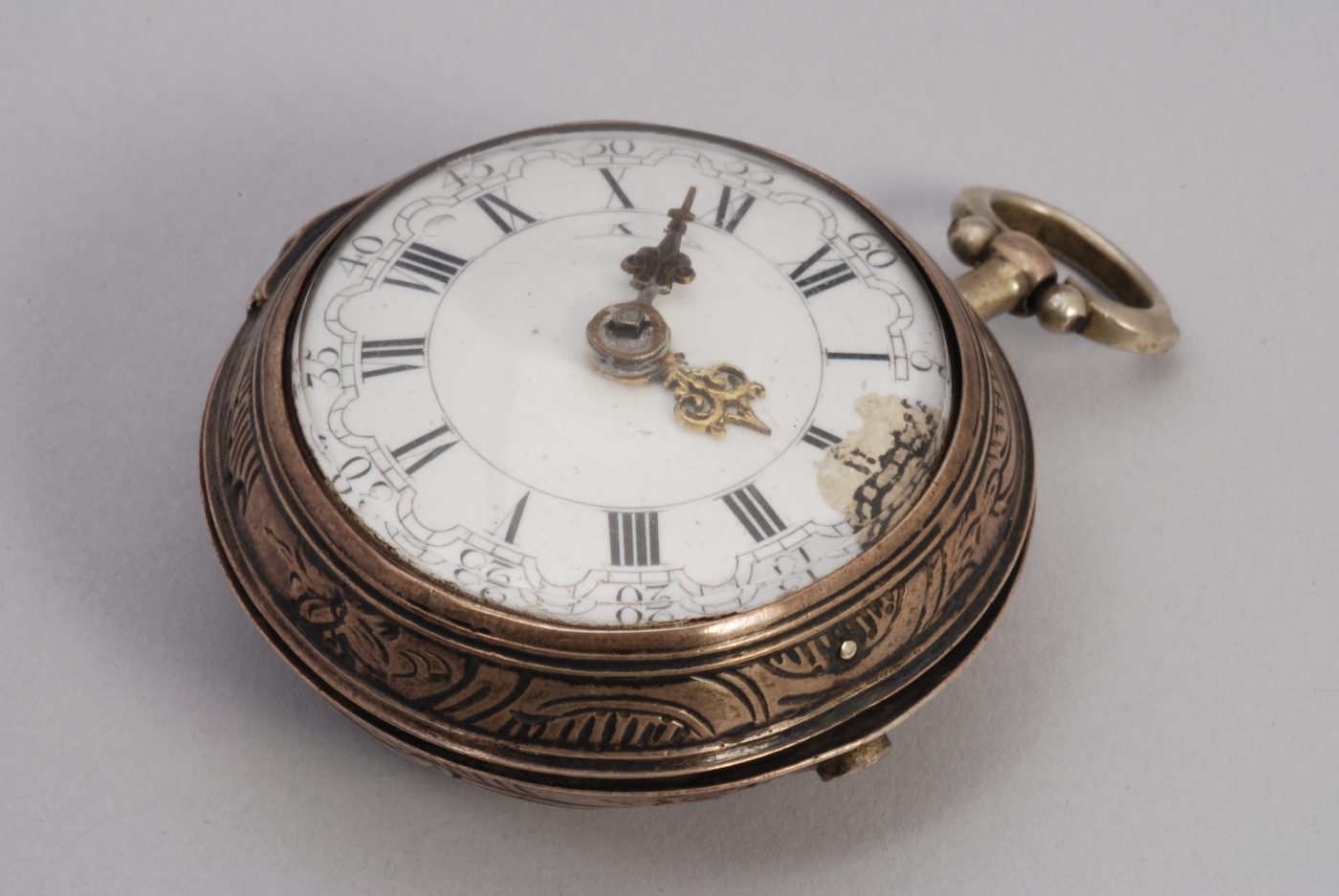
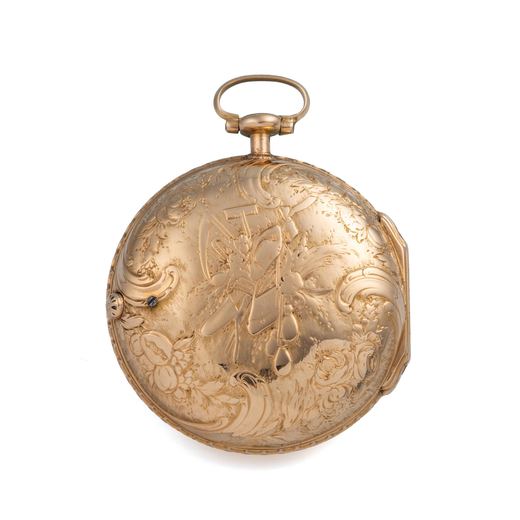
Pocket watch by J.G. Seytz, 1750
- Maker / attribution
- J.G. Seytz (creator)
- Date
- 1750
- Historical period
- Precision & Scientific Horology (1750 – 1850)
- Country of origin
- Unrecorded in source
- Object type
- Pocket watch
- Holding institution
- Museum Rotterdam
- Accession / object no.
- europeana_fashion_11387_A_B
- Catalogue title (original)
- Zakhorloge met email wijzerplaat met hierin datumkalender met maangezichten en gouden wijzers (Dutch)
Record summary
Held and catalogued by Museum Rotterdam (object number europeana_fashion_11387_A_B), this is a pocket watch by J.G. Seytz, dated 1750. The Atlas places it in the Precision & Scientific Horology period (1750 – 1850) of its Pocket Watches collection. The record is illustrated with 1 photograph.
Assembled from the source record's structured fields. Dates and attributions are given as the source states them; where a field is missing the Atlas leaves it blank rather than estimating.
Catalogue description
Catalogue description from Museum Rotterdam (Dutch)
Wit emaille wijzerplaat, de minuutband met boogjes. Arabische minuutcijfers, Romeinse uurcijfers. Ajourgezaagde wijzers. Het uurwerk met spillegang met snek. Vierkante balustervormige pilaren. Ajourgezaagd ornament voor de stuiting van de snek. Stalen veer voor de kastsluiting. Op de achterplatine een zilveren halfgesloten brug met de afbeelding van een spelend (?) kind. Achter de opening van de kloof het zichtbare deel van de balans en de balansveer. Op de kloof een dun stalen wijzertje. Rond de signatuur een ajourgezaagd ornament met het 'kompas' voor de regulage. Gladde zilveren binnenkast, gestempeld "DLH". Gedreven zilveren buitenkast met voluten en een galante scène.
Shown in the original language of the source catalogue. An editor-reviewed English translation has not yet been published; we do not publish machine translations as authoritative text.
Historical context
Precision & Scientific Horology (1750 – 1850)
Harrison solves longitude; Mudge invents the lever; Breguet's Paris workshop defines the modern watch.
From 1750 to 1850 the watch became a precision instrument. Mudge's lever escapement, the cylinder escapement, Lépine's thin bar calibre, Breguet's innovations (overcoil, tourbillon, perpétuelle) and the pocket chronometer of Arnold and Earnshaw all date from this period, while verge watches remained common in cheaper production.
Read the period in the timelineMore pocket watches from this periodEarlier: Early Modern Horology
Atlas type guide
Calendar, moon-phase and perpetual calendar watches
Calendar complications range from a simple date to the perpetual calendar, which automatically allows for months of different lengths and leap years until 2100. Pocket watches with perpetual calendars were made in the eighteenth and nineteenth centuries; Patek Philippe made the first perpetual calendar wristwatch in 1925, and series production followed in 1941. The annual calendar (Patek Philippe, 1996) needs correction only once a year.
Moon-phase displays use a disc with two moons and 59 teeth advanced daily, approximating the 29.5-day lunation; more precise trains reduce the error to one day in over a century.
What to look for
- Apertures or subsidiary dials for day, date, month and leap year.
- Moon disc under a 'bosom' shaped aperture.
- Recessed correctors on the case band for setting the calendar.
Dating clues
- Triple-date wristwatches: popular c. 1940–1955.
- Perpetual calendar wristwatches: from 1925 (unique) and 1941 (series).
General guidance written by the Atlas editors about this kind of object. It is not a statement about this particular piece; for that, rely on the source record above and on physical examination.
Related records
Pocket Watches · 1700-1815
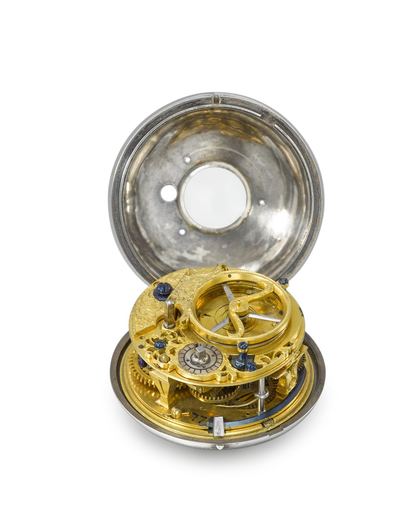
Pocket watch by Debaufre, Peter, England, 1700-1815
Science Museum Group, London
Pocket Watches · ca. 1740–60
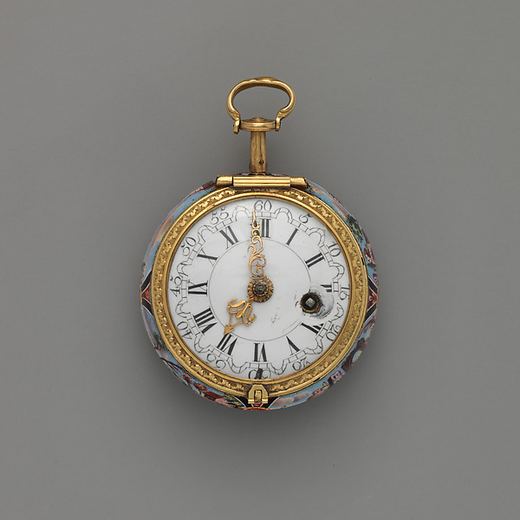
Watch by Charles Cabrier II, United Kingdom, ca. 1740–60 (The Met 17.190.1458)
The Metropolitan Museum of Art, New York
Pocket Watches · ca. 1740–60
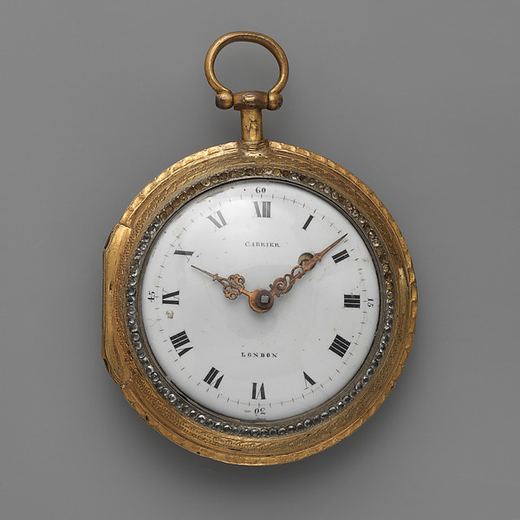
Watch by Charles Cabrier II, United Kingdom, ca. 1740–60 (The Met 17.190.1461)
The Metropolitan Museum of Art, New York
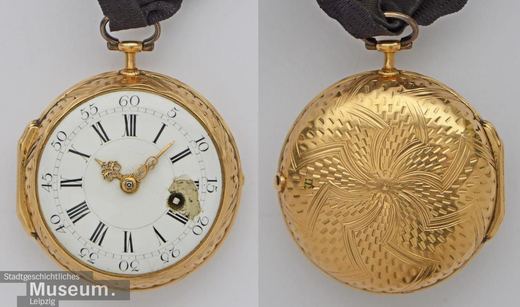
Pocket Watches · 1745–1755
Pocket watch by Jean Baptiste Baillon, France, 1745–1755
Museum of City History Leipzig
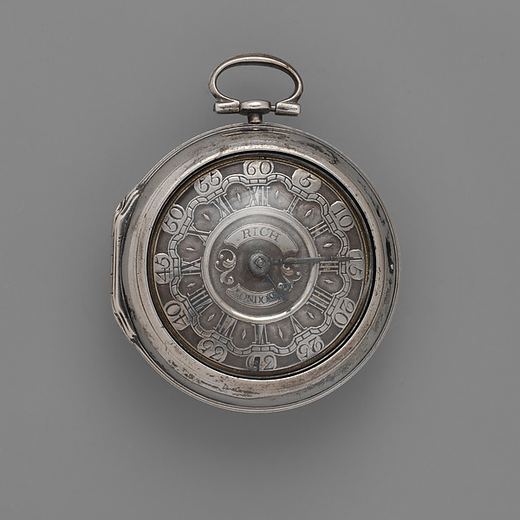
Pocket Watches · ca. 1751–52
Watch by John Rich, United Kingdom, ca. 1751–52
The Metropolitan Museum of Art, New York
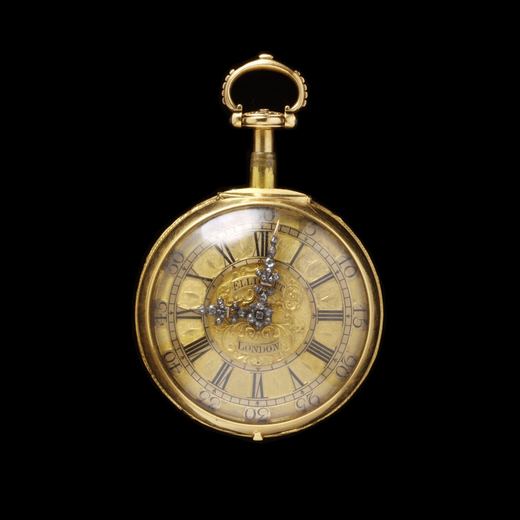
Pocket Watches · ca. 1753
Gold watch, signed 'Jno. Ellicott, London, 3719', the inner case pierced and engraved, with a casemaker's mark 'JB', London, about 1753
Victoria and Albert Museum, London
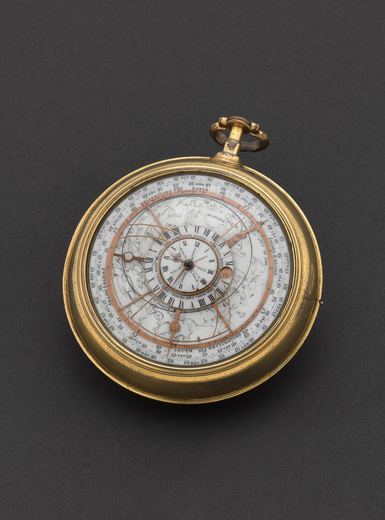
Pocket Watches · 1750-1810
Astronomical watch by George Margetts No.3043 in pair case, 1750-1810
Science Museum Group, London
Pocket Watches · circa 1750
Baillon À Paris pocket watch, circa 1750
Antiquorum auction archive, Geneva