Pocket Watches · Pocket watch
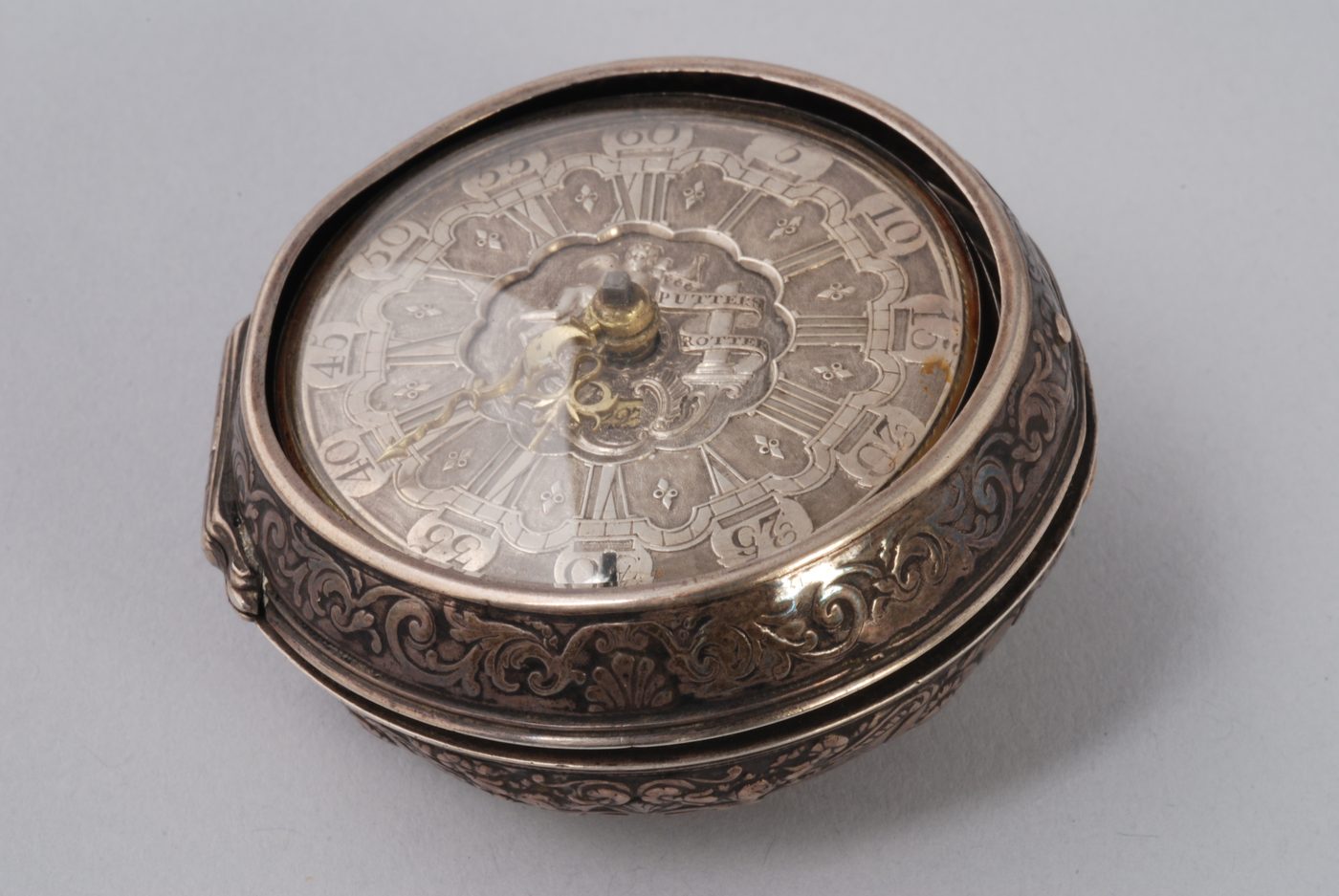
Pocket watch by G. Putters, 1730
- Maker / attribution
- G. Putters (creator)
- Date
- 1730
- Historical period
- Early Modern Horology (1600 – 1750)
- Country of origin
- Unrecorded in source
- Object type
- Pocket watch
- Holding institution
- Museum Rotterdam
- Accession / object no.
- europeana_fashion_5230_A_C
- Catalogue title (original)
- Zakhorloge met zilveren wijzerplaat met hierin datumkalender en gouden wijzers en twee zilveren buitenkasten waarvan één sober en één sierlijk (Dutch)
Record summary
Held and catalogued by Museum Rotterdam (object number europeana_fashion_5230_A_C), this is a pocket watch by G. Putters, dated 1730. The Atlas places it in the Early Modern Horology period (1600 – 1750) of its Pocket Watches collection. The record is illustrated with 1 photograph.
Assembled from the source record's structured fields. Dates and attributions are given as the source states them; where a field is missing the Atlas leaves it blank rather than estimating.
Catalogue description
Catalogue description from Museum Rotterdam (Dutch)
Wijzerplaat: champlevé zilver met Romeinse cijfers voor de uren en Arabische cijfers voor de minuten. In het centrum met een geschulpte rand een engel, die een banderol houdt met daarop een signatuur. Vergulde fraai bewerkte wijzers. Onder de wijzeras een opening voor de aangifte van de datum. Het uurwerk met gaand werk met spillegang. Vier rechthoekige pilaren met zwanehals ornamenten aan beide zijden tussen voor- en achterplatine. Een opengewerkt ornament dient als steun voor de stuiting van de snek. Een geblauwd stalen veer met een bewerkt voetje dient voor de sluiting van de kast. Een opengewerkt messing ornament op de achterplatine houdt de stift voor de instelling van de balansveer vast. De brug heeft een afbeelding van een kind met zwaard en schild, tussen twee bomen. Als tekst: "PRO PATRIA". De onderzijde van de kloof heeft een niervormige opening, waardoor te zien is: het gegroefde slingerlensje ( het zichtbare deel van de balans) en de balansveer. Op de achterplatine zijn gegraveerd de cijfers 1 t.m. 6. Aan weerszijden van de kloof bevinden zich twee kleine gebleuwd stalen wijzertjes. Op de de kloof de signatuur en de opwindstift voor de veer. Het geheel in een gladde zilveren kast met vier Engelse merken. De sierlijke buitenkast bewerkt met voluten, traliewerk, maskerons en in het midden een gedreven voorstelling van Diogenes in zijn ton, die wordt bezocht door Alexander de Grote. De sobere buitenkast is van zilver en heeft geen versieringen.
Shown in the original language of the source catalogue. An editor-reviewed English translation has not yet been published; we do not publish machine translations as authoritative text.
Historical context
Early Modern Horology (1600 – 1750)
Huygens' pendulum and balance spring transform accuracy; English makers develop the anchor and deadbeat escapements.
The balance spring (c. 1675) improved watches dramatically and introduced the minute hand. English pair-cased verge watches with pierced balance cocks and French oignons were typical; enamel painting at Blois and Geneva, and the repeating watch (1680s), made watches objects of great refinement.
Read the period in the timelineMore pocket watches from this periodEarlier: Renaissance Horology
Atlas type guide
Calendar, moon-phase and perpetual calendar watches
Calendar complications range from a simple date to the perpetual calendar, which automatically allows for months of different lengths and leap years until 2100. Pocket watches with perpetual calendars were made in the eighteenth and nineteenth centuries; Patek Philippe made the first perpetual calendar wristwatch in 1925, and series production followed in 1941. The annual calendar (Patek Philippe, 1996) needs correction only once a year.
Moon-phase displays use a disc with two moons and 59 teeth advanced daily, approximating the 29.5-day lunation; more precise trains reduce the error to one day in over a century.
What to look for
- Apertures or subsidiary dials for day, date, month and leap year.
- Moon disc under a 'bosom' shaped aperture.
- Recessed correctors on the case band for setting the calendar.
Dating clues
- Triple-date wristwatches: popular c. 1940–1955.
- Perpetual calendar wristwatches: from 1925 (unique) and 1941 (series).
General guidance written by the Atlas editors about this kind of object. It is not a statement about this particular piece; for that, rely on the source record above and on physical examination.
Related records
Pocket Watches · early 17th century
Engraved silver and gilt brass watch signed 'J. Bock', Germany (Frankfurt), early 17th century
Victoria and Albert Museum, London
Pocket Watches · 1600–1699
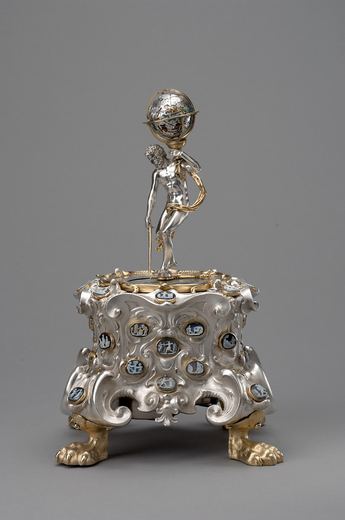
Pocket watch by #Georg_Ernst_Künstler/in, Germany, 1600–1699
Fine Arts Museum Vienna
Pocket Watches · 1600
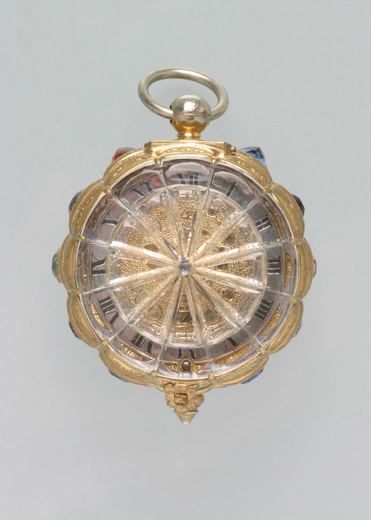
Pocket watch by Balthasar de Paep, Belgium, 1600
German Clock Museum
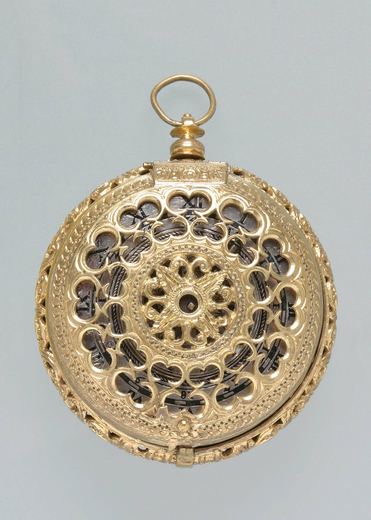
Pocket Watches · 1600
Pocket watch by Hans Reinboldt, France, 1600
German Clock Museum
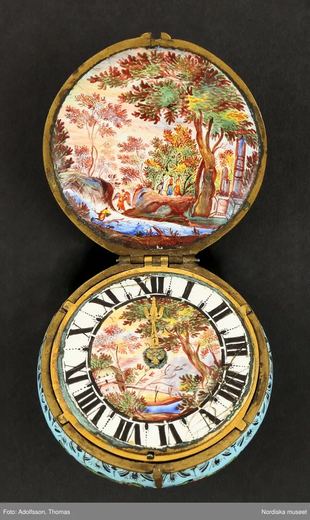
Pocket Watches · 1600–1699
Pocket watch by Johan Etmiller, Germany, 1600–1699
Nordic Museum Foundation
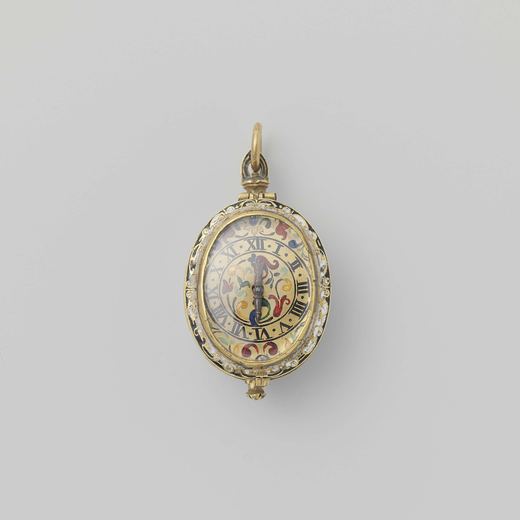
Pocket Watches · 1600
Pocket watch by anoniem, France, 1600
Rijksmuseum
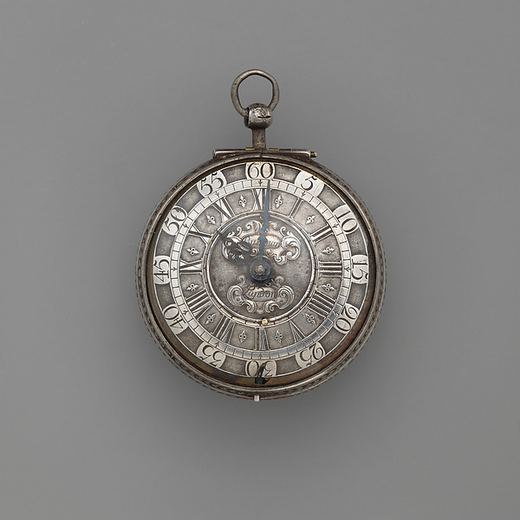
Pocket Watches · 17th century
Watch by John Bushman, United Kingdom, 17th century
The Metropolitan Museum of Art, New York
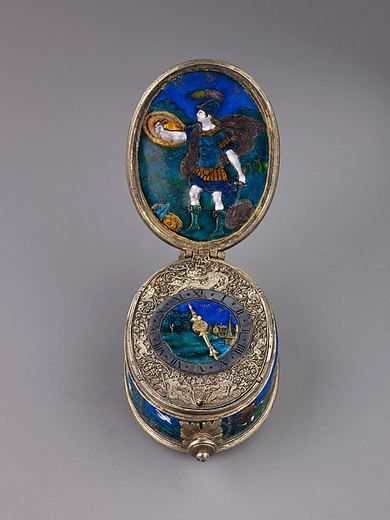
Pocket Watches · first quarter of 17th century
Watch by Suzanne de Court, France, first quarter of 17th century
The Metropolitan Museum of Art, New York