Pocket Watches · Pocket watch
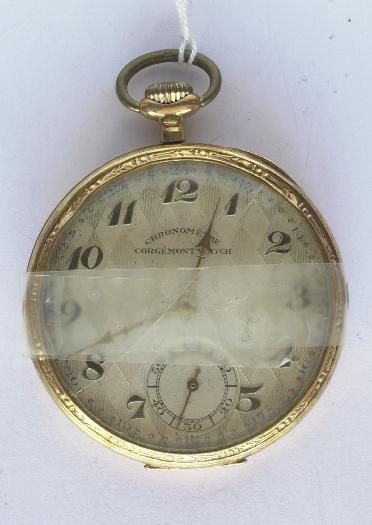
Pocket watch by Chronomètre Corgémont Watch, 1800–1899
- Maker / attribution
- Chronomètre Corgémont Watch (creator)
- Date
- 1800–1899
- Historical period
- Precision & Scientific Horology (1750 – 1850)
- Country of origin
- Unrecorded in source
- Object type
- Pocket watch
- Holding institution
- National Museum of Decorative Arts
- Accession / object no.
- pages_Main_idt_16461_inventary_CE20050_table_FMUS_museum_MNAD
- Catalogue title (original)
- Reloj de bolsillo
Record summary
Held and catalogued by National Museum of Decorative Arts (object number pages_Main_idt_16461_inventary_CE20050_table_FMUS_museum_MNAD), this is a pocket watch by Chronomètre Corgémont Watch, dated 1800–1899. The Atlas places it in the Precision & Scientific Horology period (1750 – 1850) of its Pocket Watches collection. The record is illustrated with 1 photograph.
Assembled from the source record's structured fields. Dates and attributions are given as the source states them; where a field is missing the Atlas leaves it blank rather than estimating.
Catalogue description
Catalogue description from National Museum of Decorative Arts (def)
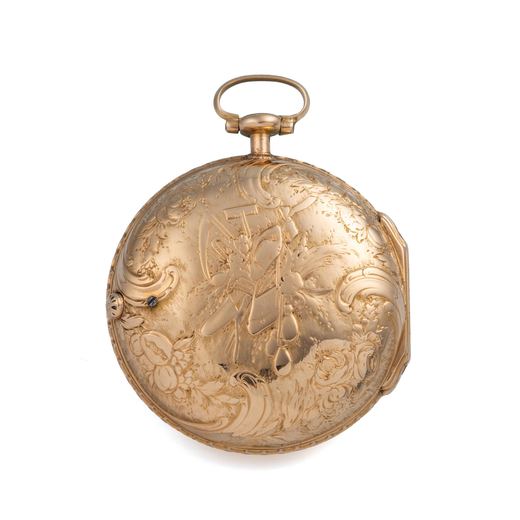
Reloj de caballero de bolsillo realizado en oro. Marca Gorgemont Remontoir. Caja de tapa sencilla tipo Lepine. Tapa posterior en oro. Anilla y remontoir situados sobre las 12 horas. Rota la bisagra. Esfera en metal con adorno ajedrezado y números árabes en metal dorado. Cronómetro con segundero y agujas horarias en punta de flecha. Decoración floral en moldura. En el reverso, cartela para iniciales.
Historical context
Precision & Scientific Horology (1750 – 1850)
Harrison solves longitude; Mudge invents the lever; Breguet's Paris workshop defines the modern watch.
From 1750 to 1850 the watch became a precision instrument. Mudge's lever escapement, the cylinder escapement, Lépine's thin bar calibre, Breguet's innovations (overcoil, tourbillon, perpétuelle) and the pocket chronometer of Arnold and Earnshaw all date from this period, while verge watches remained common in cheaper production.
Read the period in the timelineMore pocket watches from this periodEarlier: Early Modern Horology
Atlas type guide
Chronographs and split-seconds watches
A chronograph is a watch with an additional seconds hand that can be started, stopped and returned to zero independently of the timekeeping. Louis Moinet built an early example in 1816 and Nicolas Rieussec a recording 'chronographe' in 1821; Adolphe Nicole's heart-shaped reset cam (patented 1862) made the modern return-to-zero possible. Split-seconds (rattrapante) chronographs add a second hand that can be stopped for intermediate times; flyback chronographs restart instantly.
Chronographs were essential tools for doctors (pulsometer scales), artillery (telemeter), engineers and sport. In wristwatches, Valjoux, Venus, Lemania and later the automatic chronographs of 1969 (Zenith El Primero, the Chronomatic Calibre 11 group and Seiko 6139) are milestones.
What to look for
- Push-pieces on the case band or a single button in the crown (monopusher).
- Subsidiary registers for minutes and hours; tachymeter, telemeter or pulsometer scales.
- Column wheel versus cam control visible in the movement.
- Calibre markings of specialist makers (Valjoux, Lemania, Venus, Landeron).
Dating clues
- Pocket chronographs with heart cam reset: after 1862.
- Wrist chronographs: from c. 1910; two-button designs from the 1930s.
- Automatic chronographs: from 1969.
General guidance written by the Atlas editors about this kind of object. It is not a statement about this particular piece; for that, rely on the source record above and on physical examination.
Related records
Pocket Watches · 1700-1815
Pocket watch by Debaufre, Peter, England, 1700-1815
Science Museum Group, London
Pocket Watches · ca. 1740–60
Watch by Charles Cabrier II, United Kingdom, ca. 1740–60 (The Met 17.190.1458)
The Metropolitan Museum of Art, New York
Pocket Watches · ca. 1740–60
Watch by Charles Cabrier II, United Kingdom, ca. 1740–60 (The Met 17.190.1461)
The Metropolitan Museum of Art, New York
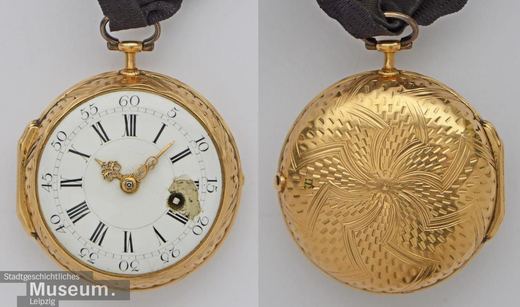
Pocket Watches · 1745–1755
Pocket watch by Jean Baptiste Baillon, France, 1745–1755
Museum of City History Leipzig
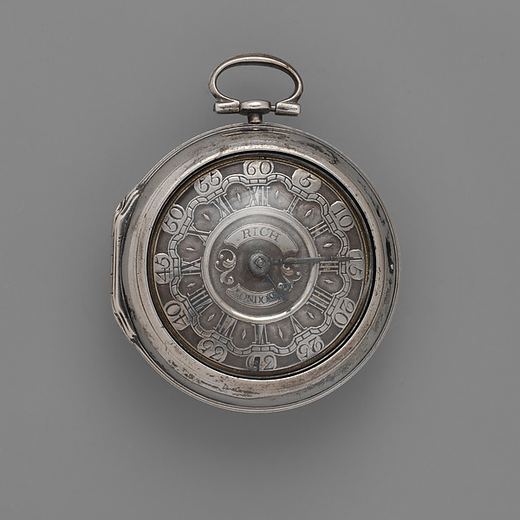
Pocket Watches · ca. 1751–52
Watch by John Rich, United Kingdom, ca. 1751–52
The Metropolitan Museum of Art, New York
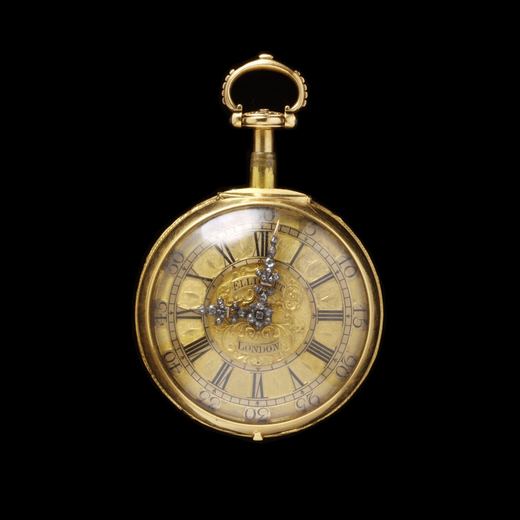
Pocket Watches · ca. 1753
Gold watch, signed 'Jno. Ellicott, London, 3719', the inner case pierced and engraved, with a casemaker's mark 'JB', London, about 1753
Victoria and Albert Museum, London
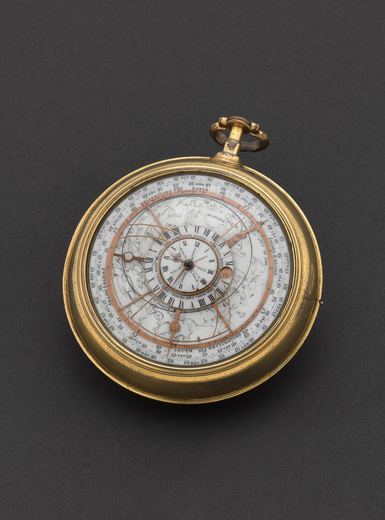
Pocket Watches · 1750-1810
Astronomical watch by George Margetts No.3043 in pair case, 1750-1810
Science Museum Group, London
Pocket Watches · circa 1750
Baillon À Paris pocket watch, circa 1750
Antiquorum auction archive, Geneva