Instruments · Diptych compass and sundial
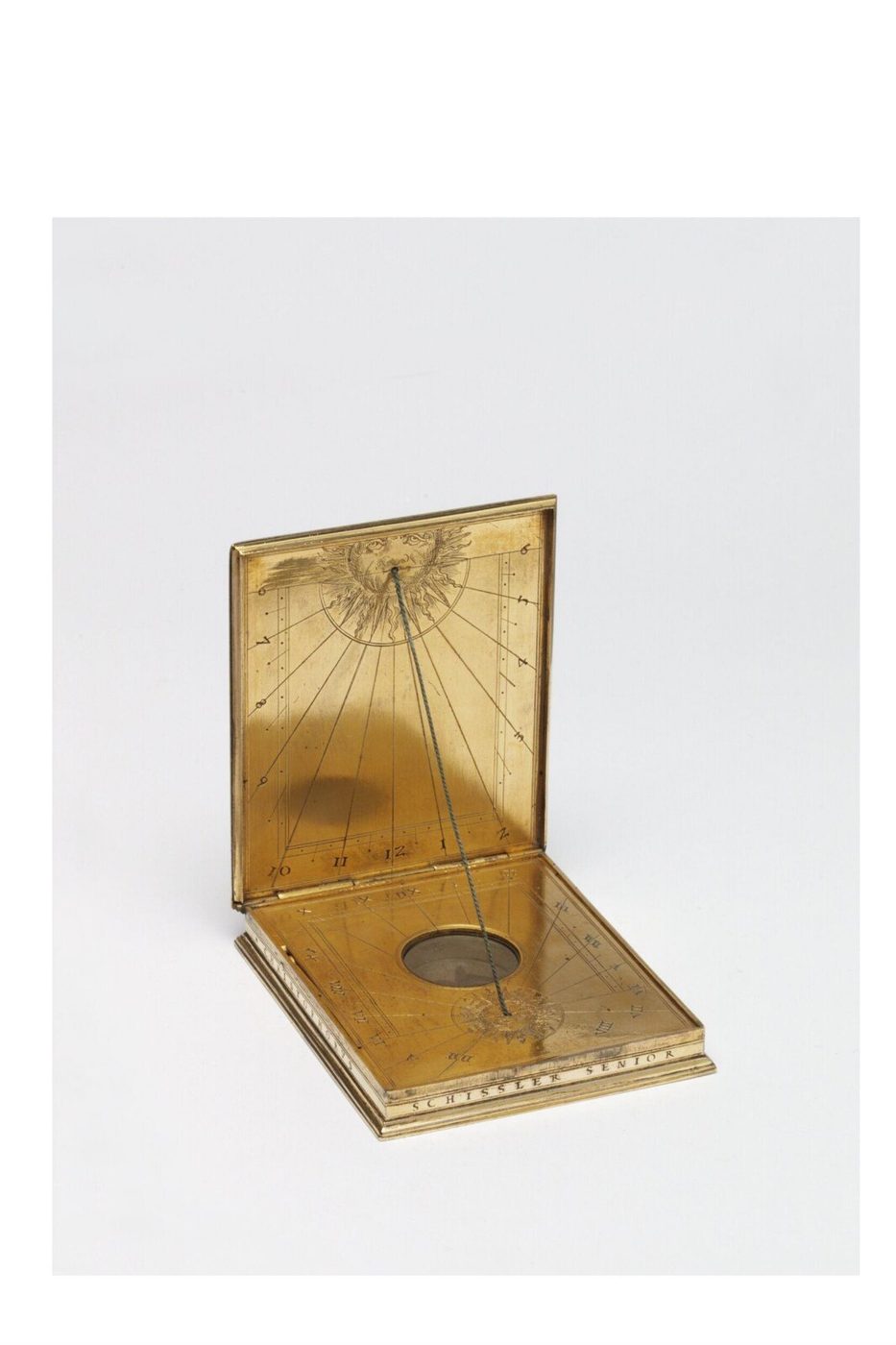
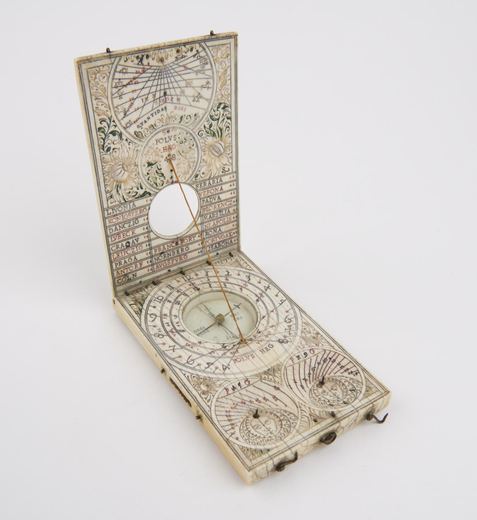
Pocket sundial and compass of sheet brass, gilt, etched and engraved.
- Maker / attribution
- Christopher Schissler (maker)
- Date
- 1581
- Historical period
- Renaissance Horology (1400 – 1600)
- Country of origin
- Germany
- Place
- Augsburg
- Object type
- Diptych compass and sundial
- Materials / technique
- Gilt-brass, etched and engraved
- Dimensions
- Length: 9.6 cm (closed); Height: 1.8 cm (closed); Length: 9.8 cm (open); Height: 10.4 cm (open); Weight: 8.3 kg
- Holding institution
- Victoria and Albert Museum, London
- Accession / object no.
- M.86-1921
Record summary
Held and catalogued by Victoria and Albert Museum, London (object number M.86-1921), this is a diptych compass and sundial by Christopher Schissler, made in Augsburg, Germany, dated 1581. The Atlas places it in the Renaissance Horology period (1400 – 1600) of its Instruments collection. Materials and techniques recorded by the source: Gilt-brass, etched and engraved. Recorded dimensions: Length: 9.6 cm (closed); Height: 1.8 cm (closed); Length: 9.8 cm (open); Height: 10.4 cm (open); Weight: 8.3 kg. The record is illustrated with 2 photographs.
Assembled from the source record's structured fields. Dates and attributions are given as the source states them; where a field is missing the Atlas leaves it blank rather than estimating.
Catalogue description
V&A — Summary
Portable sundials enabled travellers to predict the time while on the road. The 'diptych' dial, with two leaves hinged together, was one of the most common forms. This dial has the hours of the day engraved on both leaves and a compass inserted on the lower leaf. Diptych dials were produced in Nuremberg, southern Germany, from the early 16th century by specialist compass makers. This dial is signed by Christopher Schissler's of Augsburg and dated 1581. Schissler's workshop was famous. He supplied precision instruments of exquisite quality to an international clientele including the courts of August I, the Elector of Saxony and Emperor Rudolph II of Prague. Specialist makers of scientific instruments catered for an increased interest in navigation, travel, geography and the workings of the universe. By the 1580s, it was fashionable for wealthy gentlemen to have a sound understanding of all branches of learning, from arts and literature to mathematics and the natural sciences. This sundial was not simply a functional timepiece but also a treasury item, bought for its craftsmanship and ingenuity. Sundials were housed alongside automatons, clocks and astrolabes in Scientifica , collections celebrating human ability to control nature. They were designed to impress as well as educate. The dial is engraved with the arms of Fugger-Kirchberg-Weissenhor, a prominent group of European bankers from the southern German city of Augsburg. They traded throughout Europe and funded military and political campaigns.
V&A — Physical description
Pocket sundial and compass of sheet brass, gilt, etched and engraved. The dial is of diptych form and comprises two leaves hinged together, with the dials on the inside. The gnomon (the part of the instrument that casts the shadow onto the dial) is provided by a string stretched between the inner surfaces of the two leaves. The dials are engraved with the 'common hours', the lower one in Roman numerals and with a compass under glass in the centre. The top cover of the dial is engraved with the arms of the prominent Augsburg family Fugger-Kirchberg-Weissenhorn. The bottom cover is etched with strapwork and arabesques. On the outside walls of the dial is inscribed: *CHRISTOPHORVS SCHISSLER SENIOR FACIABAT AVGVSTA ANNO x 1581*.
V&A — Historical context
The 'diptych' dial, with two leaves hinged together, was one of the most common forms of portable sundial. Diptych dials were produced in Augsburg and Nuremberg, southern Germany, from the early 16th century by specialist compass makers. This plain dial has the hours of the day engraved on both dials but more elaborate ones were designed to be used in more than one latitude, with a series of holes in the upper leaf, through which the string could be threaded to adjust its angle to the correct latitude. Specialist makers of scientific instruments catered for an increased interest in navigation, travel, geography and the workings of the universe. By the 1580s, it was fashionable for wealthy gentlemen to have a sound understanding of all branches of learning, from arts and literature to mathematics and the natural sciences. This sundial was not simply a functional timepiece but also a treasury item, bought for its craftsmanship and ingenuity. Sundials were housed alongside automatons, clocks and astrolabes in Scientifica , collections celebrating human ability to control nature. They were designed to impress as well as educate.
V&A — Object history
The dial is engraved with the arms of Fugger-Kirchberg-Weissenhorn. The Fugger family was a historically prominent group of European bankers from the southern German city of Augsburg. They traded throughout Europe and funded military and political campaigns. They were accepted in princely circles as they not only acted as patrons for artists and scholars, but advanced huge loans such as when the Emperor Charles V needed to pay the electors who appointed him. No details of the provenance of the object are known. It was bought by the Museum in 1921 for £20 from Mr C.F. Corbould Ellis of Stevenage, Herts. (RP 31/3491). Historical significance: Not only is this dial engraved with the arms of Fugger-Kirchberg-Weissenhorn, an important German family of bankers, it was also made by one of the most celebrated scientific instrument makers of the 16th century. Christopher Schissler's workshop was famous in his own time. He was born in around 1531 and started his workshop after 1550. He supplied precision instruments of exquisite quality including globes, astrolabes, sundials, armillary spheres, astronomical compendia and surveying and drawing equipment. Schissler's clientele was international. Many of his dials are laid out for English or Italian latitudes. In 1571 Schissler travelled to the Dresden court of August I, the Elector of Saxony, in order to set up and demonstrate his instruments. He also visited in 1583 the court of Emperor Rudolf II in Prague who was well-known for his fascination with clocks. From 1580 Schissler produced many surveying instruments and became invloved with the survey of the town of Augsburg between 1598 and 1602. Around a hundred instruments from Schissler's workshop survive. His eldest son Christopher Schissler Junior (also known as Hans Christoph) also became an instrument maker. Christoph Schissler Senior died on 14 September 1608.
V&A — Production note
Signed along the outside walls: *CHRISTOPHORVS SCHISSLER SENIOR FACIABAT AVGVSTA ANNO x 1581*. Christopher Schissler (around 1531-1608) added 'Senior' to his signature in 1581 after his son Christopher (also known as Hans Christoph) began making instruments.
V&A gallery label
V&A, Jones Gallery 1A 5. ASTRONOMICAL DIAL AND COMPASS By Christopher Schissler the Elder German, Augsburg, 1581 Etched and engraved gilt brass, signed and dated The instrument is in the form of a book, the cover engraved with the arms of the prominent Augsburg family Fugger-Kirchberg-Weissenhorn. M.86-1921
Inscriptions & marks
'*CHRISTOPHORVS SCHISSLER SENIOR FACIABAT AVGVSTA ANNO x 1581*.'; 'common hours' 1-12 on both dials, the lower dial in Roman numerals; The arms of FUGGER-KIRCHBERG-WEISSENHORN
Historical context
Renaissance Horology (1400 – 1600)
Spring power makes clocks portable; Nuremberg and Augsburg produce the first watches; the Prague Orloj is built.
Instrument-making flourished in Nuremberg, Augsburg, Louvain and London: ivory diptych dials, astronomical compendia, astrolabes and nocturnals for wealthy patrons, navigators and scholars.
Read the period in the timelineMore instruments from this periodEarlier: Medieval Period
Atlas type guide
Sundials and solar time-finders
A sundial tells time from the position of a shadow cast by a gnomon or style. Because the sun's apparent motion depends on latitude, every fixed dial is laid out for a particular latitude, and portable dials either carry a latitude scale or are made for one region. Sundials show local apparent solar time, which drifts against mean (clock) time by up to about sixteen minutes over the year — the equation of time.
Portable dials were the pocket instruments of the sixteenth to eighteenth centuries. Nuremberg and Augsburg workshops produced folding ivory diptych dials with inset compasses; English and French makers sold brass horizontal dials, ring dials and the Butterfield type; Japanese and Chinese makers had their own traditions of compass dials. After mechanical watches became reliable, dials remained in use for setting them, and nineteenth-century heliochronometers were built to correct directly for the equation of time.
What to look for
- The latitude engraved on the dial plate or a latitude arc on the gnomon — it shows where the dial was meant to be used.
- The type of hour lines: equal (equinoctial) hours, Italian or Babylonian hours counted from sunset or sunrise, or unequal temporal hours on early and Islamic instruments.
- An inset magnetic compass and whether a magnetic-declination mark is drawn on its card — a useful dating clue because declination changes over time.
- Maker's signatures and town marks: Nuremberg compass-makers (Kompassmacher) often struck a personal mark and the town's punch.
- Additional scales such as lunar volvelles, wind roses, perpetual calendars or lists of cities with their latitudes.
Dating clues
- Ivory diptych dials are characteristic of Nuremberg between about 1500 and 1700.
- Butterfield-type dials with a bird-shaped adjustable gnomon point to Paris workshops from the late seventeenth century onward.
- Equation-of-time tables engraved on the plate became common after the mid-seventeenth century, once pendulum clocks made the difference between solar and mean time obvious.
General guidance written by the Atlas editors about this kind of object. It is not a statement about this particular piece; for that, rely on the source record above and on physical examination.
Read next:The history timeline
Related records
Instruments · 1566
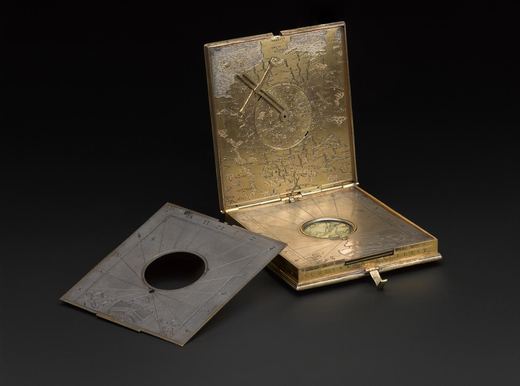
Compendium tablet sun-dial, brass gilt, with three silvered latitude plates and magnetic compass, signed Christopher Schissler, Augsburg, Germany, dated 1566.
Science Museum Group, London
Instruments · 1462
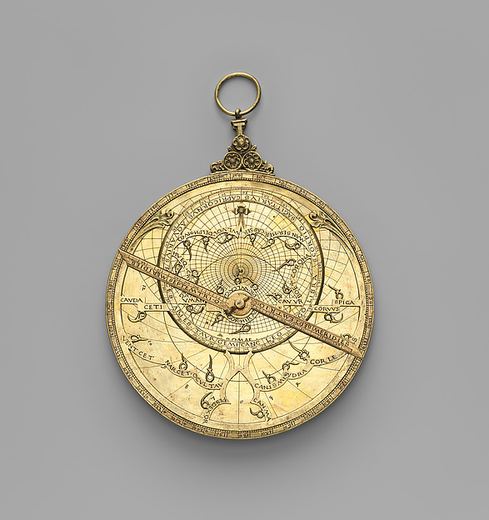
Astrolabe by Regiomontanus, Germany, 1462
The Metropolitan Museum of Art, New York
Instruments · ca. 1500
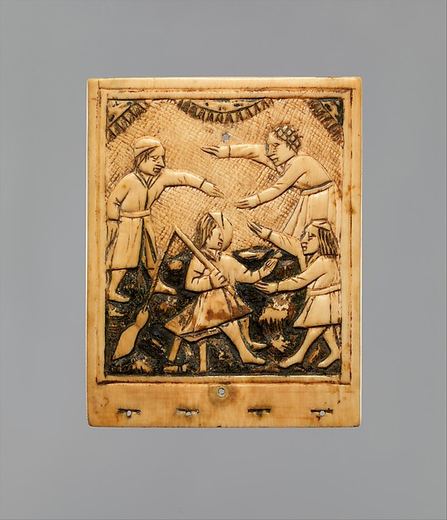
Sundial, Germany, ca. 1500
The Metropolitan Museum of Art, New York
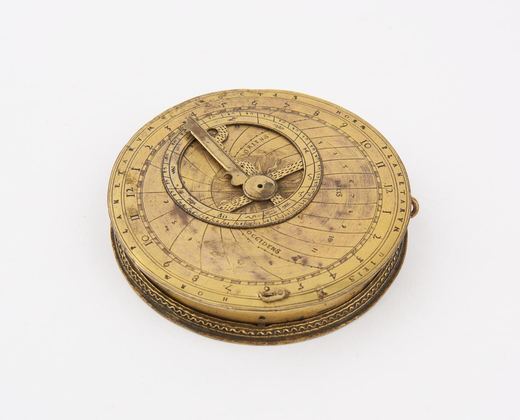
Instruments · 1501-1600
Circular sundial, copper gilt and engraved, German, 16th century (no compass needle on cover glass)
Science Museum Group, London
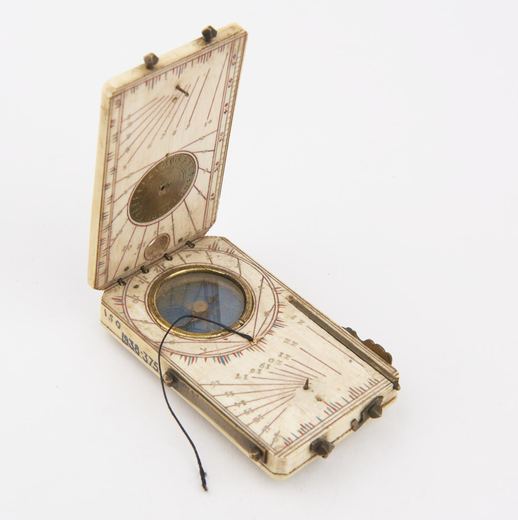
Instruments · 1501-1600
Tablet sundial, ivory, 3" x 1 3/4", German, 16th century
Science Museum Group, London
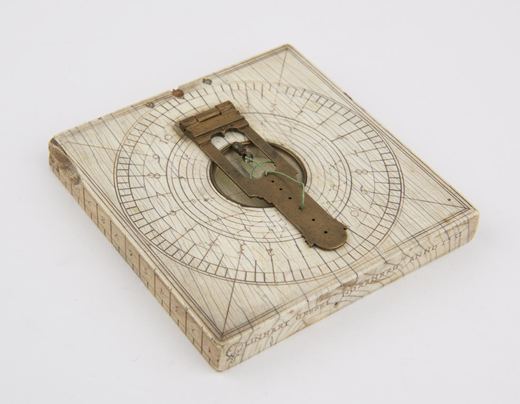
Instruments · 1531
Sundial with compass, in an engraved block of ivory by Gresel, German dated 1531
Science Museum Group, London
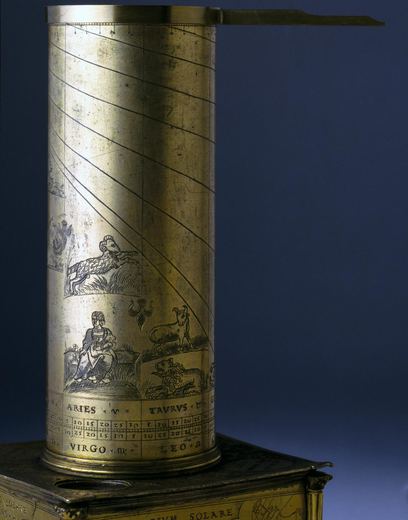
Instruments · 1531-1570
Sundial, Germany, 1531-1570
Science Museum Group, London
Instruments · 1537-1632
Tablet Sundial, ivory, engraved and coloured, 4 3/4"x3" (chipped)
Science Museum Group, London