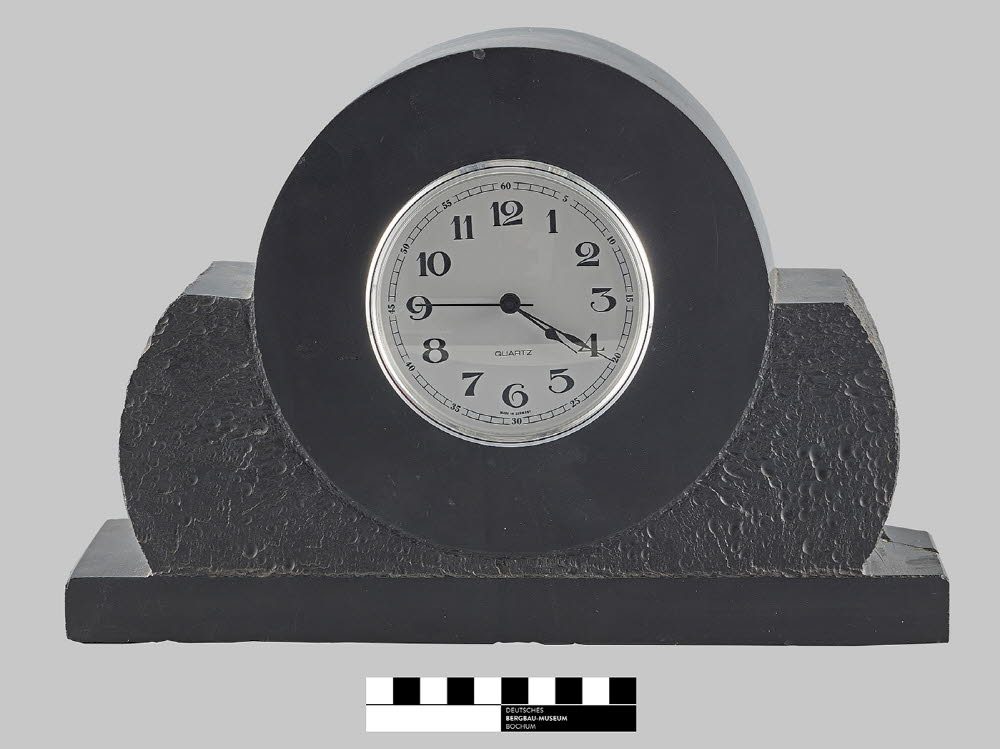
Clocks · Mantel clock
Mantel clock, Duisburg, 1974
- Maker / attribution
- Unrecorded in source
- Date
- 1974
- Historical period
- Quartz Revolution (1969 – 1990)
- Country of origin
- Unrecorded in source
- Place
- Duisburg
- Object type
- Mantel clock
- Holding institution
- Montanhistorisches Dokumentationszentrum
- Accession / object no.
- item_LJ5JQOCDX3XRFLCDIFV5A6E5LZJ4R7YN
- Catalogue title (original)
- Kaminuhr aus Kennelkohle (German)
Record summary
Held and catalogued by Montanhistorisches Dokumentationszentrum (object number item_LJ5JQOCDX3XRFLCDIFV5A6E5LZJ4R7YN), this is a mantel clock, made in Duisburg, dated 1974. The Atlas places it in the Quartz Revolution period (1969 – 1990) of its Clocks collection. The record is illustrated with 1 photograph.
Assembled from the source record's structured fields. Dates and attributions are given as the source states them; where a field is missing the Atlas leaves it blank rather than estimating.
Catalogue description
Catalogue description from Montanhistorisches Dokumentationszentrum (def)
Aus einem Stück Kohle geschnitzt. Eine polierte dicke Scheibescheint in einer Halbschale mit schwammartig-rauer Oberfläche zu liegen. Das ganze auf einer Sockelplatte. In der Scheibe eine große Bohrung zur Aufnahme des Quarzuhrwerks mit weißem Ziffernblatt mit schwarzen Zeigern und Ziffern.
Historical context
Quartz Revolution (1969 – 1990)
Seiko's Astron begins mass quartz timekeeping; traditional industries contract sharply.
Quartz movements and digital displays made accurate clocks cheap and ubiquitous after the early 1970s. LED and LCD clocks, clock radios and radio-controlled clocks appeared, while traditional mechanical clockmaking contracted sharply in Germany, France and Britain.
Read the period in the timelineMore clocks from this periodEarlier: Modern Mechanical Horology
Atlas type guide
Mantel and French pendule clocks
The mantel clock — the French pendule de cheminée — is as much decorative art as timekeeper. From the late seventeenth century Parisian clockmakers worked with cabinet-makers, bronze founders and gilders (ciseleurs-doreurs) to create cases in Boulle marquetry, gilt bronze and marble, while the movements were often supplied by specialist makers. Clocks of the Louis XIV, Louis XV and Louis XVI periods, and Empire clocks with allegorical figures, set fashions copied across Europe.
The nineteenth century industrialised the type. The 'Paris movement', a standardised round movement with silk-thread or Brocot suspension and count-wheel striking, was made in huge numbers by firms such as Japy and Vincenti, and fitted into cases of every style and material.
What to look for
- Round 'Paris' movements with makers' stamps (e.g. Japy Frères, Vincenti, S. Marti) and medal marks from exhibitions.
- Suspension type: silk thread (earlier) or Brocot adjustable suspension (after c. 1840).
- Visible Brocot escapement on the dial in later clocks.
- Fire-gilt (mercury) gilding on bronzes versus later electro-gilding.
- Signed dials naming a retailer rather than the movement maker.
Dating clues
- Silk-suspension Paris movements: c. 1800–1850.
- Brocot suspension and visible escapements: after c. 1840.
- Exhibition medal stamps on movements give dates after the medal year.
General guidance written by the Atlas editors about this kind of object. It is not a statement about this particular piece; for that, rely on the source record above and on physical examination.
Read next:Anchor (recoil) escapement
Related records
Clocks · late 20th century
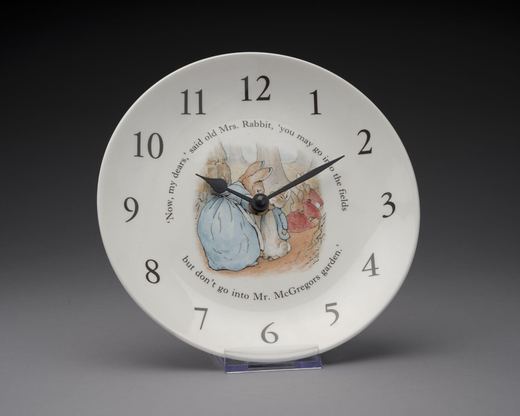
Clock, 'Peter Rabbit', Queen's ware, transfer printing, Josiah Wedgwood and Sons, Barlaston, late 20th century (V&A WE.17466-2014)
Victoria and Albert Museum, London
Clocks · late 20th century
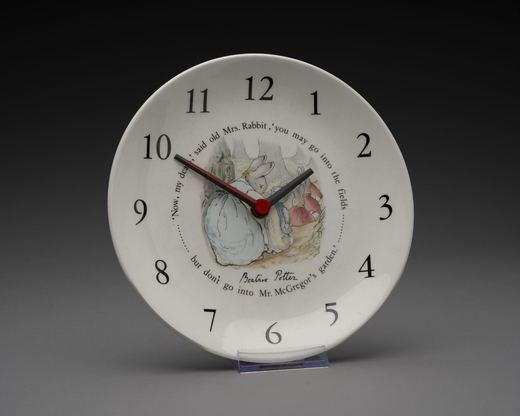
Clock, 'Peter Rabbit', Queen's ware, transfer printing, Josiah Wedgwood and Sons, Barlaston, late 20th century (V&A WE.18029-2014)
Victoria and Albert Museum, London
Clocks · late 20th century
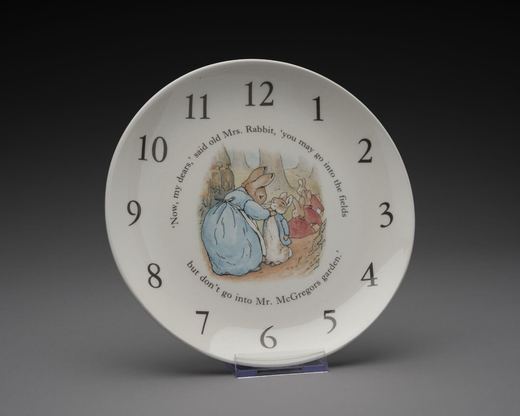
Clock, 'Peter Rabbit', glazed earthenware, transfer printing, Josiah Wedgwood and Sons, Barlaston, late 20th century
Victoria and Albert Museum, London
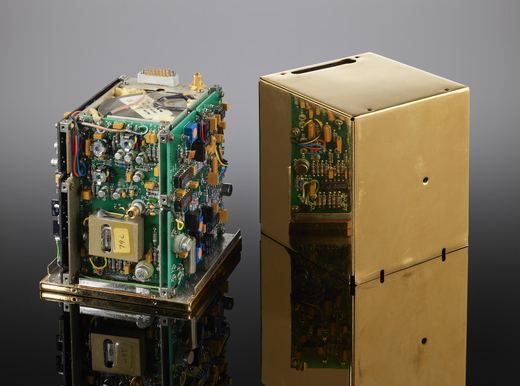
Clocks · 1960-1996
Electric clock by Efratom GmbH, Germany, 1960-1996
Science Museum Group, London
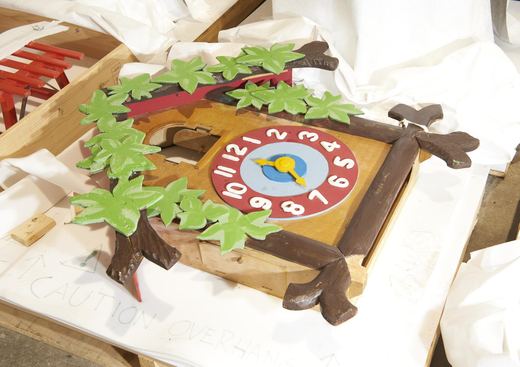
Clocks · 1964-1988
The clock from BBC children's television series 'Playschool', c 1977
Science Museum Group, London
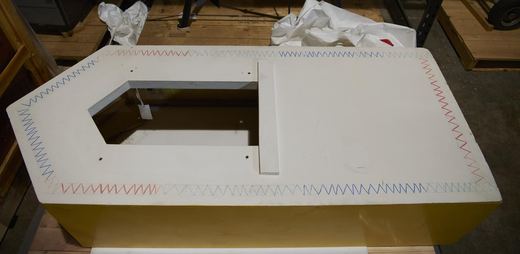
Clocks · 1964-1988
The clock housing from BBC children's television series 'Playschool', c 1977
Science Museum Group, London
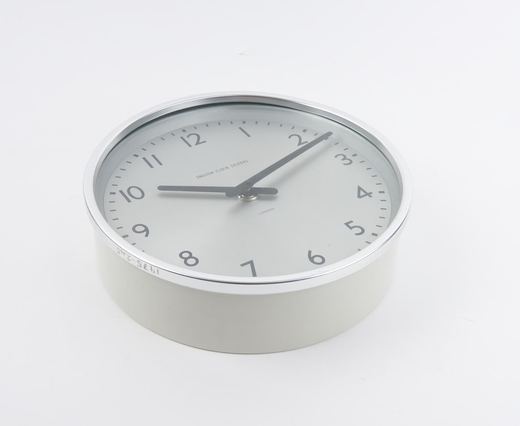
Clocks · 1965-1975
9-inch wall clock (School/3/P) by English Clock Systems, London, England, 1965-1975.
Science Museum Group, London
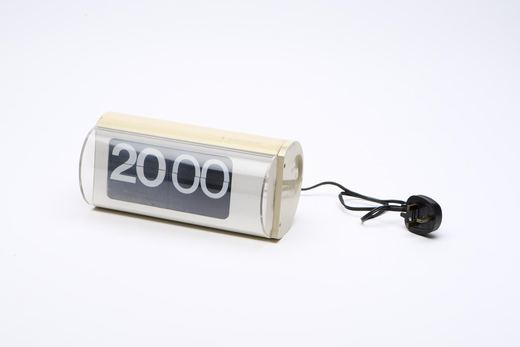
Clocks · 1965-1974
Cifra 6 digital clock
Science Museum Group, London