Pocket Watches · Watch
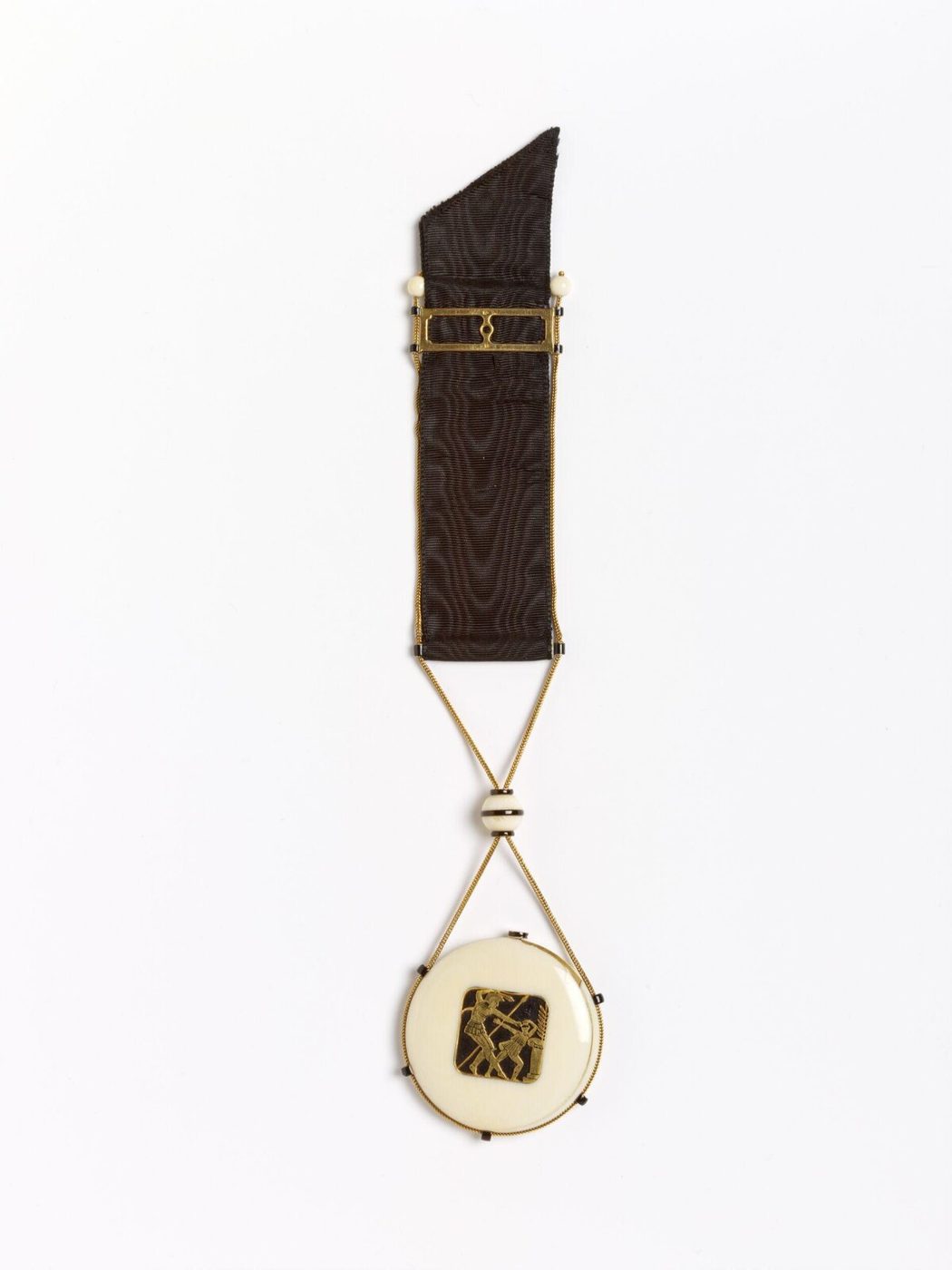
Gold, ivory, enamel pendent watch with ribbon fob, made by Verger Frères for Lacloche Frères, Paris, ca. 1927
- Maker / attribution
- Verger Frères (maker); Lacloche Frères (retailer)
- Date
- ca. 1927
- Historical period
- Golden Age of Mechanical Watchmaking (1900 – 1945)
- Country of origin
- France
- Place
- Paris, Switzerland
- Object type
- Watch
- Materials / technique
- Gold, ivory, glass, silk
- Dimensions
- Length: 230 mm (End of ribbon to bottom of watch); Width: 44 mm (East-West dimension of watch); Depth: 10 mm (diameter of large ivory and enamel bead)
- Holding institution
- Victoria and Albert Museum, London
- Accession / object no.
- M.66-2014
- Credit line
- Given by Jessie H. Price
Record summary
Held and catalogued by Victoria and Albert Museum, London (object number M.66-2014), this is a watch by Verger Frères, made in Paris, Switzerland, France, dated ca. 1927. The Atlas places it in the Golden Age of Mechanical Watchmaking period (1900 – 1945) of its Pocket Watches collection. Materials and techniques recorded by the source: Gold, ivory, glass, silk. Recorded dimensions: Length: 230 mm (End of ribbon to bottom of watch); Width: 44 mm (East-West dimension of watch); Depth: 10 mm (diameter of large ivory and enamel bead). The record is illustrated with 3 photographs.
Assembled from the source record's structured fields. Dates and attributions are given as the source states them; where a field is missing the Atlas leaves it blank rather than estimating.
Catalogue description
V&A — Summary
This elegant watch was probably made to be worn by a man with the watch inside his waistcoat pocket and the black ribbon fob hanging down in front. The contrast between the cream ivory and the black ribbon and black enamel, and the angular shape of the gold panels and the ivory panel on the fob, make the watch a strong Art Deco statement. Lacloche Frères, founded in Madrid in 1875, became one of the most fashionable jewellery houses in Paris. Verger Frères, whose mark is on the gold work, was founded in 1872. The firm passed to his two sons, Georges and Henri. It supplied work to the leading jewellers. For a bracelet made for Chaumet, see M.122-2007. The figure scenes are in the style of Ancient Greek vases.
V&A — Physical description
Slim watch with ivory case inset on the back with a square gold plaque with rounded corners enclosing a scene of two Ancient Greek figues, a soldier seizing a girl by the hair with his left hand while holding a sword above his head with his right hand. An altar stands to the right. Engraved details are inlaid in black enamel. The gold figures are cut out and stand in relief from a black ground. The dial is engine-turned and silvered with black arabic numbers and blued steel hand. Jewelled nickel lever movement. Black enamelled winding knob. The watch is suspended by a gold chain which runs around the case, the two ends passing through an ivory bead above the watch before separating to run down the sides of a black silk ribbon fob until they meet a gold mounted ivory plaque centred by a gold plaque of two Ancient Greek figures, a priestess holding a ewer standing beside a warrior with shield and spear on his left arm and holding in his right hand a vessel from which he may be about to make a libation. The gold chain terminates on each side of the ribbon fob in ivory beads.
V&A — Object history
Sotheby's, London, 11 July 2013, lot 147. A similar watch by Lacloche with ribbon fob in its original case, but with different scenes on the plaques, was sold at Sotheby's, New York, 4 December 2012, lot 44. The latter is illustrated in J. Price, Masterpieces of French Jewelry (Philadelphia, 2006), page 78.
Inscriptions & marks
FV with a tree within a lozenge; Eagle's head mark
Historical context
Golden Age of Mechanical Watchmaking (1900 – 1945)
The wristwatch displaces the pocket watch; waterproof cases, self-winding and grand complications.
The pocket watch reached technical maturity and then began to give way to the wristwatch after the First World War. Complicated watches for collectors such as Henry Graves Jr. and James Ward Packard, railroad watches, and slim Art Deco dress watches are characteristic.
Read the period in the timelineMore pocket watches from this periodEarlier: Industrial Revolution
Atlas type guide
Verge and pair-cased watches
After Christiaan Huygens and Robert Hooke applied the balance spring around 1675, the verge watch became a reasonably reliable timekeeper and the minute hand became standard. Through the eighteenth century the typical English watch was a pair-cased verge: a fusee movement with a pierced, engraved balance cock, housed in an inner case and a separate protective outer case, often of repoussé gold, shagreen, tortoiseshell or enamel.
French watches of the same period were thicker 'oignons', later replaced by elegant thinner watches following Jean-Antoine Lépine's bar-bridge calibre of c. 1770. Dutch, Swiss and German makers supplied international markets, and verge watches were made until the mid-nineteenth century as cheaper alternatives to the cylinder and lever.
What to look for
- The pierced balance cock on the backplate: winged (continental) or with a foot (English); its style dates the watch.
- Fusee and chain visible through the movement; key winding through the dial (early) or case back.
- Hallmarks inside English silver or gold cases, which give a date letter.
- Maker's name and serial number engraved on the backplate; watch papers inside outer cases.
- Enamel dials (after c. 1720) versus earlier champlevé metal dials.
Dating clues
- Champlevé dials: c. 1680–1730; white enamel dials thereafter.
- English case hallmarks give the year of assay to within a year.
- Verge watches persisted in cheap production until c. 1850.
General guidance written by the Atlas editors about this kind of object. It is not a statement about this particular piece; for that, rely on the source record above and on physical examination.
Read next:Verge escapementFuseeBalance spring (hairspring)Verge escapement
Related records
Pocket Watches · 1890–1910
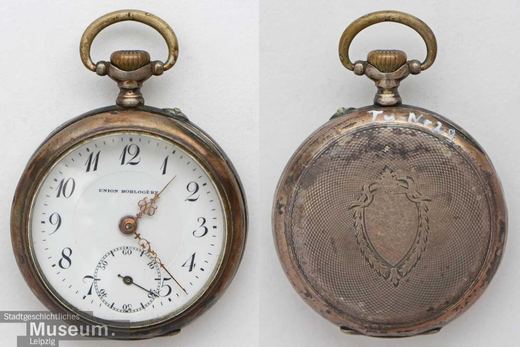
Pocket watch by Uhrenhersteller: Union Horlogère, France, 1890–1910
Museum of City History Leipzig
Pocket Watches · ca. 1900
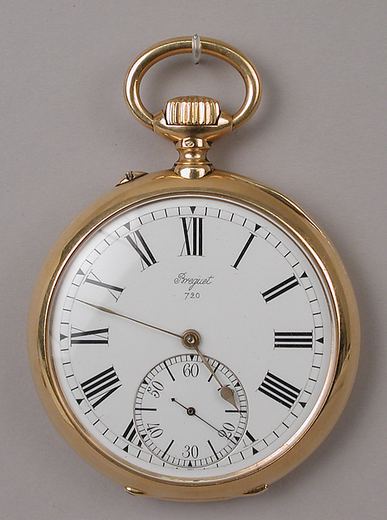
Pocket watch by Firm of Breguet et Fils, France, ca. 1900
The Metropolitan Museum of Art, New York
Pocket Watches · 1900–1930
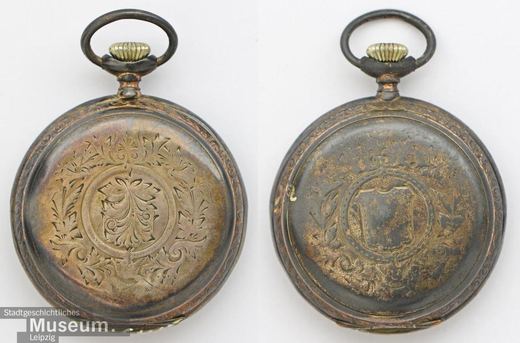
Pocket watch by Fabrique des Billodes, France, 1900–1930
Museum of City History Leipzig
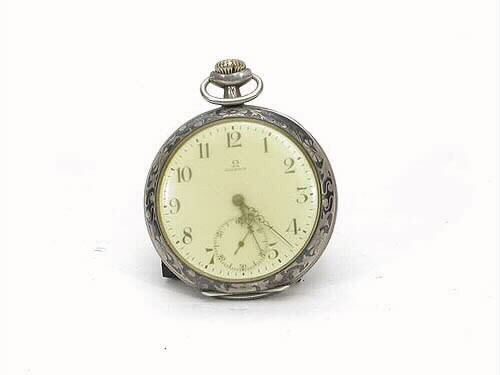
Pocket Watches · 1900
Pocket watch, France, 1900
The Silvermuseet
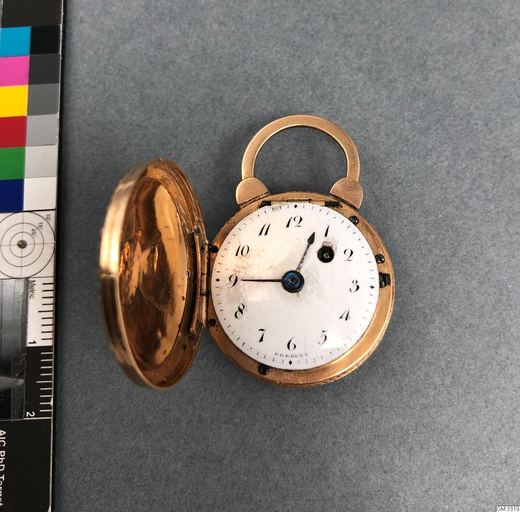
Pocket Watches · 1905
Pocket watch by Abraham Louis Breguet, France, 1905 (Museum of Gothenburg GSM_objekt_24939)
Museum of Gothenburg
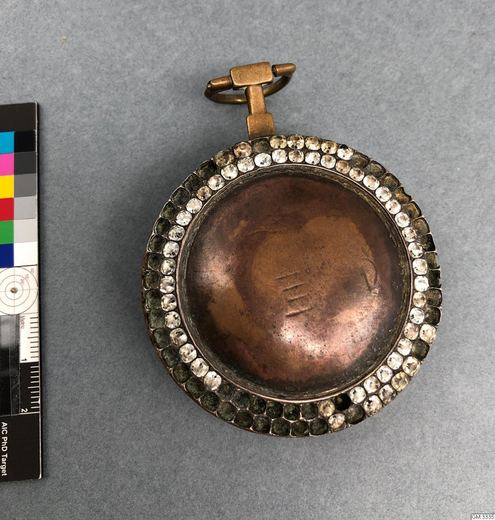
Pocket Watches · 1905
Pocket watch by Abraham Louis Breguet, France, 1905 (Museum of Gothenburg GSM_objekt_25085)
Museum of Gothenburg
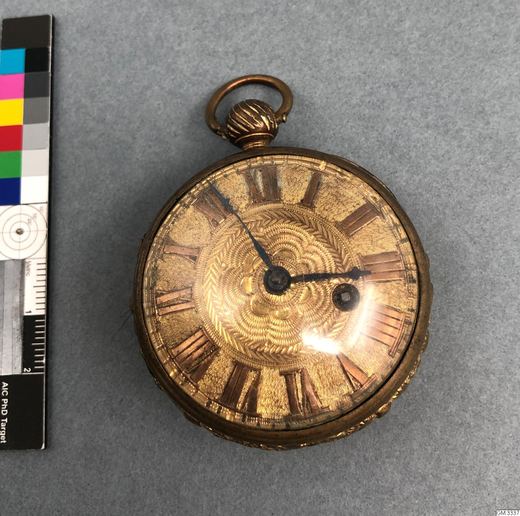
Pocket Watches · 1905
Pocket watch by Derique, France, 1905
Museum of Gothenburg
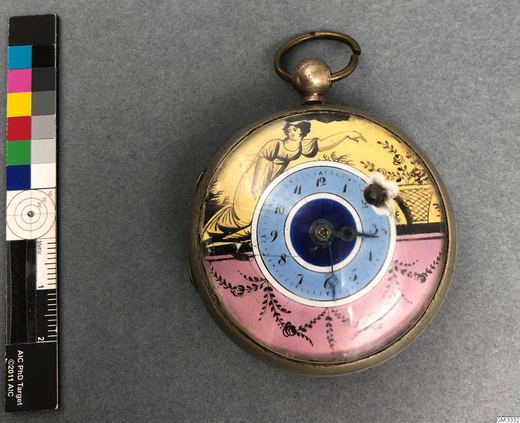
Pocket Watches · 1905
Pocket watch by John Romilly, France, 1905
Museum of Gothenburg