Pocket Watches · Clock watch
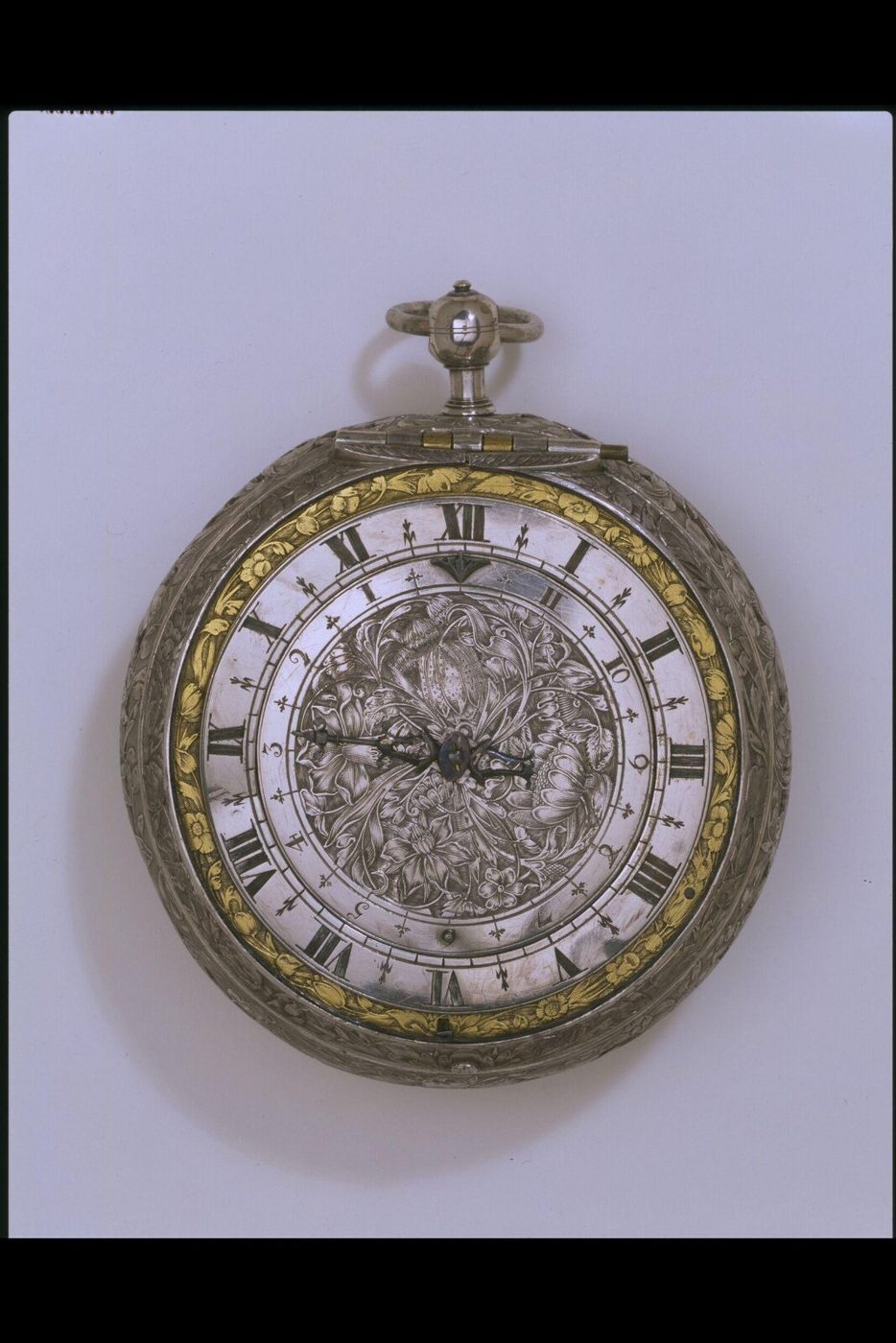
Clock watch with leather case, engraved silver case and dial, the movement with alarm and verge escapement, Edward East, ca. 1645
- Maker / attribution
- Edward East (maker)
- Date
- ca. 1645
- Historical period
- Early Modern Horology (1600 – 1750)
- Country of origin
- Unrecorded in source
- Object type
- Clock watch
- Materials / technique
- Engraved silver case and dial; movement with alarm and verge escapement
- Dimensions
- Height: 12 cm; Width: 9 cm; Depth: 4.5 cm
- Holding institution
- Victoria and Albert Museum, London
- Accession / object no.
- M.64:1, 2-1952
Record summary
Held and catalogued by Victoria and Albert Museum, London (object number M.64:1, 2-1952), this is a clock watch by Edward East, dated ca. 1645. The Atlas places it in the Early Modern Horology period (1600 – 1750) of its Pocket Watches collection. Materials and techniques recorded by the source: Engraved silver case and dial; movement with alarm and verge escapement. Recorded dimensions: Height: 12 cm; Width: 9 cm; Depth: 4.5 cm. The record is illustrated with 4 photographs.
Assembled from the source record's structured fields. Dates and attributions are given as the source states them; where a field is missing the Atlas leaves it blank rather than estimating.
Catalogue description
V&A — Summary
Object Type This clock-watch strikes the hours and also has an alarm mechanism. The central hand on the dial is the alarm indicator. The small hand on the outside of the alarm disc shows the time. The back plate is signed 'Eduardus East Londini'. People Edward East (born 1602, died around 1697) was apprenticed to Richard Rogers of the Goldsmiths' Company in 1618. He became a Freeman in 1627. In 1632, against his will, he was made one of the first Assistants of the Clockmakers' Company, which had been founded in 1631. He was Master of the Company in 1645 and 1653. In 1660 he was appointed Chief Clockmaker to the King, Charles II (ruled 1660-1685). His business appears to have been on a large scale, and to have had Royalist and Roman Catholic connections. Edward East's will suggests that he was resident in Hampton, Middlesex, in 1688, but his business continued in London. His will was proved (its validity established) in February 1697. Designs & Designing The finely engraved naturalistic flowers are in the style of the prints published for the use of engravers and enamellers by Jacques Vauquer (1621-1686) in Paris and Blois (Loir-et-Cher) in France and Johann Paul Hauer (born 1629) in Germany.
V&A — Object history
Made by Edward East (born at Southill, Bedfordshire, 1602, died in London about 1697), later clockmaker to Charles II By family tradition given by the sister of Charles I, Elizabeth, Queen of Bohemia, to Gilbert Spencer of Redleaf when he was responsible for arrangements when she stayed at Penshurst in 1661.
V&A gallery label
British Galleries: Charles I was fascinated by mechanical instruments. He always kept a rigid personal routine, from his early rising when he donned his badge of St George, to winding his two watches, one silver, one gold, last thing at night. An alarm watch was ordered from East for the King shortly before his execution.
Historical context
Early Modern Horology (1600 – 1750)
Huygens' pendulum and balance spring transform accuracy; English makers develop the anchor and deadbeat escapements.
The balance spring (c. 1675) improved watches dramatically and introduced the minute hand. English pair-cased verge watches with pierced balance cocks and French oignons were typical; enamel painting at Blois and Geneva, and the repeating watch (1680s), made watches objects of great refinement.
Read the period in the timelineMore pocket watches from this periodEarlier: Renaissance Horology
Atlas type guide
Early spring-driven watches
Portable spring-driven timepieces appeared in southern Germany, France and Italy in the early sixteenth century; Peter Henlein of Nuremberg is traditionally credited, although the historical record is complex. These early watches were worn as pendants or carried, had iron or brass movements with a verge escapement and a foliot or small balance, and used a stackfreed or fusee to equalise spring force. They indicated hours only and were notoriously inaccurate.
From the later sixteenth century watches were made in Blois, Paris, Geneva, London and Augsburg in oval, octagonal, cruciform, skull and other 'form' cases of rock crystal, gilt brass, silver and enamel. They were jewellery and status objects as much as timekeepers.
What to look for
- A single hour hand and often a touch-pin hour ring for feeling the time.
- Stackfreed (a cam and spring) instead of a fusee on German watches.
- Pierced and engraved cocks over the balance, fine gut fusee lines.
- Rock-crystal, enamelled or engraved form cases.
Dating clues
- Drum-shaped German watches: c. 1530–1580.
- Oval and form watches: c. 1580–1650.
- Before c. 1675 there is no balance spring; watches can vary by many minutes a day.
General guidance written by the Atlas editors about this kind of object. It is not a statement about this particular piece; for that, rely on the source record above and on physical examination.
Read next:FuseeFoliotThe Melanchthon watch
Related records
Clocks · ca. 1665
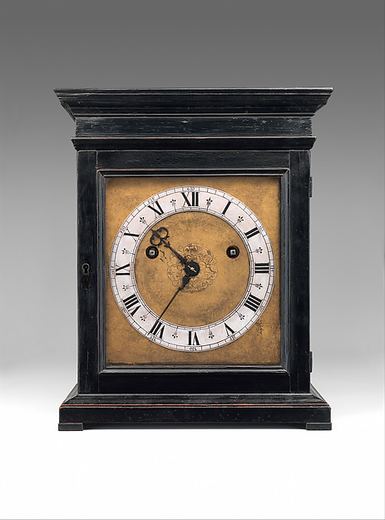
Table or bracket clock by Edward East, United Kingdom, ca. 1665
The Metropolitan Museum of Art, New York
Pocket Watches · ca. 1635
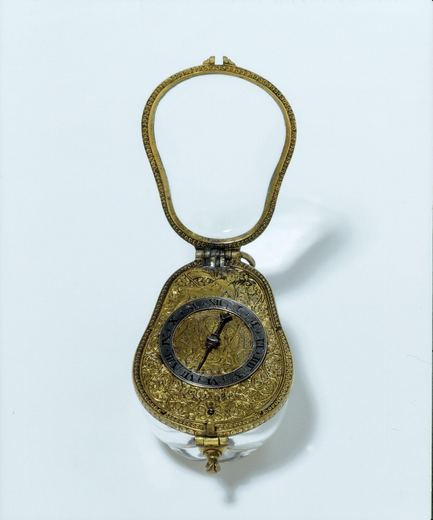
Jewellery, England
Victoria and Albert Museum, London
Pocket Watches · ca. 1640
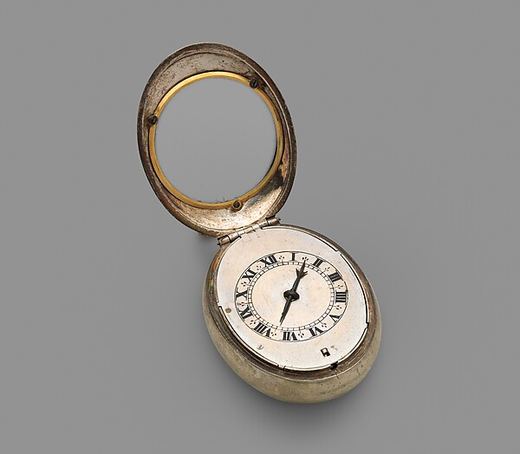
Watch by Edward East, United Kingdom, ca. 1640
The Metropolitan Museum of Art, New York
Pocket Watches · early 17th century
Engraved silver and gilt brass watch signed 'J. Bock', Germany (Frankfurt), early 17th century
Victoria and Albert Museum, London
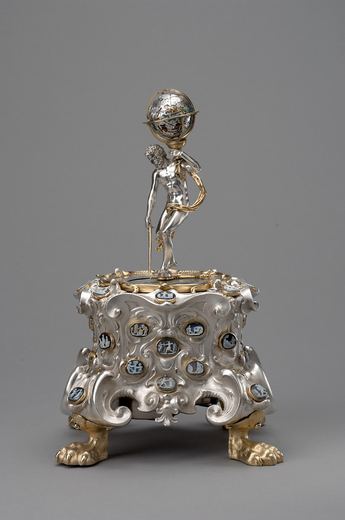
Pocket Watches · 1600–1699
Pocket watch by #Georg_Ernst_Künstler/in, Germany, 1600–1699
Fine Arts Museum Vienna
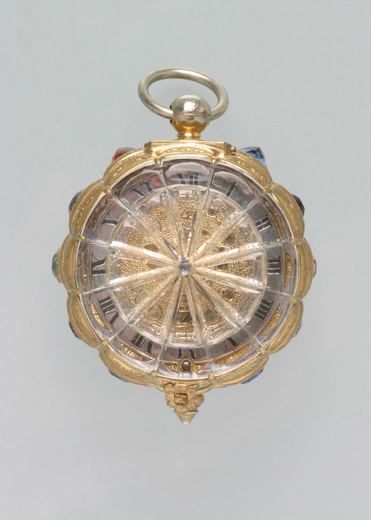
Pocket Watches · 1600
Pocket watch by Balthasar de Paep, Belgium, 1600
German Clock Museum
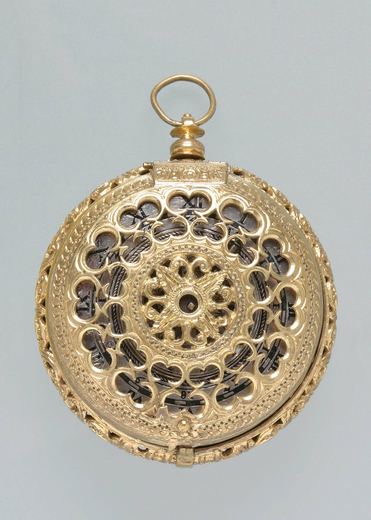
Pocket Watches · 1600
Pocket watch by Hans Reinboldt, France, 1600
German Clock Museum
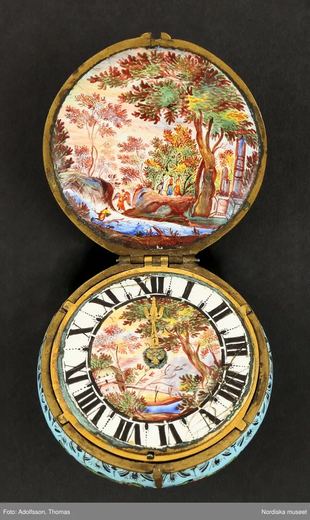
Pocket Watches · 1600–1699
Pocket watch by Johan Etmiller, Germany, 1600–1699
Nordic Museum Foundation